

Most see it as a way to access novel cancer treatments, offer last hope for patients who are out of options
Pour la version française, cliquez ici.
November 10, 2025 – New data from the non-profit Angus Reid Institute in partnership with the Canadian Cancer Society finds nine-in-ten Canadians support increasing access to clinical trials for cancer patients. This comes as most believe these sorts of experimental treatments offer new medicine otherwise unavailable to most cancer patients (80% agree).
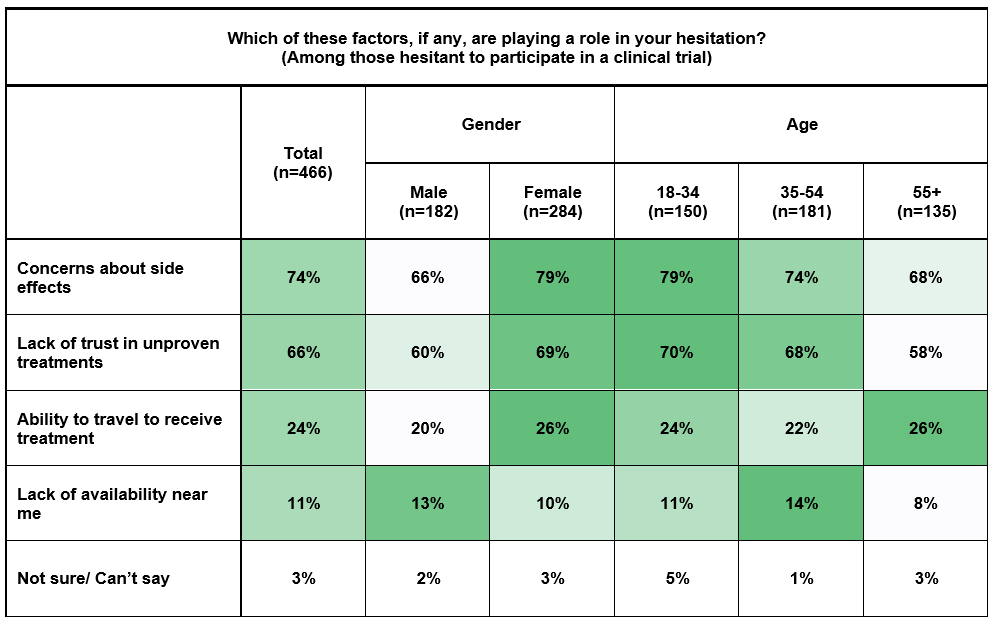
Clinical trials are carefully designed to have as few risks and as many benefits as possible for everyone who takes part. They are approved by a research ethics board and Health Canada reviews the clinical trials protocol. Despite this, Canadians remain concerned of the potential risks that they may pose. Two-thirds (67%) believe clinical trials may have bad side effects, while many who say they would be hesitant to enrol in a clinical trial were they diagnosed with cancer say their hesitation comes from the potential side effects (74%) and distrust of unproven treatments (66%).
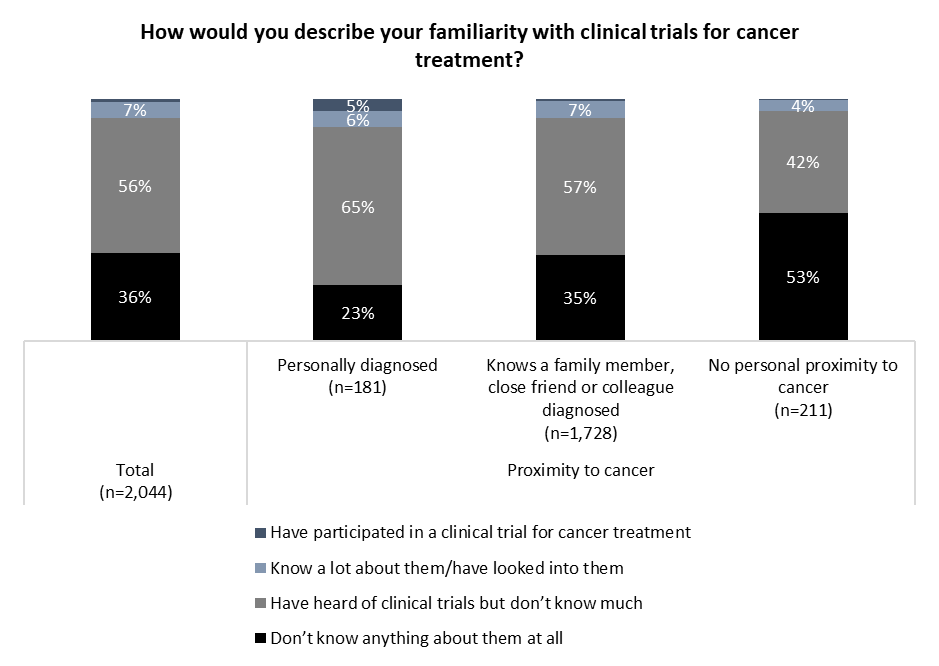
Experience and knowledge with clinical trials is uncommon among Canadians. A majority (56%) say they’ve heard of them but don’t know much about it, while one-third (36%) say they know nothing at all about them. One-in-12 (7%) say they know a lot about them, while one per cent have participated in one themselves.
INDEX
-
Canadians mostly unfamiliar with clinical trials for cancer treatment
-
Two-thirds believe clinical trials are ‘risky’ but most agree they offer ‘last hope’
-
Half of cancer diagnosed Canadians say clinical trials offer ‘better treatment’ for patients
-
Majority say they would be willing to take part
-
Women more hesitant, concerned about side effects
-
Overwhelming majority support increasing access to clinical trial
Canadians mostly unfamiliar with clinical trials for cancer treatment
In Canada, there were 144 cancer clinical trials that started in 2024. Canada’s system for clinical trials has come under criticism for its lack of funding, and the significant barriers to accessing it for those living in rural and remote areas.
Clinical trials are more familiar ground for Canadians with proximity to cancer, but still one-quarter (23%) among the personally diagnosed and one-third (35%) who knows somebody with a diagnosis say they know nothing about clinical trials. A majority (53%) of those with no personal proximity to cancer say they haven’t even heard about them:
One-in-five (19%) Canadians do not have family doctor, according to 2023 data from the Angus Reid Institute. A further three-in-ten (29%) say it’s difficult to get an appointment with the one they have.
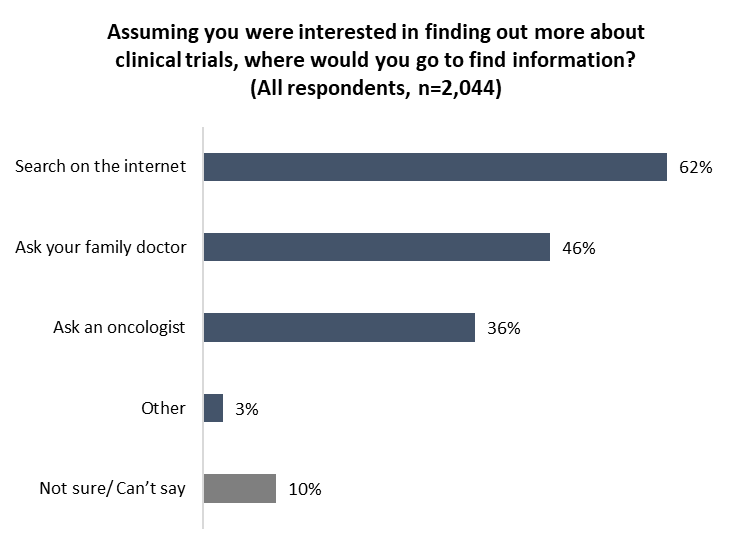
Perhaps that’s why the first resource Canadians would use to find more information about clinical trials is the internet instead of a family doctor. Approaching two-thirds (62%) say they use an internet search to find out more about clinical trials for cancer. Fewer (46%) would ask their family doctor, while even fewer (36%) say they would ask an oncologist. Notably, that previous ARI data also found that a majority (54%) who needed a specialist of any type from Canada’s health system said it was difficult to get an appointment.
Two-thirds believe clinical trials are ‘risky’ but most agree they offer ‘last hope’
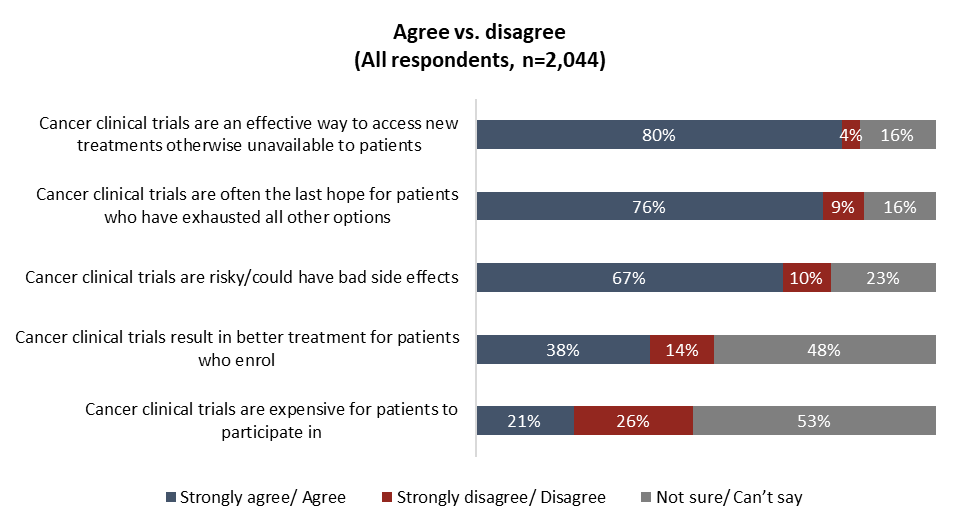
Most Canadians view clinical trials as effective ways for patients to access novel treatments (80%) and a last hope for patients who may have exhausted other options (76%). However, two-thirds (67%) believe clinical trials can have bad side effects.
There is more uncertainty among Canadians on whether clinical trials result in better treatment for patients (48% are unsure) and whether they are expensive to participate in (53%):
Half of Canadians diagnosed with cancer say clinical trials offer ‘better treatment’ for patients
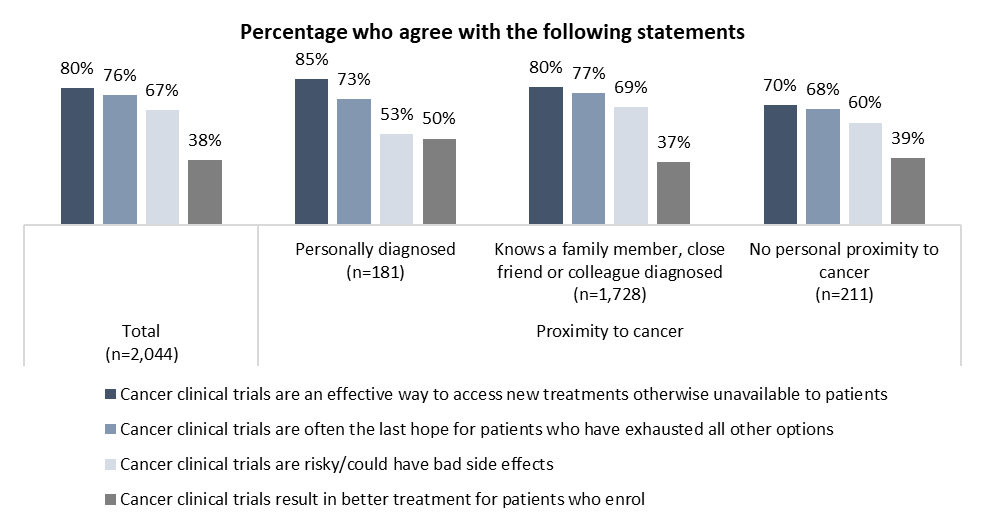
Even among Canadians who have personally experienced a cancer diagnosis, there is a lot of uncertainty about the cost of clinical trials. Half (47%) in that group say they are unsure if those types of trials are expensive for patients to participate in (see detailed tables).
However, those with personal experience express higher certainty than those with no personal experience with cancer when it comes to whether clinical trials offer paths to new treatments (85% agree) and better treatment for enrolled patients (50%). Also notably, Canadians diagnosed with cancer are less likely to agree that clinical trials have bad side effects (53%):
Majority say they would be willing to take part
Despite a general lack of familiarity among the Canadian populace with clinical cancer trials as noted above, most (62%) say they would be willing to take part in one. A majority of Canadians say that clinical trials offer a source of hope for patients who may have run out of other options (76% agree). Men are more willing than women generally, while older Canadians are more likely than younger ones to describe themselves as “very willing”.

Women more hesitant, concerned about side effects
For women, it appears their hesitancy to take part in clinical trials is driven by a higher concern with potential side effects. Four-in-five (79%) women who describe themselves as hesitant to take part also say side effects are the reason, while seven-in-ten (69%) also list “a lack of trust in unproven treatments”. Men are less likely to express those sentiments, but a majority of hesitant men also say they worry of potential side effects (66%) and distrust unproven treatments (60%). A 2024 study published in the American Cancer Society’s Cancer journal showed that women had lower odds of enrolment in clinical trials at the Princess Margaret Cancer Centre in Toronto.
Overwhelming majority support increasing access to clinical trials
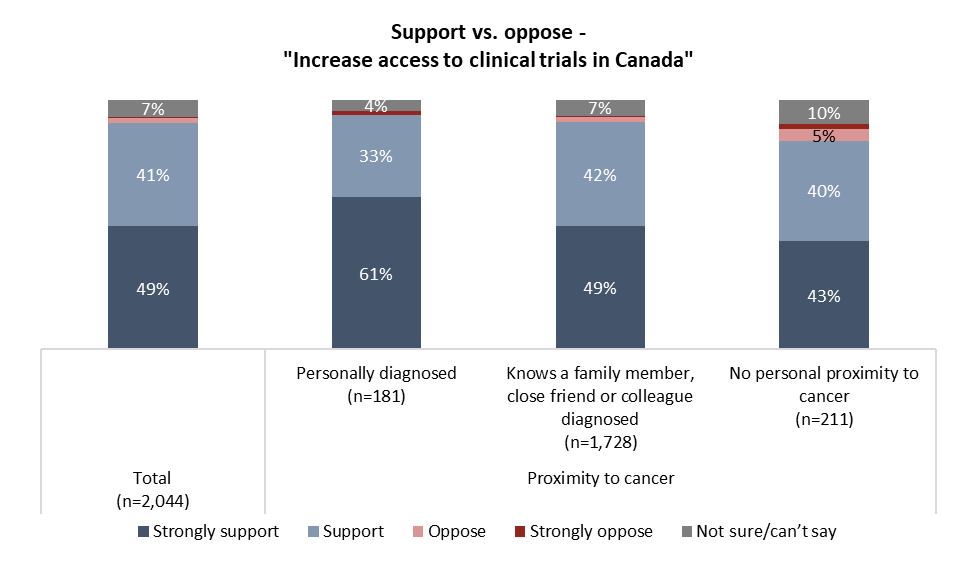
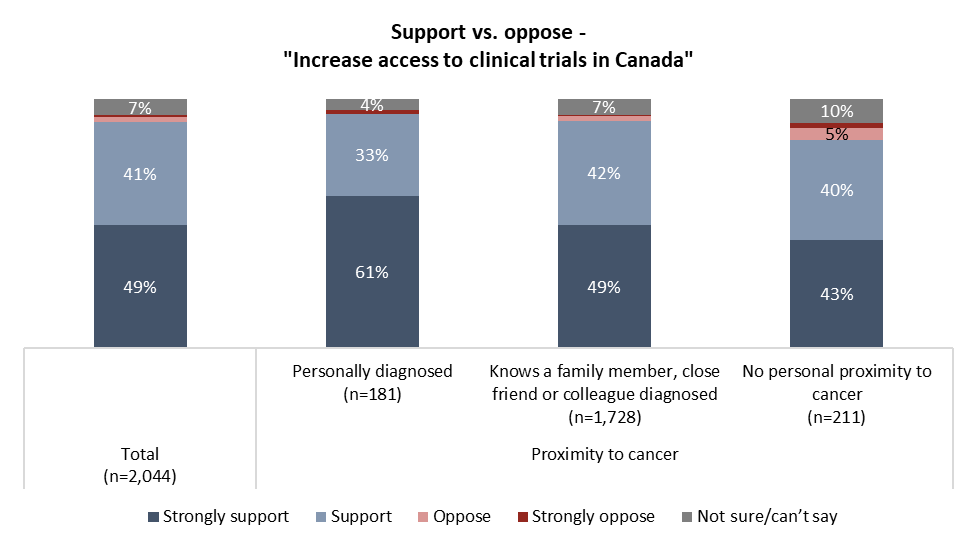
Most Canadians agree that the federal government should be increasing access to clinical trials in Canada to mitigate the costs associated with a cancer diagnosis. Those with a personal experience being diagnosed with cancer are more likely to strongly support this.
Previous data released by ARI and the Canadian Cancer Society also found that two-in-five Canadians supported the federal government prioritizing new cancer treatments and technologies, while three-in-ten Canadians who have had cancer want the federal government to invest in new cancer drugs.
Survey Methodology
The Angus Reid Institute and the Canadian Cancer Society conducted an online survey from Jan. 10-17, 2025, among a randomized sample of 2,044 Canadian adults who are members of Angus Reid Forum. The sample was weighted to be representative of adults nationwide according to region, gender, age, household income, and education, based on the Canadian census. For comparison purposes only, a probability sample of this size would carry a margin of error of +/- 1.5 percentage points, 19 times out of 20. Discrepancies in or between totals are due to rounding. The survey was self-commissioned and paid for jointly by ARI and CCS.
For detailed results by age, gender, region, education, and other demographics, click here.
For detailed results by proximity to cancer, click here.
For full release including methodology, click here.
For questionnaire, click here.
Pour la version française, cliquez ici.
About ARI
The Angus Reid Institute (ARI) was founded in October 2014 by pollster and sociologist, Dr. Angus Reid. ARI is a national, not-for-profit, non-partisan public opinion research foundation established to advance education by commissioning, conducting and disseminating to the public accessible and impartial statistical data, research and policy analysis on economics, political science, philanthropy, public administration, domestic and international affairs and other socio-economic issues of importance to Canada and its world.
About the Canadian Cancer Society
The Canadian Cancer Society works tirelessly to save and improve lives. We raise funds to fuel the brightest minds in cancer research. We provide a compassionate support system for all those affected by cancer, across Canada and for all types of cancer. Together with patients, supporters, donors and volunteers, we work to create a healthier future for everyone. Because to take on cancer, it takes all of us. It takes a society.
Help us make a difference. Call 1-888-939-3333 or visit cancer.ca today.
MEDIA CONTACT:
Shachi Kurl, President, ARI: 604.908.1693 shachi.kurl@angusreid.org @shachikurl
Victoria Young, Communications Coordinator, CCS: 416-572-4252, victoria.young@cancer.ca