


Alberta, Saskatchewan far more likely to feel poorly represented; Ontario most comfortable in federation
June 4, 2025 – The country’s premiers and Prime Minister Mark Carney found much common ground at a first ministers’ meeting in Saskatoon this week – the “best” meeting in years according to Ontario’s Doug Ford, while Alberta’s Danielle Smith was “encouraged by the immediate change of tone”. Bridging the gap between the country’s West and East has taken on a renewed importance with separation debates brewing in Alberta and Saskatchewan. But what exactly defines the “West” and what does “it” want?
New data from the non-profit Angus Reid Institute finds a region full of divergence in identity but unified by its grievances with Ottawa.
Theses data and prior releases in this series illuminate Alberta and Saskatchewan as a unique subregion of their own, with B.C. and Manitoba hesitating to join in on some of the more extreme aspects of western alienation.
Separation, for example, is much less of a desire in the latter two provinces than the former. Dissatisfaction in B.C. and Manitoba is evident but does not reach the levels seen in the provinces of Premiers Smith and Scott Moe.
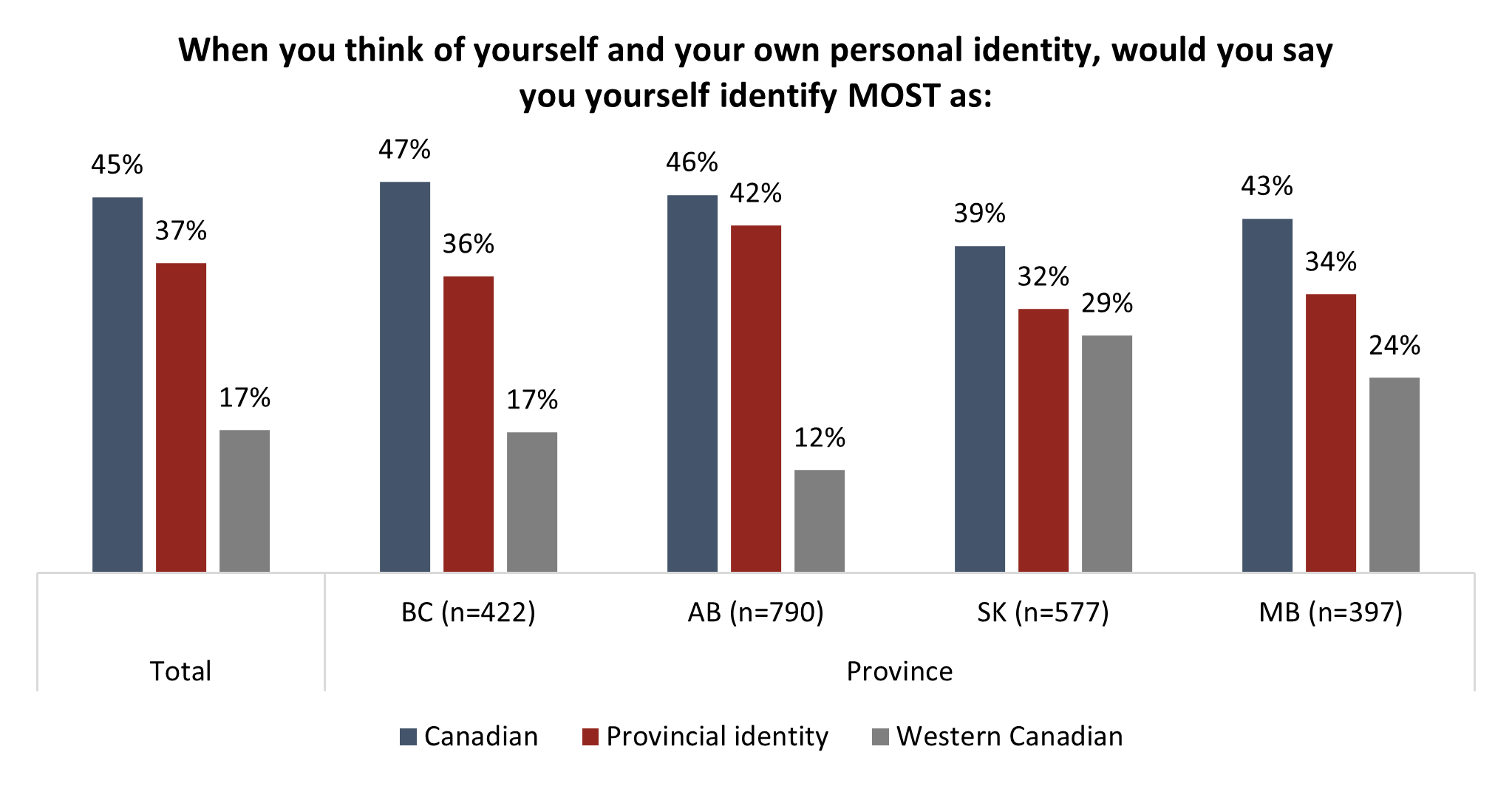
British Columbians are also less likely to see commonality between themselves and those living in the prairie provinces. Meanwhile, Manitoba and Saskatchewan residents are twice as likely as Albertans to define themselves as western Canadian first, ahead of just Canadian. Respondents in the four provinces don’t even agree on the definition of which provinces make up “the West”.
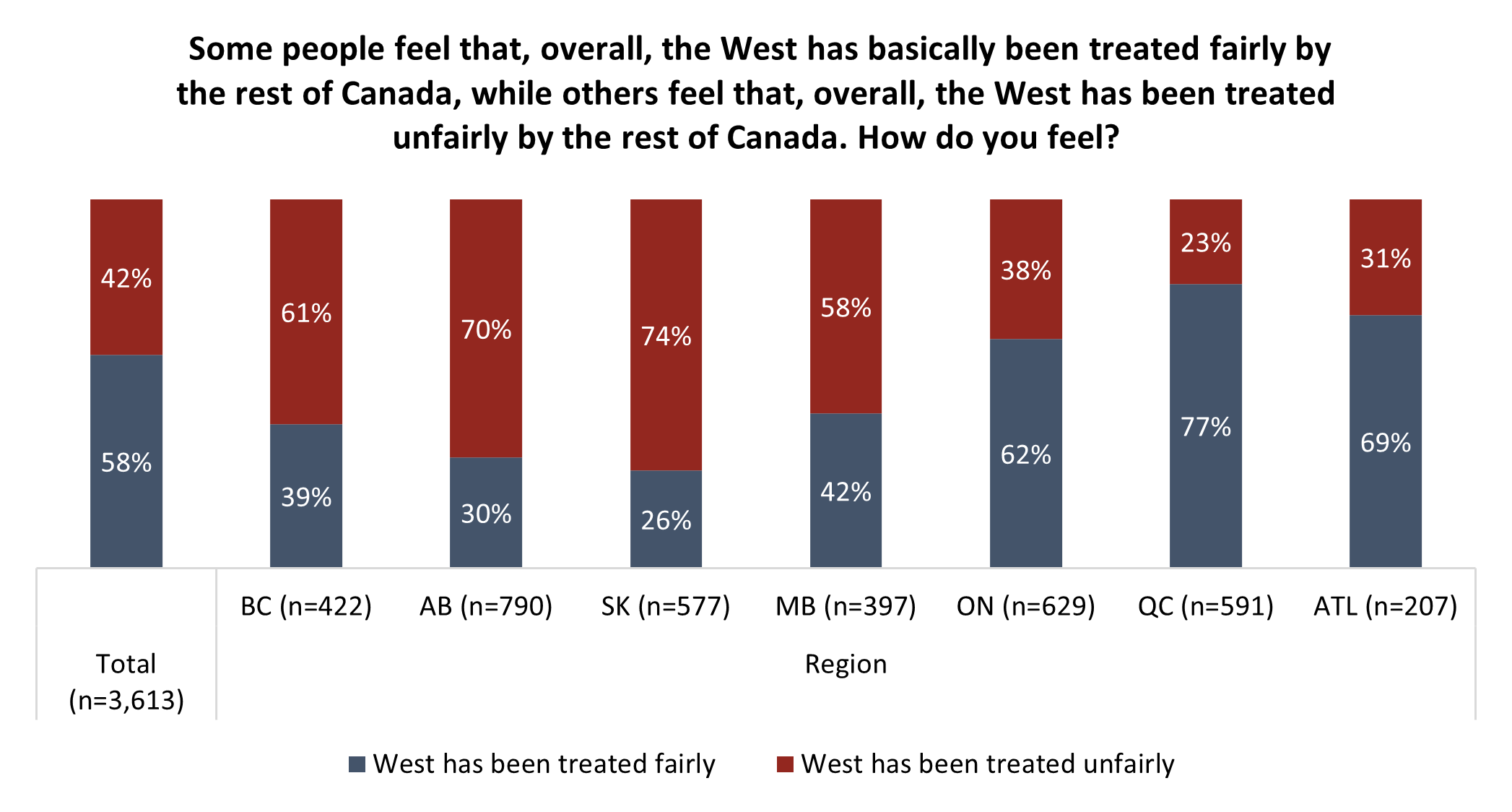
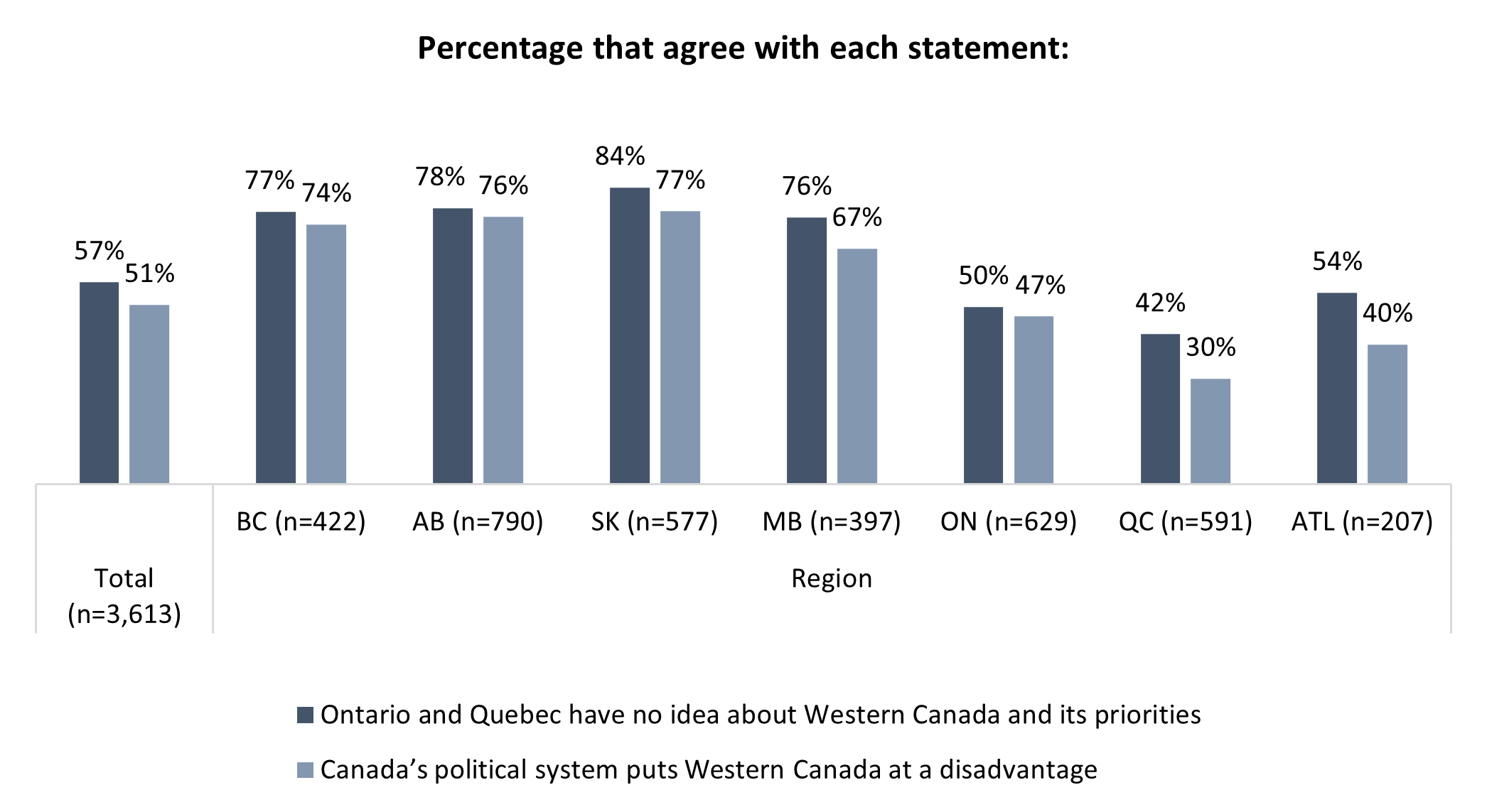
These four provinces are evidently uneasy partners, united in the search for a better deal in federation. Consider that at least three-in-five in all four provinces say the West has been treated unfairly. At least two-thirds say the West is disadvantaged politically, and at least three-quarters say Ontario and Quebec have no idea about western provinces’ priorities.
More Key Findings:
- A plurality, but not a majority, of residents in B.C., Alberta, Saskatchewan, and Manitoba say they identify as Canadian first. Smaller proportions say they think of themselves primarily as from their province, or as western Canadian.
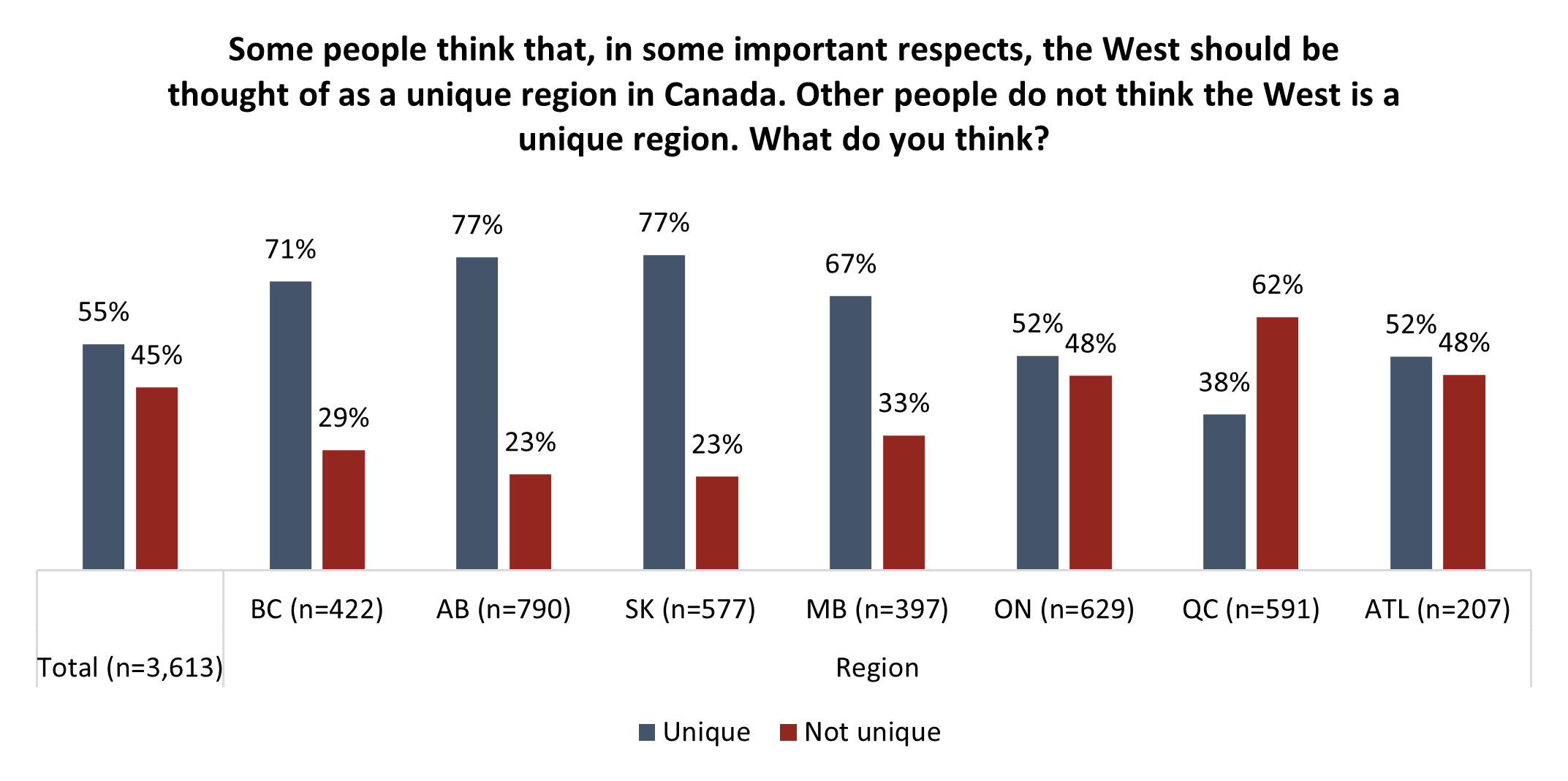
- More than half of Canadians (55%) say the West is a unique region in Canada, but 48 per cent in Ontario and Atlantic Canada, and 62 per cent in Quebec, disagree.
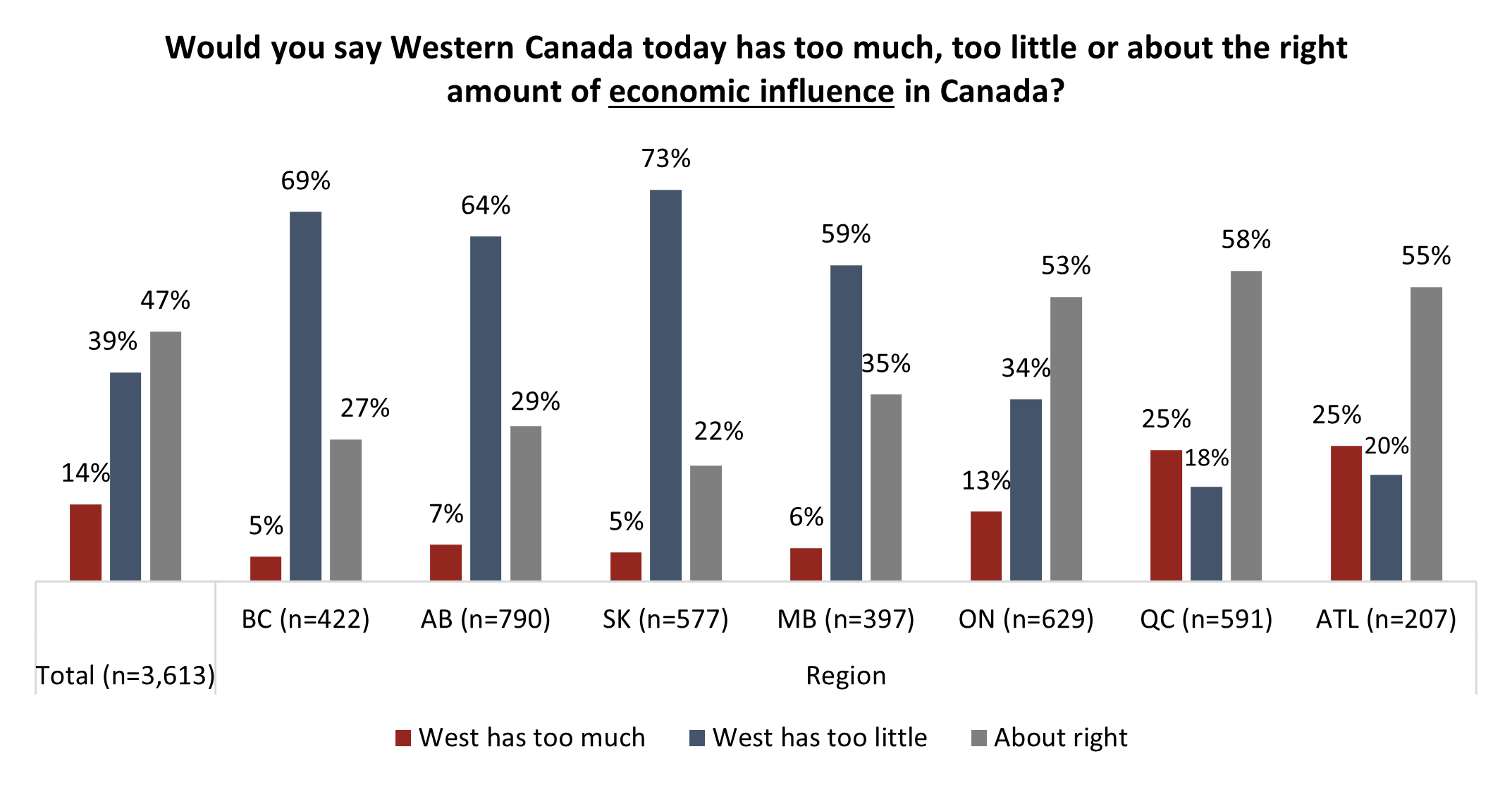
- While 59 per cent or more in all four western provinces say the West has “too little” economic influence in Canada, majorities in Ontario, Quebec, and Atlantic Canada say it has “the right amount”.
INDEX
Part One: What is the West?
- Disagreement over definition
- More than half say it’s a “unique” region
- How do western Canadians personally identify?
- B.C., the odd province out?
Part Two: Western influence and respect
- East-west divide on fair treatment of “the West”
- West feels misunderstood, disadvantaged
- Economic influence and political power
- Growing number say Western Canada complains too much
Part Three: Institutional representation
Part One: What is the West?
Throughout this nation’s history, a perceived misalignment of priorities between Central Canada – that is, Ontario and Quebec – and the western provinces, has persisted. Resentment aimed at the most recent Trudeau government, for example, is hardly unique. One need look no further than resentment toward his father’s government decades prior. These contemporary discussions have now taken on the added wrinkle of referenda, as both Alberta and Saskatchewan flirt with independence votes.
Disagreement over definition
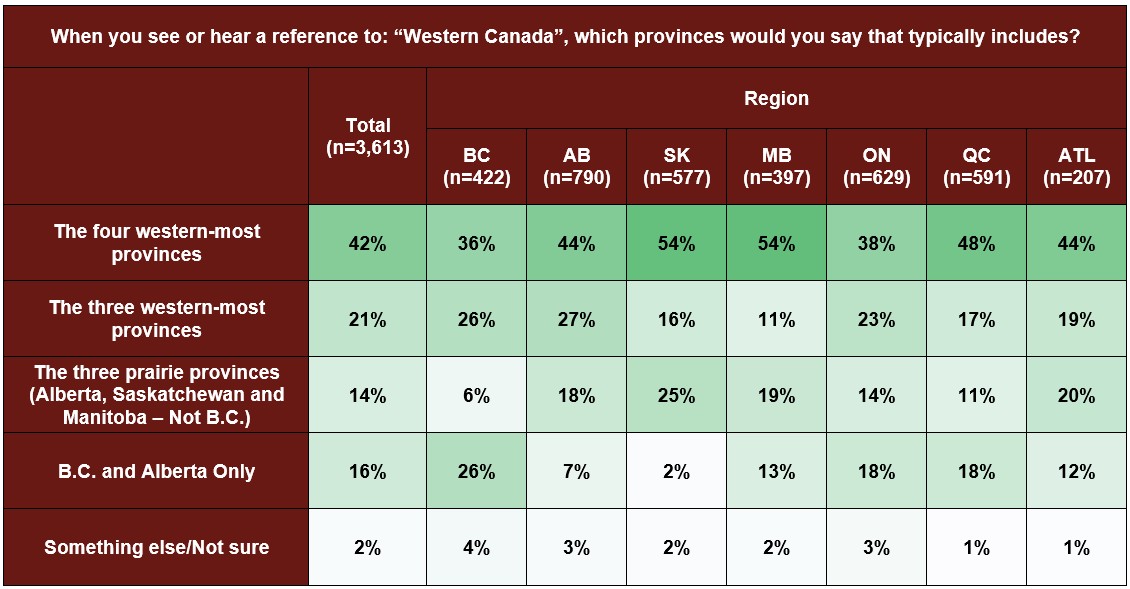
The conversation about the West begins with an important question – what is it? It turns out that there’s significant contention about what the term means. For example, in British Columbia, there are three positions chosen by at least one-quarter of the population – that it is the four western-most provinces (36%), just the three western-most (26%), or just the two (26%). In Alberta, there is no majority agreement either, while in Saskatchewan and Manitoba, a slight majority say it’s all four. In the regions east of Manitoba, similar uncertainty exists:
More than half say it’s a “unique” region
For the purposes of the survey that respondents took and the discussions in this report, the West was defined as the four western-most provinces. Under this definition, more than half of Canadians consider the region unique unto itself. This includes at least two-thirds in the western provinces, but also half in Ontario and Atlantic Canada. Only in Quebec do a majority disagree and say that the West is not unique. Tensions between Quebec and the West have a long history, more recently based on disagreement over oil and gas development and federal equalization payments.
 How do western Canadians personally identify?
The West may be unique to many, but few western Canadians see this is a principal source of identity. The largest number say that they think of themselves as Canadian first (45%), while 37 per cent identify primarily with their province. The latter is most common in Alberta (42%). Fewer than one-in-five (17%) say they think of themselves first as western Canadian, though this proportion is higher in Saskatchewan and Manitoba:
B.C., the odd province out?
While definitions and identity differ, British Columbia appears to be the least like the other provinces according to those who live there. Asked which province they feel theirs has the most in common with, the largest group say “none” (32%). Similar numbers choose Alberta (24%) and Ontario (22%). With each of the other three provinces, at least one neighbour is viewed as having significant commonality:

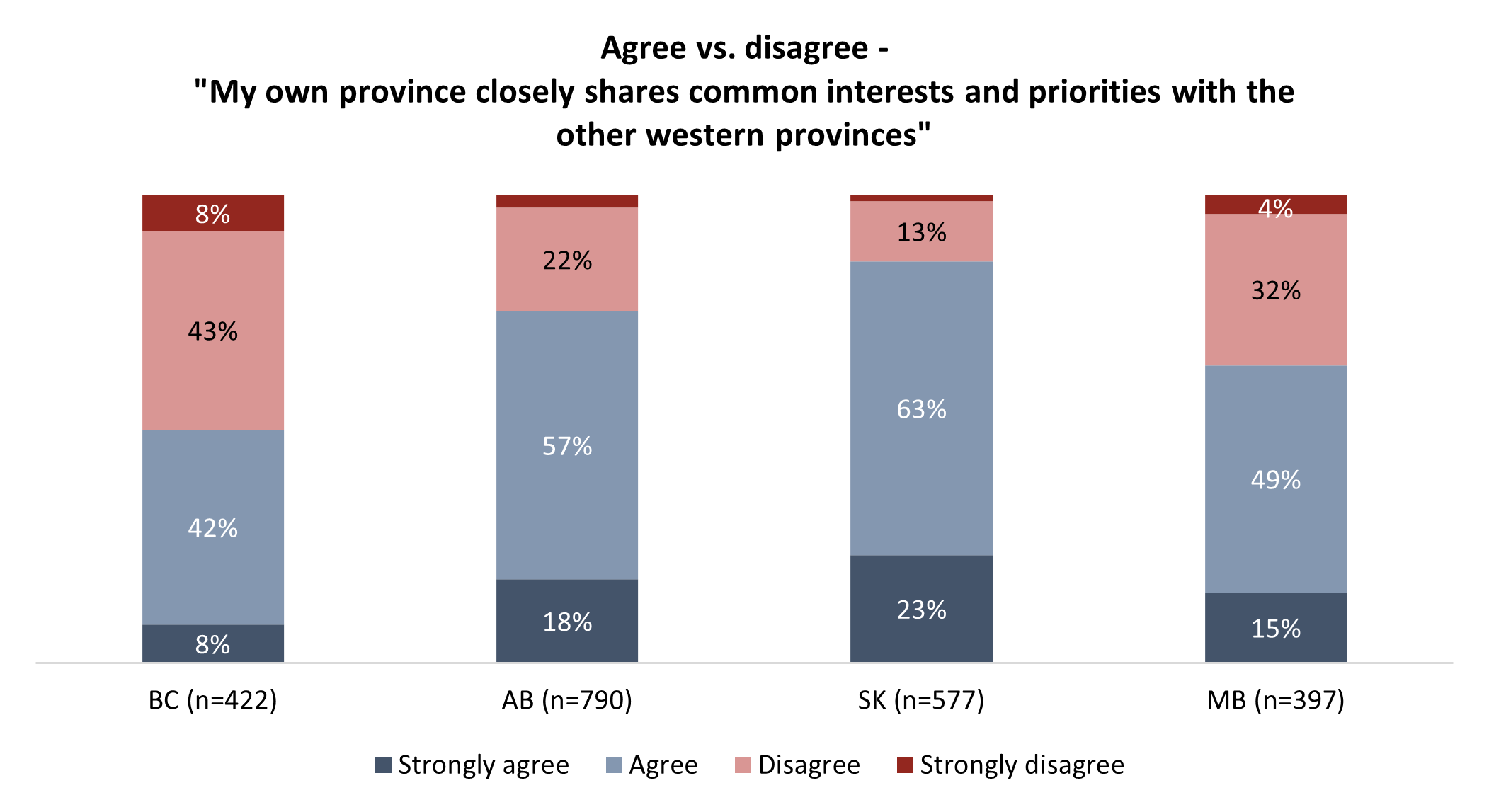
Further to this “outsider” feeling in B.C., half say they disagree that their province shares common interests with the region. In Saskatchewan and Alberta, a sense of shared priorities is more palpable:
 Part Two: Western influence and respect
The push for separation in Alberta and Saskatchewan among some is based largely on perceived unfairness. While the federal government did purchase and complete the Trans Mountain pipeline expansion, the Liberals under Prime Minister Justin Trudeau were seen as adversarial to the oil and gas industry. While new Prime Minister Mark Carney has claimed that he would like Canada to be an “energy superpower”, skeptics remain.
East-west divide on fair treatment of “the West”
The sense in much of the country is that, perhaps, western provinces are making too much of unfair treatment. In Ontario, Quebec, and Atlantic Canada, the majority of residents say the West has been treated fairly by the rest of the country. Seven-in-10 disagree in Alberta and Saskatchewan, again showing the deep geographic fissure in the country:
 West feels misunderstood, disadvantaged
The lack of political representation in Ottawa for western provinces was on display again when Carney announced his cabinet. Part of this challenge is that Carney had far fewer Prairie MPs to choose from relative to MPs from other regions. The 2025 federal election resulted in two Liberal MPs from Alberta, one from Saskatchewan, and six from Manitoba. These nine seats compare to 114 in Ontario and Quebec.
There is a sense that, because of the population distribution realities of the country, the West is at a disadvantage. With approximately 25 million of the 41 million Canadians living in Ontario and Quebec, this challenge is evident. There is also a sense in the West that Ontario and Quebec have no idea about Western Canada and its priorities, an idea that half of Ontarians and 42 per cent of Quebec residents agree with:
In the regions east of Manitoba, a majority of residents believe that the western provinces have the right amount of economic influence in Canada. Both British Columbia and Alberta account for 14 to 16 per cent of the nation’s GDP and are seen as well represented by eastern Canadians. In the West, however, the vast majority in all provinces say that they do not have appropriate economic sway:
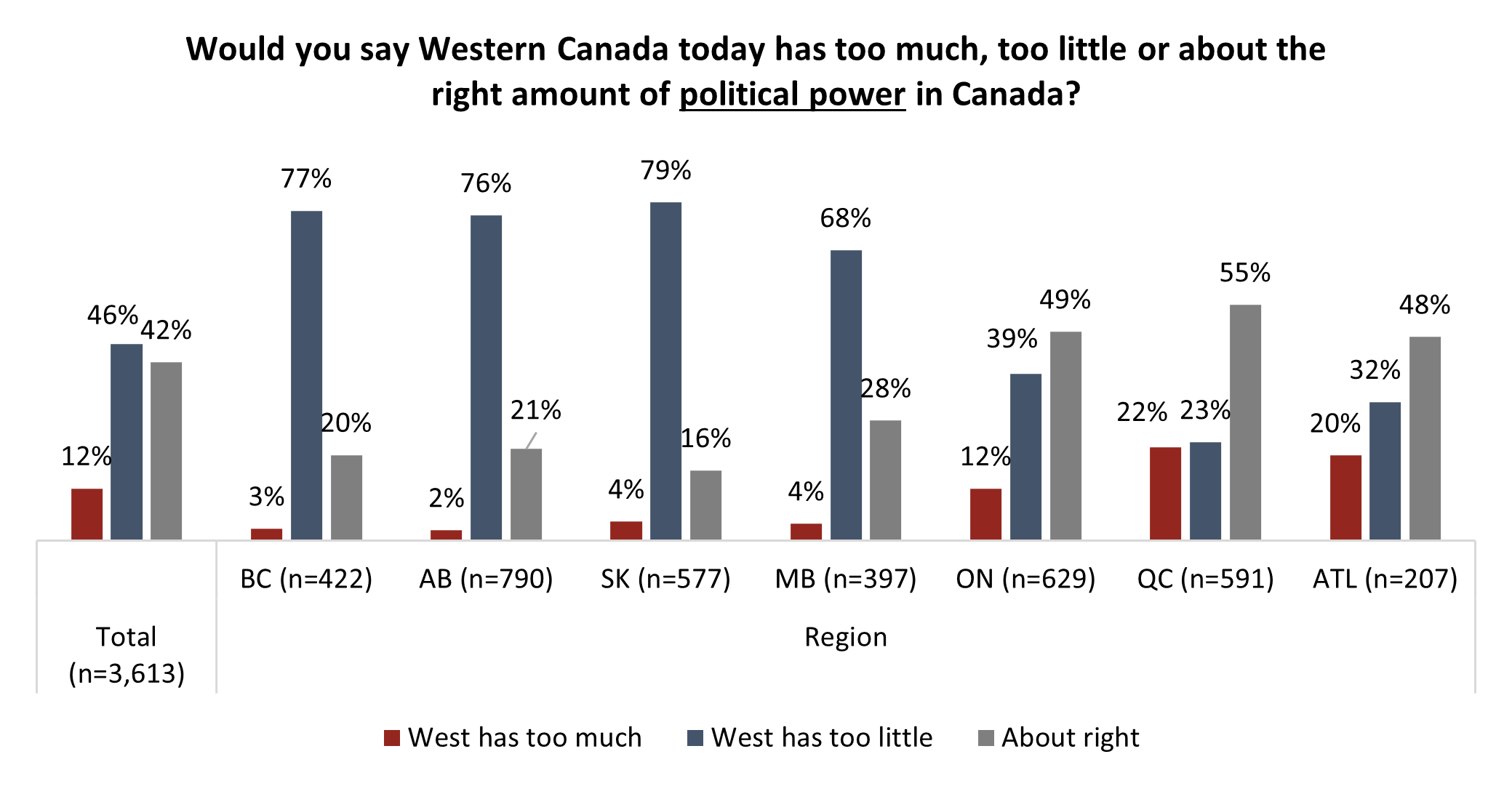
 These responses are nearly replicated on the question of the political power that the West has:
 Growing number say Western Canada complains too much
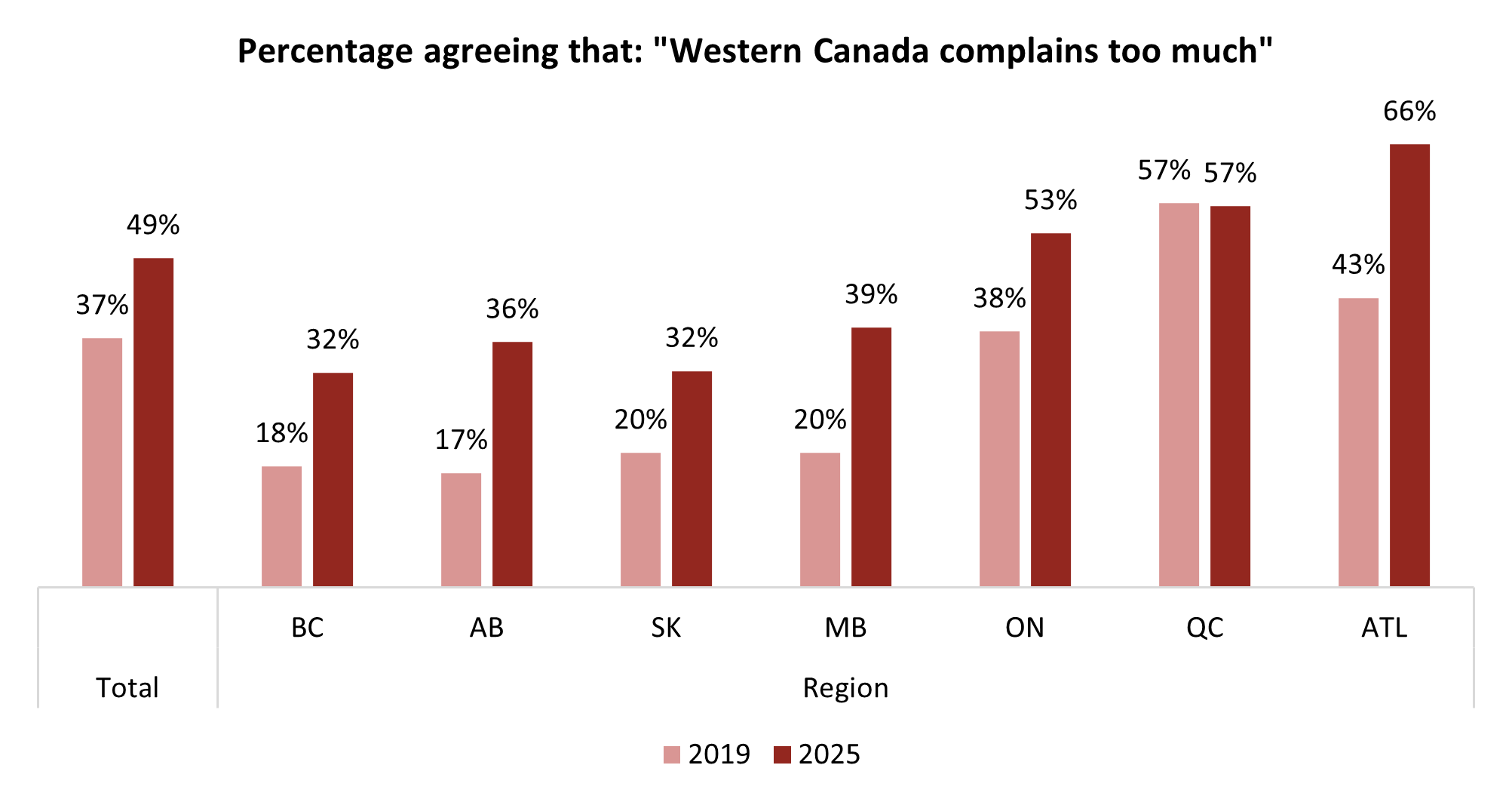
If the West seems to be getting louder, it may be because it is. Compared to 2019, the proportion of Canadians, including those in the western provinces, who say that the West complains too much has grown. This is likely due to residents of western provinces responding to separatist sentiments from their neighbours. A full majority in Ontario, Quebec, and Atlantic Canada say that the complaints are going too far:
Part Three: Institutional representation in Canada
In order to better understand the perspectives of Canadians as they relate to representation, Angus Reid Institute asked respondents about some national fixtures. Several of these are media organizations – the CBC, the Globe and Mail, the National Post, and the major television networks – alongside parliament, the federal government more specifically, and the Supreme Court of Canada. Canadians were asked if each of these, in their view, treats their province fairly.
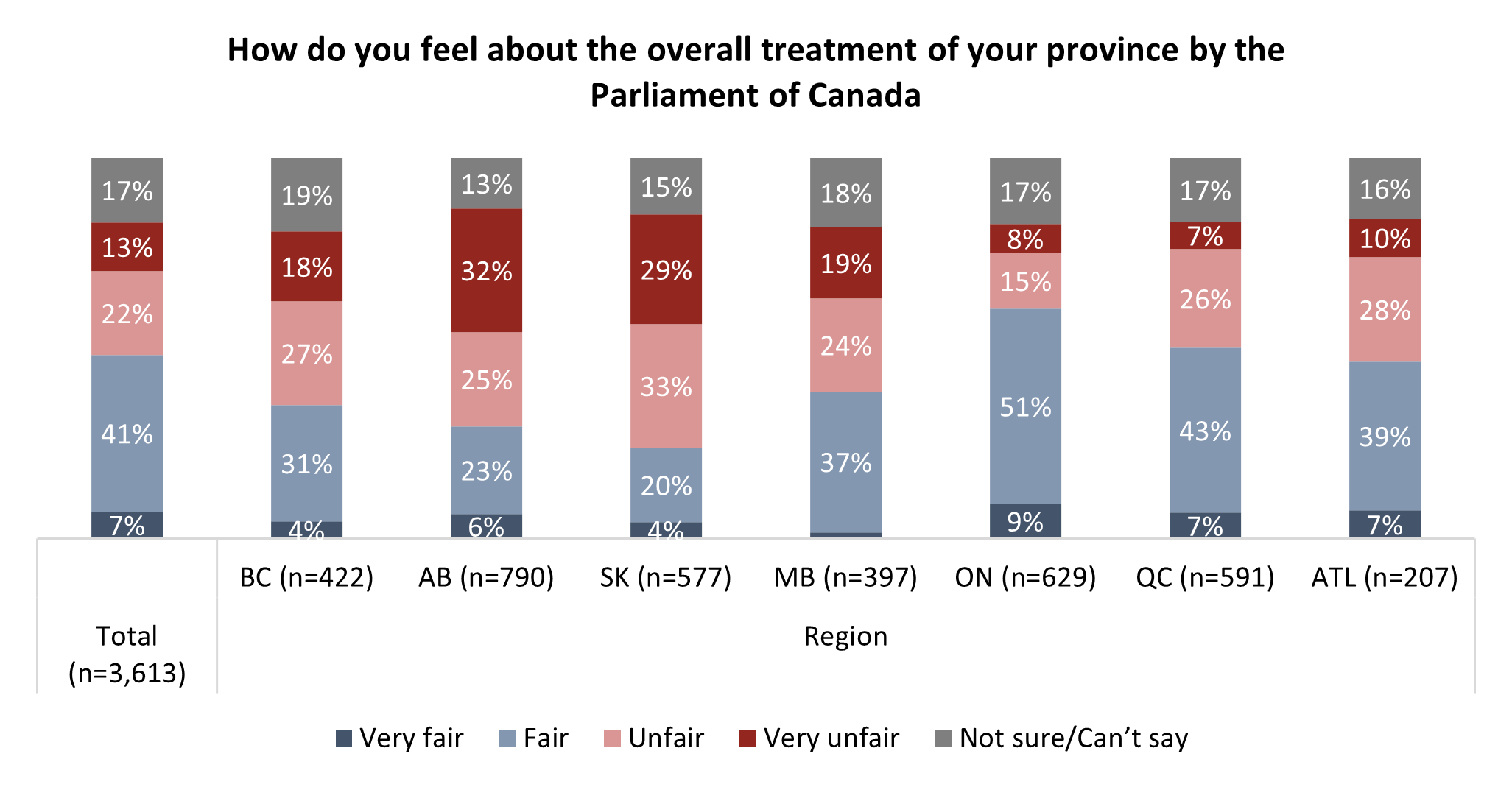
When it comes to parliament, Ontario leads the way in feeling well-served. Three-in-five (60%) say this, 10-points ahead of Quebec, the only other province wherein a majority feel fairly treated (50%). Half as many say this in Saskatchewan (24%), while three-in-10 do so in Alberta (29%):
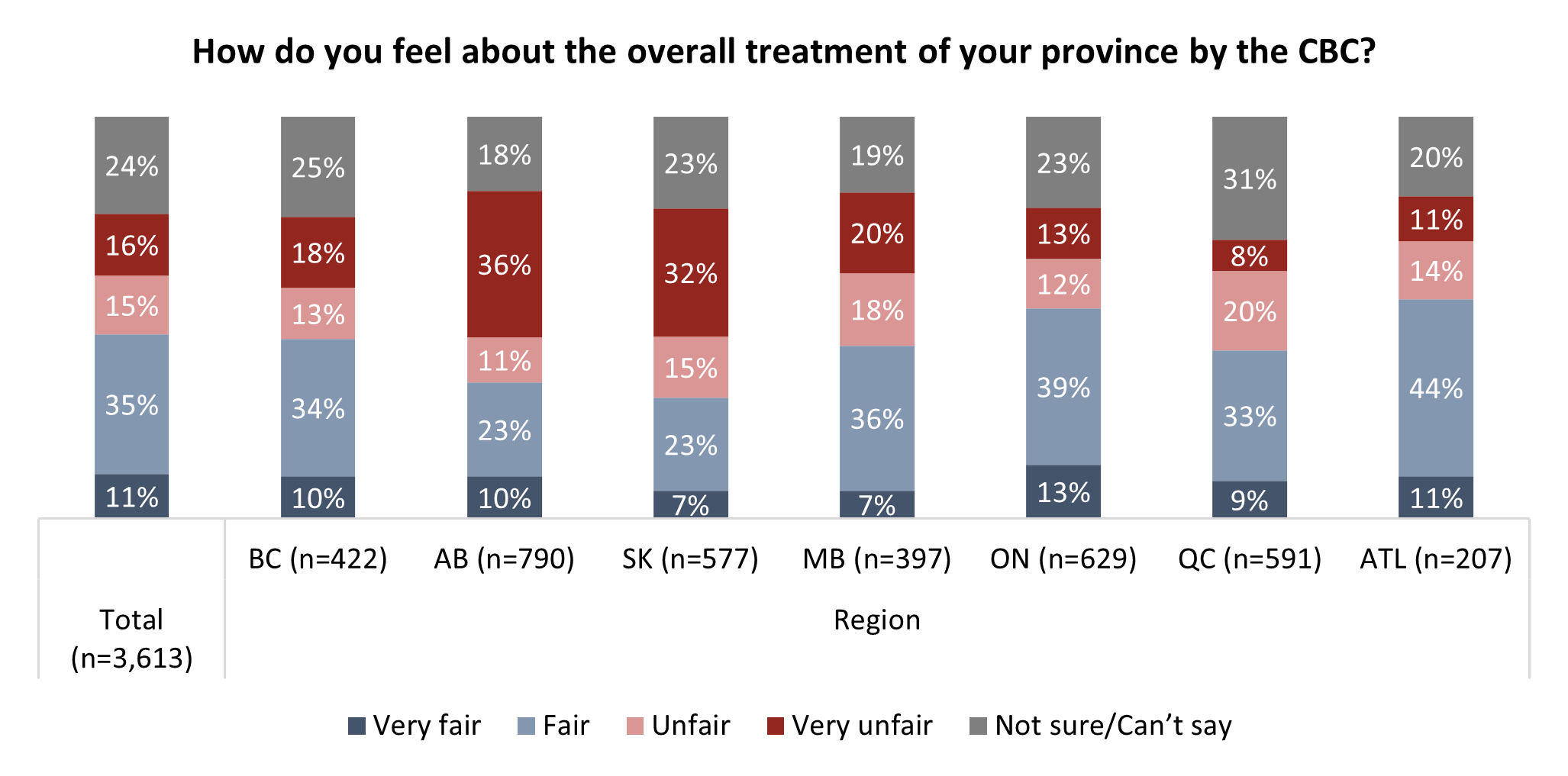
Similar perspectives are noted for the nation’s public broadcaster. A majority of Ontario and Atlantic Canadian residents say the CBC fairly represents them. In most regions, more say this than say they feel unfairly represented, though these do not reach majority levels due to the number who are unsure. In Alberta and Saskatchewan, the more prevalent view is that CBC coverage is unfair to those provinces:
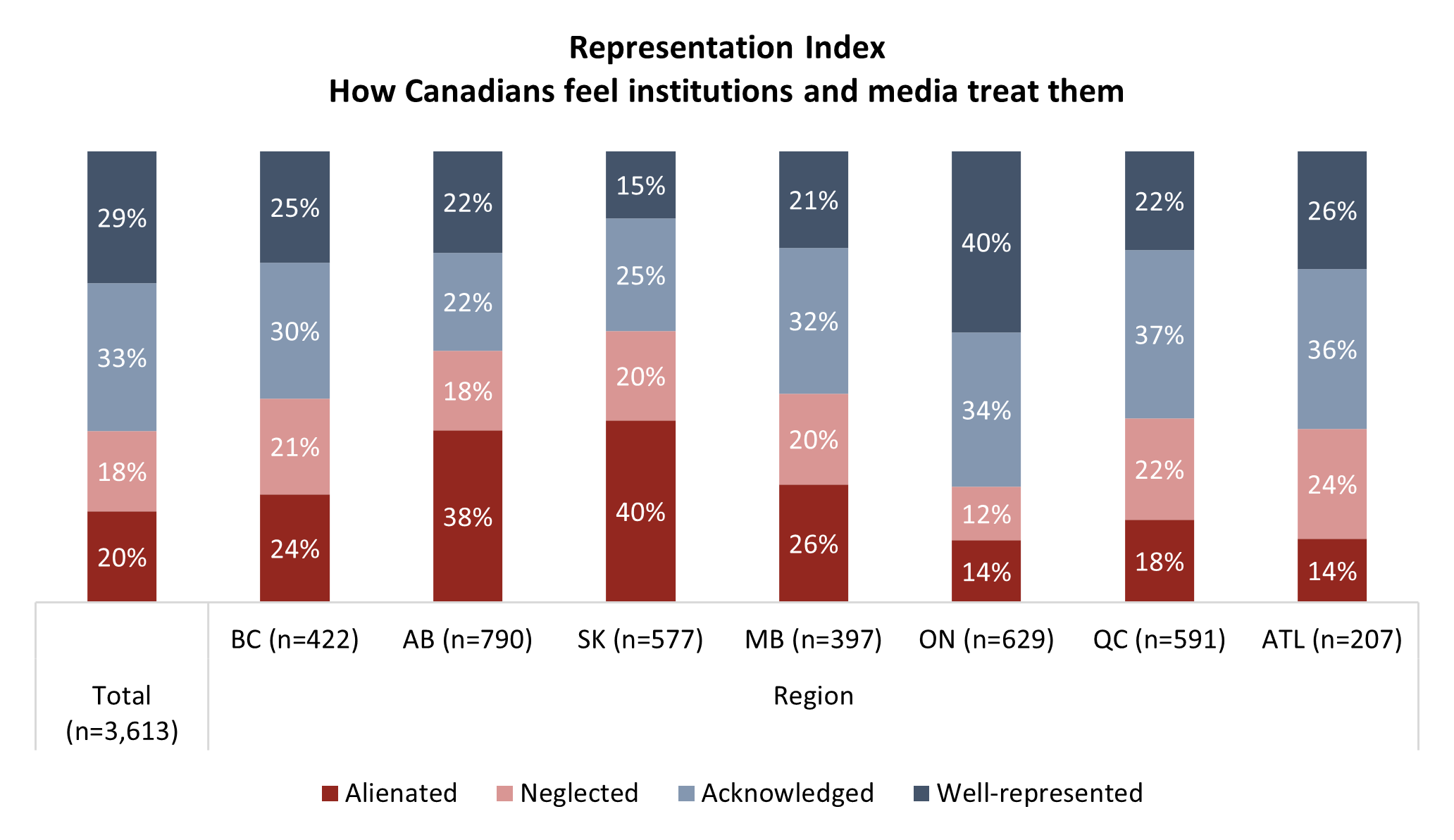
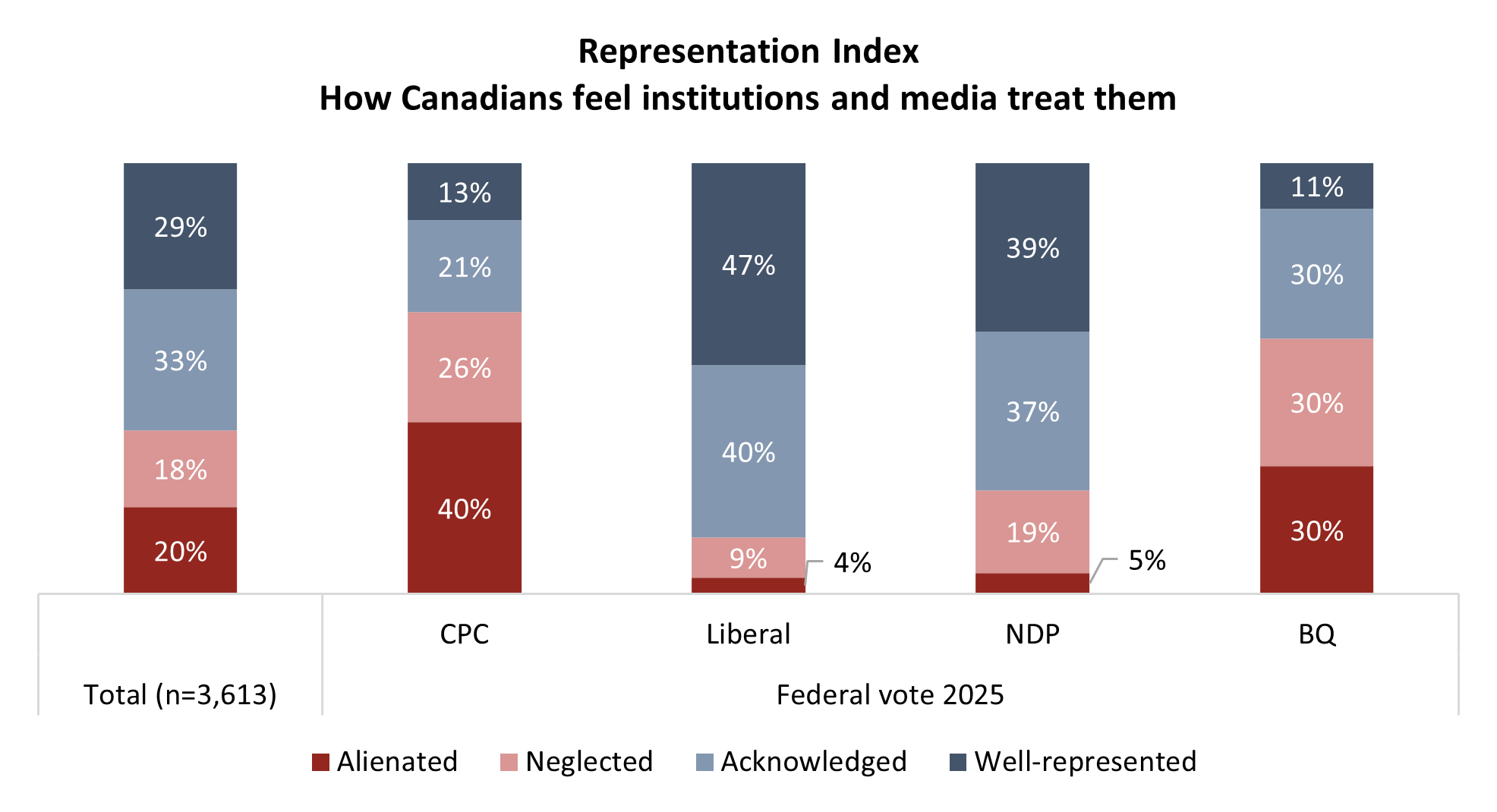
 Respondents were scored across all seven items (see detailed tables here) and split into groups based on their overall views. This provides a scale for the sense of distance between some Canadians and the institutions that make up their country.
In Ontario, 40 per cent ft into the most positive group, the Well-represented, 14 points higher than any other region. Another one-in-three (34%) fit into the Acknowledged. Three-quarters in Ontario fit into these top two groups, compared to 40 per cent in Saskatchewan and 44 per cent in Alberta. Those provinces have groups of the most negative – the Alienated – that are three times the size of Ontario’s:
Discontent is clear among Conservative Party supporters. Those who voted for the CPC are 10 times as likely as Liberals and New Democrats to be in the Alienated group and also more likely to be Neglected:
METHODOLOGY:
The Angus Reid Institute conducted an online survey from May 6-8 2025, among a randomized sample of 3,613 Canadian adults who are members of Angus Reid Forum. The sample was weighted to be representative of adults nationwide according to region, gender, age, household income, and education, based on the Canadian census. For comparison purposes only, a probability sample of this size would carry a margin of error of +/- 1.5 percentage points, 19 times out of 20. Discrepancies in or between totals are due to rounding. The survey was self-commissioned and paid for by ARI. Detailed tables are found at the end of this release.
For detailed results by age, gender, region, education, and other demographics, click here.
For Representation Index demographics, click here.
For PDF of full release, click here.
For questionnaire, click here.
MEDIA CONTACT:
Shachi Kurl, President: 604.908.1693 shachi.kurl@angusreid.org @shachikurl
Dave Korzinski, Research Director: 250.899.0821 dave.korzinski@angusreid.org
Image Credit – Mark Carney Facebook