


Electoral recovery hinges on large group of undecided & NDP voters who “might” still support Liberals
January 3, 2025 – Just days into the new year the future of the governing Liberal Party remains obscured as its most prominent figure, Prime Minister Justin Trudeau, continues to mull his next plans. This, after one of the most politically challenging months of his nine-year term saw his approval and his party’s vote intention tumble to new lows.
New data from the non-profit Angus Reid Institute finds that in an ironic twist, the person most likely to imbue the Liberals with some (though currently faint) hope in these dire electoral circumstances is the person who played a significant part in these challenges.
After she resigned as Finance Minster in December, Chrystia Freeland is most likely – among six potential candidates to potentially compete for succession in the prime minister’s resignation – to increase their party’s vote share in a future election.
Currently the Liberal Party is able to rely on loyal base of just 13 per cent of Canadians. This group is most likely to stay with the party come what may. (Note, data released December 30 indicated vote intention among only decided and leaning voters at 16 per cent)

In the event Freeland were to succeed as Liberal Party leader, the party’s fortunes among the total population jumps eight points to 21 per cent. While this offers her a large advantage over Mark Carney, Melanie Joly, Dominic Leblanc, Anita Anand, and Francois-Philippe Champagne, all of whom generate little change compared to Trudeau, the Conservative Party still holds a commanding advantage in all situations. In a faceoff against a Freeland-led Liberal Party, the CPC still hold a 15-point lead.

*data released earlier this week limited to leaning and decided voters, had Liberal Party at 16 per cent.
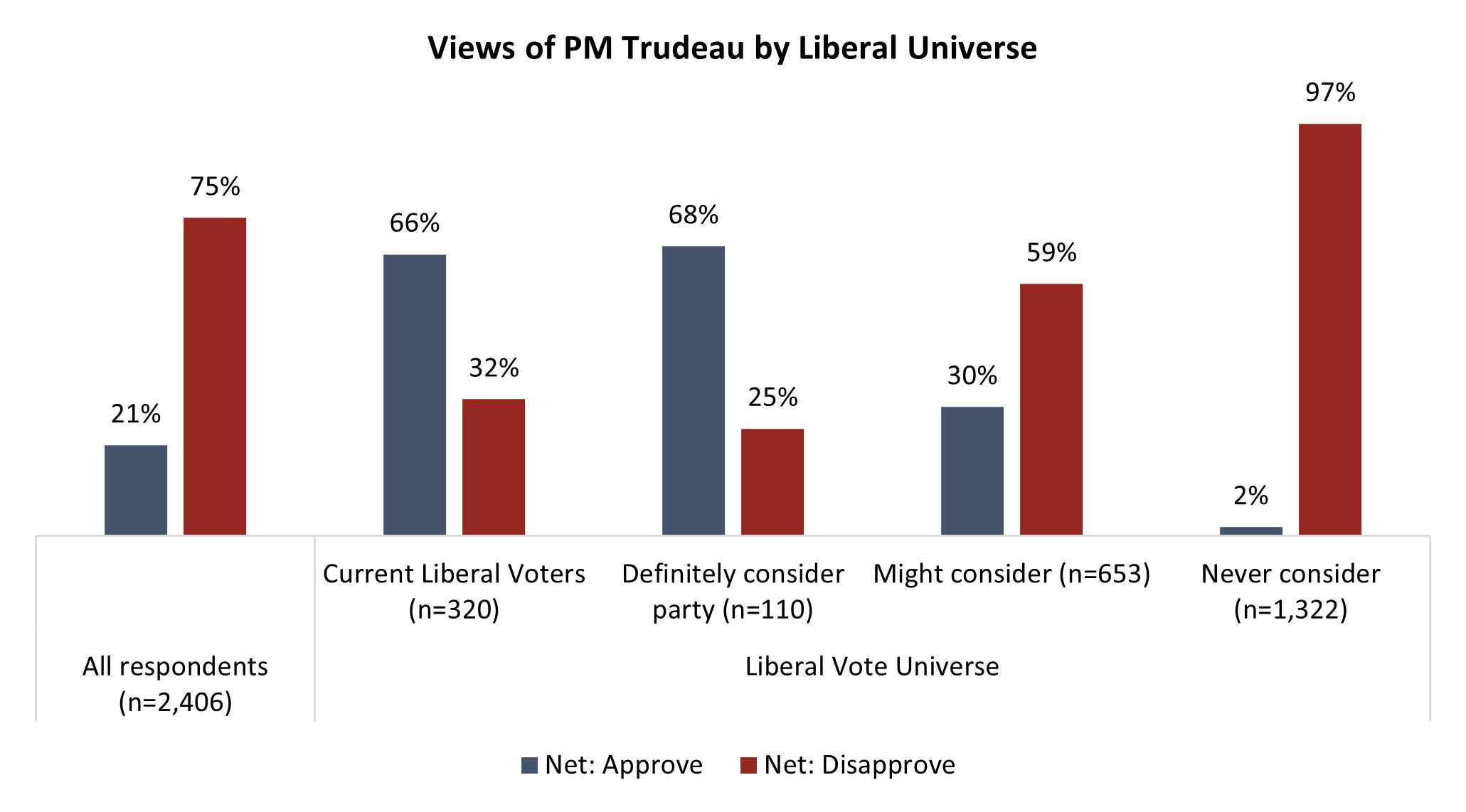
For the Liberals, the challenge is clear: currently, one-quarter of Canadians (27%) say they might consider supporting that party but do not currently. Within this group of available voters two-in-five (38%) say they would vote for the NDP, while 26 per cent are initially undecided when asked about a future election. Prime Minister Trudeau does not fare well among this group that “might consider” his party. He holds a 59 per cent disapproval rating, though Pierre Poilievre fares even worse, with 79 per cent saying they view him unfavourably.
Full Story
INDEX
Part One: The current Liberal vote universe
-
Those who “Might Consider” the LPC do not approve of Trudeau
-
But they view Poilievre even more negatively
-
Liberals would need to draw votes away from NDP, convince the initially undecided
-
Who wants the PM to stay? Mostly people who say they’d never vote Liberal anyway
Part Two: Potential Liberal successors
-
Freeland holds lead across Liberal Vote Universe
-
CPC still dominates, regardless of leader
Part One: The current Liberal vote universe
Parliamentarians are scheduled return to the House of Commons January 27 with many questions unanswered, including whether parliament will be prorogued, and whether New Democratic Party leader Jagmeet Singh will follow through on his threat to bring down the government in a non-confidence vote. One Conservative member has stated he will bring such a vote as early as January 30.
Amid all the parliamentary and legislative bluster, many will be asking the question, “just how bad is it for the Liberals”? The bad news is their vote intention polling is about as bad as it has been in modern history. The good news is that nearly half of Canadians are still open to the party in theory. Among all Canadians who are eligible to vote, 45 per cent wouldn’t rule out voting for some iteration of the Liberals:
Those who “Might Consider” the LPC do not approve of Trudeau
While securing the base of current voters is important, perhaps the most valued of these groups for electoral purposes are those who “might consider” voting Liberal. Among this group, the push for Trudeau to step away is likely strong, as twice as many disapprove of him as approve:
But they view Poilievre even more negatively
The counterpoint of Trudeau’s unpopularity among that group of potential voters is that opposition and Conservative leader Pierre Poilievre is viewed even more dimly. Four-in-five (79%) of those who might consider the Liberals hold an unfavourable view of Poilievre, while 11 per cent view him positively. This negativity unites 55 per cent of the total population:

Liberals would need to draw votes away from NDP, convince the initially undecided
If the Liberal Party is to avoid an electoral catastrophe, it will need foremost to pull fence sitters from supporting the NDP. More than half of those who would definitely consider the Liberals currently lean toward Jagmeet Singh’s party. A smaller number but still a plurality (38%) of the “might consider” group also currently support the NDP, while one-in-four of this group are initially undecided when asked how they would vote:

Who wants the PM to stay? Mostly people who say they’d never vote Liberal anyway
One thing has become clear within these data, both in ARI’s previous release and this one, those who support the CPC or in this case, say they would never support the Liberals, are most likely to want Justin Trudeau to remain on as Prime Minister. Three-in-five current voters would have him resign, as would half of those who would consider the party:

Part Two: Potential Liberal successors
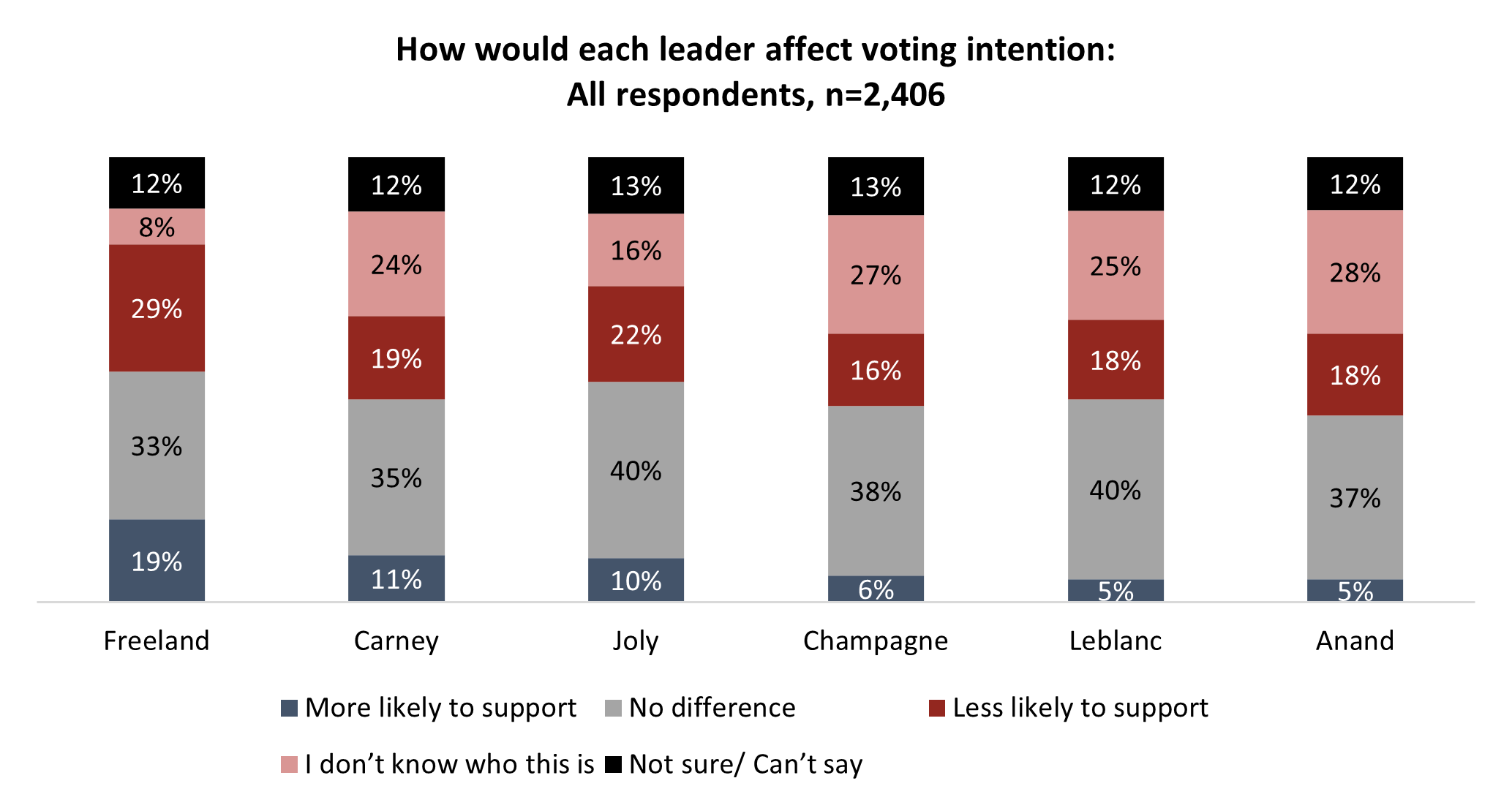
Speculation is rampant in and outside of Ottawa as to who would run to replace Trudeau if he were to step down. The Angus Reid Institute asked about six talked-of names in the discussion to see how each might impact their party’s fortunes. While Chrystia Freeland is most likely to turn Canadians toward the Liberals, she is divisive, and also most likely to turn voters away. This, owing to her strong place among current Liberal voters and poor standing among would-be Conservatives (see detailed tables):
Freeland holds lead across Liberal Vote Universe
Focusing in on these three key figures and within the Liberal vote universe, Chrystia Freeland appears the obvious choice in terms of giving the party at least an opportunity to generate positive momentum in an uphill battle against the frontrunning CPC:
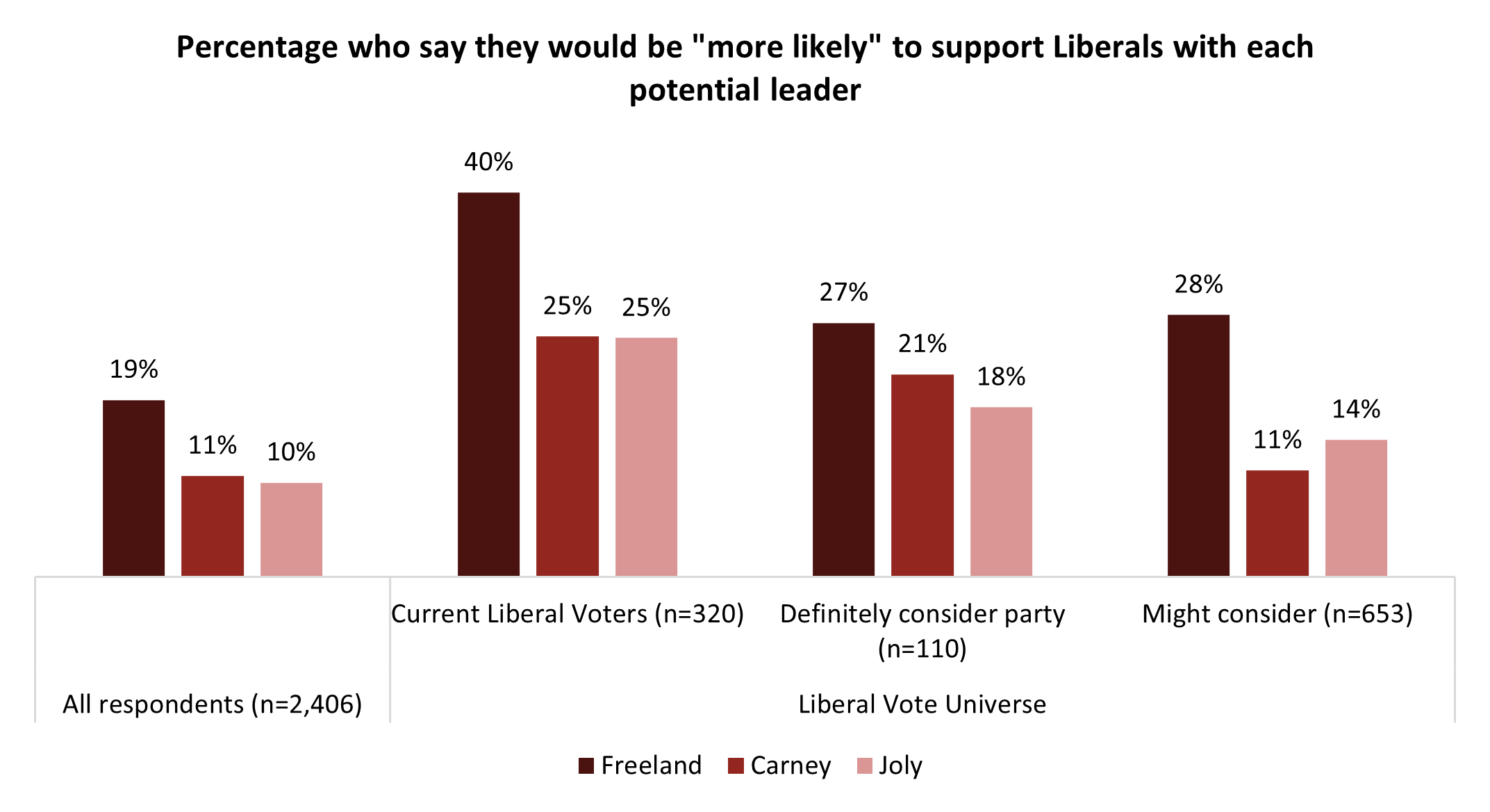
Using a “net score” allows us to understand the overall impact of each potential leader, that is, the proportion of those in the Liberal vote universe who would be more likely to support the party minus those who would be less likely under each leader. The recently resigned Freeland doubles Carney and Joly among current Liberal voters on this measure and is the only option that resonates considerably with they key “might consider” group. Recall that this is 27 per cent of the total population:

An interesting dynamic is unfolding for Freeland, however, among the core and fringe of the Liberal vote universe. Her net score has dropped 11 points since June among current Liberal voters, while her score among the “might consider” has jumped 18 points. This, perhaps owing to her recent decision to stand up to a Prime Minister most of that group disapproves of:

CPC still dominates, regardless of leader
How this will all play out is yet to be seen. The hope for the Liberal Party in a leadership contest would be the creation of new momentum and a fundamental altering of the vote picture. Current vote projections with different leaders suggest they have a lot of work to do if Trudeau does ultimately decide to leave. A party led by Freeland is more competitive than others, but still trails behind the CPC by a considerable margin:
*data released earlier this week limited to leaning and decided voters, had Liberal Party at 16 per cent.
For full release including methodology, click here.
For detailed results by age, gender, region, education, and other demographics, click here.
For detailed results by Liberal Vote Universe, click here.