


Percentage supporting pathway to citizenship for TFWs drops from 36 to 30 per cent over past year
September 25, 2025 – Criticisms of Canada’s Temporary Foreign Worker program aren’t new, but sustained objections to the policy from the left and right side of the political spectrum have soured Canadians on it – further worsening sentiment compared to this time last year.
New data from the non-profit Angus Reid Institute finds a nation holding the view that the more than 50-year-old program – designed to help employers fill vacancies in the labour market – is now accepting too many foreign workers, negatively impacting the housing market, and contributing to high youth unemployment.
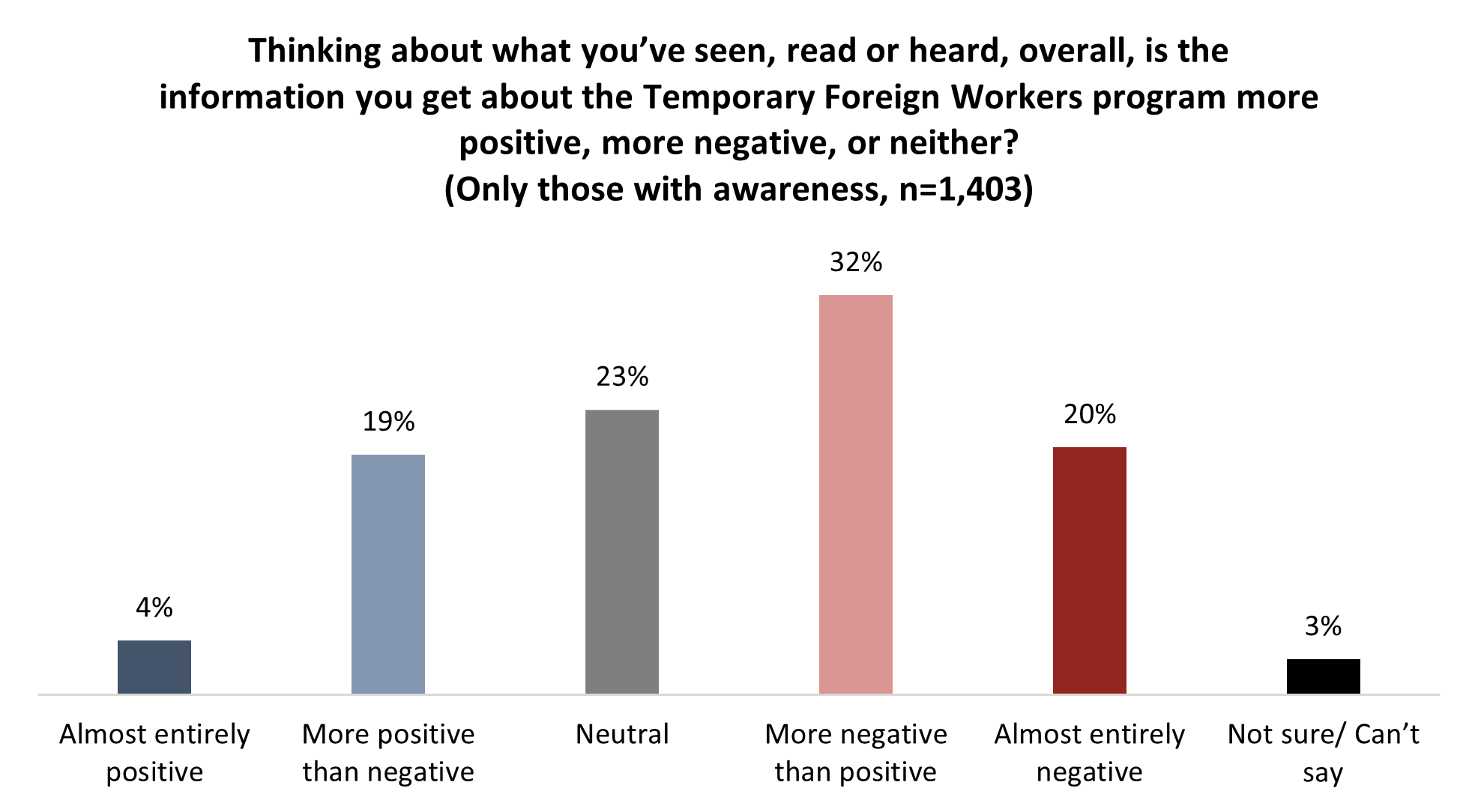
Against the backdrop of the number of TFWP permit holders precipitously increasing in recent years, fully half (52%) say they view the program more negatively than positively, compared to one-quarter (23%) who view it in the inverse.
Alongside this, 55 per cent say Canada accepts too many TFWs – something the current federal government has begun to address, with the wage rules, regional restrictions and other reforms. One-quarter of Canadians consider the number of TFWs coming to Canada about right, while few (9%) would increase use of the program.
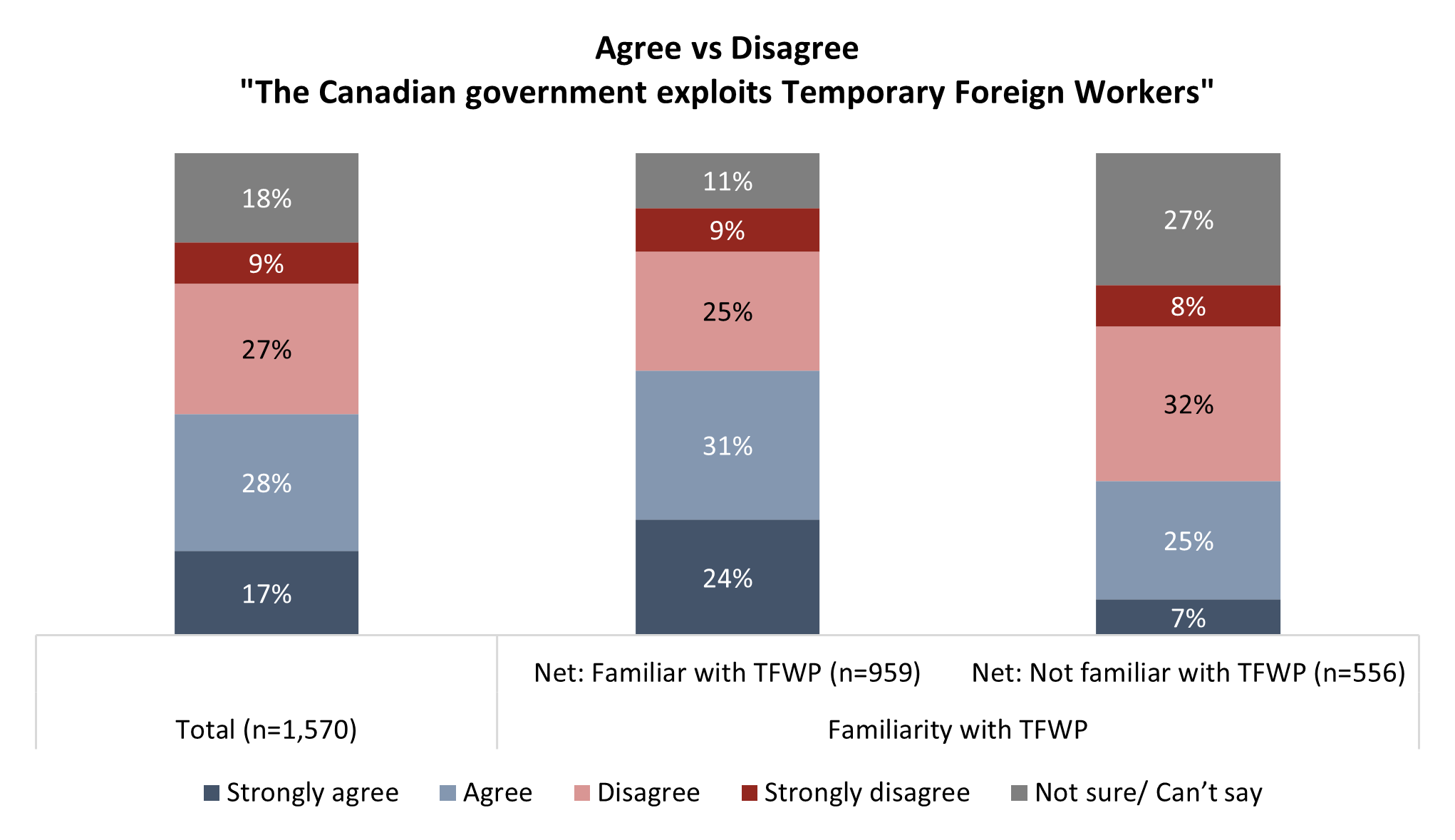
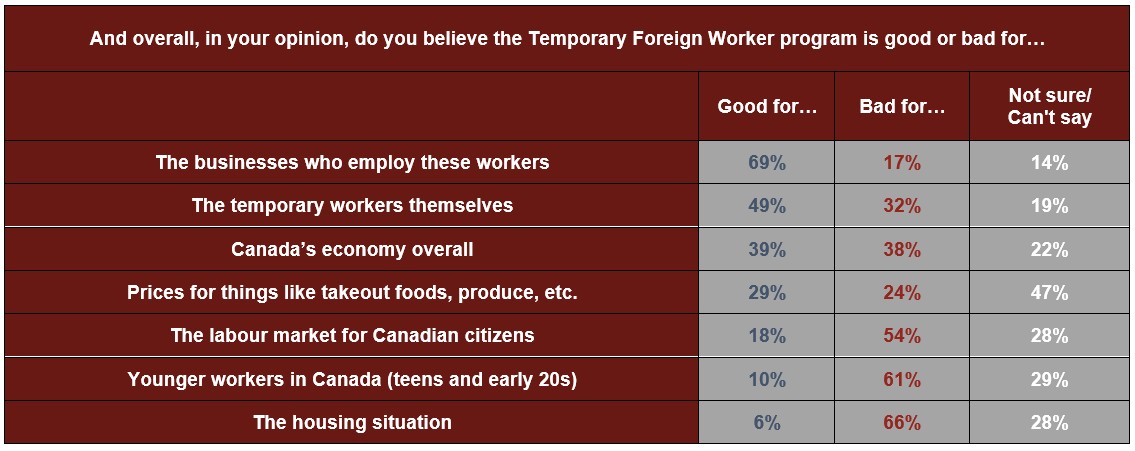
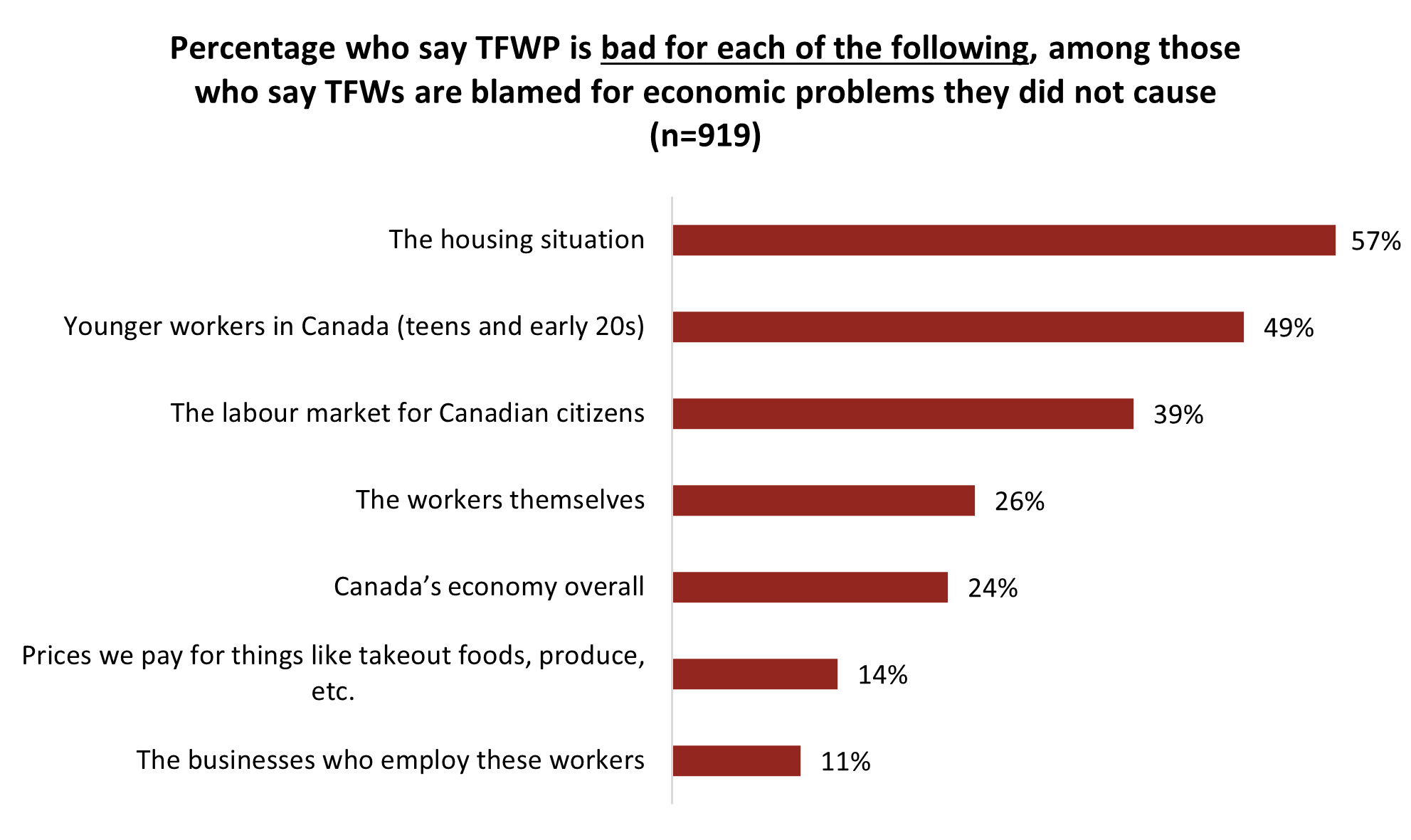
A significant dissonance exists between Canadian views of the program and its perceived ills – and their view that foreign workers themselves are being unfairly scapegoated. Consider that a majority of Canadians say the TFWP has a negative impact on the labour market (54%), young workers in Canada (61%) and the housing market (66%). At the same time, they’re twice as likely to agree (58%) than disagree (29%) that these workers are blamed for economic problems that they did not create. It would appear, then, that government faces the bulk of the blame. More than half of Canadians who are familiar with the TFWP (55%) say the government exploits temporary foreign workers.
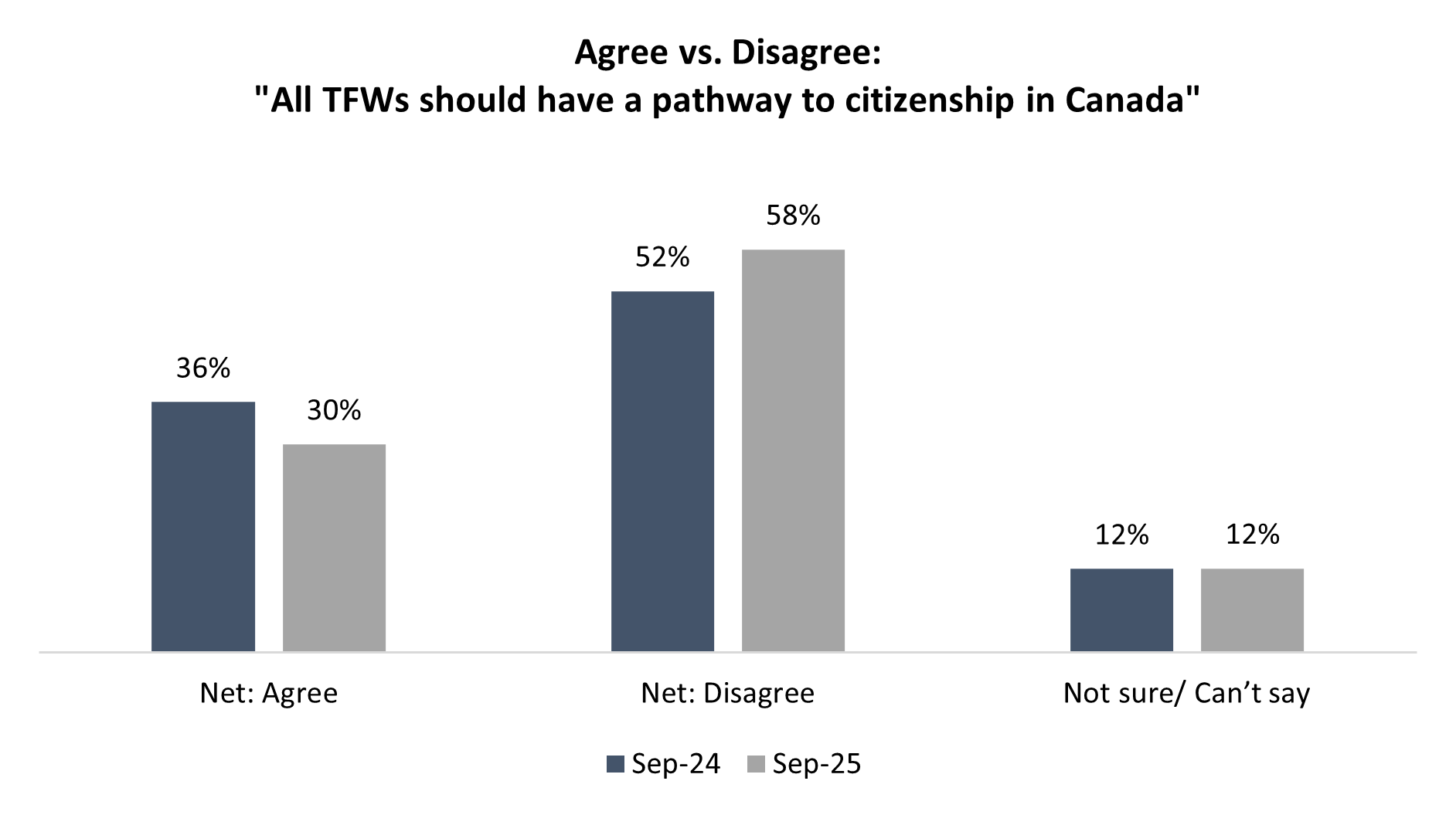
Nonetheless, few Canadians support extending a pathway to citizenship to those who come to work here temporarily. The proportion of Canadians supporting this has dropped from 36 per cent last year to 30 per cent.
More Key Findings:
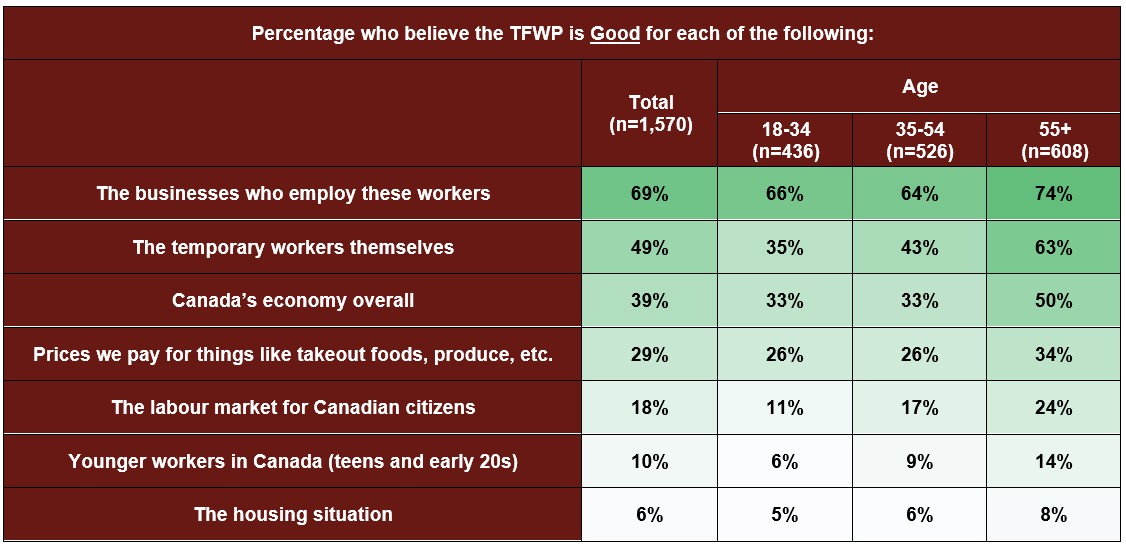
- The TFWP is viewed as “good for” businesses using the program (69%) and temporary foreign workers themselves (49%) at higher levels than other individuals and sectors. The impact on the Canadian economy is viewed equally as good (39%) and bad (38%)
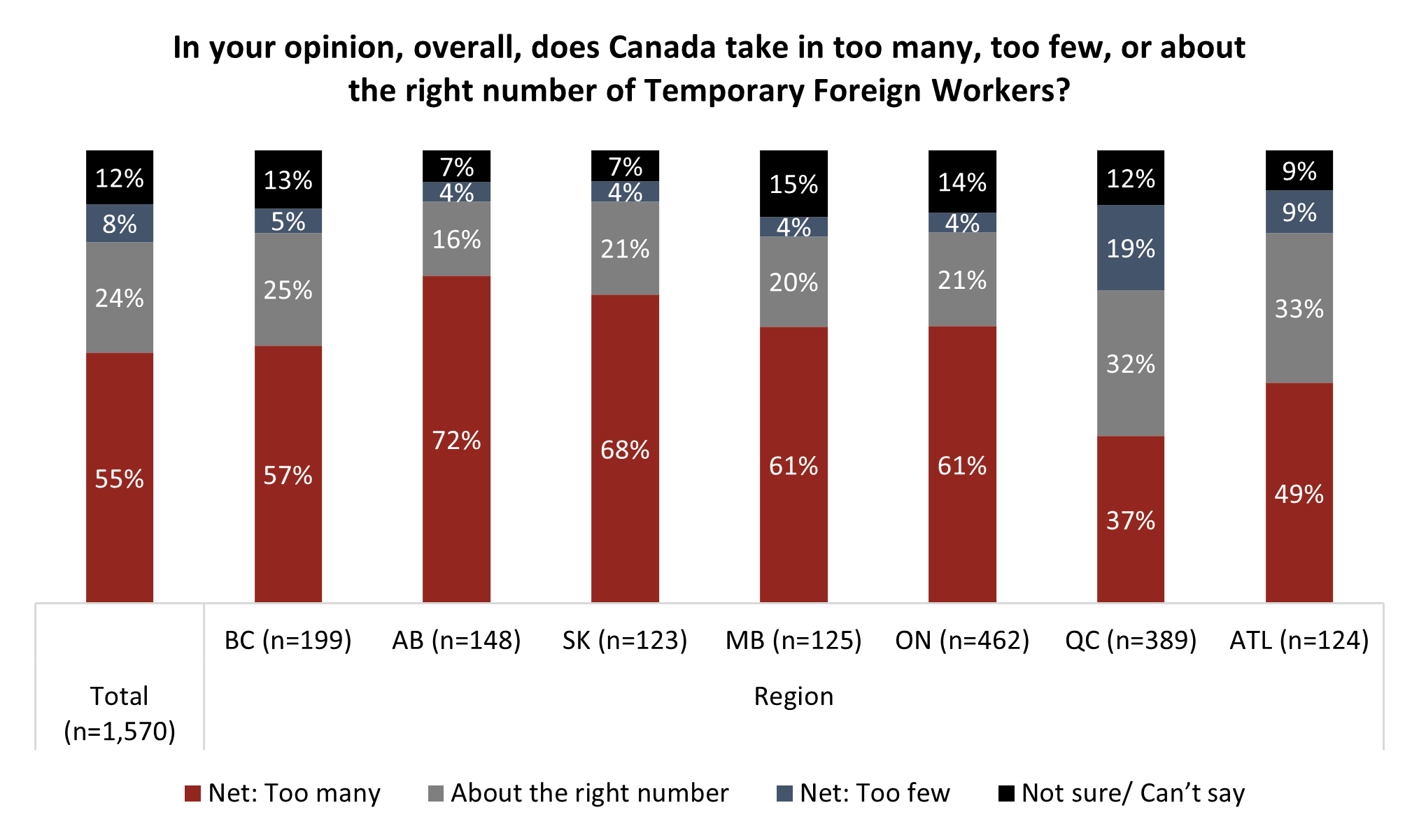
- All regions of the country are more likely to say Canada permits too many TFWs rather than the right amount or too few. Quebec is least likely to be critical of the number of workers (37% say too many) and Alberta most likely (71%)
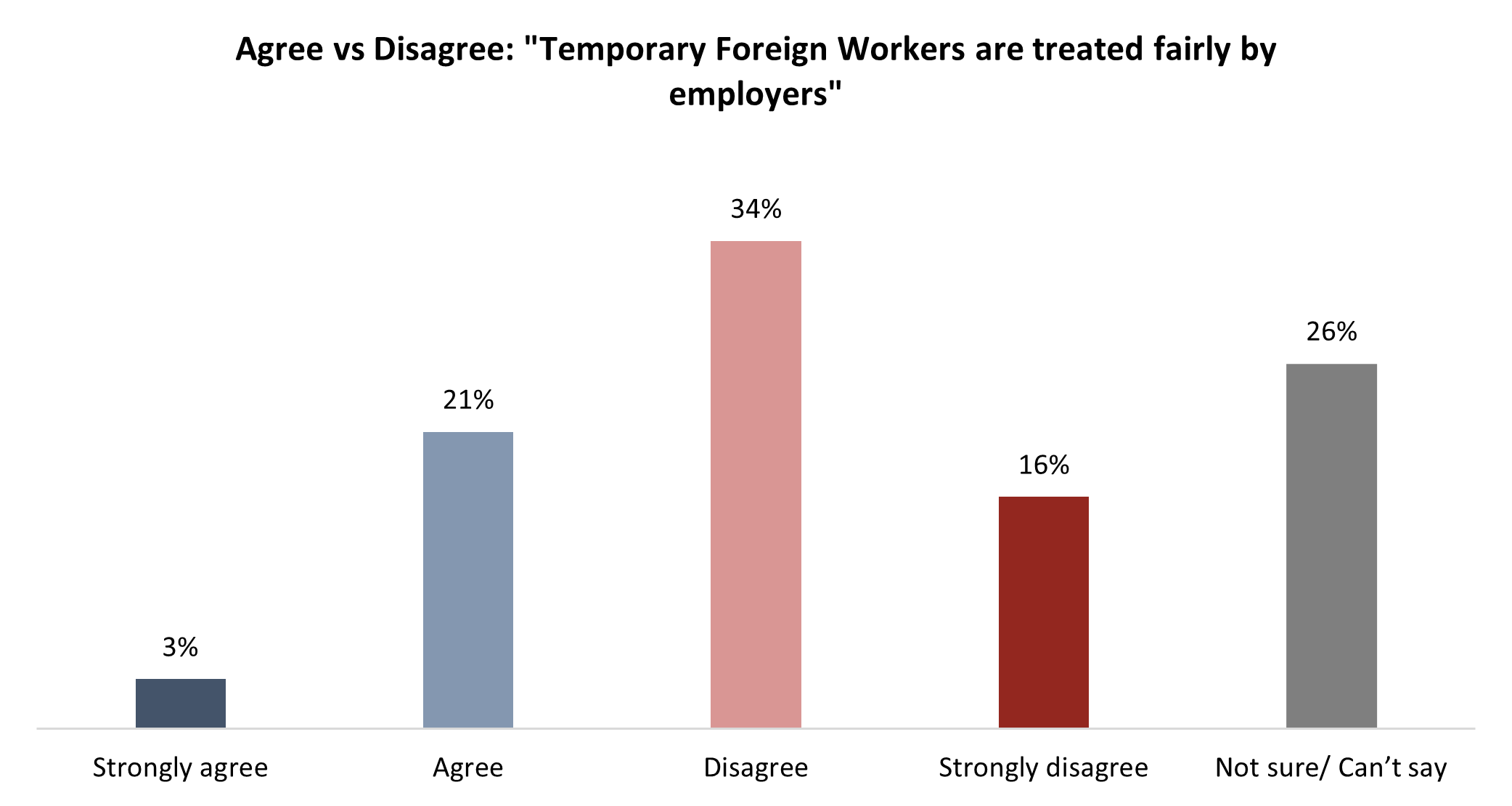
- Half of Canadians say TFWs are treated unfairly by employers (50%) while 24 per cent feel the opposite. Power imbalances between employers and employees have long been a criticism of the TFWP.
INDEX
Part One: Views of the Temporary Foreign Worker Program
-
Awareness of TFWP high
-
Views are mostly negative
-
More than half say “too many” TFW entering Canada
Part Two: Perceived consequences of the Temporary Foreign Worker Program
-
What impact does the TFWP have on…
-
Canadians feel TFWs face undue blame
-
Will young people want to do the jobs left by TFWs?
-
Concerns about exploitation
-
Low support for path to citizenship for TFWs
-
Other agree statements
Part One: Views of the Temporary Foreign Worker Program
The Temporary Foreign Worker Program is not new in Canada, but it has certainly been subject to renewed scrutiny in recent months. Created in 1973, the premise of the program was simple – to allow businesses to apply through the federal government to hire temporary workers from abroad to fill labour shortages. Data on the early years of the program are not available, but the program was subject to rapid increases in usage in the early 2000’s. Debates now largely consist of those who feel the program is a necessary backstop to keep the economy moving – particularly in lower-skill, lower wage sectors – and those who feel it has grown unwieldly and is creating crises in both housing affordability and the labour market, among other critiques.
Awareness of TFWP high
For their part, Canadians are mostly aware of the program, though admittedly few know a lot about it. One-in-five (19%) say they’ve read a lot about it, while the largest group say they’ve read a few things and seen some coverage. Two-in-five show lower awareness levels, or none at all:

Views are mostly negative
Changes to the program have been multiple, in order to improve clarity and better improve performance and perceptions. For example, in 2014 the federal government split streams into those that require a labour market impact assessment and those that do not. The latter tend to be higher-skill, higher wage workers. That change leg to a significant dip in permit holders for the TFWP program, a trend that reversed in 2017 and skyrocketed after the COVID-19 pandemic began.
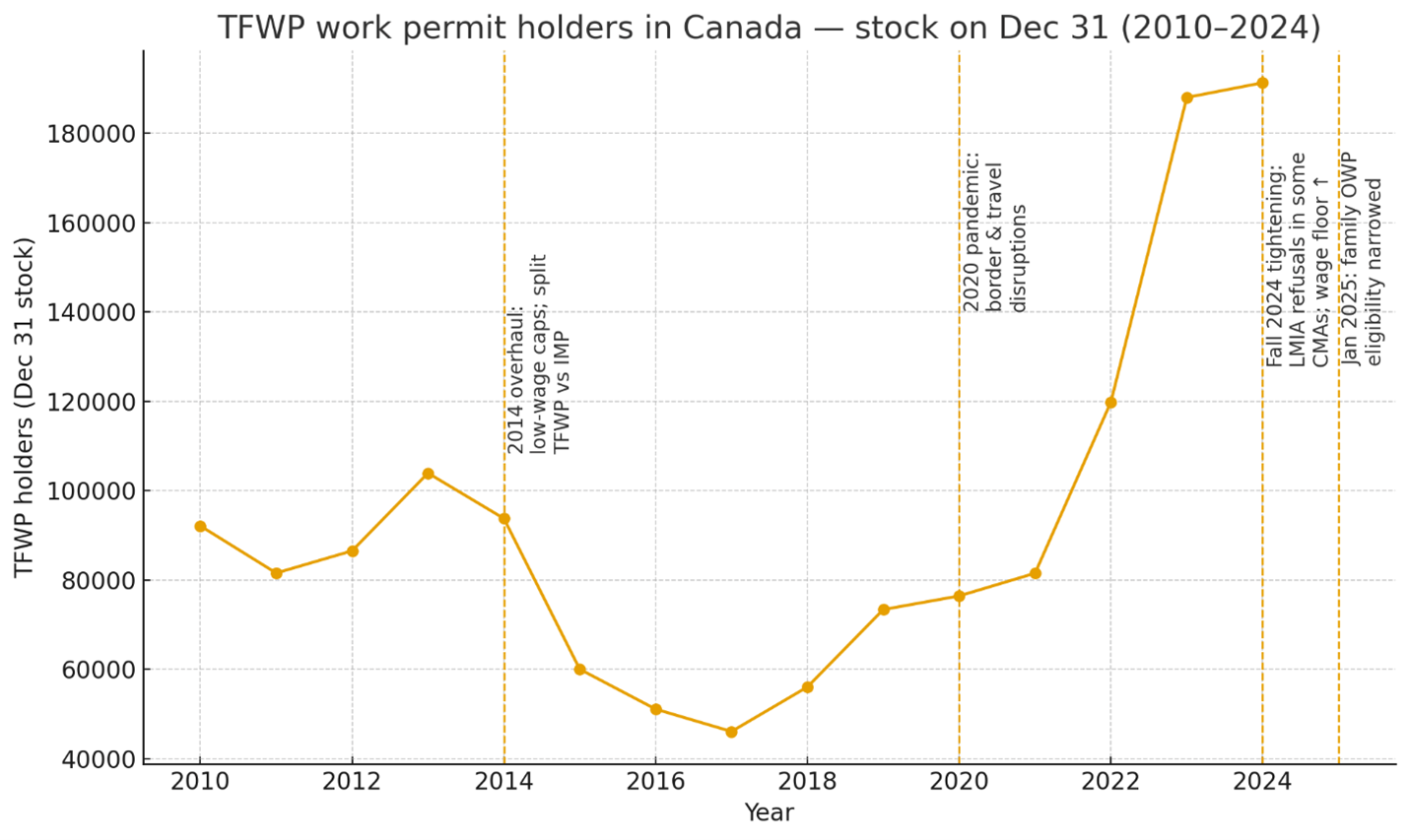
Source: IRCC,CBC
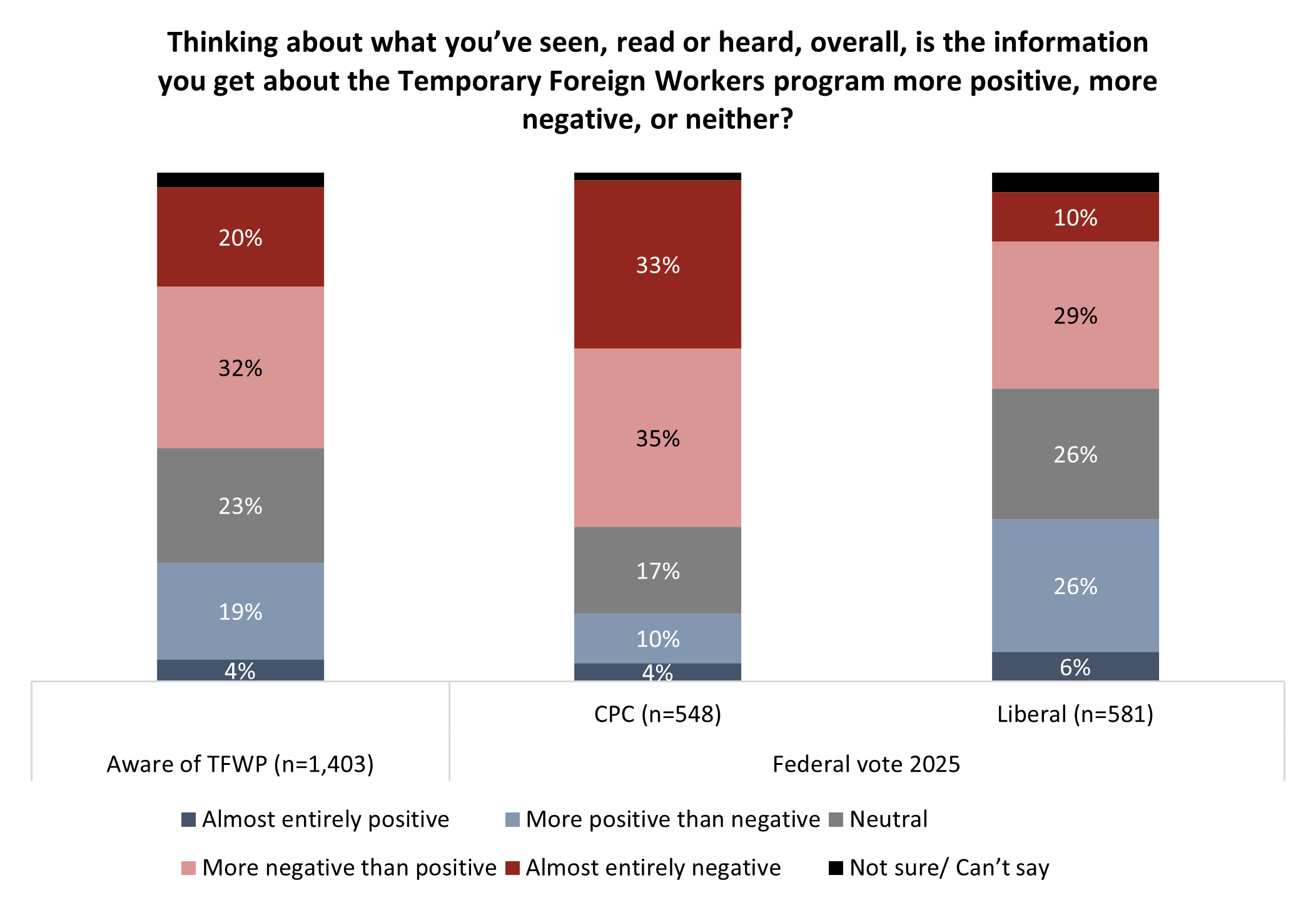
Those who said they had heard of the program are mostly negative in their views. Fully half (52%) have a more negative than positive view, while the rest are divided between being neutral (23%) or positive (23%):
Those who are more familiar with the TFWP are most negative. Among this group, three-quarters (73%) hold a negative view, with just one-in-seven (15%) are positive. Positivity is higher among those who have lesser knowledge, though they are also most neutral:
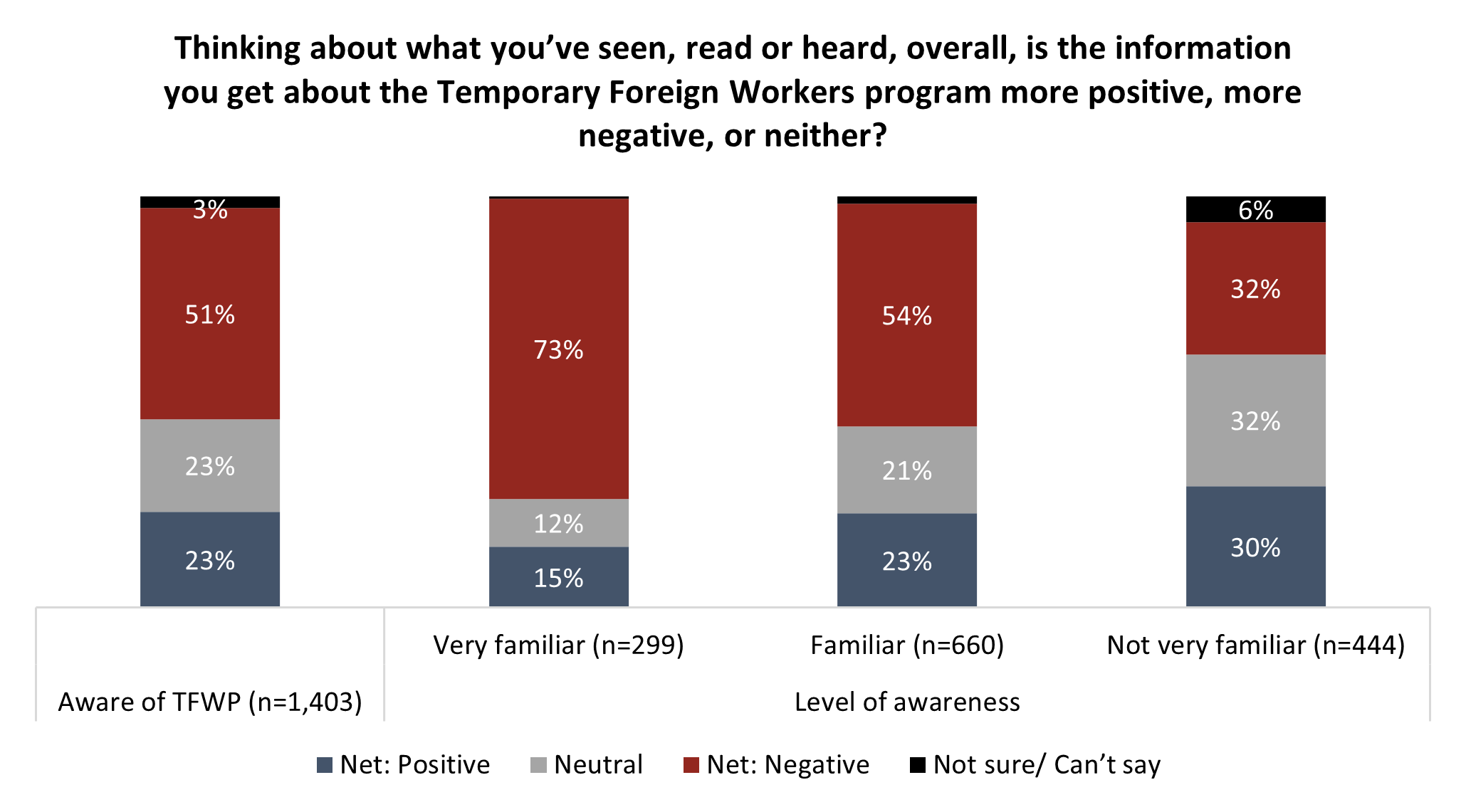
Politically, CPC voters are less than half as likely (14%) as Liberal voters (32%) to view the program positively. Seven-in-10 Conservatives view it negatively (68%) compared to 39 per cent of Liberals. Evidently neither side is willing to endorse the program in a major way, though a majority of Liberals are either neutral (26%) or positive (the aforementioned 32%).
More than half say “too many” TFW entering Canada
The federal government has announced that it will reduce the number of TFWs entering Canada in 2025. The office for the immigration minister Lena Diab has claimed that approximately 33,000 TFW permits for new workers were extended from January to June 2025 – 125,000 fewer than the same period the year prior. Conservative leader Pierre Poilievre has argued that the government continues to allow too many permits, citing the 105,000 that have been issued up to June – a number that includes extensions for those already working in the country.
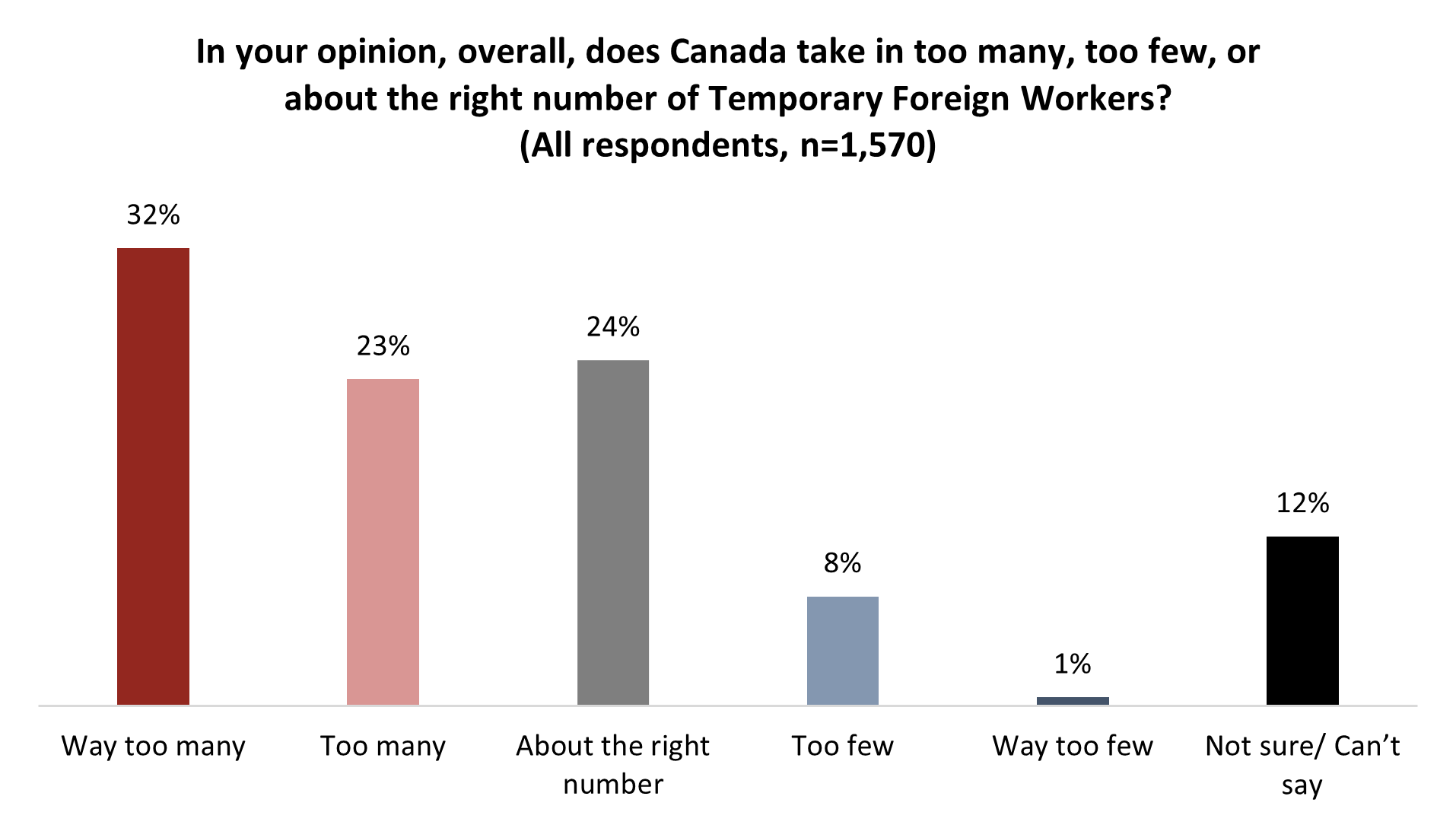
Canadians are critical of the number of TFWs they believe are coming to the country, with 55 per cent saying too many. Note, Angus Reid Institute did not provide respondents with an estimate and asked based only on their own perceptions:
In Quebec, views of the level of TFWs are less critical, though still the largest group (37%) say the numbers are too high. Quebec holds greater administrative control over the program than other provinces and relies heavily on it to staff a massive agriculture sector.
Those in Alberta and Saskatchewan are more critical of the number of TFWs coming to Canada, which aligns with the political perspective from more Conservative Canadians (see detailed tables):
Part Two: Perceived consequences of the Temporary Foreign Worker Program
Aside from the mechanics of the program, Canadians hold views about the results of bringing in hundreds of thousands of temporary employees each year on a number of different areas of society.
What impact does the TFWP have on…
On the positive end of the perception spectrum for the TFWP, are the perceived impacts on the workers and the businesses that employ them. On each of these items, Canadians are more likely to say that they feel the program is good rather than bad. Views are more opaque when it comes to the impact on the economy and various prices in Canada. Residents have considerably more uncertainty about how TFWPs affect food prices. These impacts are generally beneficial to consumers, as prices are lowered by what some call an addiction to cheap foreign labour in industries like agriculture.
On three other items – the labour market, the youth labour market, and the housing market – views are majority negative:
Notably, those who are more acquainted with the TFWP are less positive about its impacts across each of these societal areas:
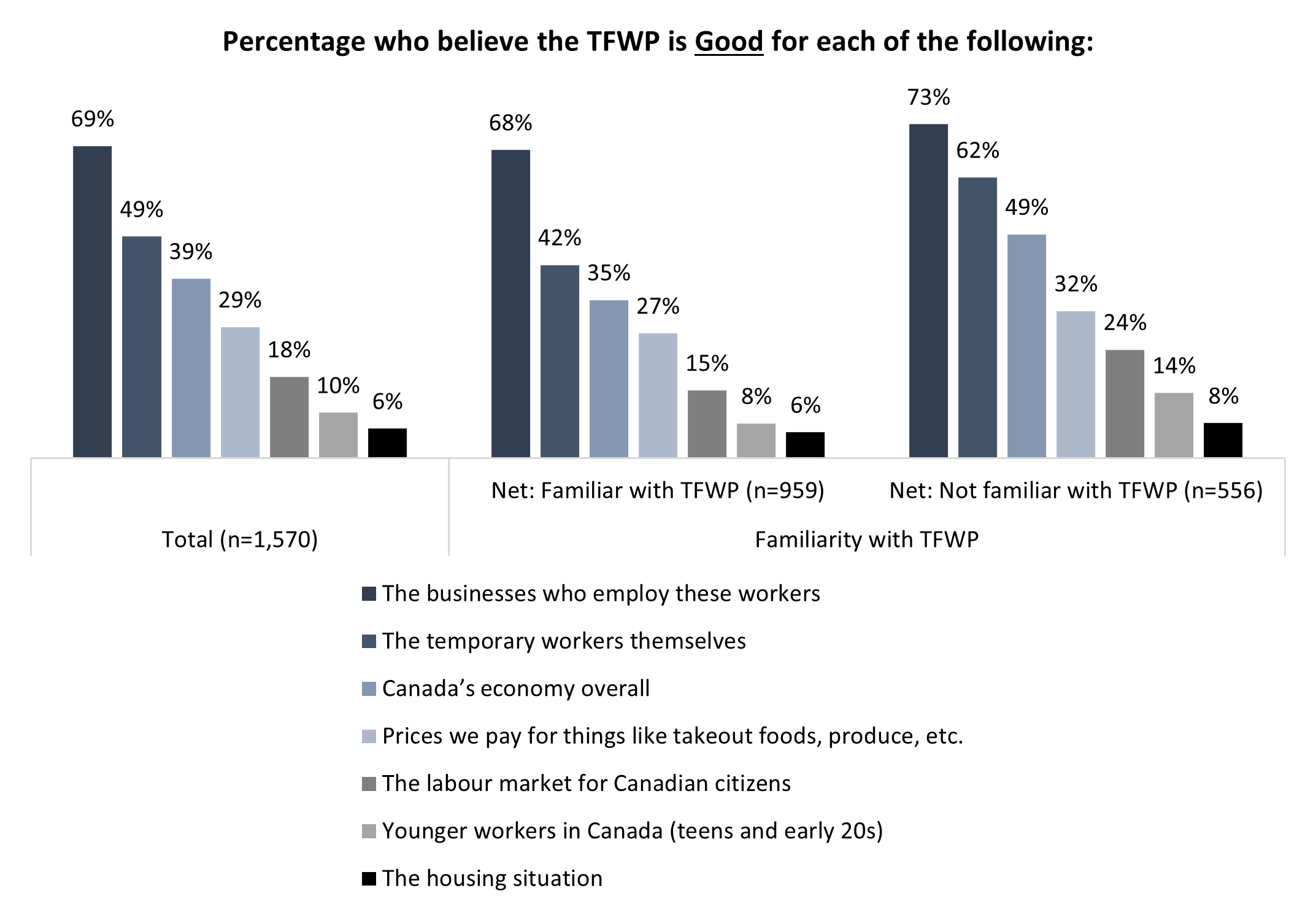
Older Canadians are more likely to view the program as positive across all, which is suggestive of a growing disparity between the younger and older age groups in Canada on economic issues. Last week, ARI found Canadians younger than 65 far more critical of the Canadian economy than those older than that mark:
Canadians feel TFWs face undue blame
While many Canadians perceive these negative impacts, there is also a sense that TFWs are being blame unfairly for creating these problems. A firm majority (58%) feel this way, though this drops to two-in-five among past CPC voters (39%):

Even among that 58 per cent, however, the group that says TFW face unfair blame, large numbers say that the program itself has a negative impact on a number of areas of Canadian society:
Concerns about exploitation
Allegations of employer abuse in TFW cases have been numerous in recent years, from Manitoba, to Ontario, to New Brunswick. Between April and October of 2024, 20 employers were banned from using the program for non-compliance, and 11 per cent of the 649 employers inspected by the federal government were found to be non-compliant. While not all employers abuse the program, the perception among half (50%) is that workers are treated unfairly through this program:
A United Nations report from 2023 suggested that the TFWP was comparable to a “contemporary form of slavery”. Government officials in Canada disputed that allegation, calling it “inflammatory” but many Canadians agree that the government exploits TFWs. Approaching half (45%) say this overall, and this rises above a majority among the more informed (55%):
Will young people want to do the jobs left by TFWs?
After young adults endured one of the weakest summer job markets since 2010, some have pointed at the TFWP as taking up jobs that young people could attain in absence of the program. Both B.C. Premier David Eby and Conservative Party leader Pierre Poilievre have made such a claim recently. Whether or not this is the case is a major subject of contention, but half of Canadians say that they think it’s unlikely young people in Canada would want the jobs done by TFWS. Some have noted that in order to access these jobs, a Labour Market Impact Assessment is needed to prove that local workers are unwilling or unable to fill the job before it can be offered to a TFW.
Young people themselves lean toward disagreeing that young workers would spurn these jobs: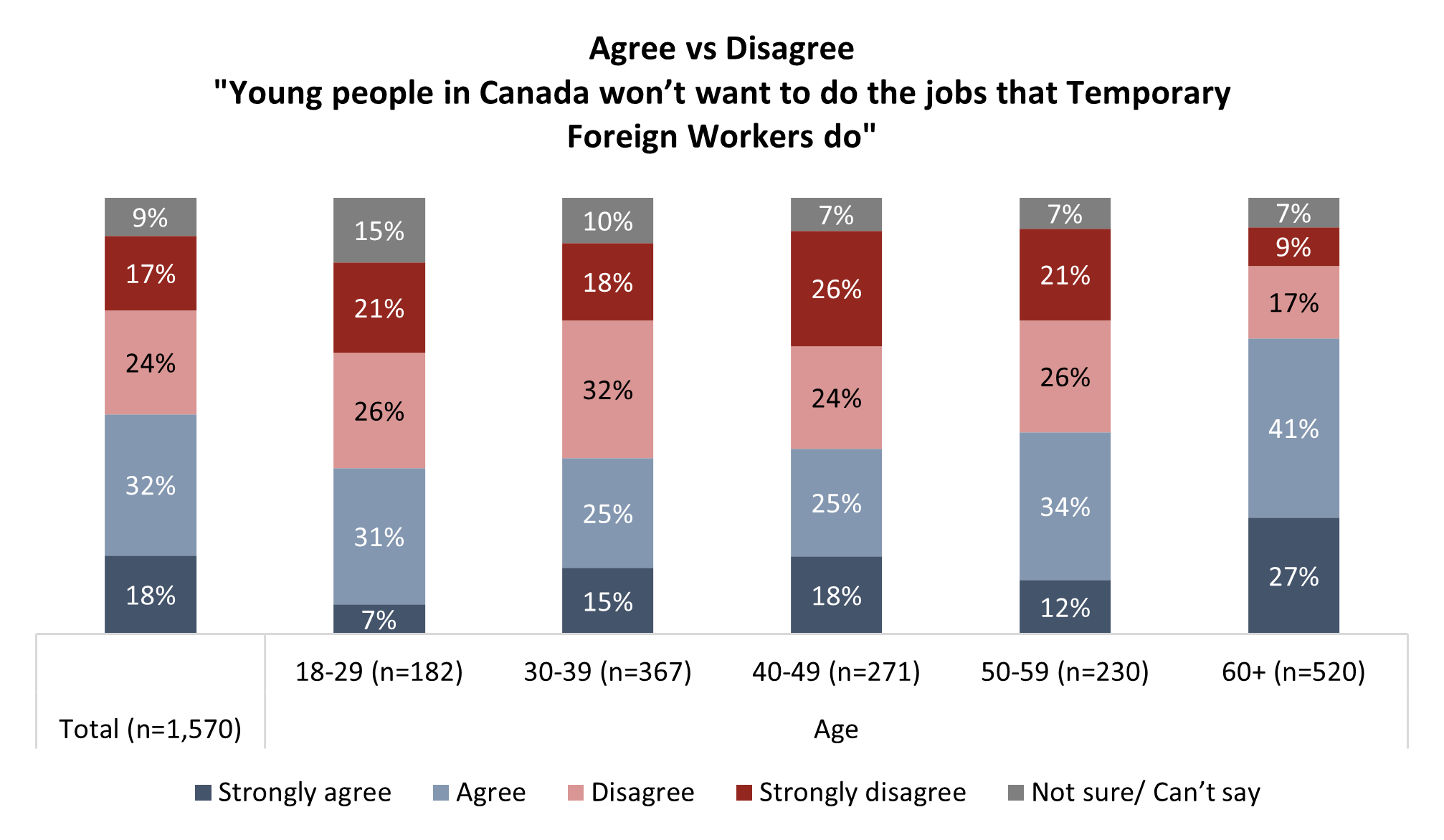
Low support for path to citizenship for TFWs
As criticism of the TFWP has continued, Canadians have evidently become less willing to add more permanent residents to the country through this program. Last year, 36 per cent said they supported a pathway to citizenship for TFWs. This year, 30 per cent say the same.
METHODOLOGY
The Angus Reid Institute conducted an online survey from September 19 – 22, 2025, among a randomized sample of 1,570 Canadian adults who are members of Angus Reid Forum. The sample was weighted to be representative of adults nationwide according to region, gender, age, household income, and education, based on the Canadian census. For comparison purposes only, a probability sample of this size would carry a margin of error of +/- 2 percentage points, 19 times out of 20. Discrepancies in or between totals are due to rounding. The survey was self-commissioned and paid for by ARI. Detailed tables are found at the end of this release.
For detailed results by age, gender, region, education, and other demographics, click here.
For PDF of full release, click here.
For questionnaire, click here.
MEDIA CONTACTS
Shachi Kurl, President: 604.908.1693 shachi.kurl@angusreid.org @shachikurl
Dave Korzinski, Research Director: 250.899.0821 dave.korzinski@angusreid.org