


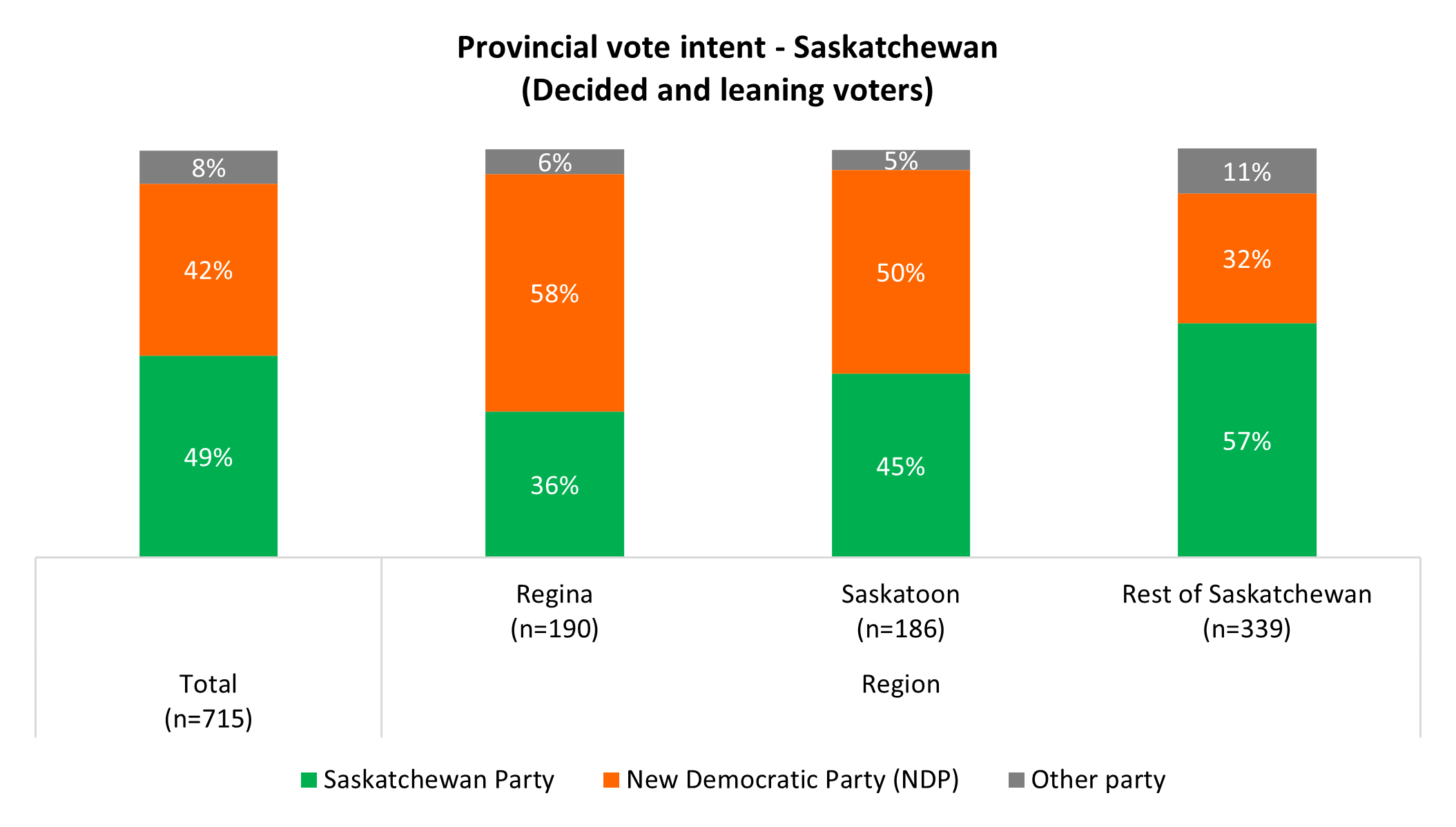
The Saskatchewan Party has built a provide-wide lead with a big base of support in the areas of the province outside of Regina and Saskatoon. The NDP have majority support in Regina and a narrow lead in Saskatoon.

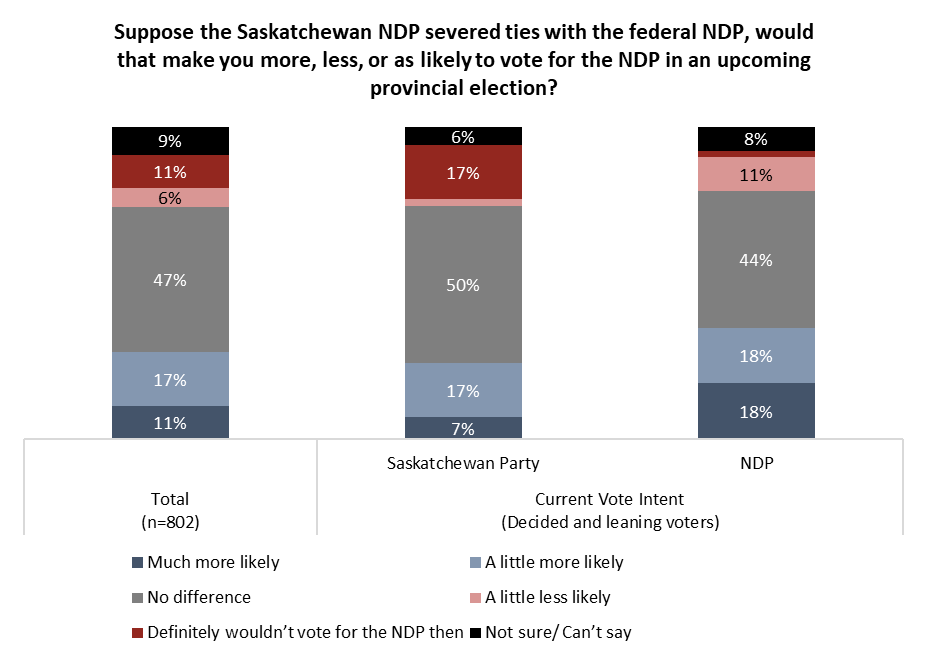
While half (47%) in Saskatchewan are indifferent to the provincial NDP breaking away from its federal counterpart, those who say it would make them more likely to vote for the provincial party (28%) outnumber those who say it would make them less likely (17%).
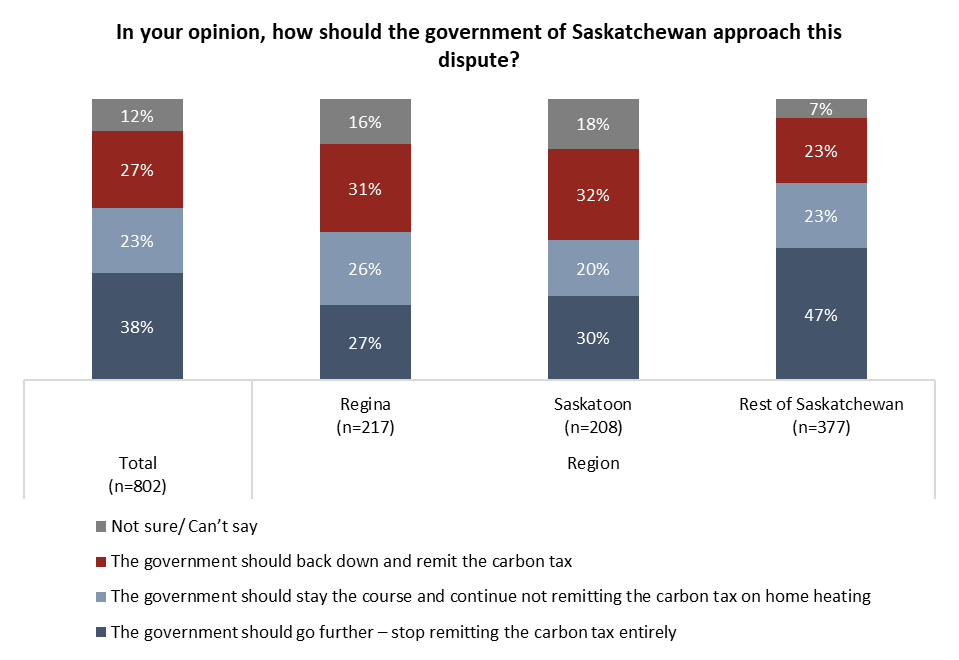
Most in Saskatchewan want the government to either stay the course in its dispute with the federal government over the carbon tax on natural gas used for home heating or go further by refusing to remit other forms of carbon tax. A minority – one-quarter (27%) – believe the government should back down.
The Full Story
INDEX
Part One: Issues
Differing priorities between NDP and Saskatchewan Party supporters
Part Two: Leadership
Half approve of Moe; Beck struggles outside of Regina, Saskatoon
Opinions of leaders more likely to have worsened than improved in recent weeks
Part Three: Vote intent
Gap between two parties the smallest it has been since 2020 election
NDP voters less certain if they’ll stick with party
Sask Party support doubles the NDP outside of Regina and Saskatoon
Part Four: Vote dynamics
Criticism for government on key issues
Most support Sask government on carbon tax remittance, two-in-five want to go further
Could severing ties with the federal party make a difference for the NDP?
Part One: Issues
With less than two months before the election, those living in Saskatchewan are focused on two concerns that dwarf all others: the state of health care and the high cost of living. The issues facing health care in Saskatchewan are the same as those afflicting systems across the country – a struggle in finding enough family doctors, staffing issues in general, service closures and disruptions in rural areas, and long waitlists for surgeries – which remain high despite government efforts to trim the waits with out-of-province surgeries. Three-in-five (60%) say health care is the top issue facing the province in this election year.
The high cost of living remains a significant issue for many in the province. The percentage of those Struggling by ARI’s Economic Stress Index has consistently been one of the highest in the country, with approaching half (46%) falling in that category in July. According to Food Banks Canada’s Poverty Report Card, more than one-quarter in the province are food insecure, and one-in-ten live in poverty, both above the national average. Food bank usage has been growing in the province, as the province provided $2 million in funding to food banks struggling to deal with the demand. Three-in-five (59%) say inflation is a top concern to them.
The other top five issues are less chosen, but there are still at least one-quarter who say they are concerned with the economy more broadly (25%) and the education system (25%) and one-quarter are worried about public safety (21%).
Differing priorities between NDP and Saskatchewan Party supporters
The supporters of the two contending political parties share some concerns – cost of living and health care are the top two issues for both those who say they will vote NDP and those who would vote for the Saskatchewan Party – but diverge on others. Current Saskatchewan Party supporters are much more likely to say the economy (39%), government spending (25%), public safety (28%) and energy policy (21%) are top issues than those who would vote NDP. Education (44%) and poverty (21%) are chosen at much higher rates by NDP supporters:

Part Two: Leadership
Half approve of Moe; Beck struggles outside of Regina, Saskatoon
Saskatchewan Party leader and Premier Scott Moe has consistently been one of the most approved-of provincial leaders in the country since he was first elected in 2018. Half (49%) in Saskatchewan say they approve of his performance currently, still a relatively strong mark but a notable decline from the highs of 60 per cent approval he had as recently as March of last year.
Moe holds an advantage over opposition and NDP leader Carla Beck on this front, who is less likely to be viewed favourably (37%) than not (48%). Beck has struggled to win over those outside of the province’s two largest cities, where three-in-five (58%) say they view her in a negative light. Inversely, a majority in Regina (63%) and Saskatoon (54%) say they disapprove of Moe’s performance.
Beck performs better among 18- to 34-year-olds than Moe (47% favourability for Beck; 33% approval for Moe) but is viewed unfavourably by a majority of those older than 54 (58%, see detailed tables).

When Nadine Wilson became the first leader of Saskatchewan United in 2022, she also became the first MLA to sit in the legislature with a party other than the NDP and Saskatchewan Party since 2003, when the Liberal Party lost its three seats. Wilson passed the leadership of the fledgling party to Jon Hromek, who evidently has a lot of work to do to make himself known to potential voters. Three-in-five (59%) in Saskatchewan say they don’t know enough to say to have an opinion of the Saskatchewan United leader (see detailed tables).
Opinions of leaders more likely to have worsened than improved in recent weeks
While a majority say their opinions of Moe (61%) and Beck (62%) have not shifted during the summer, the rest are more likely to say their opinions have worsened than improved.
Few (11%) say their opinion of Moe has become more positive recently, as the premier finds himself losing ground in all three areas of the province, and especially among 18- to 34-year-olds (37% say their opinion has worsened) and 25 to 34-year-olds (28%, see detailed tables).
Beck does enjoy a net improvement from 18- to 34-year-olds, one-in-five (18%) of whom say their opinion has improved, but she is not making headway among older residents. More than one-third (36%) of those older than 54 say their opinion of the NDP leader has worsened in recent weeks (see detailed tables).
It also appears that advancing the NDP’s position outside of Regina and Saskatoon will prove difficult, as one-third (33%) outside of the province’s two largest cities say their opinion of Beck has worsened:

Part Three: Vote intent
Gap between two parties the smallest it has been since 2020 election
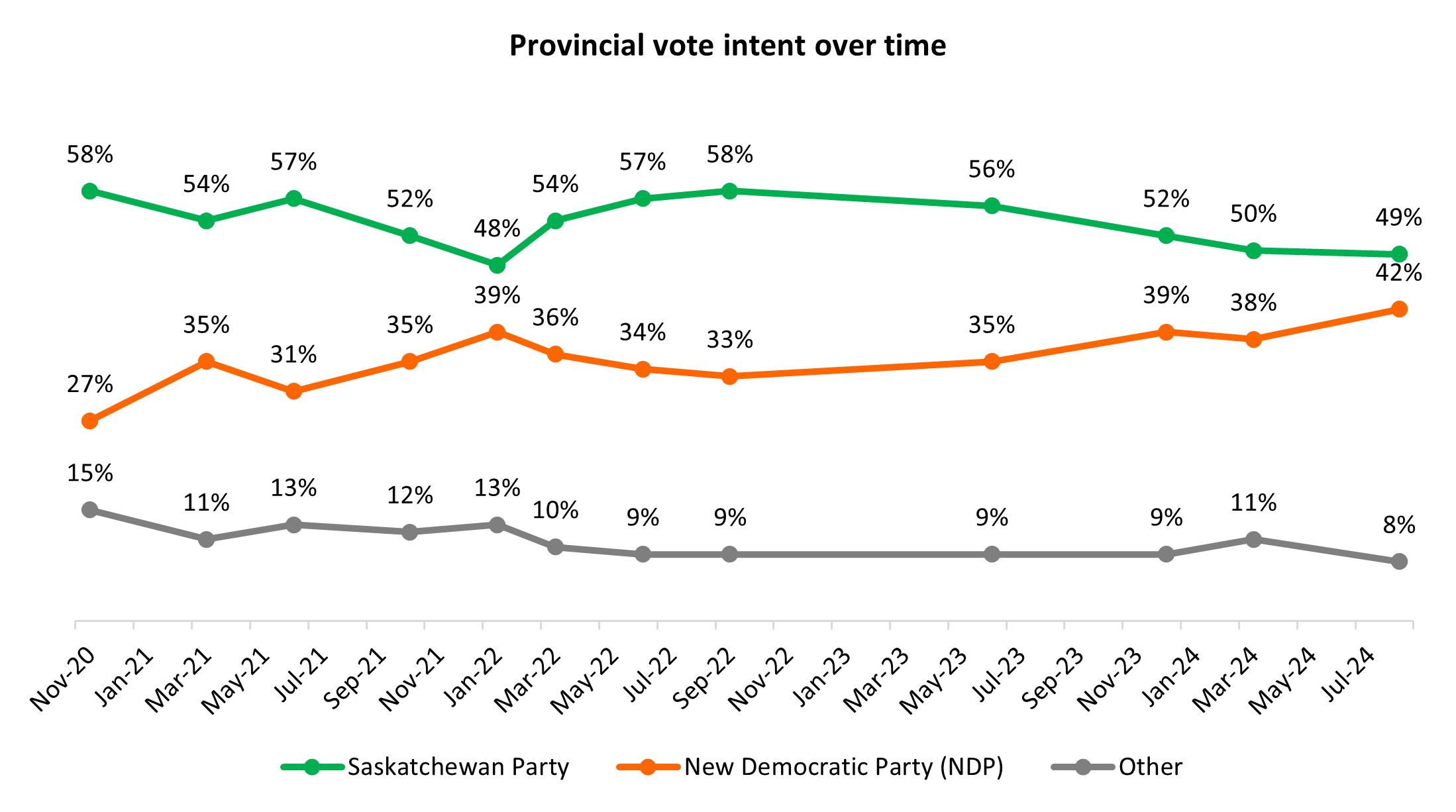
The last three elections in Saskatchewan have been akin to green tsunamis. In winning three straight majorities in 2007, 2011 and 2016, the Saskatchewan Party doubled the NDP vote. This fall’s contest projects to be a much closer race.
Half (49%) intend to vote for the Saskatchewan Party, while two-in-five (42%) say they would support the NDP. A decline in support for the Saskatchewan Party over time, and a bump up for the NDP, puts the gap between the two parties at seven points, the closest they have been in the four years since the last election:
The Saskatchewan Party continues to dominate the rural areas of the province. Three-in-five (57%) say they intend to vote for Moe’s party. The NDP perform the best in Regina, where three-in-five (58%) would support the party if the election were held today. Saskatoon leans slightly towards the NDP (50%), but the Saskatchewan Party (45%) is not far behind.
Generating support outside of Regina and Saskatoon continues to present a problem for the NDP. Of the provinces 61 seats, 35 are outside of the two biggest cities. The NDP lost all of them but the two northern ridings of Athabasca and Cumberland in 2020, and subsequently lost Athabasca in a 2022 by-election.
The NDP lead in vote intent among women (49% to 45%) and 18- to 34-year-olds (58% to 31%), while splitting the support of 35- to 54-year-olds with the Saskatchewan Party. As always, converting young support to votes at the ballot box has always been a challenge in Canadian elections, and will present one for the NDP this fall.
A majority of men (54%) and those older than 54 (66%) intend to vote for the Saskatchewan Party:

NDP voters less certain if they’ll stick with party
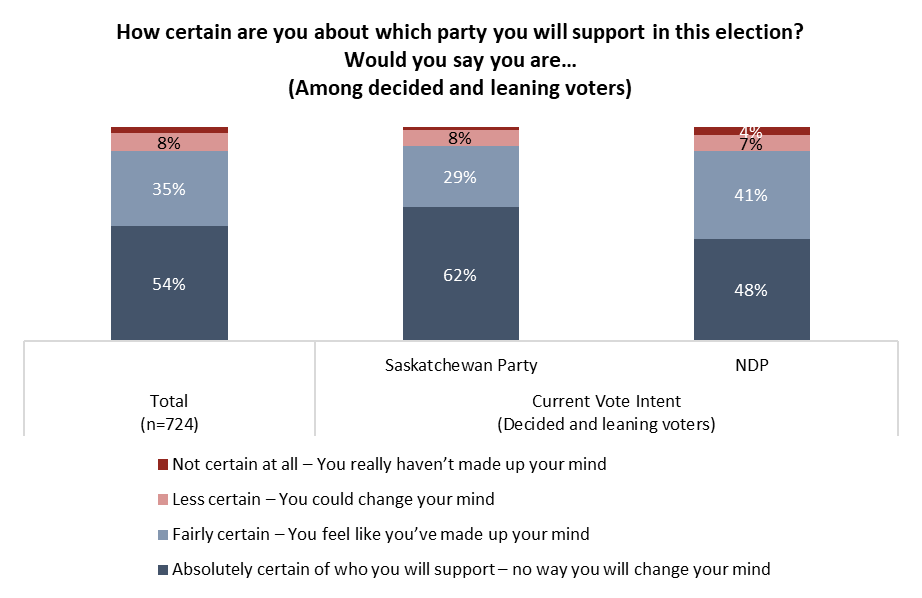
With a younger vote base, the NDP are also dealing with an issue of voter commitment. Half (48%) of those who intend to vote for the party say there is no way they would change their mind before October, fewer than the three-in-five (62%) of those who support the Saskatchewan Party who say the same. For the NDP, that leaves 41 per cent who are “fairly certain” of their choice and one-in-ten (11%) who express more openness to placing their vote elsewhere more:
Part Four: Vote dynamics
Criticism for government on key issues
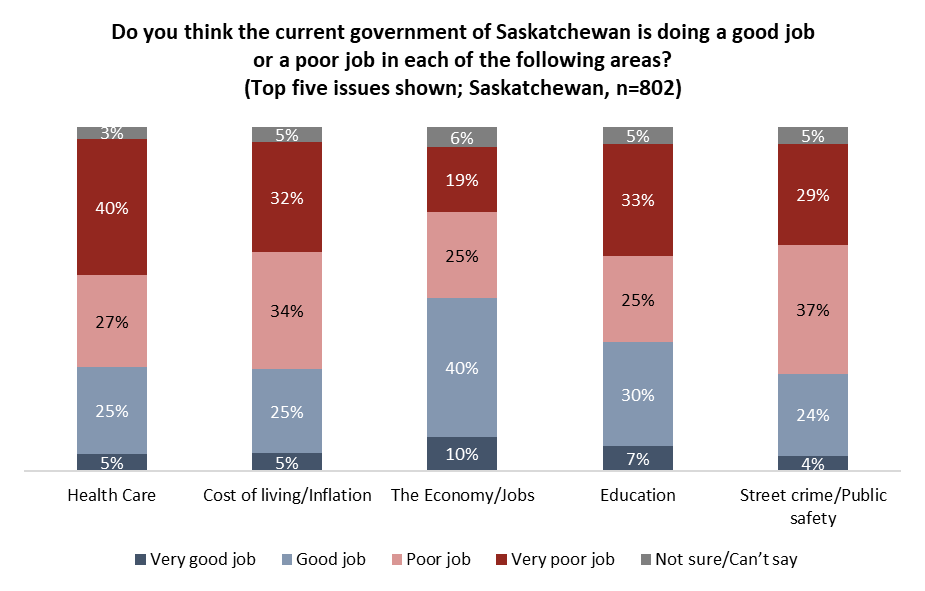
There does appear to be an opening for the NDP to present an alternate vision for the province as many are dissatisfied with the current government’s performance on the top issues of the day. Two-thirds believe the Saskatchewan Party government has performed poorly on health care (66%), inflation (66%) and public safety (67%). Education (58% say poor job) is also a source of criticism. Residents offer more praise on the economy (50% good job, 44% poor job), but there are still many who believe the government could be doing better on that front.
This criticism isn’t only coming from those living in cities, either. Majorities outside of Regina and Saskatoon believe the government has mishandled health care (62%), inflation (60%), education (52%) and crime and safety (62%, see detailed tables).
Most support Sask government on carbon tax remittance, two-in-five want to go further
The Saskatchewan government’s relationship with the federal government has become more adversarial in recent years, as the province has drawn lines in the sand over federal interference over the management of natural resources, its electricity grid and environmental regulations. This combative stance is evidently divisive among residents, as half (46%) say the province has done well managing the relationship with the federal government, and half (47%) say it has done poorly (see detailed tables).
However, there is broad support of the government’s fight against the federal carbon tax. After the federal government announced home heating oil would be exempted from the carbon tax last year, the Saskatchewan government responded by stopping the collection of the tax on natural gas used for home heating.
The carbon tax has been unpopular in the province. In March, three-in-five (61%) said they would prefer to abolish it.
Related:
- Carbon Tax: Perceptions of insufficient rebates, cost of living concern & questions over efficacy send support plummeting
- Raise, pause, abolish? Centre-left voters rally around carbon tax, but majority would still reduce or eliminate it
Perhaps its no surprise then, that a majority (61%) support the provincial government as it faces an audit from the Canada Revenue Agency for its refusal to remit the carbon tax on home heating. In fact, two-in-five (38%) say they would go further and find ways to stop remitting all carbon tax entirely. That concept is more popular outside of Regina and Saskatoon (47%).
In the provinces two largest cities, only a minority believe the government should back down in this dispute over the carbon tax on natural gas:
Could severing ties with the federal party make a difference for the NDP?
The carbon tax also marks a point of contention between the provincial and federal branches of the NDP. Beck says she opposes the carbon tax, while the federal NDP have repeatedly voted down Conservative House of Commons motions to abolish carbon pricing.
Provincial New Democratic parties have been challenged in recent years by the connection to the federal brand because of leader Jagmeet Singh and the NDP’s supply-and-confidence agreement with the unpopular Prime Minister Justin Trudeau and the governing Liberals. In Alberta, new NDP leader Naheed Nenshi made separating from the federal party an issue during his leadership campaign. He plans to ask party members in that province to vote on the matter sometime in the future.
In Saskatchewan, a move away from the federal NDP is met with indifference by half (47%) but is received more positively (28%) than not (17%) among those who say it will affect their vote. Notably, one-quarter (24%) of current Saskatchewan Party voters say they would be more likely to vote for the provincial NDP if it were not connected to the federal party:
Survey Methodology:
The Angus Reid Institute conducted an online survey from Aug. 16-20, 2024 among a representative randomized sample of 802 Canadian adults living in Saskatchewan who are members of Angus Reid Forum. For comparison purposes only, a probability sample of this size would carry a margin of error of +/- 3 percentage points, 19 times out of 20. Discrepancies in or between totals are due to rounding. The survey was self-commissioned and paid for by ARI.
For detailed results by age, gender, region, education, and other demographics, click here.
For the full release including methodology, click here.
For the questionnaire, click here.
Images – Carla Beck Facebook/ Scott Moe Facebook
Shachi Kurl, President: 604.908.1693 shachi.kurl@angusreid.org @shachikurl
Jon Roe, Research Associate: 825.437.1147 jon.roe@angusreid.org