


Amid pipeline tensions, both Eby (40%) and Smith (44%) see negligible downward movement
December 5, 2025 – The political fortunes of Canada’s provincial leaders are varied this holiday season, with some – Manitoba’s Wab Kinew, New Brunswick’s Susan Holt, and Saskatchewan’s Scott Moe – set for a merry break from the legislature.
Others – namely Ontario’s Doug Ford and Quebec’s Francois Legault – may be in for a more Dickensian season of holiday introspection, as they contend with high levels of disapproval from their constituents for the job they’ve done in recent months.
For two leaders caught in a Christmas quarrel over the future of an Alberta-B.C. pipeline, public opinion appears frozen as residents evidently wait for words from both David Eby and Danielle Smith to turn into actions.
These are the Angus Reid Institute’s final Premier Approval ratings for the year 2025.

Note: Because its small population precludes drawing discrete samples over multiple waves, data on Prince Edward Island is not released.
INDEX
Part One: Snowdrift stragglers
-
Doug Ford, Ontario
-
Francois Legault, Quebec
Part Two: Frozen in the 40s
-
Danielle Smith, Alberta
-
(New) Tony Wakeham, Newfoundland and Labrador
-
David Eby, British Columbia
Part Three: Front of the Sleigh
-
Wab Kinew, Manitoba
-
Susan Holt, New Brunswick
-
Scott Moe, Saskatchewan
-
Tim Houston, Nova Scotia
Part Four: Opposition leaders
Part One: Snowdrift stragglers
Doug Ford, Ontario
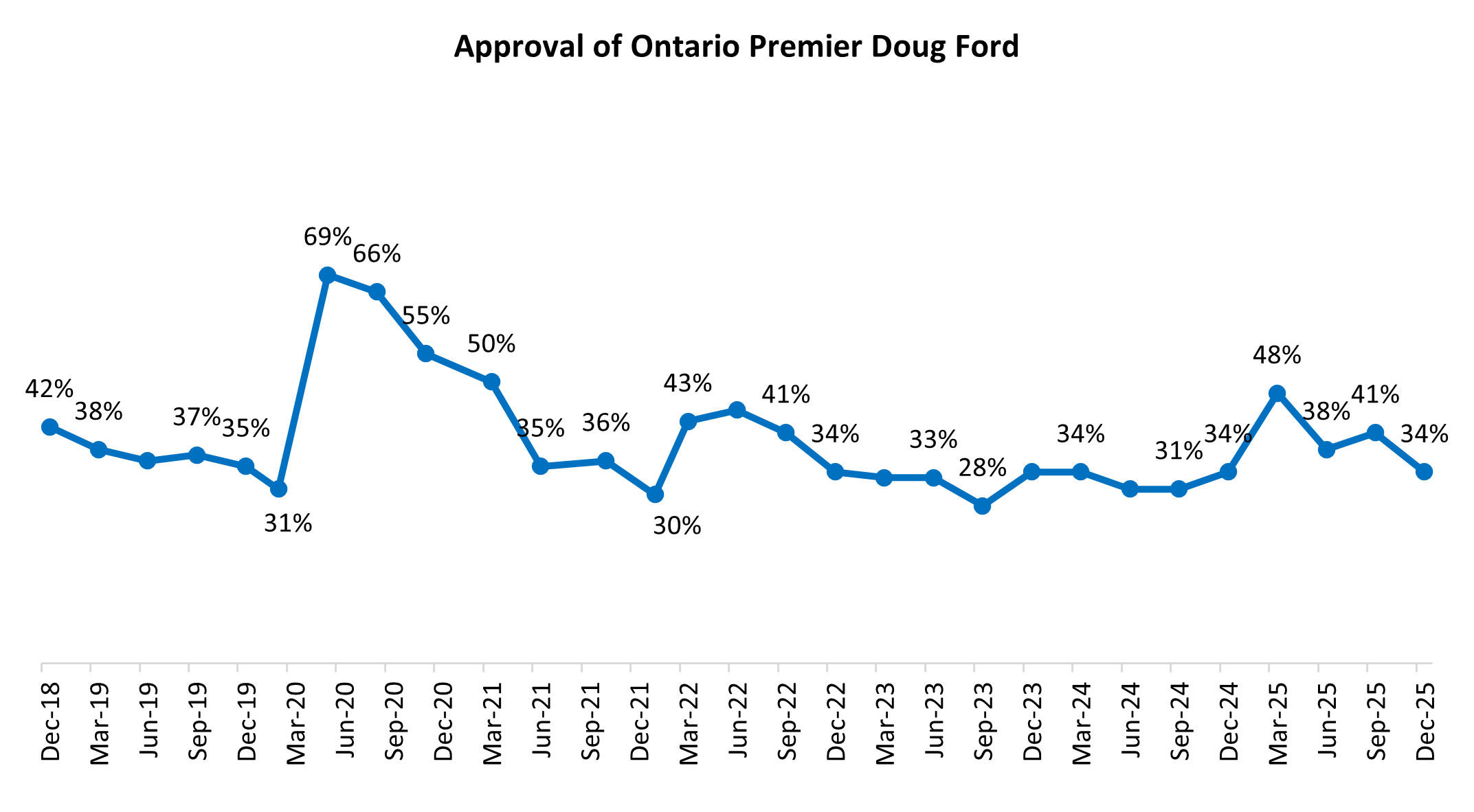
No premier generated more attention this fall than Ontario’s Doug Ford, who made international headlines after running an ad featuring former President Ronald Reagan espousing views of tariffs in contradiction to those of current President Donald Trump. At the time, more than half of Canadians said Ford made the right call in running the ad, but he sees his approval in Ontario drop considerably this quarter, from 41 to 34 per cent.
Likely driving this are more top of mind issues facing Ontarians, as the Trump threat continually now ranks outside of the top five. Ford’s government is reportedly moving to eliminate Ontario’s commitment to emissions reductions and climate targets, and has been moving aggressively forward with development of the Ring of Fire region. The government projects a $13.5-billion deficit and “meek” economic growth this year and next:
François Legault, Quebec
Coalition Avenir Quebec leader and Premier François Legault continues to be Canada’s least approved of provincial leader, garnering praise from just 25 per cent of Quebec residents. Legault’s government reportedly “outraged” physicians in the province after adopting Bill 2, which will change the way doctors are compensated and matching pay to performance targets. Doctors in Montreal said that this will cause health clinics to close and put patients at risk.
This has added to criticisms of Legault over cost overruns and mismanagement of an online platform called SAAQclic, a new portal for the Société de l’assurance automobile du Québec. On the plus side for Legault, his province has maintained modest but positive growth through a difficult economic period. Much like the rest of the country, however, significant deficits are forecast for 2025/26:

Part Two: Frozen in the 40s
Danielle Smith, Alberta
Premier Danielle Smith followed up the announcement of a memorandum of understanding around energy projects with Ottawa by asking the separatist wing of her party not to “throw in the towel and give up on our country”. Convincing supporters after years of chiding Ottawa to give the deal with Prime Minister Carney a chance has been a tougher sell than perhaps she had imagined. This, as former Progressive Conservative deputy premier Thomas Lukaszuk’s Forever Canadian petition campaign may force the government to confront the separatism question once and for all, which may prove another challenge for Smith.
For many, words are wind, and until a deal is struck and project is built, those doubts will persist. For others in Alberta, the government’s animosity to renewable energy has proved a frustration. Smith sees her approval drop two-points to 44 per cent, down seven points from the summer.

Tony Wakeham, Newfoundland and Labrador
Newfoundland and Labrador Premier Tony Wakeham ascended to the highest office in the province after a surprise victory in October’s election. His Progressive Conservatives focused on health care, the cost of living and crime during the campaign, but also on putting forward a referendum on the future of the Churchill Falls power station. The Labrador generating station was the centre of a controversial deal signed in 1969 between Newfoundland and Labrador and Quebec, which saw the latter receive cheap electricity at a fixed rate from the power plant. Hydro-Quebec then went on to sell the electricity at a markup. Former Liberal Premier Andrew Furey signed a memorandum of understanding with Quebec earlier this year, which would have the price of electricity increase and laid the groundwork for a future power station. After Furey retired, he was replaced by John Hogan, who made the deal a centrepiece of the Liberals unsuccessful re-election campaign. Wakeham wants an independent review of the new deal and then decided by a referendum.
Wakeham’s nascent government faces other challenges. The Liberals left a ballooning deficit, which may make fulfilling promises on the issues of health care and transportation difficult. But Wakeham enters with relatively positive appraisal from constituents. Two-in-five (41%) in the province approve of his early performance; three-in-ten (31%) do not:

David Eby, British Columbia
On Canada’s west coast all of the talk has centred on Premier David Eby’s response to the memorandum of understanding between Alberta and Ottawa as to a potential pipeline that would carry bitumen to the west and out to Asian markets. Eby has stated in recent days that he would be open to such a project if it did not include a lifting of the oil tanker moratorium. Eby, however, has other concerns as well.
While lower than prior projections, the fiscal year will likely record a historic deficit, eclipsing $11 billion. Some have criticized the government for failing to follow through on key campaign promises from the fall of 2024, including those the cost of living, housing, and health care. After a boost in popularity in the initial wake of threats and tariffs from U.S. President Donald Trump in March, Eby has seen his approval fall in subsequent waves this year, ending 2025 at 40 per cent.
The BC NDP’s opposition, however, remains in turmoil as leader John Rustad resigned this week after internal pressure from his party and a reported vote of non-confidence from the party’s legislative members. This, alongside other MLA defections in 2025 has the future of B.C.’s Conservative Party looking blurry heading into the new year:
Related: Rustad’s rocky road: Half of the BC Conservative Party’s 2024 voters say they want him to go

Part Three: Front of the Sleigh
Wab Kinew, Manitoba
The competition for Canada’s most approved of provincial leader has tightened, with Manitoba’s Wab Kinew edging out New Brunswick’s Susan Holt by just two points this quarter. Kinew’s approval is down 10 points compared to June, but he remains atop the list. Kinew reported that the long-awaited and much-debated Brady Road landfill search began in full last week, as searchers seek the remains of missing person Ashlee Christine Shingoose.
Manitoba did not receive an official project on the first two “major projects” lists announced by the federal government, but Prime Minister Mark Carney and Kinew released a statement about the Port of Churchill Plus project as an area of national interest. That project is hoped to increase and diversify trade with Europe, and is reportedly a “priority” for both governments:

Susan Holt, New Brunswick
It’s been more than a year in office for Premier Susan Holt and her constituents offer her majority approval (56%). Holt and the Liberal government likely weren’t anticipating the seismic effect tariffs would have on New Brunswick’s economy; exports to the U.S. make up one-third of the province’s GDP, including industries like softwood lumber, which has been subject to escalating tariffs from the U.S. The effect of tariffs have yet to show up in budget figures, according to government officials, which could add further to a growing deficit. Initially, the government projected a $668.7 million shortfall this fiscal year, but has since revised it to $834.7 million.
Part of the budgetary pressures have been added by Holt’s Liberals, who have not shied away from spending on key campaign priorities including health care. In November, the government signed a new agreement with doctors in the province, which it believes will help improve access to primary care in New Brunswick. The deal will help the province establish 30 “collaborative care clinics” Holt’s Liberals promised during the election.

Scott Moe, Saskatchewan
In Saskatchewan, Premier Scott Moe has continued to stress the financial challenges his province is facing due to trade strains with the U.S., China, and India. Moe praised some of the steps taken by Prime Minister Mark Carney and encouraged “broad-based” regulatory reform to attract investment.
Health care continues to be a frustration for many in Saskatchewan. In October, 445 health care professionals and front line workers signed an open letter calling for more resources and attention to address emergency room challenges. Half of residents continue to approve of the premier’s performance, a number that has held relatively stable over the past two years:

Tim Houston, Nova Scotia
After securing a second mandate in a snap election last year, Premier Tim Houston has already indicated he plans to seek a third, whenever the next election comes. He remains a relatively popular figure compared to his peers, with half (50%) in Nova Scotia saying they approve of his performance. But that represents a decline of nine points throughout 2025.
Houston has made energy development a key focal point of his second term, taking on the position of Energy Minister in a fall cabinet shuffle. His government announced Wind West, a $60-billion offshore wind development, which could be referred to the federal government’s major projects office. The project will generate more power than Nova Scotia needs, which the province could sell.
An additional source of revenue would be welcome as the government faces its first ever billion-dollar deficit. Fixing the health-care system was a campaign promise of Houston’s first election, and health spending now accounts for 46 per cent of the budget. The spending has had mixed results. The Montreal Economic Institute reported nearly 10 per cent of patients left emergency rooms without receiving treatment in 2024, a figure that is on the rise. Houston’s government has touted progress on finding Nova Scotians a family doctor, halving the waitlist from 2025.

Part Four: Opposition leaders
Headlined by a dramatic week in British Columbia, wherein B.C. Conservative Party leader John Rustad was reportedly ousted by his party, then claimed he would not be leaving, then stepped down shortly after, these are the favourability ratings for Canada’s provincial opposition leaders.

Note: Because its small population precludes drawing discrete samples over multiple waves, data on Prince Edward Island is not released.
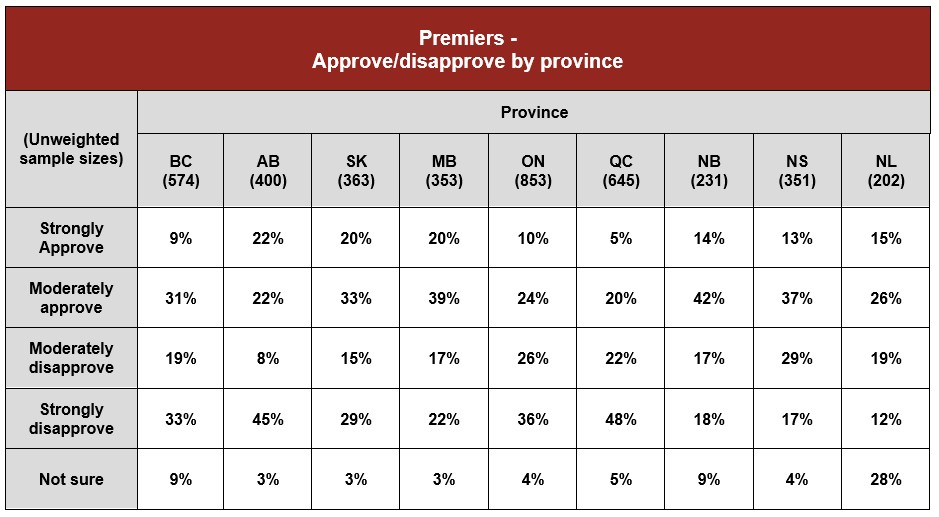
Summary table
METHODOLOGY
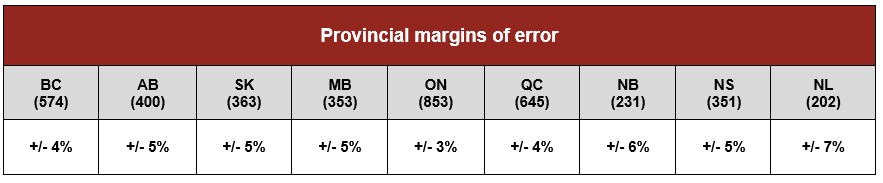
The Angus Reid Institute conducted an online survey from November 26 – December 1, 2025, among a randomized sample of 4,025 Canadian adults who are members of Angus Reid Forum. The sample was weighted to be representative of adults nationwide according to region, gender, age, household income, and education, based on the Canadian census. For comparison purposes only, a probability sample of this size would carry a margin of error of +/- 1.5 percentage points, 19 times out of 20. Discrepancies in or between totals are due to rounding. The survey was self-commissioned and paid for by ARI. Detailed tables are found at the end of this release.
For PDF of full release, click here.
MEDIA CONTACT:
Shachi Kurl, President: 604.908.1693 shachi.kurl@angusreid.org @shachikurl
Dave Korzinski, Research Director: 250.899.0821 dave.korzinski@angusreid.org
Jon Roe, Research Associate: 825.437.1147 jon.roe@angusreid.org