


Two-in-five satisfied with projects announced, one-in-three unsatisfied, many not yet sure
September 23, 2025 – Prime Minister Mark Carney’s big reveal of the first five major projects to be built in the “national interest” is drawing mixed reviews from Canadians.
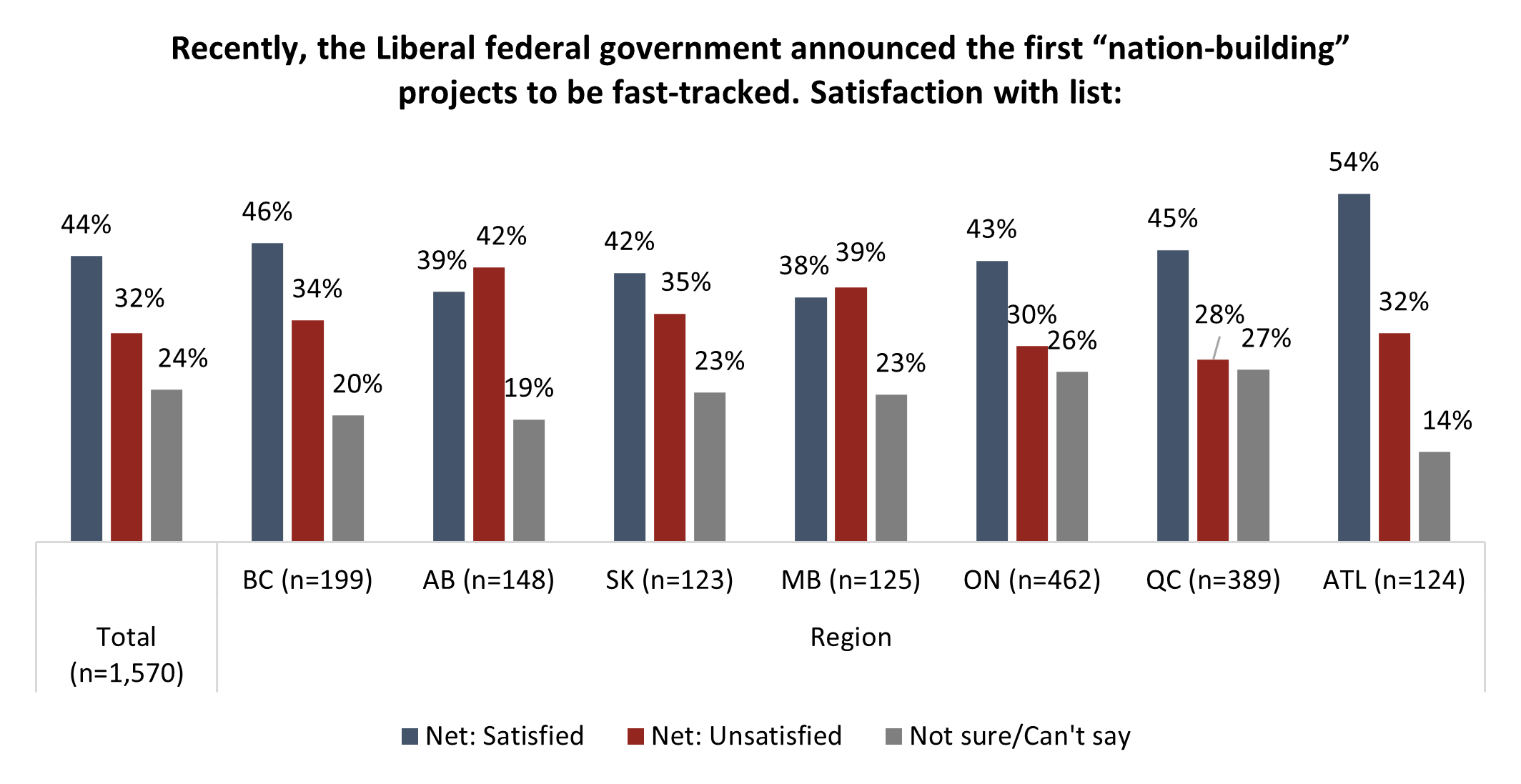
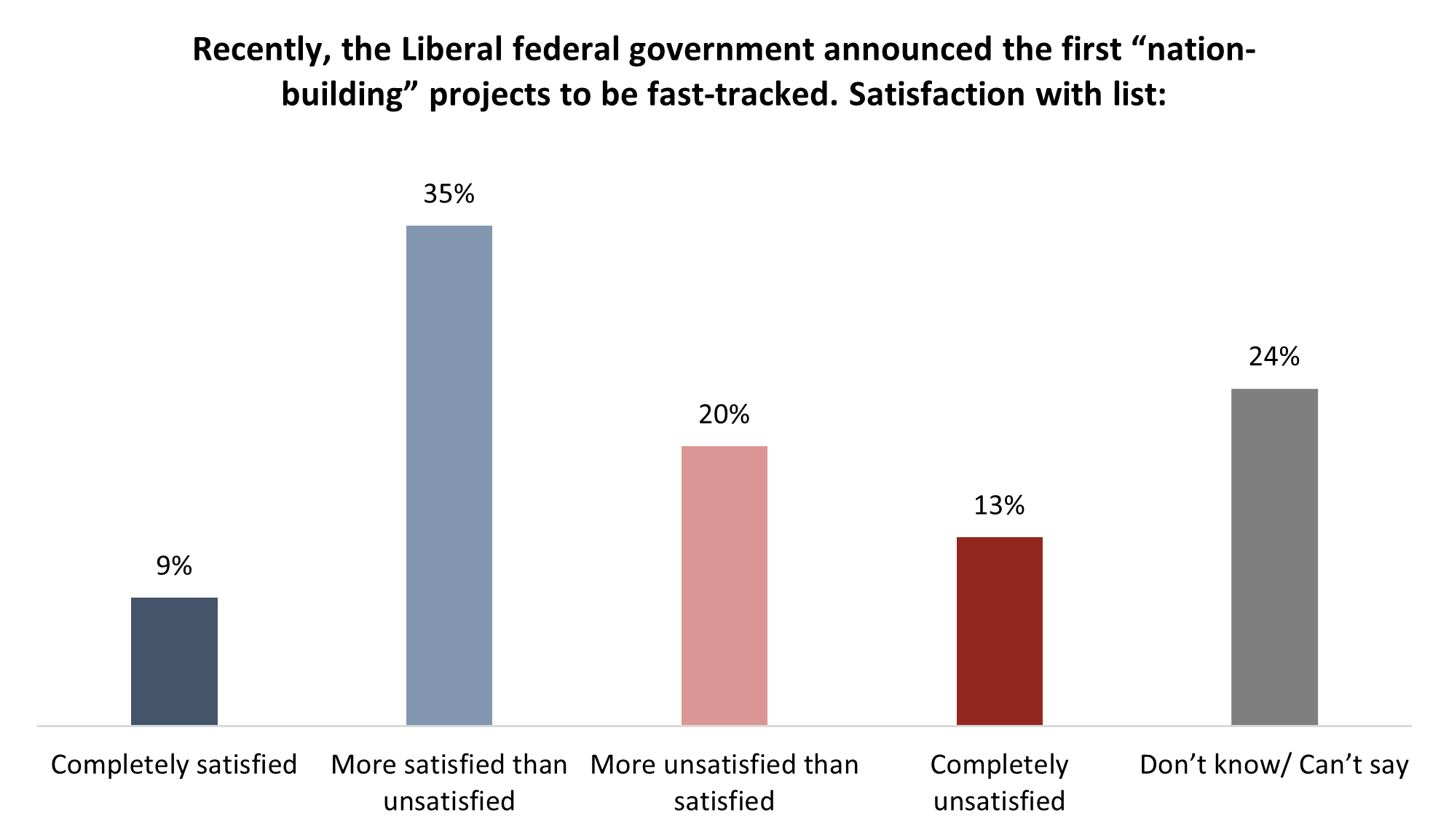
New data from the non-profit Angus Reid Institute finds Canadians responding to this initial list with a mix of positivity, disappointment and uncertainty. The good news for Carney and the Liberals is that the largest group say they are more satisfied than not with the project focus, which includes two in British Columbia and one each in Ontario, Quebec and Saskatchewan. More than two-in-five (44%) say they are satisfied, though just nine per cent say they are “completely” satisfied. Alternatively, one-in-three (32%) are dissatisfied, while one-quarter (24%) say they are not sure. Despite the focus on four provinces, satisfaction levels are relatively even across the country, ranging from 38 per cent in Manitoba to 46 per cent in B.C., with the exception of Atlantic Canadians, who are more positive overall (54%).
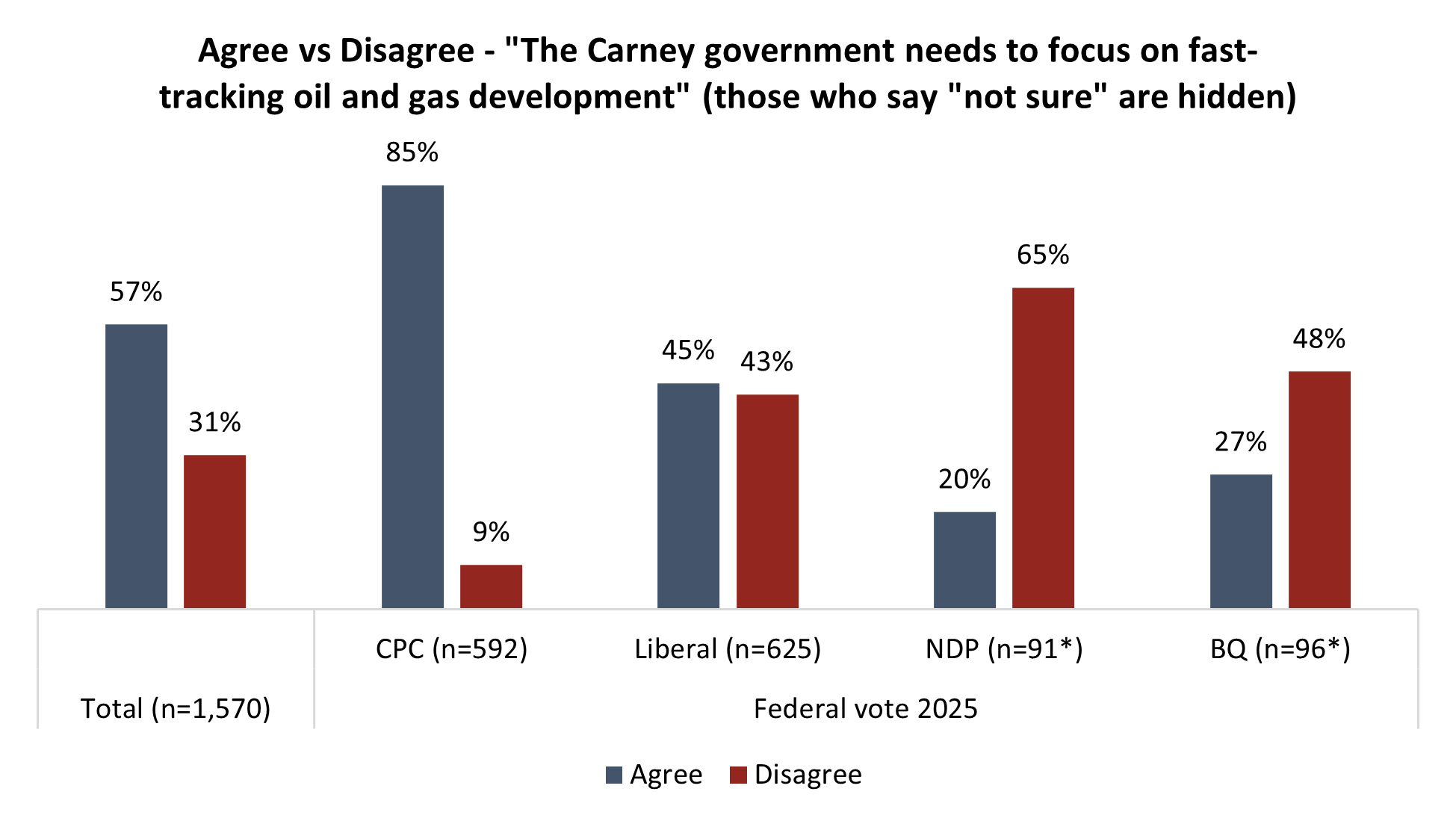
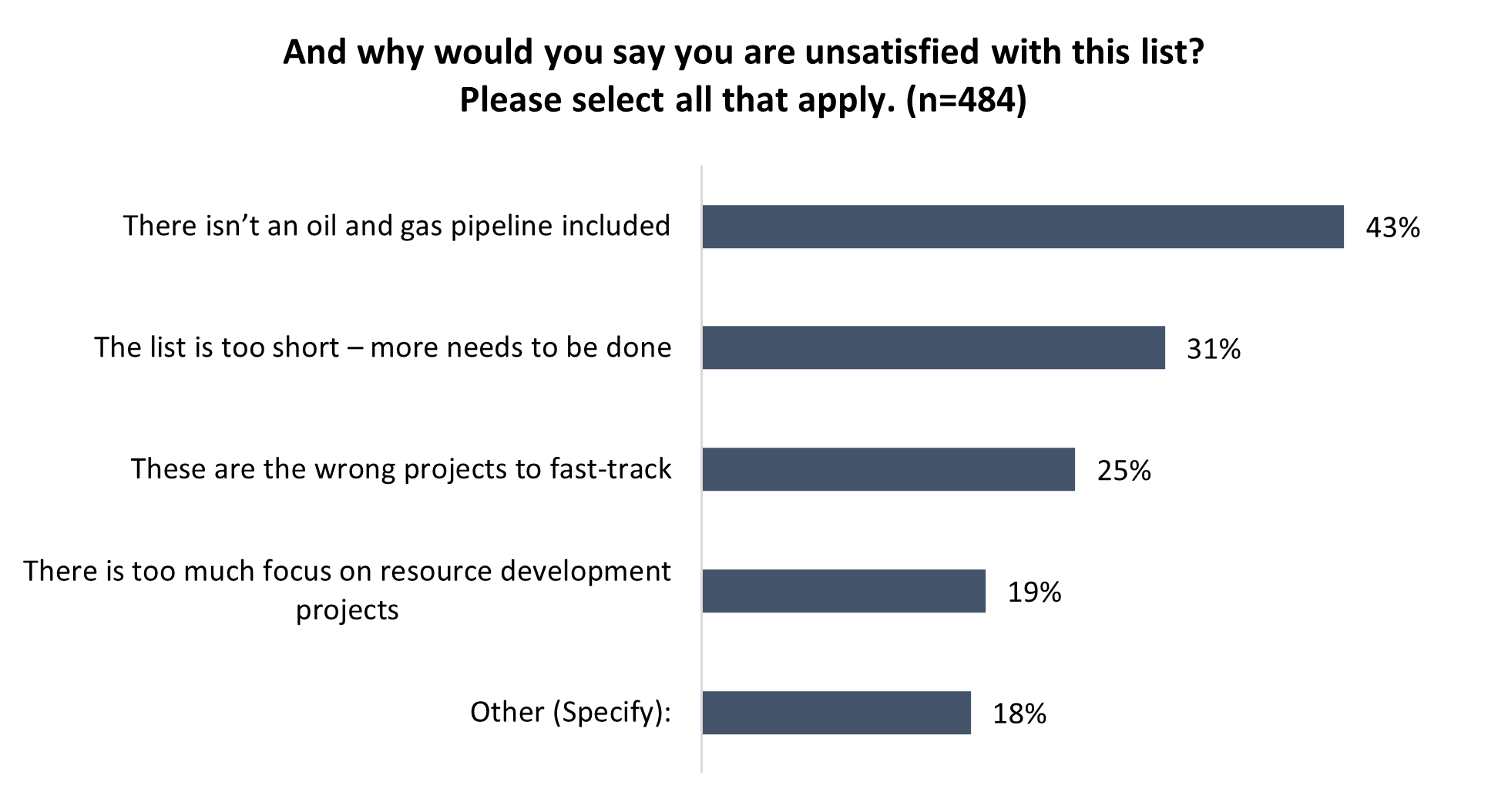
Among those who are dissatisfied, the top concern is the absence of an oil and gas pipeline (43%). Approaching three-in-five (57%) say the Carney government needs to focus on fast-tracking more oil and gas development. Conservatives lead the way on this view (85%) but are joined by 45 per cent of Carney’s 2025 Liberal voters.
On broader fronts, Canadians are forming a picture of the Carney government less than six months into the Liberals’ minority mandate. ARI asked residents to weigh in on early progress and finds both positive and negative assessments.
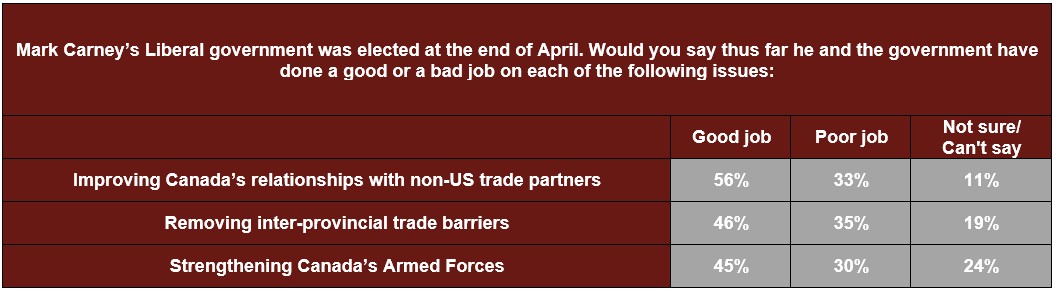
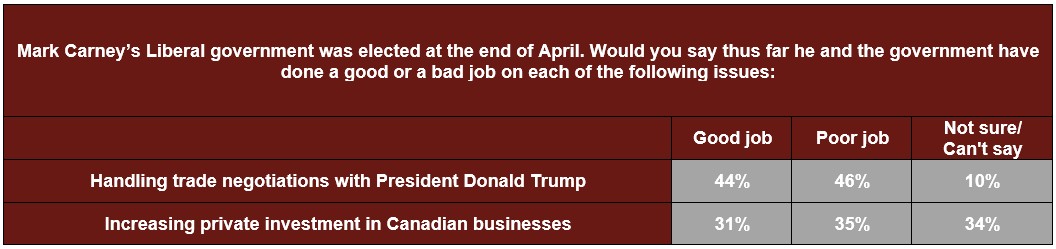
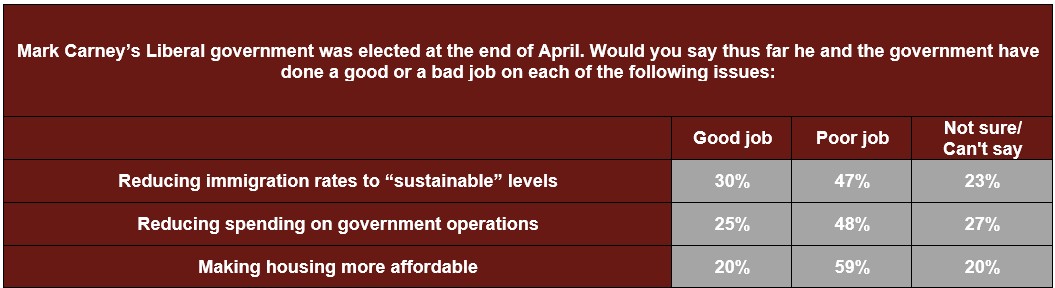
Canadians are significantly more positive than negative on three files – improving relationships with non-U.S. trade partners (56% good job, 33% poor job), removing interprovincial trade barriers (46%, 35%) and strengthening Canada’s Armed Forces (45%, 30%). They are divided nearly equally on two – handling trade negotiations with Donald Trump (44%, 46%) and increasing private investment (31%, 35%). They are more negative on three others – reducing immigration (30% good job, 47% poor job), reducing spending on government operations (25%, 48%) and improving housing affordability (20%, 59%).
More Key Findings:
- Three-in-10 CPC voters (28%) are satisfied with project list, while more than twice as many Liberals give it a thumbs up (66%)
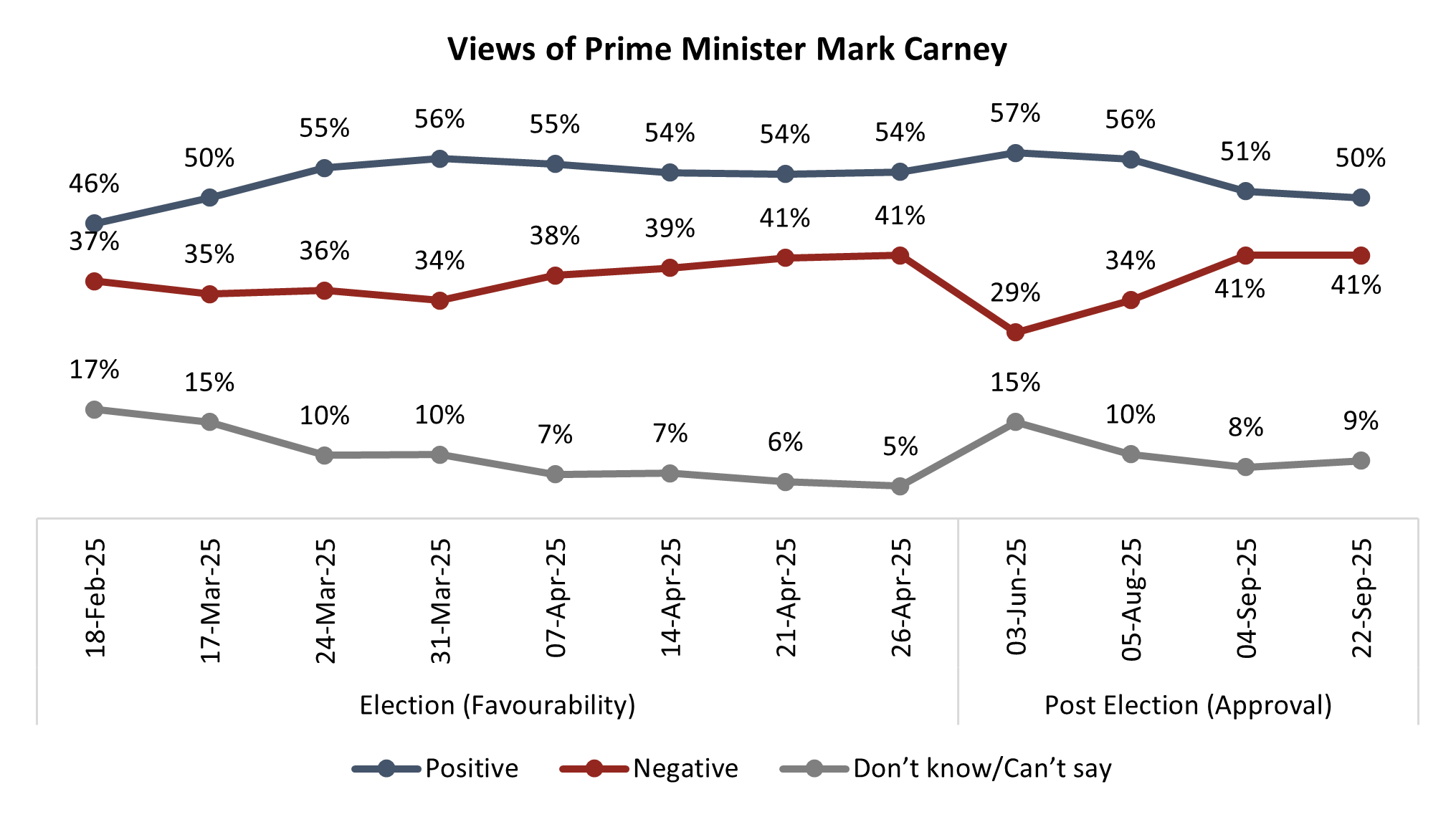
- Carney’s approval remains unchanged after announcement, as half of Canadians say they like what they’ve seen so far (50%)
- Asked whether these major projects needed to be fast-tracked, Canadians evenly divided. Equal numbers say yes (31%), no (35%), or are not sure (34%)
INDEX
Part One: Initial major projects announcement
-
Initial response is mixed
-
Those who are dissatisfied want more oil and gas development
-
Majority agree that oil and gas projects need the fast track
-
Did these projects need government support?
Part Two: Weighing in on early Carney government progress
-
The Good – Non-US relationships, interprovincial trade barriers, Canada’s Armed Forces
-
The Varied – Trump trade negotiations, private investment in Canada
-
The Bad – Immigration levels, reducing government spending, affordable housing
Part Three: Approval and vote
Part One: Initial major projects announcement
One of the major campaign pitches from then-Liberal candidate Mark Carney was to get Canada building again. Shortly after his party’s election victory, Carney shifted this rhetoric toward pushing major projects in the “national interest” – a key pillar of the One Canadian Economy Act, passed in June. Now, the government has announced the first five major projects. The projects set to be “fast-tracked” are:
- LNG Canada Phase 2 in B.C.
- Darlington New Nuclear Project in Ontario
- Contrecoeur Terminal Container Project at the Port of Montreal
- McIlvenna Bay Foran Copper Mine Project in Saskatchewan
- Red Chris Mine expansion in B.C.
Initial response is mixed
Angus Reid Institute asked Canadians for their initial response to this list, finding positivity mixed with negativity and uncertainty. The largest group say they’re more satisfied than not with the list, while one-in-three are unsatisfied:
One might notice that the initial list features projects only in B.C., Saskatchewan, Ontario, and Quebec. Despite this, there are no significantly higher or lower pockets of support or opposition in Canada, aside from elevated satisfaction in Atlantic Canada:
At least one-quarter of all party supporters say they’re satisfied with the list. While not an overwhelming show of support, this moderate level of non-partisanship would have been difficult to imagine in the later days of the Trudeau-era, as his approval dropped to two per cent in December of 2024 among CPC voters.
Within his own political base, two-thirds say they’re satisfied with the government’s initial focus on major projects:
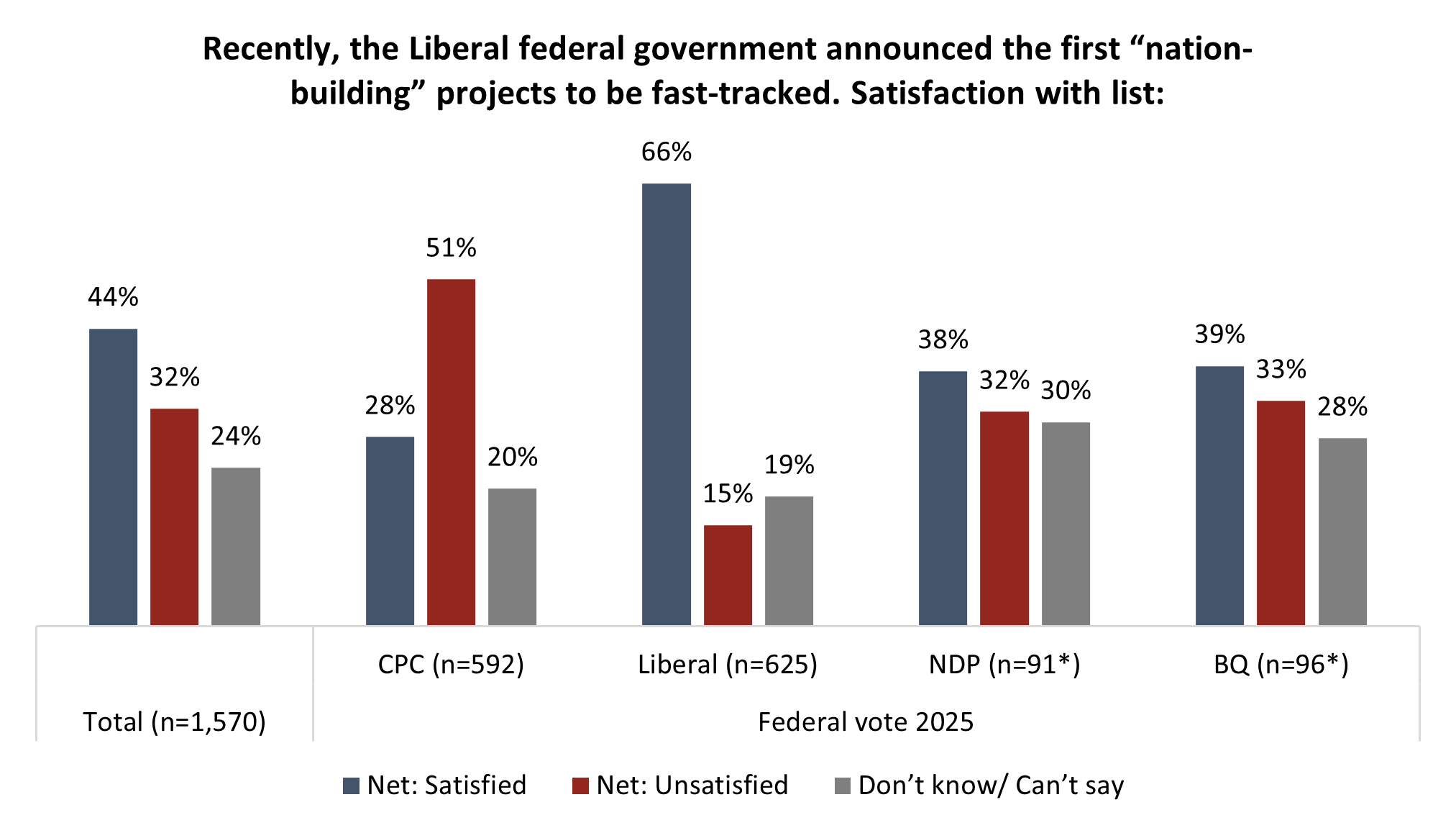 *Unweighted sample sizes of 100+ weighted down to representative size. Interpret small sample sizes with caution
Those who are dissatisfied want more oil and gas development
The dissatisfied were offered a chance to share their rationale in a follow up question about these projects. Among those who were less impressed, the largest criticism is the lack of inclusion of an oil and gas pipeline. Pipeline projects have been politically difficult and financially dubious in recent year. Alberta Premier Danielle Smith noted on the absence of such a project that there is still “work to do to be able to get an environment where oil companies want to expand their production”.
 Majority agree that oil and gas projects need the fast track
The sentiment expressed by these Canadians – that oil and gas development needs to be fast-tracked as well – is relatively popular across the country. In every region, more Canadians agree with this idea than disagree. That said, enthusiasm ranges from modest in Quebec to more intense in Alberta and Saskatchewan:
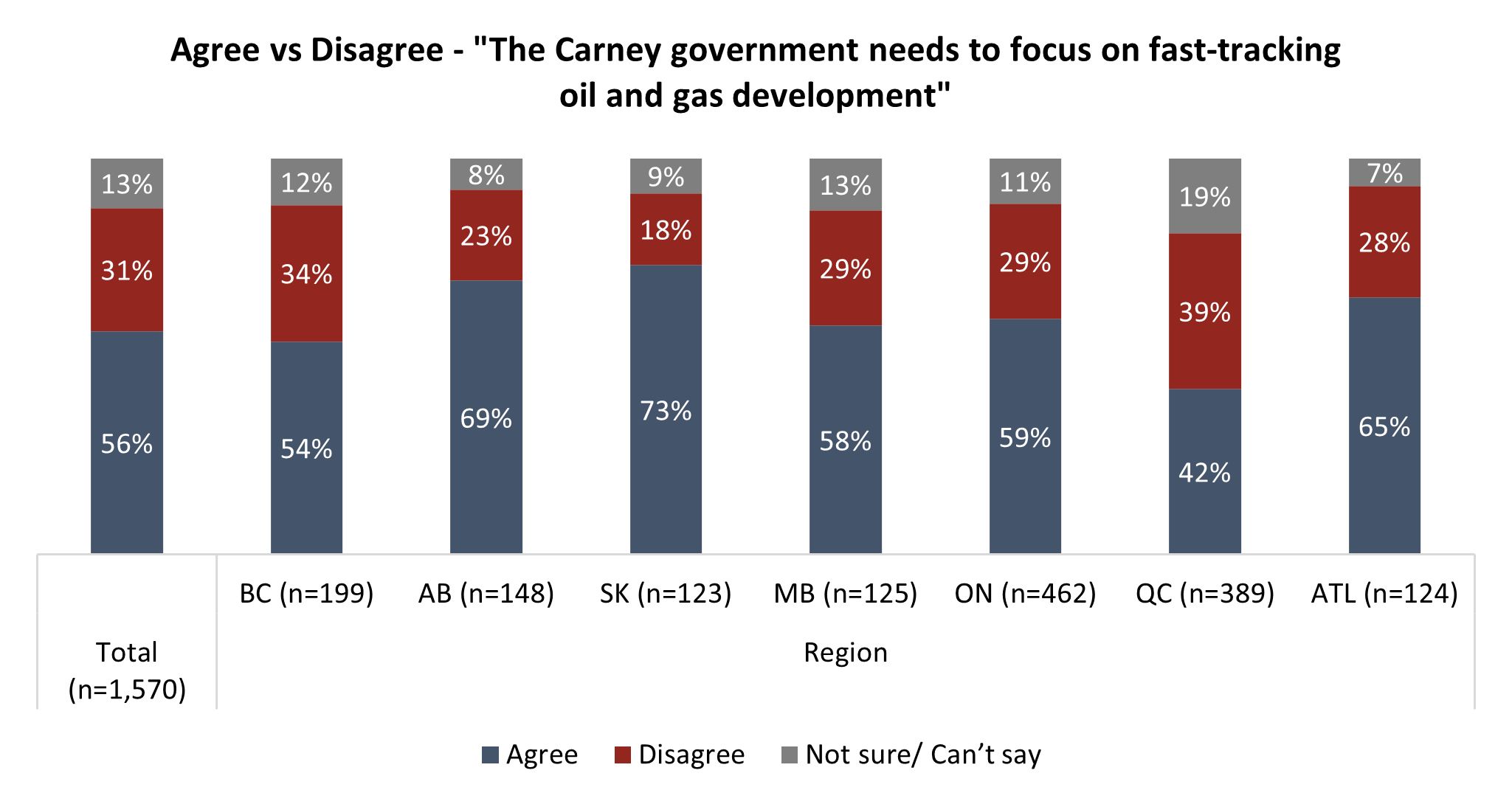 Unsurprisingly, Conservatives lead this push on this sentiment. That said, 2025 Liberal Party voters are divided, with 45 per cent adding their voice to the chorus:
Did these projects need government support?
Other critics of the slate of projects announced have suggested that the list is comprised of low hanging fruit, that is, projects that have already been approved or would be built regardless of government support. Asked about this line of reasoning, Canadians have no unified view. Close to equal numbers agree, disagree, and are not sure. In Alberta, Saskatchewan, and Manitoba, residents are more skeptical.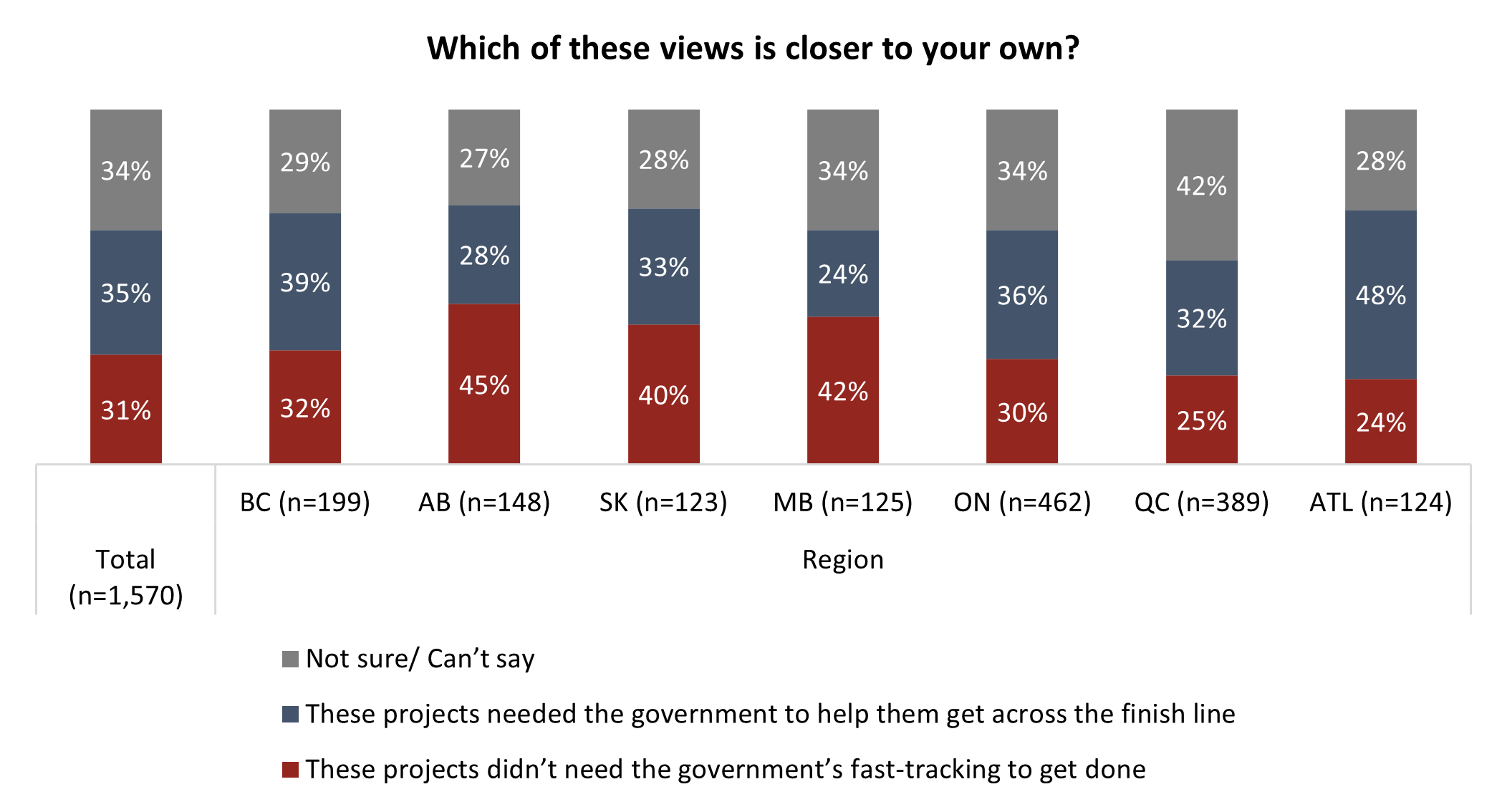
Part Two: Weighing in on early Carney government progress
While the federal election was held less than six months ago, early indicators show a mixed view of the Carney government’s actions so far. The agenda has spanned numerous files, but eight key measures help us to understand views of progress so far.
The Good – Non-US relationships, interprovincial trade barriers, Canada’s Armed Forces
The strongest levels of commendation for the Carney government are on three issues, each of which receives considerably more praise than criticism. These are improving non-U.S. trade relationships, removing provincial trade barriers, and strengthening Canada’s Armed Forces.
Carney and his government have been busy on the trade front. They government announced a new strategic partnership with the EU, formed the UK-Canada Economic and Trade Working Group in June, announced that negotiations with India would re-convene, and are resuming free-trade discussions with the South American trade bloc Mercosur. More than half of Canadians (56%) say the government is doing a good job on this file.
The One Canadian Economy Act (Bill C-5) introduced in June 2025, removed all 53 federal exceptions under the Canadian Free Trade Agreement and introduced the Free Trade and Labour Mobility in Canada Act and Building Canada Act to eliminate interprovincial trade barriers. Nearly half (46%) say Carney has done well so far on this.
The federal government also announced an investment of more than $9 billion in defence for the fiscal year, alongside pay raises for Armed Forces members. More than two-in-five (45%) say the government has done a good job here, while three-in-10 disagree.
The Varied – Trump trade negotiations, private investment in Canada
Trade negotiations with the U.S. and Donald Trump have proven excessively difficult. Canadians, who voiced majority confidence in the Carney government to deliver on this file, have seen that confidence shaken as deadlines have passed and tariffs on targeted Canadians sectors have persisted. The population is divided about how Carney has handled these negotiations so far, with an equal number saying he’s done a good or poor job.
On private investment, the first half of the year was relatively strong, with $5.2 billion in Canada-based aggregate capital raised through May 2025. This nearly amounted to the total raised in all of 2024 ($5.7 billion). That said, uncertainty has been the law of the land throughout much of this year. More recent data are yet to be published, but Canadians are divided about whether Carney has improved this climate, as seen in the table below.
The Bad – Immigration levels, reducing government spending, affordable housing
Three files generate more negativity than positivity. On immigration, nearly half say the government has done a poor job of reducing newcomers to a sustainable level. The government announced a reduced immigration target for 2025/26, hoping to bring in between 367,000 and 436,000 residents.
The federal budget will be presented in November, and government spending will be a key item for many Canadians. Currently, residents are twice as likely to say Carney and the Liberals are doing a poor job rather than a good job on reducing operational spending. Increasing cuts to operational spending have been announced for the next three years but time will tell whether these come to fruition.
A new federal agency – Build Canada Homes – was announced just last week “to build and finance affordable housing”. This includes billions in new funding for projects across the country. Just one-in-five Canadians (20%) say the government is doing a good job so far, as housing woes continue for many:
Part Three: Approval and vote
As Prime Minister Carney approaches the six-month mark in his term, his approval stands at 50 per cent. Notable here is the lack of movement from before and after the major projects announcement.
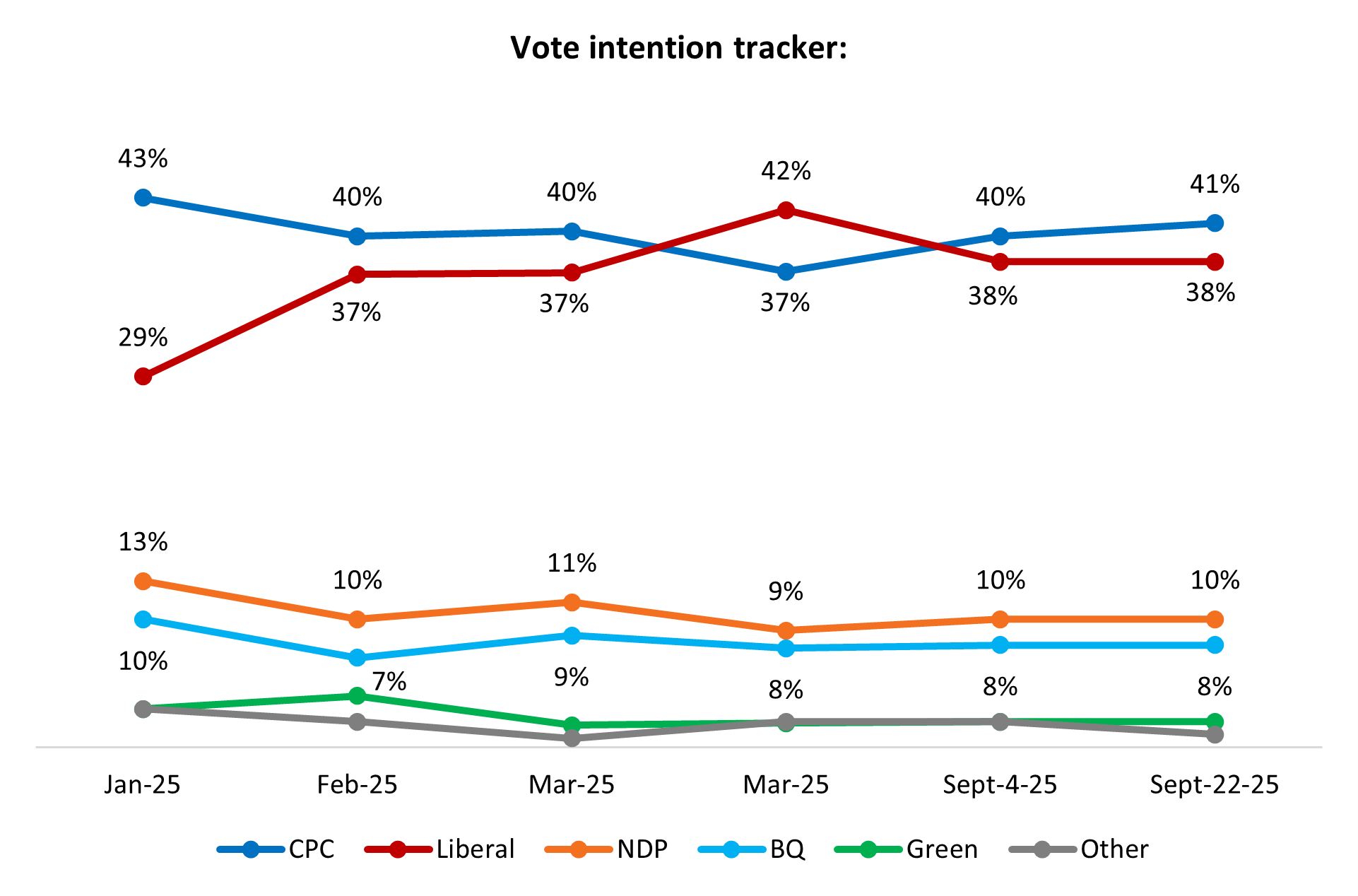
 There has also been no significant movement on vote intention. For detailed results, view tables at the end of this release.
METHODOLOGY
The Angus Reid Institute conducted an online survey from September 19 – 22, 2025, among a randomized sample of 1,570 Canadian adults who are members of Angus Reid Forum. The sample was weighted to be representative of adults nationwide according to region, gender, age, household income, and education, based on the Canadian census. For comparison purposes only, a probability sample of this size would carry a margin of error of +/- 2 percentage points, 19 times out of 20. Discrepancies in or between totals are due to rounding. The survey was self-commissioned and paid for by ARI. Detailed tables are found at the end of this release.
For detailed results by age, gender, region, education, and other demographics, click here.
For PDF of full release, click here.
For questionnaire, click here.
MEDIA CONTACTS:
Shachi Kurl, President: 604.908.1693 shachi.kurl@angusreid.org @shachikurl
Dave Korzinski, Research Director: 250.899.0821 dave.korzinski@angusreid.org