



Overall, one-third support the capital gains inclusion rate increase, while half oppose it. Among 18-to-34-year-old’s, three-in-ten (29%) say they don’t know if they support or oppose the policy, while the rest are divided between support (34%) and opposition (38%). Uncertainty and division is evident among the 35 to 44 age group as well, but majority opposition exists among all older cohorts:

Lower-income earners, who the government says will be helped most by this tax policy change, are most uncertain about whether or note they support it.

At least 13 per cent of all income groups say they’ll pay more because of the change to the inclusion rate. The proportion saying this rises as income rises.

Political perspectives are key on this issue. Across all income brackets, would-be CPC voters are more likely to say they’ll pay more because of capital gains changes. In the case of higher income households, CPC voters are twice as likely as Liberal voters to say this.

Amid all this, the Conservative Party advantage continues to grow. Currently 42 per cent of leaning and decided voters would support the CPC, double the number who would vote Liberal or NDP:

The Full Story
INDEX
Part One: Capital Gains Confusion
Half of younger Canadians unaware of changes
One-in-five say they expect to pay more
Opposition to the capital gains inclusion increase outpaces support
Part Two: Leadership
Prime Minister Trudeau
Pierre Poilievre
Jagmeet Singh
Best Prime Minister
Part Three: CPC doubles Liberals in vote intent
Liberal and NDP bases smaller, more uncommitted than CPC
Regional picture
Age and gender
Part One: Capital Gains Confusion
Prime Minister Justin Trudeau and his Liberal government have spent the first half of this year promoting the concept of “generational fairness” through the 2024 budget. One of the trademark pieces of this legislative package is an evidently controversial change to the capital gains inclusion rate from 50 to 67 per cent on gains of over $250,000. Part of the apparent challenge for the Liberals with this policy has been communicating it. The obvious first hurdle is that tax policy is hardly compelling to large swaths of the population. Further, simplifying a complex issue, with heated debate on both sides, is a challenge in itself.
Half of younger Canadians unaware of changes
Currently, approximately two-in-five Canadians have heard little to nothing about the issue, while one-quarter (27%) claim they are following it closely. Young people, the target of this generational fairness campaign, are the most tuned out.”

One-in-five say they expect to pay more
Given the low salience of this issue, Angus Reid Institute provided Canadians with basic information about the inclusion rate increase. The language included in the questionnaire is shown below:
“A capital gain is the difference between the cost of an asset — an investment property, a stock or a mutual fund — and its total sale price. The change would mean tax must be paid on two-thirds of this sale now instead of half on capital gains of more than $250,000.
Will this change in how capital gains are treated affect your personal after-tax income over the next five years?”
With this context in place, one-in-10 Canadians say they will pay “a lot” more (11%), and one-in-10 say they will pay “a little” more (12%). Many are uncertain (24%) and half say they will have no change to their personal after-tax income. Whether from confusion on their part or inaccurate assessment from the government, this far outpaces the Liberal estimation of impact:

Importantly, this issue is complex, and capital gain calculations depend on myriad factors. That said, there are no income groups in this survey where fewer than 13 per cent of individuals feel they will pay more after the change takes place. Perceived impact rises with household income, as shown in the graph below:
Information and income tell part of the story, but politics also play a significant role. Across all income levels, those who say they will support the Conservative Party in the next federal election are more likely to say they’ll be affected by this change. Conservatives in the highest income bracket are twice as likely as Liberals to say they’ll pay “a lot more”. Notably, however, Liberals in the lower income bracket are just as likely as Conservatives to hold this view:
Opposition to the capital gains inclusion increase outpaces support
In terms of selling this policy, there is a clear gap in communication from the Liberals to those who the government says will gain most from this change. Among 18-to-34-year-old’s, three-in-ten (29%) say they don’t know if they support or oppose the policy, while the rest are divided between support (34%) and opposition (38%). Uncertainty and division is evident among the 35 to 44 age group as well, but majority opposition exists among all older cohorts:
If this capital gains inclusion change is, indeed, to generate billions for fairness, geared toward those with the lowest income levels, it is not an encouraging sign for the government that the most uncertainty about the policy exists among those with the lowest household incomes:
Support is highest among those who say they would back the Liberals again in the next election but does not exceed three-in-five (58%). Among those who would vote for the opposition Conservatives, more than four-in-five (84%) oppose the capital gains adjustment:

Part Two: Leadership
In addition to selling the capital gains changes this month, Prime Minister Trudeau spent time at the G7 summit discussing a host of issues including meeting with Indian Prime Minister Narendra Modi for the first time since publicly accusing the Indian government of complicity in the death of Canadian Hardeep Singh Nijjar last year.
Related story:
India, alongside China, has also been the subject of alleged foreign interference in Canadian elections. A report released this month by the National Security and Intelligence Committee of Parliamentarians (NSICOP) suggested the members of parliament had wittingly or semi-wittingly participated in this interference.
Prime Minister Trudeau
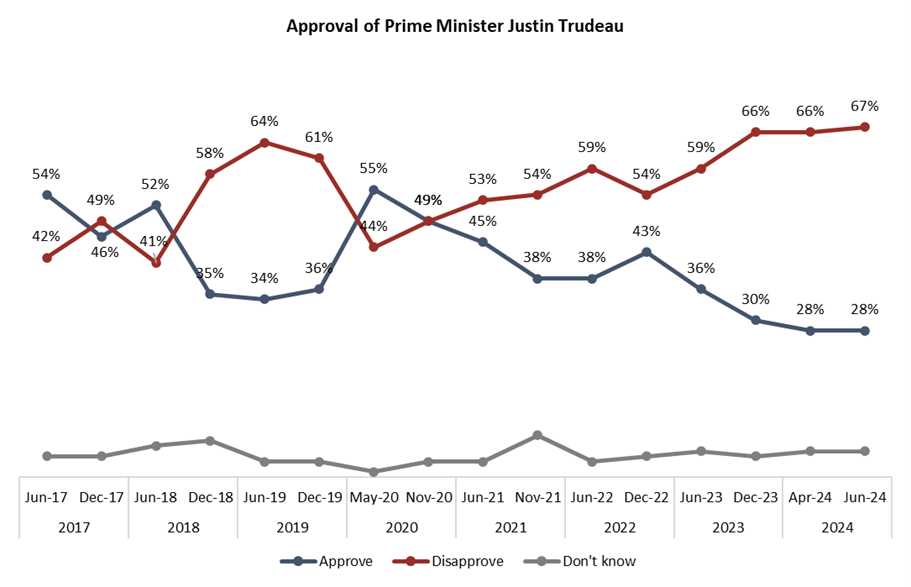
While all parties and leaders search for answers and clarification about what this portends and how to overcome it, Trudeau’s approval level remains at its lowest level since taking office in 2015 (view Trudeau Tracker here). Three-in-10 (28%) Canadians say they approve of him, while two-thirds disapprove (67%):
Pierre Poilievre
Across the aisle, opposition leader Pierre Poilievre, too, sees his personal favourability unchanged. Two-in-five (39%) view him favourably, while half (51%) do not. The Conservative Party leader has been criticized for an unwillingness to read the NSICOP report, something NDP leader Jagmeet Singh stated “disqualifies” him from leading the country as a prospective prime minister:

Jagmeet Singh
Singh, himself, fares no better in favourability. In fact, a near identical number of Canadians say they view he and Poilievre favourably or unfavourably. Indeed, Canada’s federal party leaders have never been less popular.

Best Prime Minister
Canadians have been consistent over the last nine months, placing Pierre Poilievre in top spot as “best Prime Minister”. That said, just one-in-three (33%) hold this view. Nearly the same number say that none of the leaders are a good option right now (29%) and 14 per cent choose either Justin Trudeau or Jagmeet Singh:

Part Three: CPC doubles Liberals in vote intent
Amid tax policy changes, this months G7 visit, and the hullabaloo over foreign interference, the Conservative Party’s vote intention advantage has increased slightly. The opposition now doubles the Liberals (42% to 21%) among leaning and decided voters, with the NDP competing for second place, tied with the incumbents:
Liberal and NDP bases smaller, more uncommitted than CPC
The Conservative Party not only holds the largest share of the vote, but it also holds the most committed vote. Two-thirds (65%) of CPC voters say they are very committed to the party. With more than a year until an expected election, significant portions of the electorate remain fluid:

Regional picture
The Conservative Party of Canada is now the top choice in every region of the country outside of Quebec and holds at least a six-point advantage in each. In Quebec, the Bloc Quebecois has capitalized on the Liberal lull, increasing its’ support to 41 per cent in the province:

Note: Because its small population precludes drawing discrete samples over multiple waves, data on Prince Edward Island is not released.
Age and gender
The Liberal’s last remaining demographic advantage, found in women over the age of 54, has now dissipated. Consider that last year, this group still offered the incumbents an eight-point lead, the only age and gender combination within which the Liberals still led. Now, the Conservative Party are the beneficiaries of a three-point lead over the Liberals:

METHODOLOGY
The Angus Reid Institute conducted an online survey from May 24-28, 2024 among a representative randomized sample of 1,603 Canadian adults who are members of Angus Reid Forum. For comparison purposes only, a probability sample of this size would carry a margin of error of +/- 2 percentage points, 19 times out of 20. Discrepancies in or between totals are due to rounding. The survey was self-commissioned and paid for by ARI. Detailed tables are found at the end of this release.
For detailed results by age, gender, region, education, and other demographics, click here.
For full release including methodology, click here.
For questionnaire, click here.
Shachi Kurl, President: 604.908.1693 shachi.kurl@angusreid.org @shachikurl
Dave Korzinski, Research Director: 250.899.0821 dave.korzinski@angusreid.org