

Majority criticism of government performance on top issues, but two-in-five believe Manitoba on right track
Sept. 12, 2025 – NDP Premier Wab Kinew personal popularity is perhaps carrying a more positive outlook for residents in Manitoba, despite significant criticism of the NDP government’s performance on top issues.
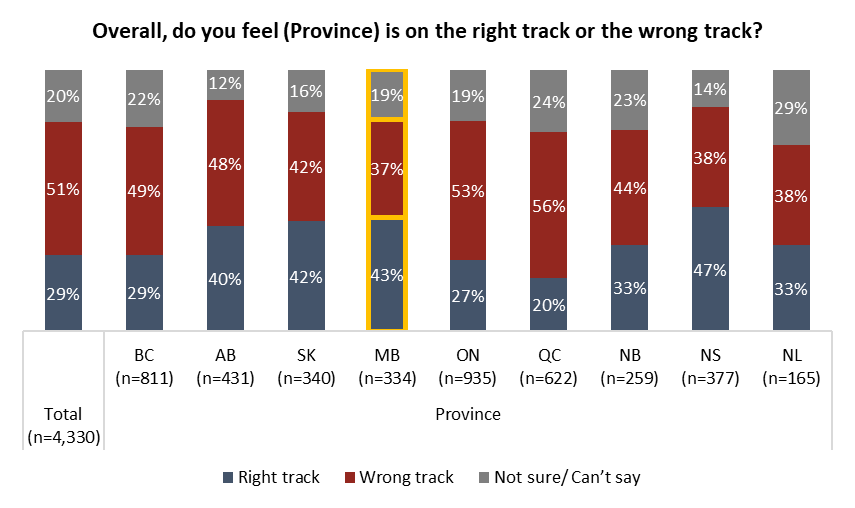
While overall Manitobans are split as to whether their province is heading in the right direction (43%) or the wrong one (37%), Manitoba is performing better on this metric than other provinces in the country.
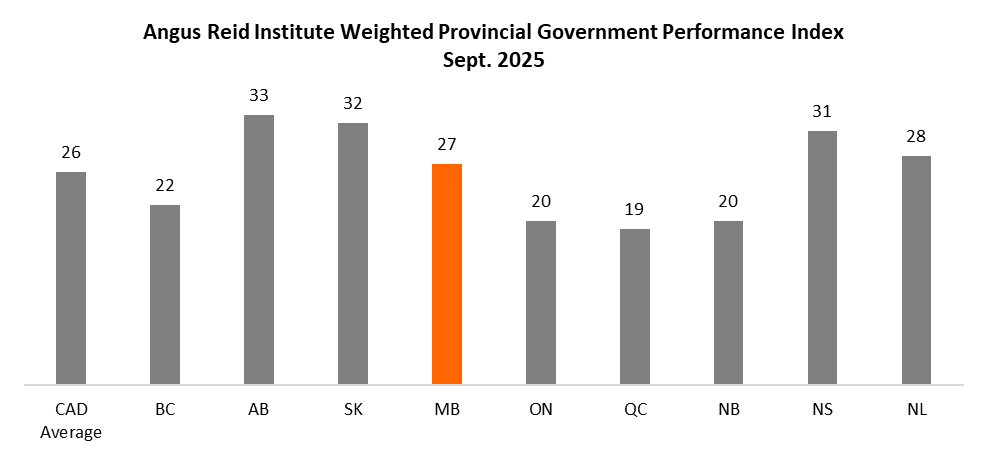
But when it comes to assessments of the government’s handling of key files, Kinew’s government faces a similar level of criticism as other provincial governments from their constituents. Manitoba government receives an average rating by the Angus Reid Institute’s Weighted Government Performance Index, which includes positive assessments of government performance on more than a dozen issues and weights according to how important residents believe those issues are.
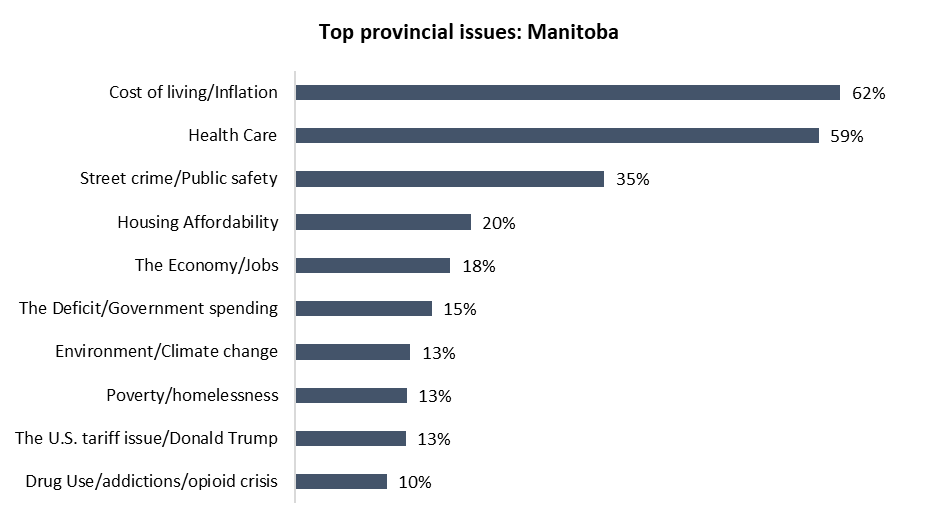
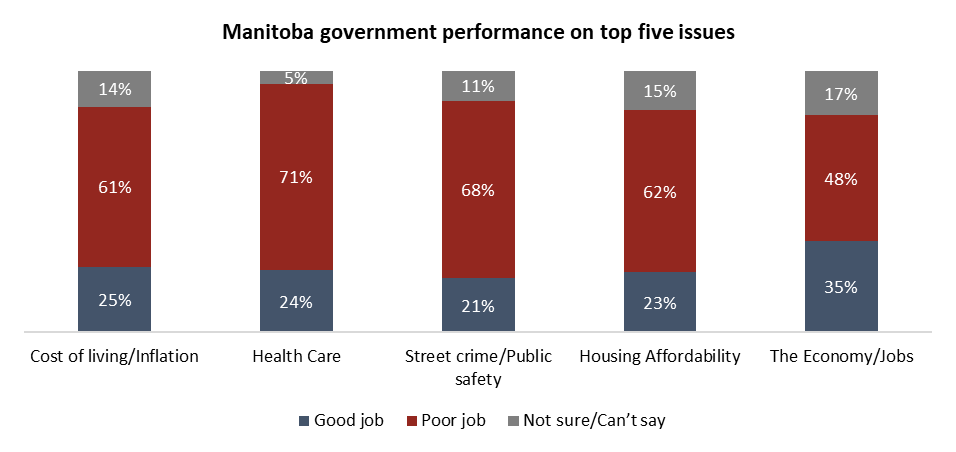
The top four issues the province is facing, according to residents, are the cost of living (62%), health care (59%), public safety (35%) and housing affordability (20%). On all four, at least three-in-five Manitobans believe the government is doing a poor job.
Still, Kinew is the most approved-of premier in the country (61% approval).
INDEX
-
Views of the premier and opposition leader
-
Government Performance Index
-
Government performance trend
-
Top issues
-
Performance on top issues
-
Right track or wrong track?
-
Vote intention update
Views of the premier and opposition leader
The New Democratic Party of Manitoba are halfway through their majority term in government and Premier Wab Kinew is still the most approved-of premier in the country. Since he was elected in 2023, the lowest approval he’s seen is 57 per cent, in the first quarter of his term, and otherwise has had approval above 60 per cent.
Related: Premiers’ Performance: The journey from first to worst for Legault; Eby’s decline continues
That October 2023 election saw the defeat of Premier and PC leader Heather Stefanson, who at the time was the least popular premier in the country. After the election loss, Stefanson stepped aside and the PC leadership was eventually won by Obby Khan, a Manitoba businessman and former CFL lineman, who is the first Muslim elected to Manitoba’s legislative assembly.
The political rivalry between Khan and Kinew has become personal at times, with “outright hostility” between the two in at least one committee meeting. Notably, this is not the first time insults have been exchanged between a PC leader and Kinew in such a setting. Khan called Kinew a “bully” in May, a descriptor that has been used by others. However, Khan and the PCs have made little headway in denting Kinew’s high popularity in the province, as Kinew enjoys 61 per cent approval.
Khan also has made little progress in closing the favourability gap between PC leadership and the popular NDP leader, faring no better than his predecessor Stefanson on this front. One-quarter (24%) of Manitobans say they have a positive view of Khan, while more than two-in-five (46%) do not. However, the 30 per cent who say they don’t know enough to say suggests that there are many minds left to be made up with two years left until the scheduled election date:

Government Performance Index
Kinew’s personal popularity has not lifted perceptions of the performance of the Manitoba provincial government. The Angus Reid Institute’s Weighted Provincial Government Performance Index incorporates both assessments of government performance and how highly the issue is ranked by provincial residents. For a list of all issues, see detailed tables. The Index finds Manitoba’s government to be about average when compared to provincial governments across the country:
Government performance trend
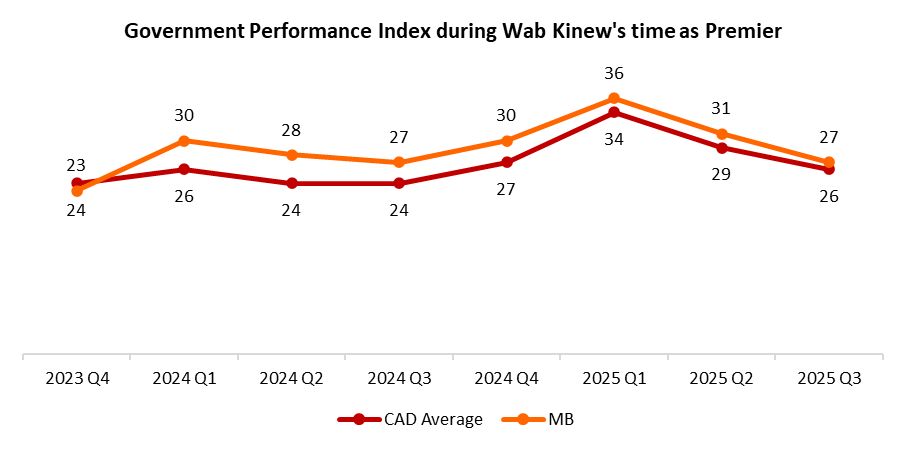
Earlier in Kinew’s term, there was more separation between the Manitoba government’s performance and its peers across the country. The gap between the average and Manitoba’s performance on the index has closed from +4 at the beginning of 2024 to +1 now.
Top issues
As with all other provinces in the country, the top two issues facing the province chosen by Manitobans are the rising cost of living (62% select it as a top issue) and health care (59%). Compared to other provinces, Manitobans express more concern over public safety (35%, highest in the country) and less about education (6%, lowest in the country):
At least three-in-ten of all age groups say they are concerned with public safety, but it is Manitobans older than 54 that are most likely to select it as a top issue (42%). The government’s deficit is a higher priority for those older than 34, while younger Manitobans are the most concerned about climate change (27%). The latter may be something to keep track of, as Kinew has faced criticism for focusing more on development and less on climate change since taking office.

*Smaller sample size, interpret with caution
Performance on top issues
Across Manitoban’s top issues, there is much more criticism than praise for the Manitoba government. At least three-in-five believe the government is performing poorly on the high cost of living (61%), health care (71%), public safety (68%), and housing affordability (62%).
As the above Government Performance Index shows, the provincial government is not seen as performing better on these top issues when compared to other province’s residents’ assessments of their own provincial government. The economy is perhaps one relative bright spot, with half (48%) saying they believe Manitoba is doing a poor job on this file, one of the lower marks in the country (Saskatchewan, 44%; Newfoundland and Labrador, 43%). But there is also a high amount of uncertainty, 17 per cent say they don’t know enough to say, higher than all but New Brunswick (20%) and Newfoundland and Labrador (20%):
Right track or wrong track?
Overall, Manitobans are divided as to the direction of the province. Still, the province performs better on this metric than others. Despite the criticism of government performance, and perhaps owing to Kinew’s own personal popularity, Manitobans are more likely to believe their province is on the right track (43%) than those elsewhere in the country, excluding Nova Scotia (47%). Manitobans are also the least likely (37%) to believe the province is on the wrong track.
Vote intention update
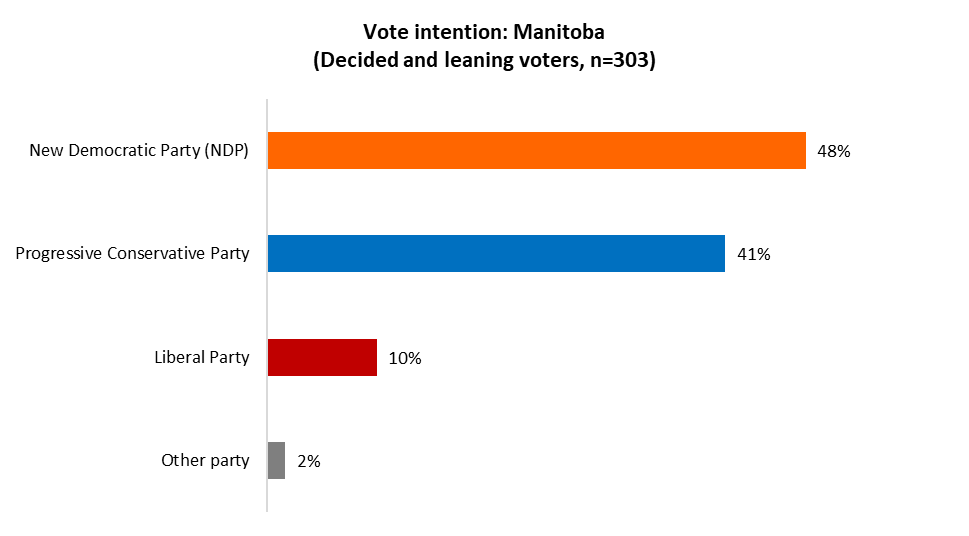
The vote intention picture has changed little from the 2023 election, which saw the NDP secure 45.6 per cent of the popular vote, and the PCs earn 41.9 per cent. Half (48%) say they would vote NDP if the election were today, while two-in-five (41%) would support Khan’s Progressive Conservatives:
Survey Methodology:
The Angus Reid Institute conducted an online survey from Aug. 28 to Sept. 5, 2025, among a randomized sample of 4,330 Canadian adults who are members of Angus Reid Forum. The sample was weighted to be representative of adults nationwide according to region, gender, age, household income, and education, based on the Canadian census. Discrepancies in or between totals are due to rounding. The survey was self-commissioned and paid for by ARI.

For more information on our polling methods, click here.
For detailed results by age, gender, region, education, and other demographics, click here.
For PDF of full release, click here.
For the questionnaire, click here.
MEDIA CONTACT:
Shachi Kurl, President: 604.908.1693 shachi.kurl@angusreid.org @shachikurl
Dave Korzinski, Research Director: 250.899.0821 dave.korzinski@angusreid.org
Jon Roe, Research Associate: 825.437.1147 jon.roe@angusreid.org