

Number saying they’re worse off financially compared to last year is second highest in the country
April 8, 2026 – Saskatchewan residents are navigating a complex moment: one where political stability and relative optimism about the province’s direction coexist with persistent financial strain.
New data from the non-profit Angus Reid Institute finds that while Premier Scott Moe maintains majority approval and the governing Saskatchewan Party continues to outperform other provincial governments on a range of issues, many residents say their personal economic situation has worsened over the past year, underscoring a disconnect between macro-level governance and day-to-day affordability pressures.
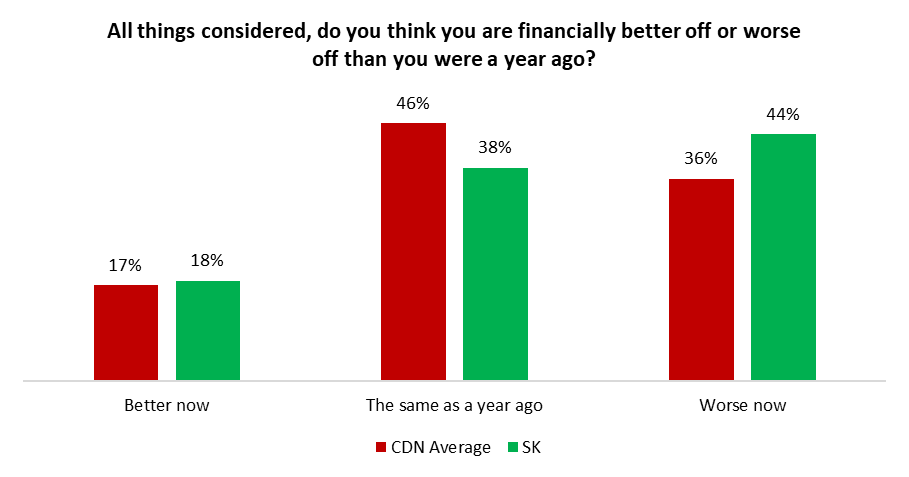
More than two-in-five (44%) Saskatchewan residents say they are worse off financially than they were a year ago – a proportion notably higher than the national average. Looking ahead, optimism is muted, with the largest group expecting their situation to remain unchanged, and more than one-third anticipating further decline. These sentiments come as cost of living and health care dominate the public agenda, each selected by more than three-in-five as top concerns, far outpacing all other issues.
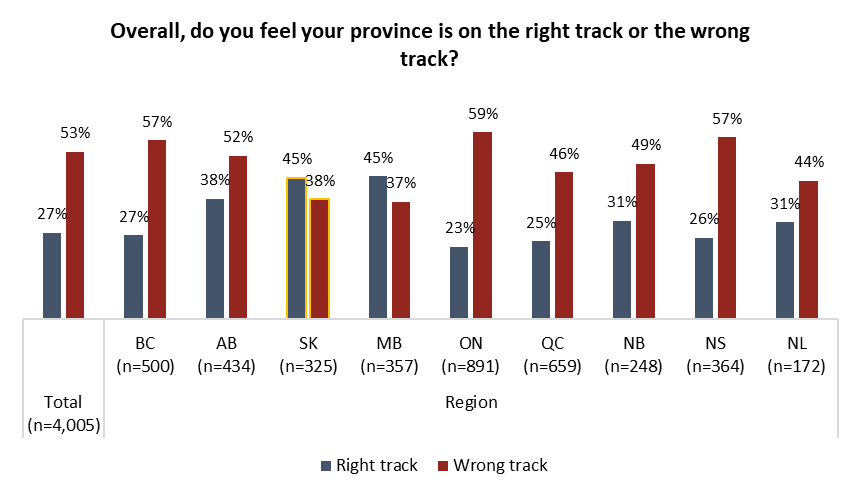
Despite these challenges, Saskatchewan stands out nationally for its relative confidence in direction. Nearly half (45%) say the province is on the right track, among the highest levels of optimism in the country. This outlook is buoyed by comparatively stronger assessments of government performance across key files, though ratings remain modest on the issues residents care about most.
About ARI
The Angus Reid Institute (ARI) was founded in October 2014 by pollster and sociologist, Dr. Angus Reid. ARI is a national, not-for-profit, non-partisan public opinion research foundation established to advance education by commissioning, conducting and disseminating to the public accessible and impartial statistical data, research and policy analysis on economics, political science, philanthropy, public administration, domestic and international affairs and other socio-economic issues of importance to Canada and its world.
INDEX
-
Views of the premier and opposition leader
-
Government Performance Index
-
Government performance trend
-
Top issues
-
Performance on top issues
-
Economic Outlook
-
Right track or wrong track?
Views of the premier and opposition leader
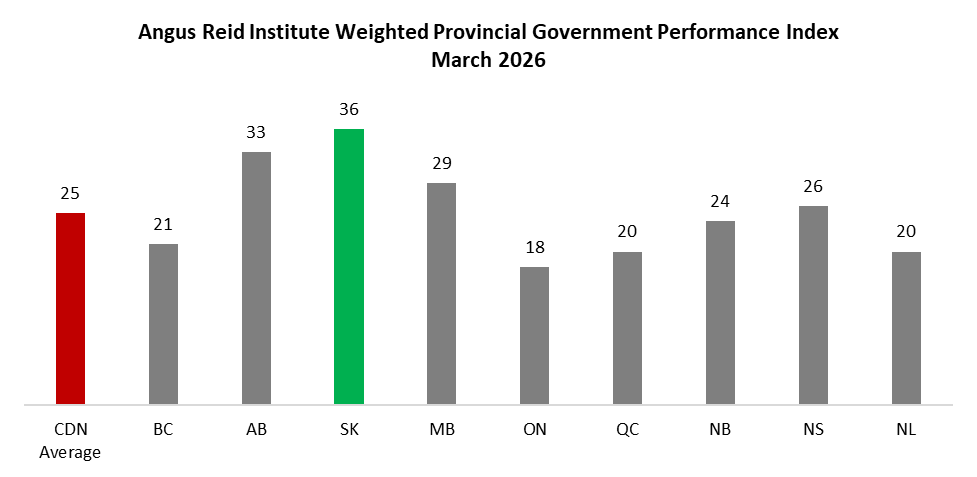
Premier Scott Moe, who recently passed the eight-year mark in his tenure leading Saskatchewan, maintains his place among the more popular provincial leaders, with the approval of half (51%) placing him behind Manitoba’s Wab Kinew and New Brunswick’s Susan Holt on the Premier Rankings. Opposition and New Democratic Party of Saskatchewan leader Carla Beck, who has served in the position since 2022, has a favourability rating of one-third (33%) and is viewed unfavourably by 57 per cent.
The NDP gained 13 seats under Beck in 2024 compared to the result four years prior, with the Saskatchewan Party repeating its majority government, though with a lesser presence at the legislative assembly in Regina than it held previously:
Government Performance Index
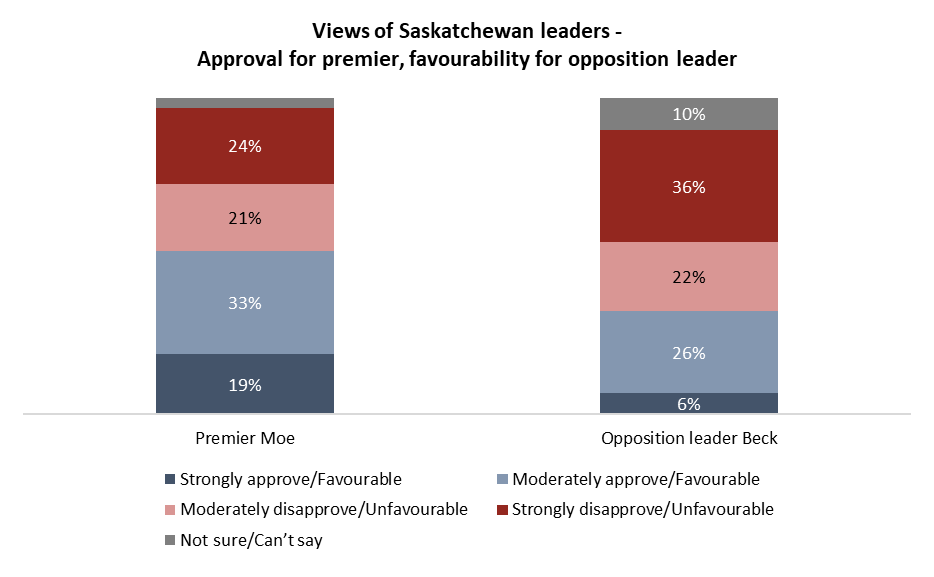
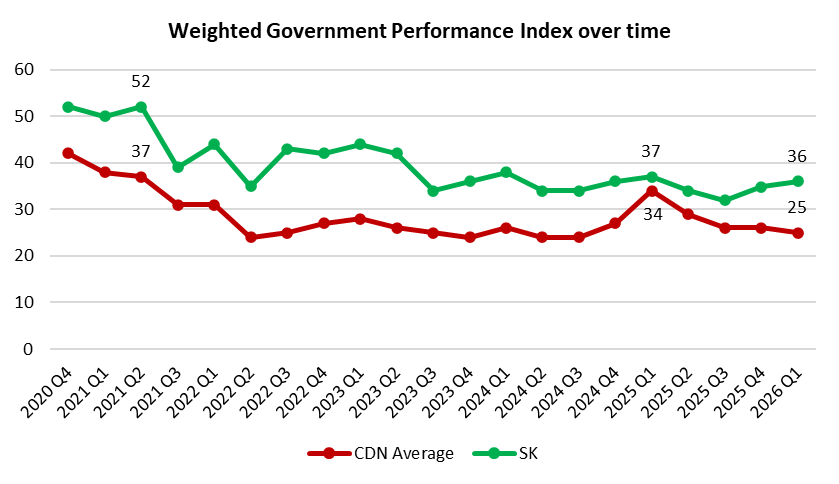
The news is good and bad for the Saskatchewan Party when it comes to appraisals from constituents. The government receives the highest marks of those canvassed this quarter on the Weighted Provincial Government Performance Index, which scores performance across 16 different provincial issues. The bad news is that no provincial government is performing overwhelmingly positively:
Government performance trend
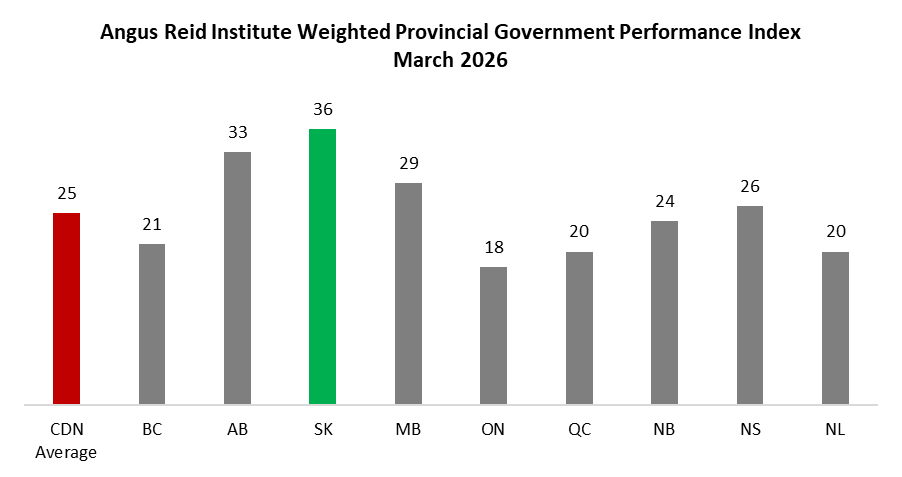
The ongoing economic challenges, which many have attributed to repeated international shocks under U.S. President Donald Trump, have made it difficult for many governments to increase their own positive perceptions. Saskatchewan announced another deficit projected for 2026-27, this time at approximately $819 million, which follows $1.2 billion from the year previous. The plan for the forthcoming year is reportedly no new taxes and no service cuts. Opposition and NDP leader Carla Beck criticized a lack of inflation relief measures for residents:
Top issues
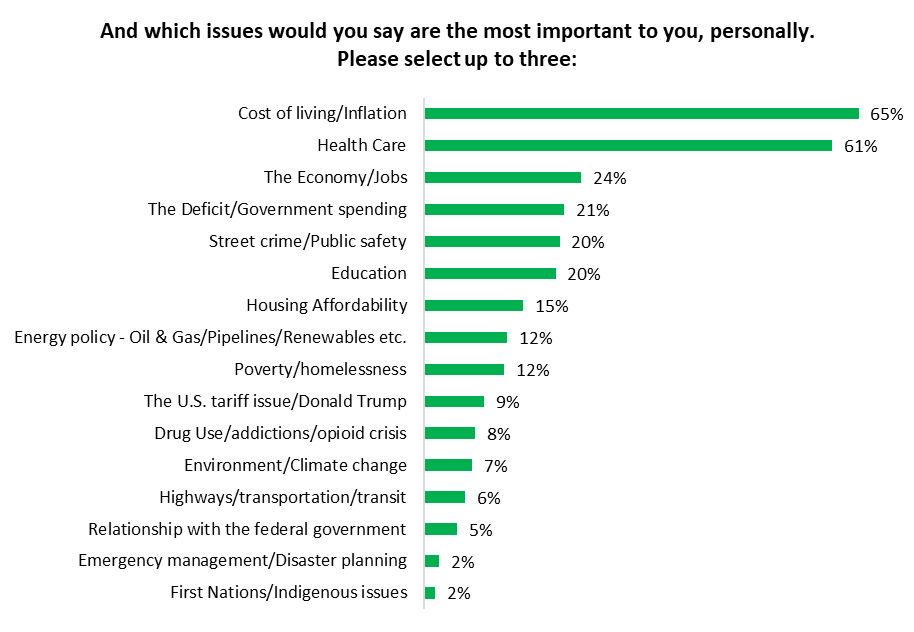
Cost-of-living concerns continue to dominate residents’ priorities, alongside health care. Both of those issues are chosen by more than three-in-five Saskatchewan residents, nearly triple the third-place issue, the economy, which is chosen by 24 per cent. The government announced a new plan for health care access expansion in March – the Patients First Health Care Plan – to address the province’s ailing health care system. The province will also reportedly begin to utilize more private surgery clinics to increase delivery in the public system.
Performance on top issues
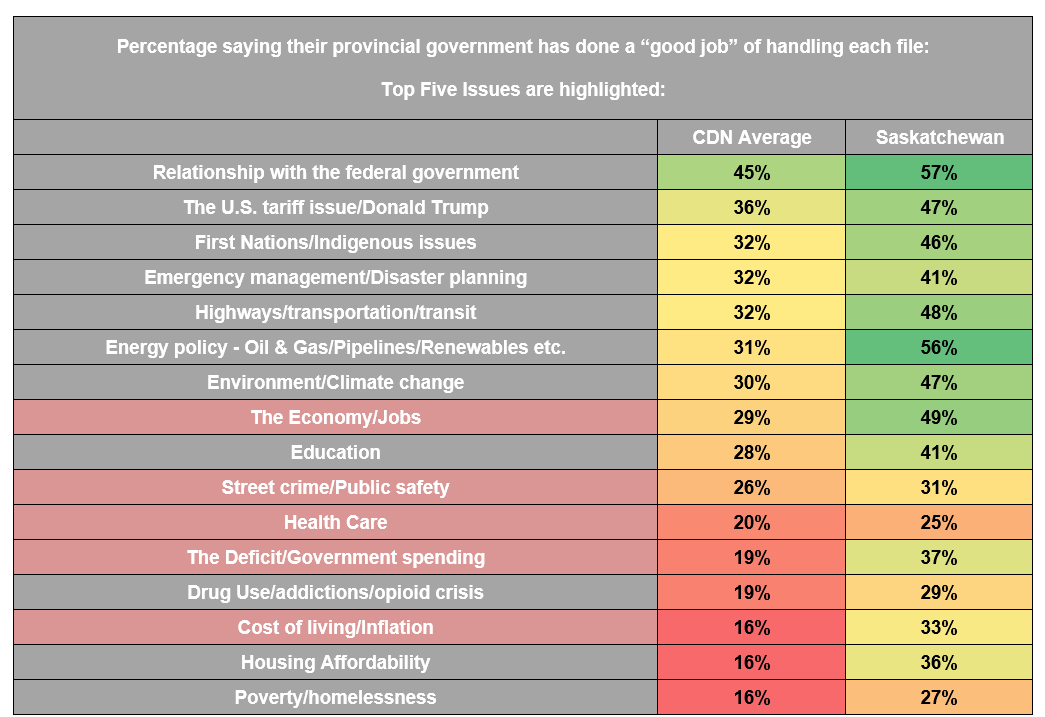
Examining government performance across a number of different items, Saskatchewan compares favourably with the Canadian average, outpacing it on every issue. That said, government performance still remains poor on many top issues, including health care, where just 25 per cent say the Sask. Party is doing a good job:
Economic Outlook
With the cost of living weighing heavily on the minds of most residents, Angus Reid Institute asked two core questions about the past twelve months and the next twelve months. More than two-in-five (44%) in Saskatchewan say they’re worse off now than they were last year, suggesting that despite the more positive views of government, the financial realities of 2025 and 2026 are still hitting hard. This 44 per cent is eight points over the national average:
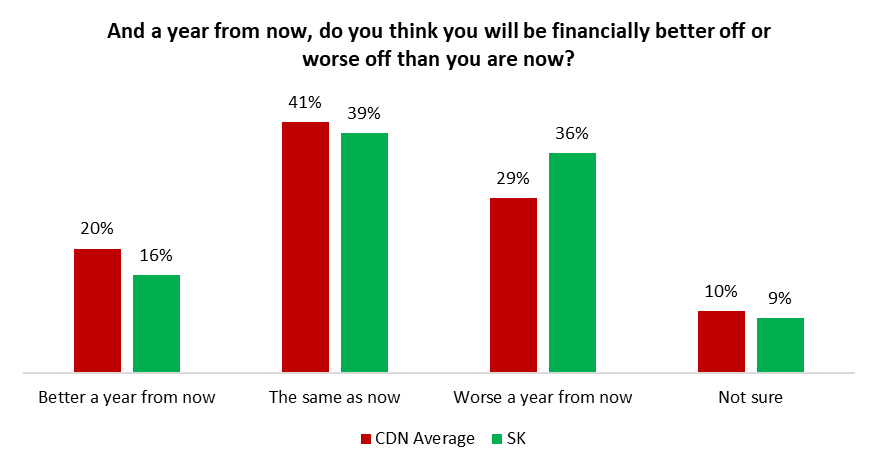
In terms of economic optimism, the largest number (39%) say that they expect to be in about the same position next year as they are currently. Slightly fewer (36%) say that they will be worse off, again a higher number than the national average (29%):
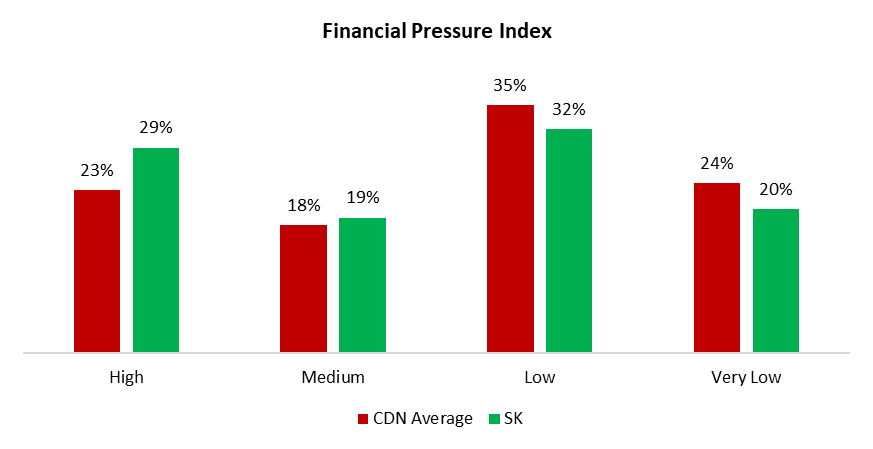
To understand and compare the realities of Canadians across the country, ARI created a Financial Pressure Index, which scores respondents on eight questions and sorts them into one of four groups based on the intensity of the financial pressure they face. The number of residents in Saskatchewan dealing with High pressure is higher than most of the country, though 52 per cent are described as facing Low (32%) or Very Low (20%) pressures. To explore any of these findings further, view detailed tables:
Right track or wrong track?
Despite the economic precariousness that many residents feel, optimism in Saskatchewan is higher than most other parts of the country. Overall, 45 per cent say the province is still on the right track – tied with Manitoba for the most in the country. Fewer, but close to the same number, 38 per cent, say the province is on the wrong track. This is well below the national average of 53 per cent:
METHODOLOGY:
The Angus Reid Institute conducted an online survey from March 11-17, 2026, among a randomized sample of 325 Canadian adults who are residents of Saskatchewan. Respondents are drawn from the Angus Reid Forum, a large-scale online panel developed to include Canadian residents in each of the 343 federal ridings in Canada and representative of the Canadian population by age, gender, family income, ethnic status and education. The sample was weighted to be representative of adults nationwide according to region, gender, age, household income, and education, based on the Canadian census. For comparison purposes only, a probability sample of this size would carry a margin of error of +/- 5 percentage points, 19 times out of 20. Discrepancies in or between totals are due to rounding. The survey was self-commissioned and paid for by ARI.
For detailed results by age, gender, region, education, and other demographics, click here.
For PDF of full release, click here.
MEDIA CONTACT:
Shachi Kurl, President: 604.908.1693 shachi.kurl@angusreid.org @shachikurl
Dave Korzinski, Research Director: 250.899.0821 dave.korzinski@angusreid.org
Jon Roe, Senior Research Associate: 825.437.1147 jon.roe@angusreid.org