


Majority believe CPC has ‘hidden agenda’ it won’t reveal until the party is in office
September 18, 2024 – The House of Commons returns from its summer break this week in a more precarious situation than it left, as the minority Liberals govern without the firm backstop of a supply and confidence agreement with the NDP. This has many looking ahead to a potential election in the coming months, and a potential CPC government given the lopsided vote intention picture in the party’s favour.
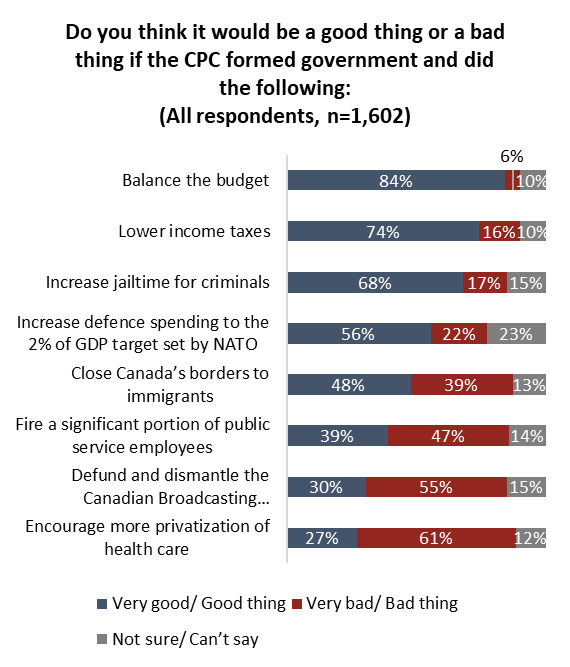
A new survey from the non-profit Angus Reid Institute asks Canadians to assess potential and hypothetical CPC policy addressed at some of the key ballot issues for the next federal election. Some – balancing the budget, lowering income taxes, increasing jail time for criminals, spending more money on defence – are viewed as overwhelming winners by Canadians. Others – the potential of further privatization of health care, defunding the CBC – are viewed by a majority as “bad things”.
These policies are presented to respondents in a mix of both real promises made by Pierre Poilievre since he became leader of the CPC, as well as hypotheticals beyond what the Conservatives have laid out so far.
Despite plenty of policies that will likely form the pillars of a campaign platform once an election is called – “axe the tax”, “jail not bail”, “defund the CBC” – other areas have remained relatively blank. How would a CPC government approach health care and reach the balanced budget it promises?
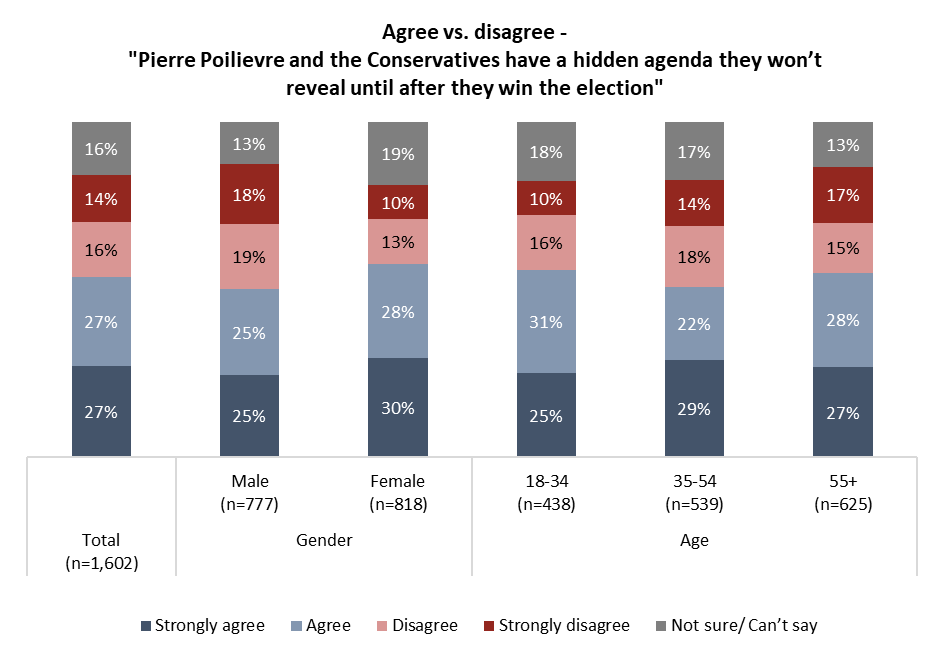
In the absence of these important policy proposals, there is evidently some apprehension among Canadians. Half (46%) say they are “fearful” of the CPC forming government, while fewer (35%) anticipate it with hope. A majority (54%) suspect Poilievre and the CPC have a “hidden agenda” that won’t be revealed until after the party wins the elections.
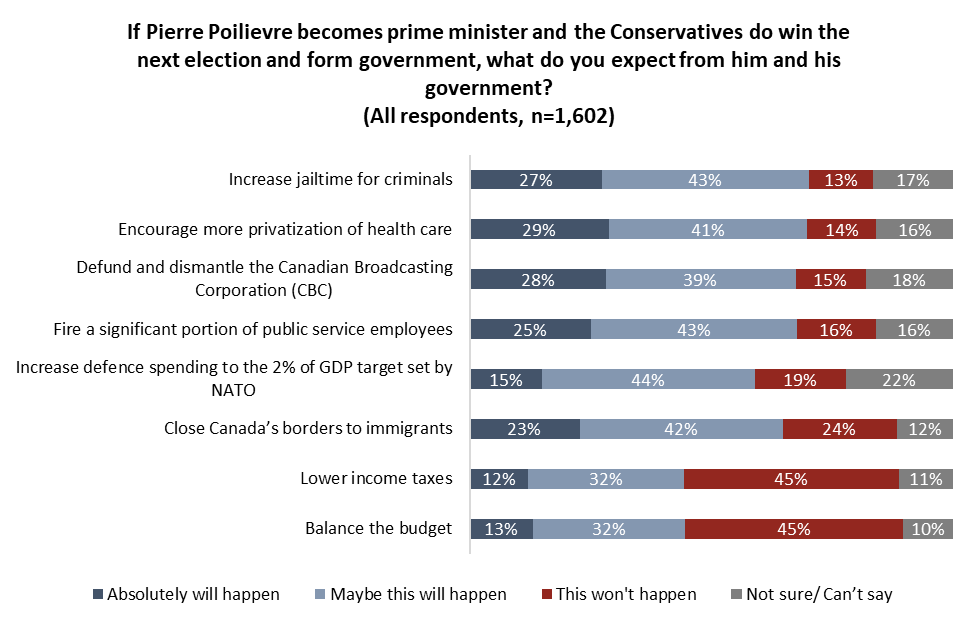
There is also some doubt that a Poilievre-led government can balance the budget and lower income taxes as promised, even if most view them to be “good things”. More than two-in-five (45%) say neither will happen.
Click below to see Key Takeaways from the data
ARI asked Canadians to assess potential and hypothetical CPC policy. Some promises made by Poilievre already – a balanced budget, decreased income taxes, more jail time for criminals – are viewed as ‘good things’ by a majority of Canadians. A majority say it would be a ‘bad thing’ if a potential CPC government defunded the CBC.
Three-in-ten say a potential CPC government would ‘absolutely’ increase jail time for criminals, encourage privatization of health care and defund the CBC. There is more doubt that Poilievre as prime minister will lower income taxes or balance the budget.
Fifty-four per cent of Canadians agree that “Pierre Poilievre and the Conservatives have a hidden agenda they won’t reveal until after they win the election.” Men are more likely than women to disagree.
The Full Story
INDEX
Part One: Poilievre’s promises and perceived policies
Most see more jail time for criminals as ‘good’, defunding CBC as ‘bad’
Part Two: But which policies do Canadians expect a CPC government to implement?
Canadians most certain of more jail time, health care privatization, defunding the CBC
Opposition supporters doubt CPC will balance budget
Part Three: The ‘fear factor’
More say they’re ‘fearful’ of CPC victory than ‘hopeful’
CPC supporters optimistic for victory of their party
Majority say the CPC ‘has a hidden agenda’
Part One: Poilievre’s promises and perceived policies
As the Conservative Party of Canada has maintained a 20-point lead in vote intention, there has been much commentary as to what leader Pierre Poilievre might do should the polling lead carry through the next election and lift his party into government.
Related: Federal Politics: Concern over immigration quadruples over last 24 months
While he has signalled he would repeal Liberal policies – the carbon tax, various bills regulating the internet – Poilievre has also been criticized for a lack of concrete plans otherwise.
To gauge what Canadians expect from a potential CPC government, the Angus Reid Institute presented respondents with a series of policies which included some real policy suggestions raised by Poilievre since he became leader as well as others that were more hypothetical and beyond anything suggested by Poilievre and the Conservatives.
For example, on immigration, Poilievre has said he would limit immigration by tying it to the growth of the housing stock. This would scale back immigration but fall short of closing Canada’s borders completely to immigrants.
Poilievre has signalled he would honour last year’s increase in federal health transfers, but has not offered much beyond that as to what to expect from a Conservative government under him when it comes to health care policies.
However, he has said he would increase jail time for criminals by limiting bail, balance the budget and lower income taxes.
On the CBC, Poilievre has suggested he would keep the French-language Radio-Canada programming while defunding the English services. English respondents were asked if they believed a CPC government would defund and dismantle the CBC entirely, while French respondents were asked the same but for Radio-Canada (see the questionnaire for details).
Most see more jail time for criminals as ‘good’, defunding CBC as ‘bad’
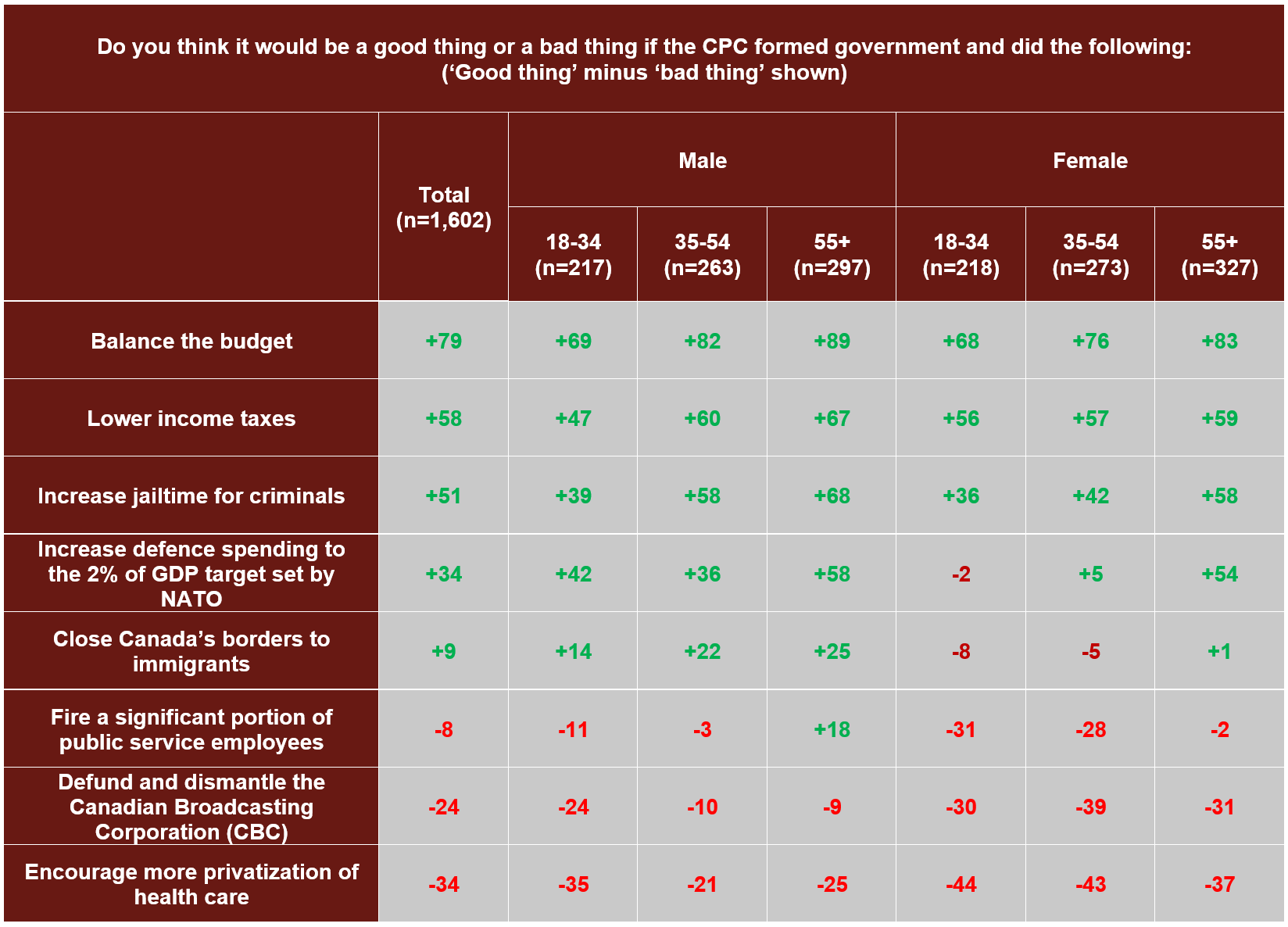
At least half of Canadians say that defunding the nation’s public broadcast system would be bad for the country (54%) and three-in-five (61%) say that more privatization in health care would worsen an already difficult situation. While Poilievre has not indicated this is a direction he would choose for health care, it has been a path well worn by provincial conservative governments in recent years.
As Canadians’ concern over immigration has grown, they have become more supportive of limiting immigrants coming into the country. Half (48%) say closing Canada’s borders to immigrants would be a ‘good thing’, though again this goes beyond what Poilievre has said a government under him would do.
Other stated CPC policies are much more highly supported, however. Balancing the budget, something not done in a decade, is overwhelmingly seen as a good thing, while lower taxation levels are also viewed positively. Increasing jail time for criminals would be welcomed by two-thirds (68%) of Canadians:

As to which of these policy concepts are political winners, those who support the Conservatives already are in favour of all of them at a higher rate than others. That said, increasing sentencing length for criminals, increasing the defence budget to the two per cent of GDP NATO target, balancing the budget and lowering income taxes are all cross-partisan winners:
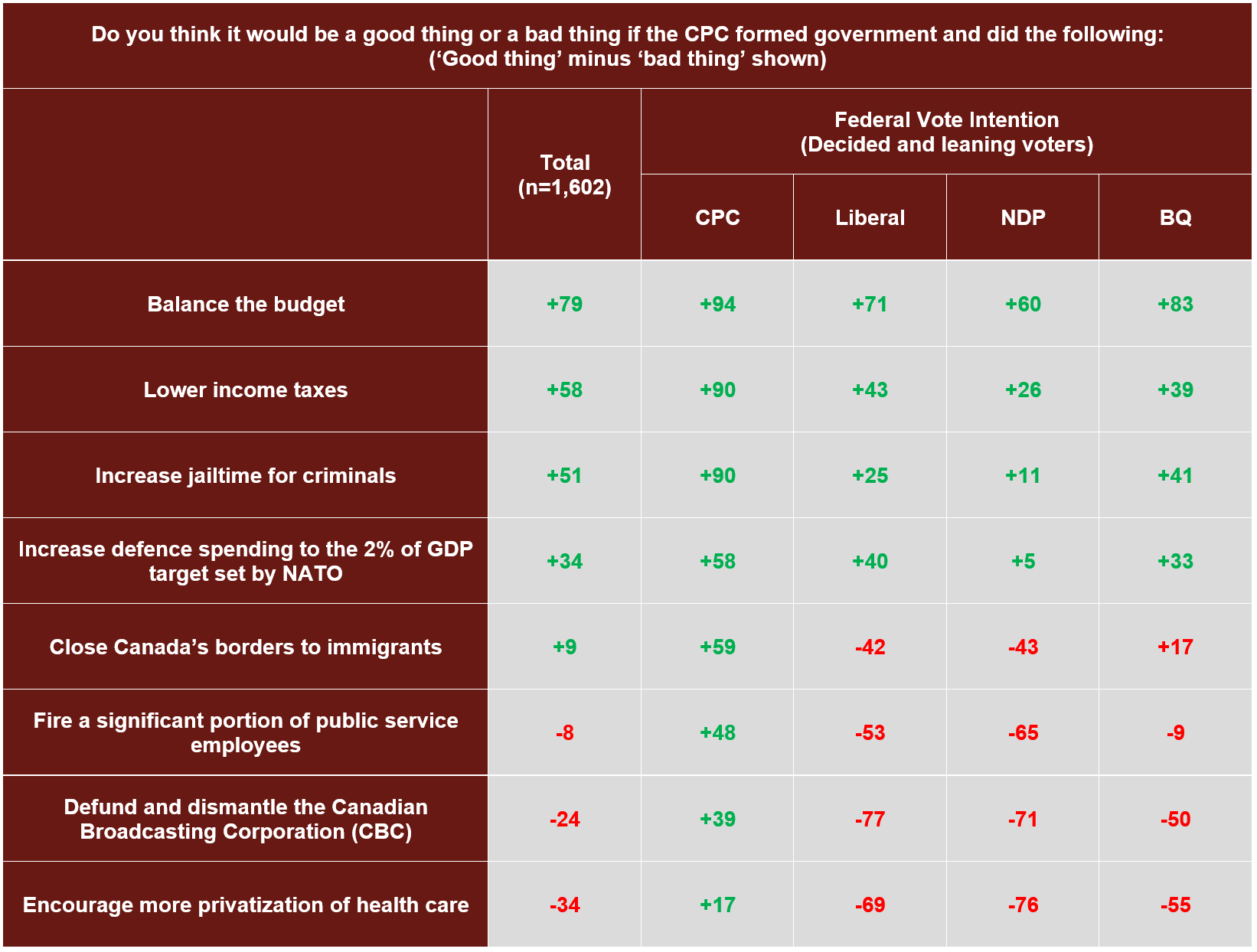
The breakdown between men and women continues to be notable and worth watching as the gears of the electoral cycle begin to grind into motion. Immigration in particular is an issue that divides men and women, as do, to a certain extent, defunding the CBC and reducing the public service. Age and gender dynamics will be a key storyteller in the months (or year, if the election date holds) to come.
Part Two: But which policies do Canadians expect a CPC government to implement?
Canadians most certain of more jail time, health care privatization, defunding the CBC
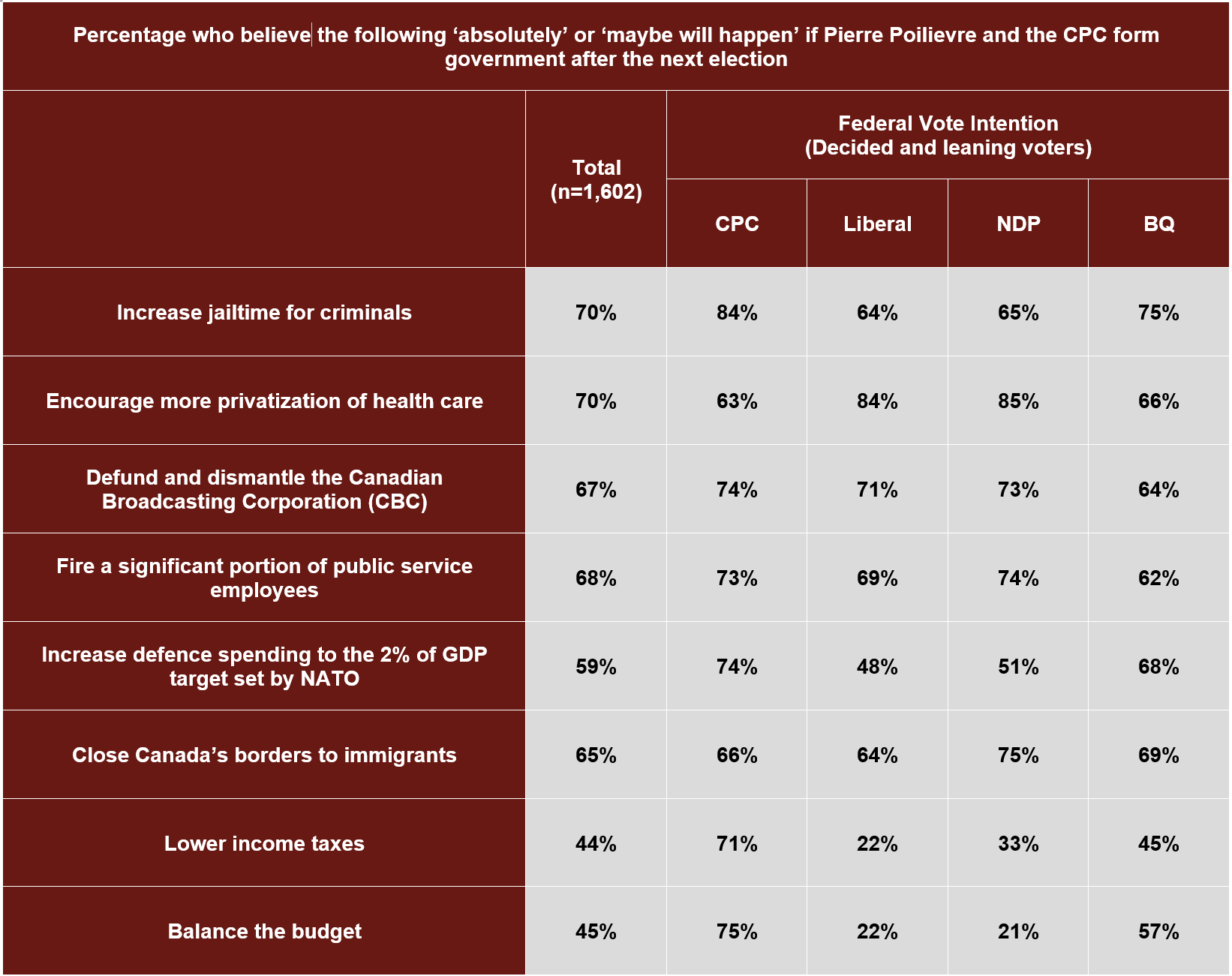
There is a difference between talk and action as campaign promises sometimes fall by the wayside once a party takes office. For the most part, there is uncertainty as to whether a Poilievre CPC government would enact many of the above policies. Canadians are most certain that a CPC government would encourage more health care privatization (29% say this will absolutely happen), increase jail time for criminals (27%) and defund the CBC (28%). One-quarter also say they believe it’s a certainty that Poilievre as prime minister would “fire a significant portion of public service employees” (25%) and “close Canada’s borders to immigrants” (23%), which have not been explicitly promised by Poilievre or the Conservatives.
Canadians are most likely to doubt that a Poilievre-led government can lower income taxes (45% say this won’t happen) or balance the budget (45%):
Opposition supporters doubt CPC will balance budget
On most matters, expectations are shared by similar numbers of CPC, Liberal, NDP and Bloc Québécois supporters. There is more doubt among likely Liberal and NDP voters that a future CPC government will live up to the two per cent GDP defence spending target, and even more skepticism from those groups of supporters that Poilievre as prime minister will balance the budget:
Part Three: The ‘fear factor’
More say they’re ‘fearful’ of CPC victory than ‘hopeful’
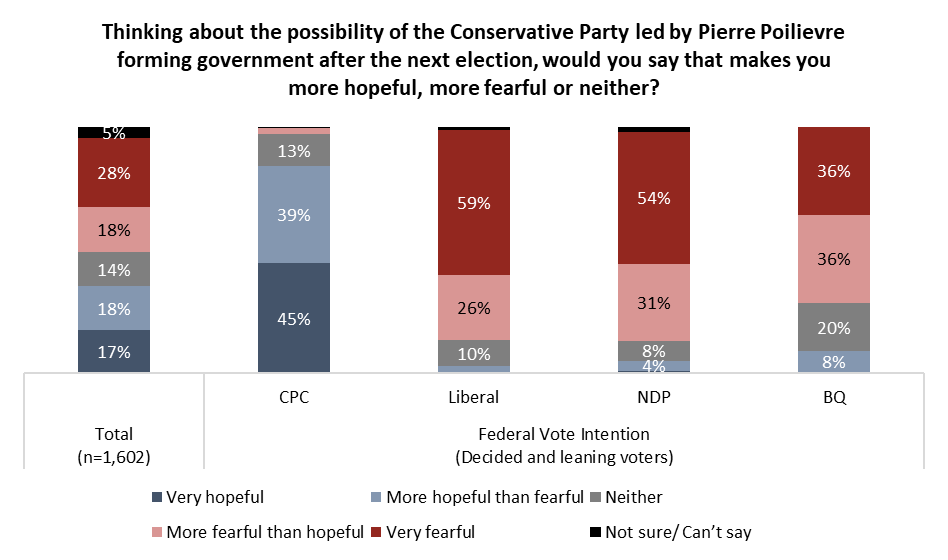
The prospects of a Poilievre government, while tantalizing to some, are more likely to induce unease among Canadians, particularly women. Overall, approaching half (46%) of Canadians say the potential of a CPC government under Poilievre makes them afraid, while fewer (35%) are hopeful for that outcome. Women are more fearful (53%) than men (38%), who are more likely to express hope (44%):

CPC supporters optimistic for victory of their party
The political divide is evident. The bulk of the fear is coming from the current supporters of opposition parties, while most of the hope is coming from current CPC supporters, who also represent two-in-five Canadians currently:
Majority say the CPC ‘has a hidden agenda’
This fear from Canadians may be built on the uncertainty of which direction a Poilievre government might take. There are evidently many Canadians who believe Poilievre and the Conservatives have more of a plan for if they form government than they are letting on. A majority (54%) say the CPC have “a hidden agenda they won’t reveal until after they win the election”.
Approaching three-in-five (58%) women believe the Conservatives have plans they are not revealing until they potentially win the next election. Half of men (50%) agree, but they are more likely to disagree (37%):
Survey Methodology
The Angus Reid Institute conducted an online survey from Aug. 29 to Sept. 4, 2024 among a representative randomized sample of 1,602 Canadian adults who are members of Angus Reid Forum. For comparison purposes only, a probability sample of this size would carry a margin of error of +/- 2 percentage points, 19 times out of 20. Discrepancies in or between totals are due to rounding. The survey was self-commissioned and paid for by ARI.
For detailed results by age, gender, region, education, and other demographics, click here.
For the full release including methodology, click here.
For the questionnaire, click here.
Image – Pierre Poilievre/ Facebook
Shachi Kurl, President: 604.908.1693 shachi.kurl@angusreid.org @shachikurl
Dave Korzinski, Research Director: 250.899.0821 dave.korzinski@angusreid.org
Jon Roe, Research Associate: 825.437.1147 jon.roe@angusreid.org @thejonroe