


Half believe corruption in housing, essential goods like groceries, plays ‘a big role’ in rising cost of living
November 27, 2024 – As Canada’s federal government offers a tax holiday to help Canadians deal with the high cost of living over the holiday season, many say there is another culprit playing “a big role” in raising the price of essential goods like groceries and housing – corruption.
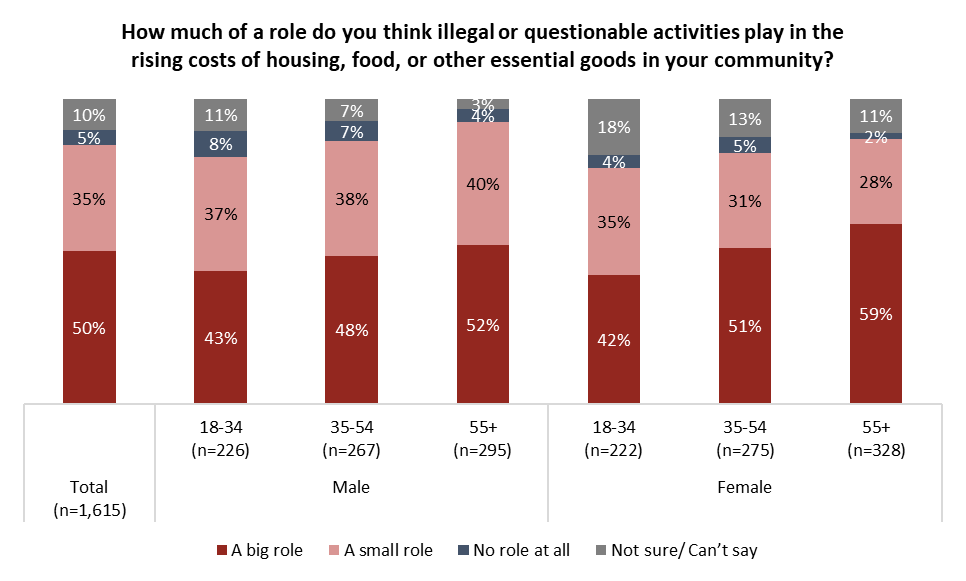
New data from the Angus Reid Institute in partnership with the Mindset Social Innovation Foundation and the World Refugee & Migration Council finds most Canadians believe corruption among businesses – for example taking “under the table” payments or being involved in money laundering – and in politics – e.g. backroom deals or bribes – is widespread and half (49%) believe it has a significant part in the rising cost of living.
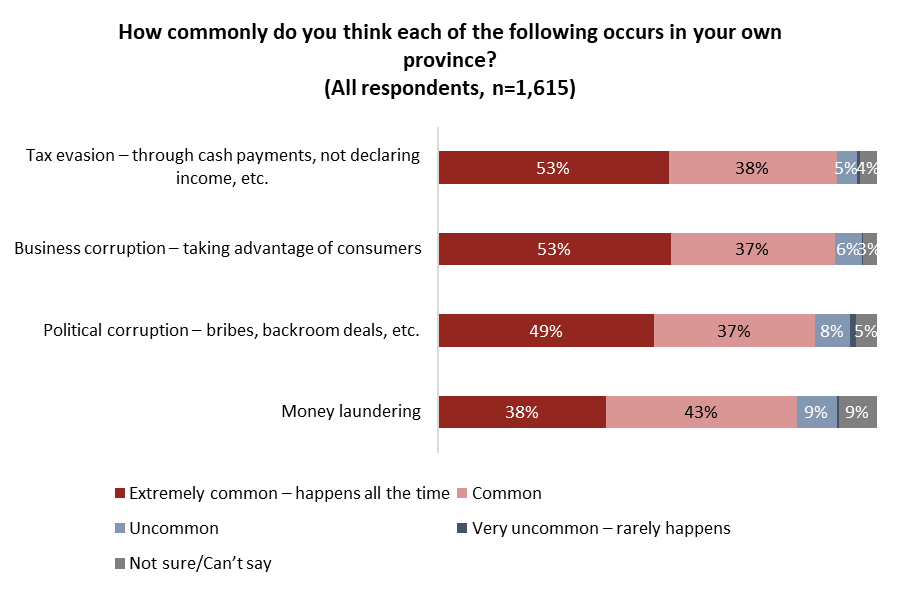
Nearly all believe tax evasion (91%) and businesses taking advantage of customers through overcharging, misrepresenting their goods or services, or otherwise (91%) are common occurrences in their province, while more than four-in-five say backroom political deals (86%) and money laundering (81%) occur regularly.
This comes as Canadians are four-times as likely (79%) to believe the level of corruption in the country has increased in the past three years than stayed the same (21%). Just one-in-100 (1%) see less corruption around them.
Meanwhile, there is little confidence in Canadian businesses to prevent illegal behaviour such as bribery or money laundering by their employees. One-quarter (27%) say they are very confident or confident in businesses and even fewer that the federal government (19%) and their respective provincial (19%) governments are equipped to combat corruption in Canadian businesses.
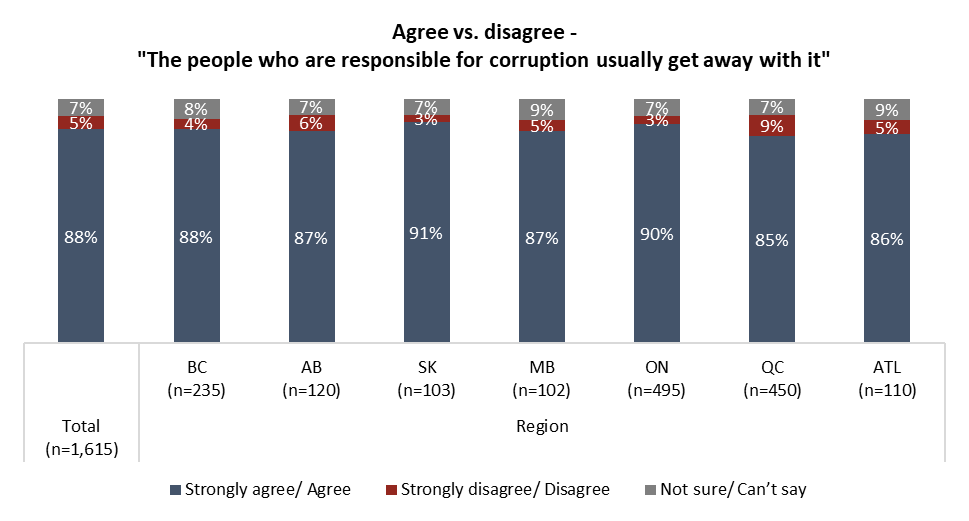
This has left Canadians broadly agreeing (88%) with the perception that the people responsible for corruption are rarely brought to justice.
Click below to see Key Takeaways from the data
More than four-in-five Canadians believe money laundering (82%), political corruption (86%), business corruption (91%) and tax evasion (91%) are common occurrences in the province they live in.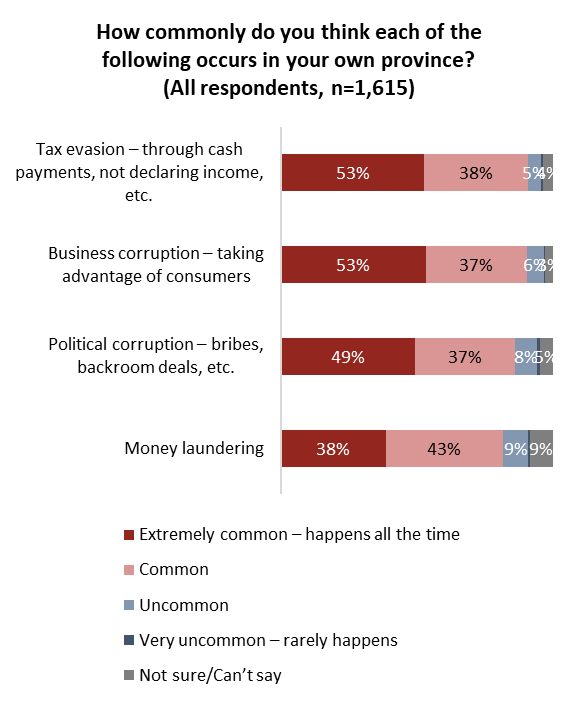
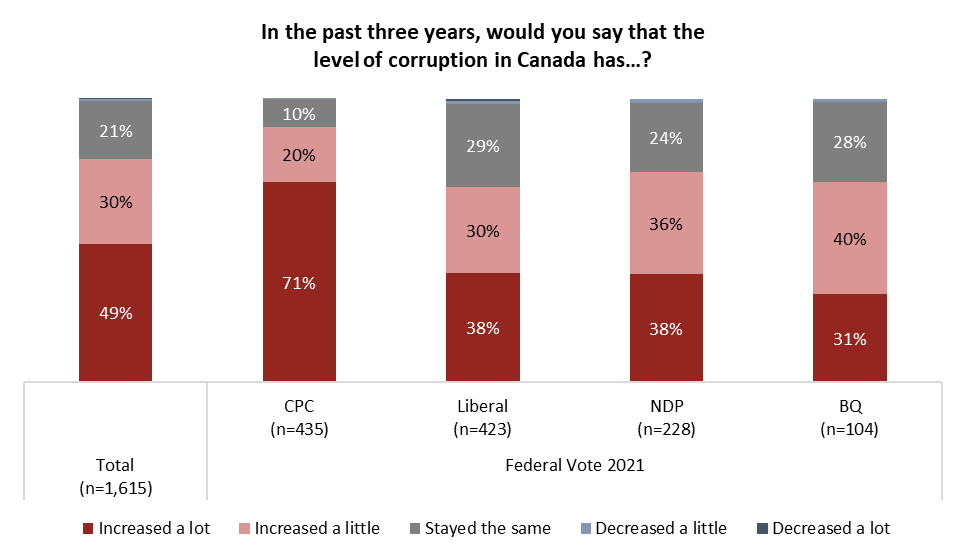
Four-in-five (79%) believe corruption in Canada has increased a little (30%) or a lot (49%) in the past three years. While past Conservative voters are more likely to believe the level of corruption has increased significantly in recent years, a majority of all groups of past voters believe corruption is on the rise in the country.
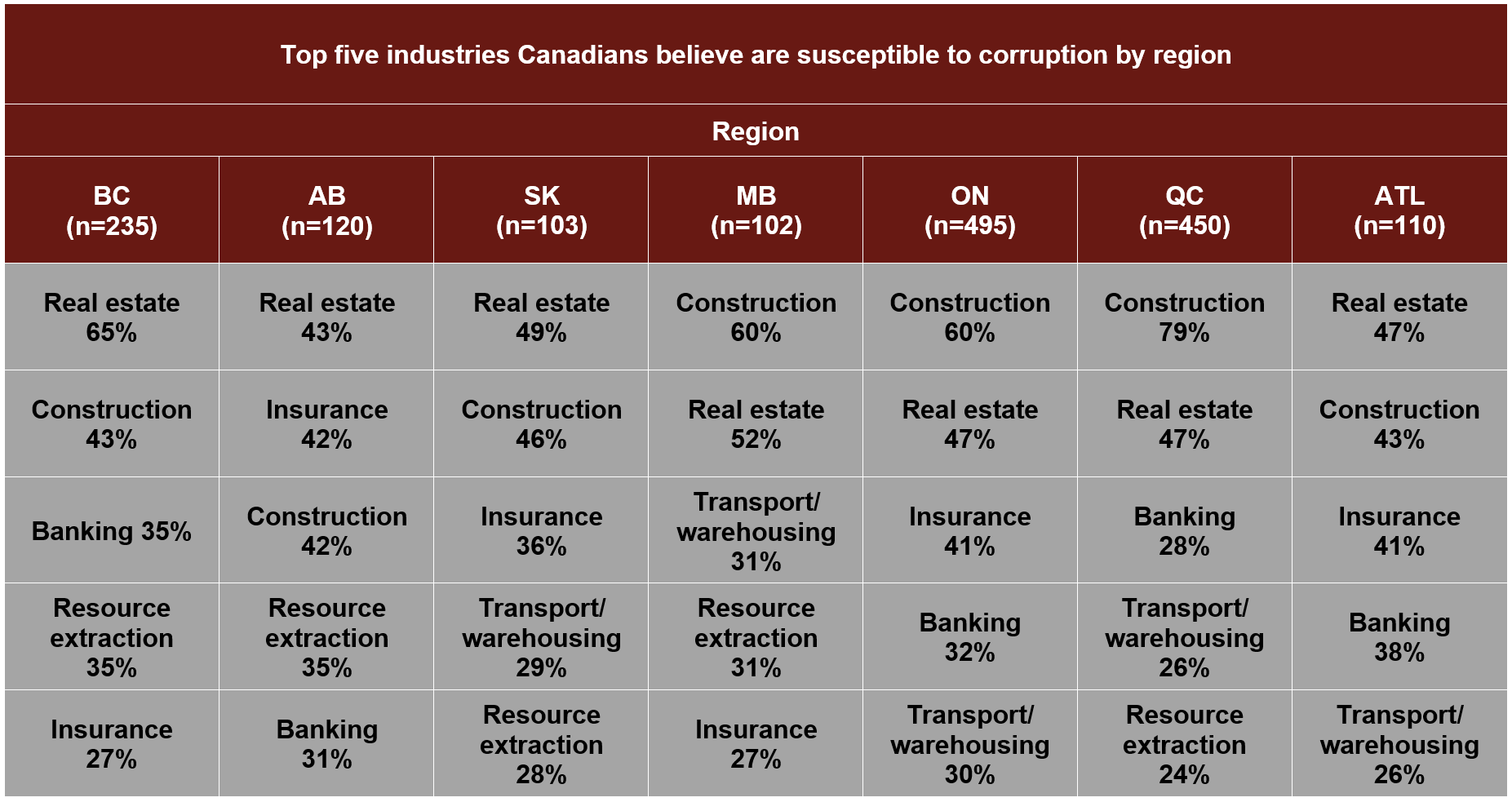
Nationally, at least half of Canadians choose real estate (49%) and construction (59%) as the two industries most susceptible to corruption. In B.C., 65 per cent believe real estate is vulnerable to illegal practices, while in Quebec, 79 per cent choose construction.
About ARI
The Angus Reid Institute (ARI) was founded in October 2014 by pollster and sociologist, Dr. Angus Reid. ARI is a national, not-for-profit, non-partisan public opinion research foundation established to advance education by commissioning, conducting and disseminating to the public accessible and impartial statistical data, research and policy analysis on economics, political science, philanthropy, public administration, domestic and international affairs and other socio-economic issues of importance to Canada and its world.
About Mindset Social Innovation Foundation
Mindset Social Innovation Foundation (Mindset) was founded in 2006 by philanthropist and advocate Alison Lawton to advance human rights and foster social innovation by supporting research and initiatives that promote transparency, accountability, and ethical governance. By partnering with organizations to scale impactful solutions, Mindset empowers communities and businesses to build trust and combat challenges such as corruption through collaboration and education.
The Full Story
INDEX
Part One: Exposure to corruption and shady dealings
Half say corruption in Canada has ‘increased a lot’ in last three years
Nearly all say business and political corruption are common in their province
Half say corruption plays ‘big role’ in rising cost of living
Part Two: Personal experiences
Two-in-five say they’ve dealt with a suspicious business
Most don’t report suspicious interactions
Nearly all believe those responsible for corruption get away with it
Part Three: Trust and confidence in professions, industries, government
Two-thirds say they have ‘no trust’ in politicians to follow rules
Construction and real estate viewed as industries most vulnerable to corruption
Little confidence in either business or government to address corruption
Part One: Exposure to corruption and shady dealings
Canada is viewed as one of the least corrupt countries in the world by Transparency International’s Corruption Perceptions Index. However, Canada’s score has fallen over the past decade, as major scandals such as the SNC Lavalin affair eroded faith in the federal government. Canada ranks below the global average in the annual Edelman Trust Barometer, which measures trust in institutions in a country including non-governmental organizations, businesses, government and media.
Related: Corruption in Canada: Seven-in-ten support an international court to fight global corruption
The spotlight has also been put on Canada as a major destination for money laundering by criminal and terrorist organizations. TD Bank, the second largest bank in Canada by total assets, recently plead guilty to conspiracy to commit money laundering and was fined $3 billion US by American regulators.
Despite recent strides in some provinces and by the federal government to address money laundering in Canada, financial crime has been described by anti-corruption advocates as a “free for all” in Canada where enforcement has been lacking.
Half say corruption in Canada has ‘increased a lot’ in last three years
The perception among Canadians is that the level of corruption in Canada has been rising in recent years. Half (49%) say it has increased “a lot” while three-in-ten (30%) believe it has increased a little.
While there is certainly a political element to this view – Canadians who voted Conservative in 2021 are nearly twice as likely to believe corruption has “increased a lot” in the past three years than any other group of past voters – majorities of all partisan groups believe corruption is on the rise in the country in the post-pandemic period.
Across the country, at least seven-in-ten (70%) in every province believe corruption has increased in recent years in Canada. Those in Saskatchewan (58%) and Ontario (55%) are the most likely to believe it has increased “a lot” (see detailed tables).
Nearly all say business and political corruption are common in their province
Canadians believe various types of corruption are widespread. At least four-in-five believe money laundering (82%), backroom political deals (86%), business corruption (91%) and tax evasion (91%) are common occurrences in their province. Majorities believe the latter two are “extremely common”.
The Canada Revenue Agency has had tools added to its arsenal to catch tax cheats in recent years, but in 2022 it was estimated the federal government is losing about $23 billion per year in uncollected taxes. In 2021, it was reported that the CRA audits had resulted in no prosecutions or convictions of ultra wealthy Canadians suspected of tax evasion, despite a 3,000 per cent increase in spending on a program to keep tabs on high net-worth individuals.
Half say corruption plays ‘big role’ in rising cost of living
The last few years have been difficult for Canadians as inflation has made essentials such as groceries and rent more expensive. And Canadians believe the corruption they see as common around them is also having an impact on this rising cost of living. Half (50%) believe illegal activities play “a big role” in the rising costs of housing and food in their community, while one-third (35%) believe it plays a role but a minor one. Few (5%) believe corruption plays no role at all in the high cost of housing, groceries and other essential goods:
Part Two: Personal experiences
At the more local level, one-quarter (23%) of Canadians believe there are “quite a few” businesses in their community who are engaged in suspicious or illegal activities. One-third (33%) say there are at least one or two businesses near them engaged in activity such as money laundering or tax avoidance, while one-in-seven (14%) say they don’t believe there are any businesses in their community doing this.
Those in B.C. (28%), Ontario (25%) and Quebec (26%) are more likely than those elsewhere to believe there are “quite a few” businesses in their community engaged in suspicious or illegal activities (see detailed tables).
Two-in-five say they’ve dealt with a suspicious business
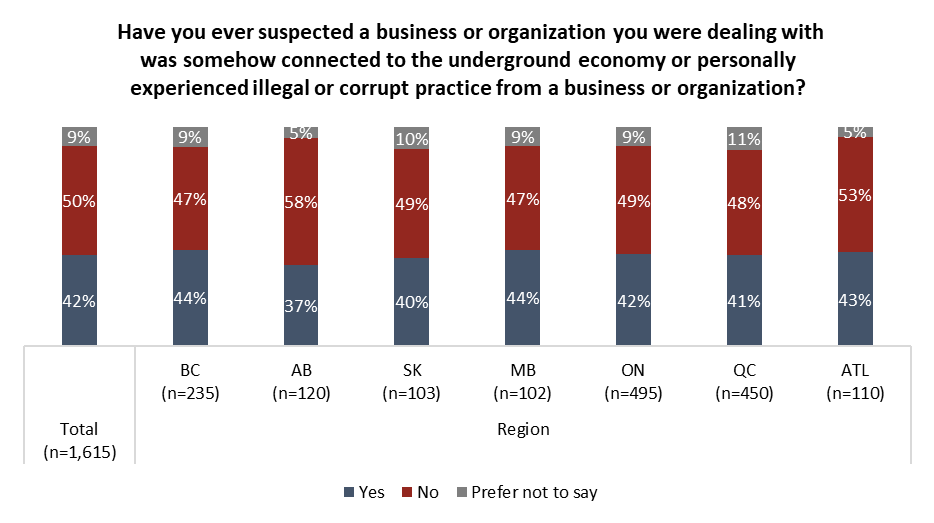
Many Canadians – two-in-five (42%) – suspect a business they’ve had dealings with was connected to the underground economy or experienced corrupt practice from the business themselves. This experience is most common in B.C. (44%), Manitoba (44%) and Atlantic Canada (43%), but approaching two-in-five in each province in the country have had a similar experience:
Most don’t report suspicious interactions
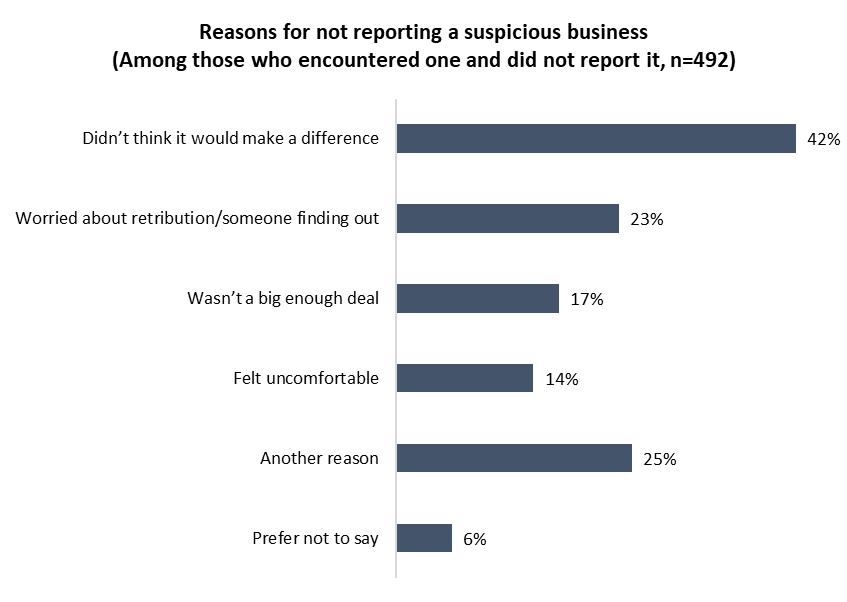
What is perhaps most notable is that the vast majority (73%, see detailed tables) of those who have experienced this have not reported this suspicious behaviour, which many feel is having damaging impacts in their communities. The top reason (42%) for this is that they didn’t feel it would make any difference, reflecting a lack of confidence in enforcement mechanisms. Another core concern is evidently fear of retribution; one-quarter (23%) say this was a reason they chose not to report.
Among those who have not had dealings with a suspicious business, a divide is evident over level of comfort in reporting a hypothetical illegal act to police. Nearing half (46%) said they would be comfortable reporting, while close to the same number would not be (39%, see detailed tables).
Nearly all believe those responsible for corruption get away with it
There is a broad sense among the public, perhaps buoyed by the lack of willingness to report suspicious activities among those who have experienced it, that corruption in Canada pays. Only a handful of Canadians – approximately six per cent – feel that those who are responsible for corruption don’t get away with it, while the vast majority (88%) say that they do:
Part Three: Trust and confidence in professions, industries, government
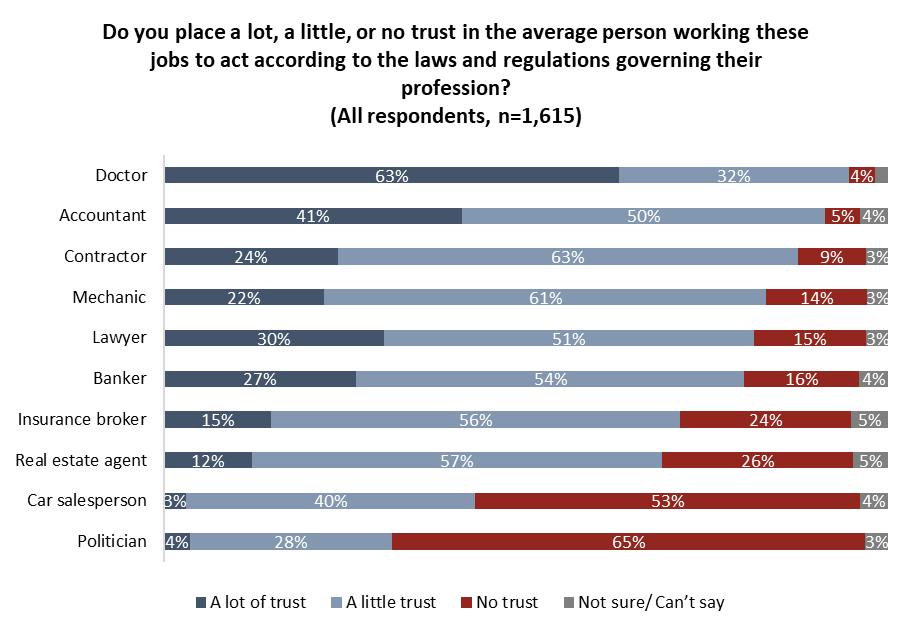
Broadening the scope of trust and legitimacy in Canadian professions and institutions, the Angus Reid Institute and Mindset asked Canadians which key professions in society they feel are trustworthy when it comes to following the standards, laws, and regulations governing their professions.
Two-thirds say they have ‘no trust’ in politicians to follow rules
Foremost on the trust scale are doctors, for whom three-in-five Canadians (63%) show a lot of trust and (32%) offer a little. Accountants are the only other group for which two-in-five or more Canadians show a lot of trust (41%). Mistrust begins to show itself further down the list with insurance brokers and real estate agents, professions for which one-quarter have no trust, and reaches a low point among politicians. Two-thirds (65%) say they have no trust in that latter profession. This, perhaps unsurprising at a time when Canada’s main federal party leaders are at their least popular point in 50 years of tracking.
Construction and real estate viewed as industries most vulnerable to corruption
Putting politics aside, the industries most vulnerable to corruption according to Canadians are two massive and related ones – construction and real estate. Example in the construction industry centre around collusion and bribery, wherein municipal bids can be manipulated for certain firms, or seemingly competitive processes can be corrupted. Tax evasion, too, has been a subject of investigation in recent years, with some analyses suggesting it costs Canadians billions each year.
In real estate, tens of billions of dollars are thought to be laundered every year, Both of these aforementioned industries are seen as susceptible to corruption by at least half in Canada (59% construction, 49% real estate, see detailed tables).
Real estate and construction dominate the list of top corruption concerns in most of the country. In British Columbia, two-thirds (65%) choose real estate. That province was the subject of a New York Times feature discussing the issue in 2022. In Quebec, long thought to be the construction corruption epicentre of the country, a staggering four-in-five choose that industry (79%):
Little confidence in either business or government to address corruption
While efforts have ramped up in recent years to take on corruption, there is little confidence at any level of government that these will be particularly effective. At least two-thirds of Canadians lack confidence across local, provincial, and federal governments. Most (80%) believe the federal government needs to invest more resources in fighting corruption (see detailed tables).
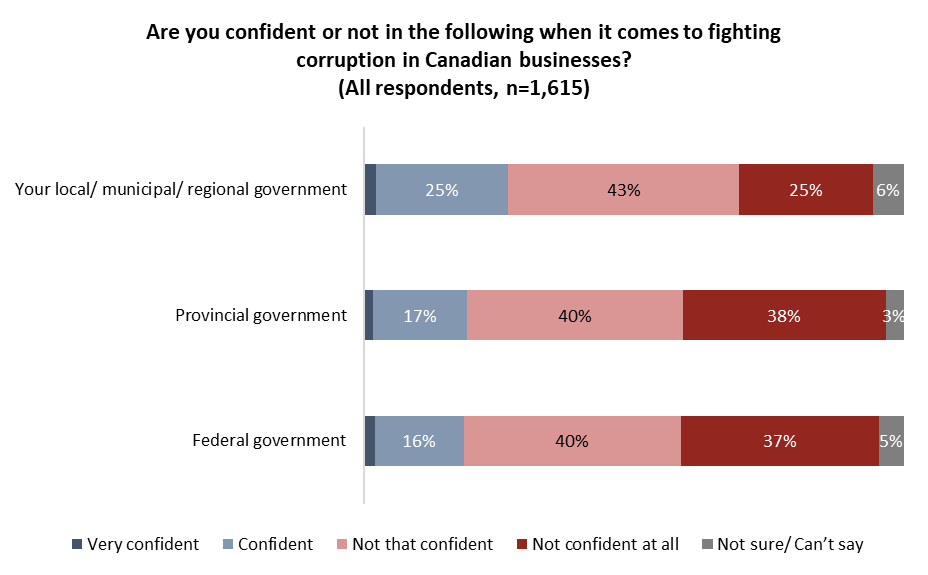
When these efforts are left to businesses, confidence is similarly low. Approximately one-quarter of Canadians feel that businesses are taking the necessary steps across these industries to ensure their employees and senior level management are acting in a legal manner.

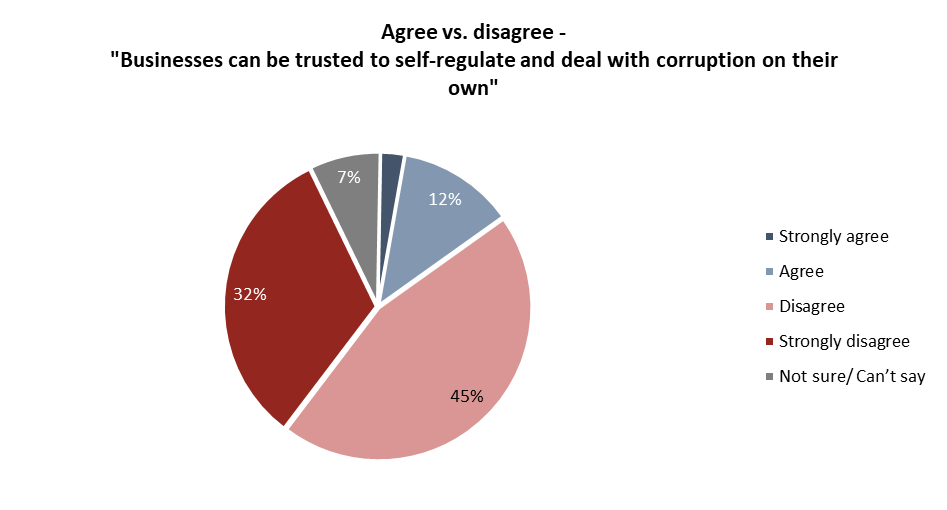
With this lack of confidence there appears to be a desire among the public to take enforcement out of the hands of businesses and hand regulation over to a third party. Just 15 per cent of Canadians say that businesses can be trusted to self-regulate, while three-quarters (77%) disagree:
Survey Methodology
The Angus Reid Institute in partnership with the Mindset Social Innovation Foundation and the World Refugee & Migration Council conducted an online survey from Nov. 14-19, 2024 among a representative randomized sample of 1,615 Canadian adults who are members of Angus Reid Forum. For comparison purposes only, a probability sample of this size would carry a margin of error of +/- 2 percentage points, 19 times out of 20. Discrepancies in or between totals are due to rounding. The survey was self-commissioned and paid for jointly by ARI and Mindset.
For detailed results by age, gender, region, education, and other demographics, click here.
For the full release, click here.
For the questionnaire, click here.
Image – ID 122234563 | © Pattanaphong Khuankaew | Dreamstime.com
MEDIA CONTACT:
Shachi Kurl, President: 604.908.1693 shachi.kurl@angusreid.org @shachikurl
Jon Roe, Research Associate: 825.437.1147 jon.roe@angusreid.org