


Three-in-five say Canada’s current divisions can be overcome; more connected are most likely to agree
December 4, 2025 – New data from the non-profit Angus Reid Institute in partnership with Cardus finds those who are regularly involved in their community more likely to express satisfaction with their life.
This is the third part in an ongoing series of reports based on a landmark cross-border study of more than 10,000 Canadian and American respondents analyzing the intersection of politics, community, and faith in the post-pandemic era.
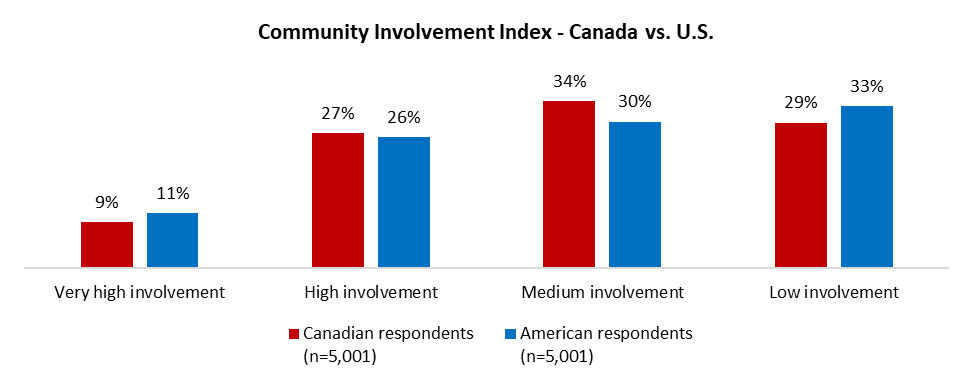
To assess community involvement, respondents were asked a series of questions as to whether they volunteered their time, donated money, participated in activities in their community, socialized with neighbours or attended religious services. The answers were amalgamated to create the Community Involvement Index, which sorted respondents on both sides of the border into four groups ranging from “very high involvement” to “low involvement” in their community. Similar numbers in both Canada and the U.S. showed “very high involvement” (9% Canada, 11% U.S.), or were regularly doing the above listed activities, and “low involvement” (29% Canada, 33% U.S.), or rarely or never spent time in their community.

Analyzing the difference between these groups, and those in between, shows a potential correlation between community involvement and some of the key societal issues post-pandemic.
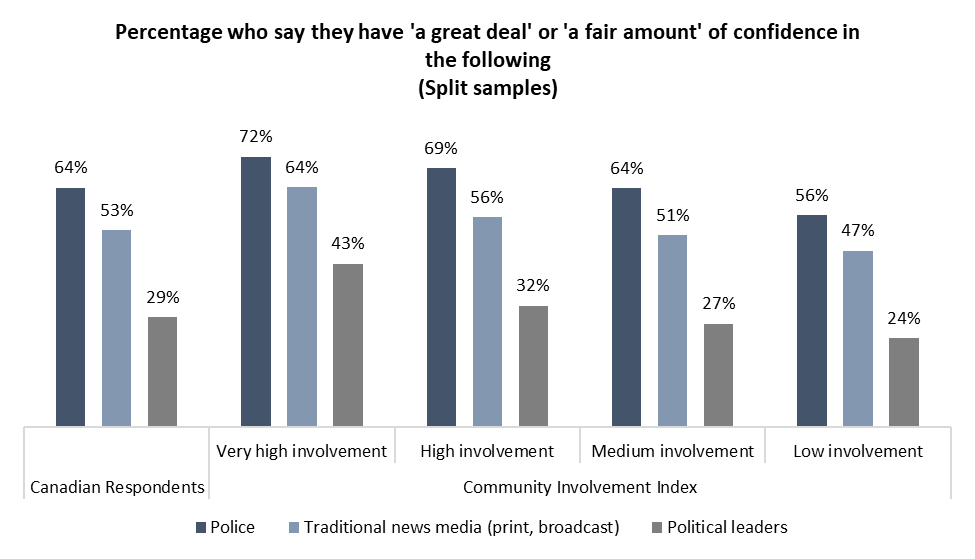
The highly involved in Canada and the U.S. are much more likely to express confidence in key public institutions and leaders – police, politicians, scientists, courts, governments, media – than those who rarely volunteer or socialized with neighbours.
More Key Findings:
- Amid a divisive political era, Canadians are more likely than not to see a path forward; more disagree (63%) than agree (33%) that “Canada is so divided that nothing is going to bring the country back together”. But those who are participate less in their community are much more likely to see the division as permanent (35%) than those who are regularly volunteering and socializing (29%).
- The very highly involved are more likely to find value in conversations with those they disagree with (65% say it is interesting and informative) than the low involvement group (52%). The most involved are also much more likely to believe that the best way to live life is to focus on helping others (64%) than the least involved (39%).
- Low involved Canadians are less satisfied with their quality of life (68%) than the very highly involved (89%).
Read the other two reports in this landmark cross-border study:
- With distrust sown in institutions and political opposition, is there a path back in this time of division?
- Religion in Canada and the United States: A cross-border comparison of faith
INDEX
- The Community Involvement Index
- Those more involved in their community express more satisfaction with life
- Religiously Committed most likely to be highly involved in local community
- Collectivism vs. individualism
- The less involved are less likely to trust institutions and leaders
- Community involvement and political division
The Community Involvement Index
It has been half of a decade since the first wave of COVID-19, and more than three years since the end of most mask and vaccine mandates, but the effect of the worst worldwide pandemic of the 21st century is still being felt. The pandemic, and the polarizing mandates instituted by governments, perhaps had a role in accelerating a fracture in politics that has many still viewing political opposition with animosity.
The first part of this ongoing series found that majorities of partisans of all stripes believe the party of their rivals are a “threat to their country”. Conservatives (87%) say this of the Liberals; Liberals (84%) say this of Conservatives; Republicans (80%) say this of Democrats; and Democrats (89%) say this of Republicans.
While that may be one lingering consequence of the pandemic era, there is a question as to how other communities have changed, adapted or splintered in the wake of an era where in-person gatherings were banned or limited and confined to digital spaces. One study from the United Kingdom found that online social contact was a poor replacement for in-person gatherings when it came to people’s mental health. A Canadian study found that mental health and even general health was tied to social connectedness.
To assess how community involvement is connected to politics, views of institutions, and other matters, ARI and Cardus queried Canadians and Americans on their activities in the community to gauge civic participation. These data – including how often respondents volunteered or donated money, helped out those in need in other ways, used local community centres or libraries, socialized with neighbours, participated in neighbourhood projects or hobby groups, or attended religious services – were amalgamated to create the Community Involvement Index, which sorts people by how often they spend time in their community. (See the scoring of the index here).
The Community Involvement Index finds about one-in-10 in Canada and the U.S. who have “very high” involvement. That is, they are doing most of the above activities regularly. Those in the “high” involvement group are doing many of those activities, but perhaps less frequently. The “medium” involvement group are doing fewer activities overall, while the “low” involvement group rarely does any activities in their community at all.
Across the board, the groups are of similar sizes in Canada and the U.S.:
Those more involved in their community express more satisfaction with life
Community involvement appears to be correlated with a number of other factors. Those who are often out in their community, talking with their neighbours and helping with neighbourhood cleanup projects are more likely to say they are satisfied with their overall quality of life (89%), how welcome they feel in their community (93%) and the way things are going in Canada (46%) than those who do few if any activities in their community. Similar trends are seen in the U.S. along the Community Involvement Index (see detailed tables).
Note, these data – taken prior to the most recent federal election – show a majority (76%) in Canada are satisfied with their overall quality life, but that satisfaction with the direction the country has taken in recent years is a minority opinion (31%):

Religiously Committed most likely to be highly involved in local community
Since 2017, the Angus Reid Institute and Cardus have measured the Spectrum of Spirituality to help understand religiosity in Canada. Using a series of questions on faith, beliefs and religious practice, the Spectrum categorizes Canadians into four mindsets: Non-Believers, the Spiritually Uncertain, Privately Faithful and Religiously Committed. To read more about the four mindsets, click here. To read more about how the Spectrum is derived, click here.
Community involvement and religious sentiment seem to go hand-in-hand. One-quarter (24%) of the Religiously Committed also fall into the “very high” category on the Community Involvement Index. Indeed, a majority of Canada’s most faithful say they volunteer (56%), donate (81%) and help out those in need (83%). Two-in-five (38%) say they participate in community projects. The Religiously Committed are the most likely to do those activities of the four groups on the Spectrum of Spirituality (see detailed tables).

Collectivism vs. individualism
Community involvement also potentially correlates with a more collectivist mindset. Canadians, overall, are split when it comes to the trade off between focusing on achieving their own dreams and happiness (50%) or helping others (50%). Two-thirds (64%) of those who are habitually in their community helping, volunteering and socializing believe the latter, while a near inverse ratio is seen among those who very rarely or never do any of the activities included in the Community Involvement Index:

The less involved are less likely to trust institutions and leaders
This survey included a question about trust in 16 key public institutions, leaders and professions. Each respondent was asked if they had “a great deal of confidence,” “a fair amount”, “not too much” or “no confidence at all” in eight of the 16 on the list, resulting in a split sample (see detailed tables for the full list of institutions and people included).
Part one of this series found there was a gap between Canadians and Americans, and further between people of the two countries depending on where they land on the political spectrum, in confidence in these important pillars of modern society.
Related: Confidence in institutions
There also appears to be a correlation between high community involvement and higher trust in society institutions and leaders. The gap between groups on the Community Involvement Index is perhaps most pronounced when it comes to the federal government (58% have confidence in the very high involvement group; 38% in the low involvement), political leaders (43% very high, 24% low), organized religion (59% very high, 15% low) and faith leaders (59% very high, 12% low).
A gap in confidence between those who are integrated into their communities versus those who are not is also seen in the data from the United States but is much more pronounced. Americans who report low involvement in their community express less confidence in general across all institutions, including the courts (31%), media (28%) and public education (33%, see detailed tables).

Community involvement and political division
While Canadians who are involved in their community are more likely to disagree “nothing is going to bring the country back together”, this is evidently a widely held view across the country. Majorities of all groups feel that divisions can be healed. Notably, in the United States, equal numbers across all community involvement groups believe America is too divided to repair (see detailed tables).

Those who are regularly out in their community – visiting local libraries and community centres, helping with community projects, attending religious services, volunteering their time and helping those in need – are much more likely to find the experience of hearing perspectives that counter their own as informative rather than stressful. Those who rarely interact with their community are more likely to find disagreeing with people frustrating.
This correlation is also seen among American respondents. Three-in-five (59%) in that country who have low involvement in their community find the experience of talking to people they disagree with “stressful and frustrating” (see detailed tables).

Survey Methodology
The Angus Reid Institute conducted an online survey from March 12-21, 2025, among a randomized sample of 5,001 Canadian adults who are members of Angus Reid Forum. The sample was weighted to be representative of adults nationwide according to region, gender, age, household income, and education, based on the Canadian census. For comparison purposes only, a probability sample of this size would carry a margin of error of +/- 1.0 percentage points, 19 times out of 20.
ARI and Cardus conducted a second online survey from March 12-21, 2025, among a randomized sample of 5,001 American adults who are members of Angus Reid Forum. The sample was weighted to be representative of adults nationwide according to region, gender, age, household income, and education, based on the American census. For comparison purposes only, a probability sample of this size would carry a margin of error of +/- 1.0 percentage point, 19 times out of 20.
Discrepancies in or between totals are due to rounding. The survey was self-commissioned and paid for jointly by ARI and Cardus.
About ARI
The Angus Reid Institute (ARI) was founded in October 2014 by pollster and sociologist, Dr. Angus Reid. ARI is a national, not-for-profit, non-partisan public opinion research foundation established to advance education by commissioning, conducting and disseminating to the public accessible and impartial statistical data, research and policy analysis on economics, political science, philanthropy, public administration, domestic and international affairs and other socio-economic issues of importance to Canada and its world.
About Cardus
Founded in 1974, Cardus is a non-partisan think tank dedicated to clarifying and strengthening, through research and dialogue, the ways in which society’s institutions can work together for the common good.
For detailed results for Canadian respondents by age, gender, region, education, and other demographics, click here.
For detailed results for Canadian respondents by the Spectrum of Spirituality and the Community Involvement Index, click here.
For detailed results by American respondents by age, gender, region, education, the Spectrum of Spirituality and the Community Involvement Index, click here.
For PDF of full release, click here.
For full questionnaire, click here.
MEDIA CONTACTS:
Shachi Kurl, President, ARI: 604.908.1693 shachi.kurl@angusreid.org @shachikurl
Daniel Proussalidis, Director of Media and Public Relations, Cardus: 613.899.5174 dproussalidis@cardus.ca