


Americans more likely to report being public about their religion (70%) than Canadians (52%)
November 6, 2025 – New data from a landmark cross-border study from the Angus Reid Institute and Cardus compares views on faith and religion in Canada and the United States through the responses of more 5,000 people in each country.
The study finds there is a significant gap in religiosity between the two neighbouring countries, but some similarities when it comes to demographic trends.
This report makes use of the Spectrum of Spirituality, an index developed in 2017 by Cardus and the Angus Reid Institute to measure Canadian mindsets on faith and spirituality. For the first time since the creation of the Spectrum, it is applied to American respondents to allow for comparisons of religiosity between Canada and its close neighbour.
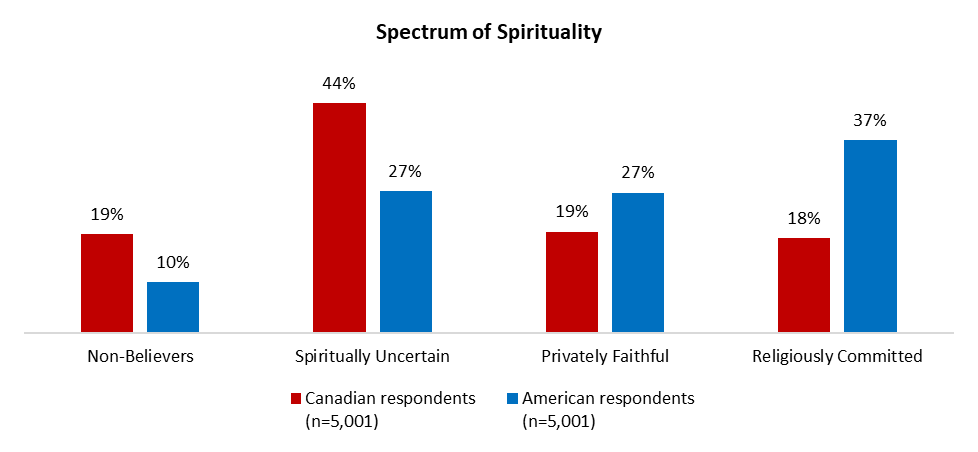
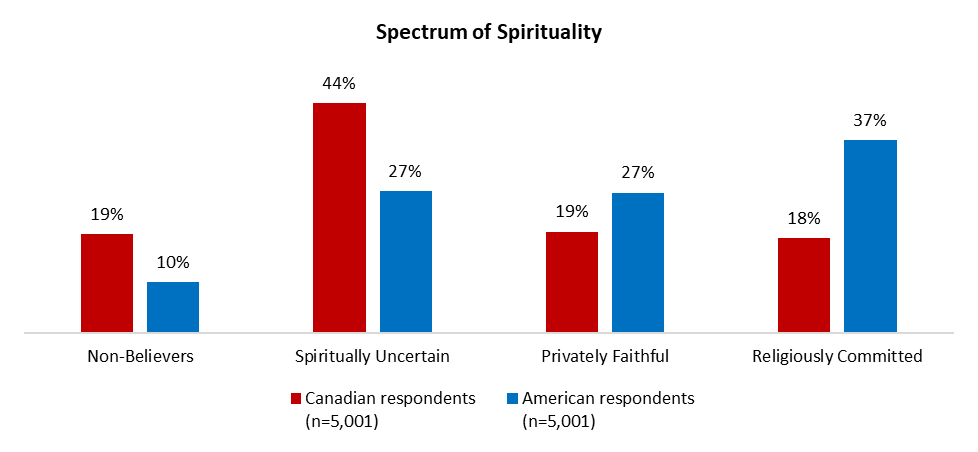
Canadians are far less religious than Americans according to the Spectrum: Americans are twice as likely (37%) to be Religiously Committed than Canadians (18%) and half as likely to be Non-Believers (10% in U.S.; 19% in Canada).
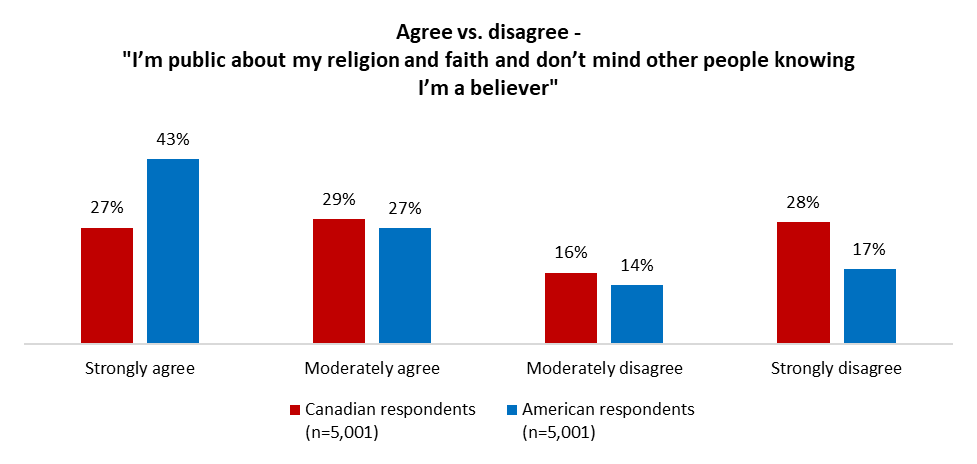
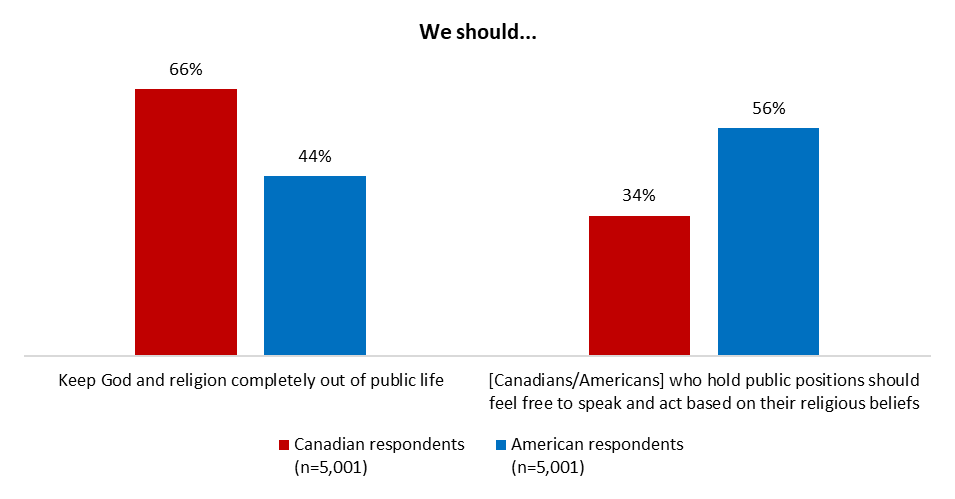
There are also clear dividing lines between the two countries when it comes to faith in the public square. Americans are much more likely to say they are public about their faith (70%) than Canadians (56%), and more likely to believe that public figures should speak and act on their religious beliefs (56% in U.S.; 34% in Canada).
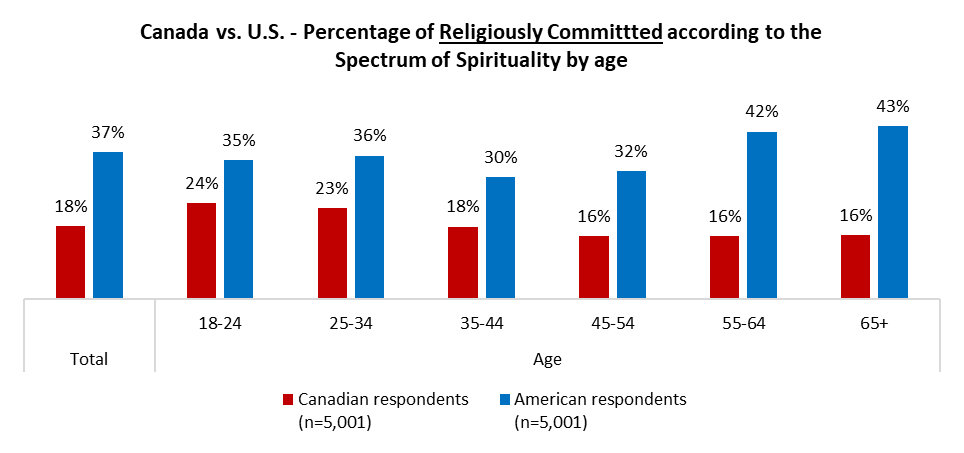
But there are some similarities. In the U.S., much has been made of data that show Generation Z is reversing a decline in religiosity observed between generations. That finding is echoed by these new data: Americans under 35 are less likely to be Religiously Committed than those older than 54 but show more religious tendencies than those between the ages of 35 and 54. In Canada, one-quarter (24%) of 18- to 24-year-olds fall into the Religiously Committed group according to the Spectrum, the most of any age group.
About ARI
The Angus Reid Institute (ARI) was founded in October 2014 by pollster and sociologist, Dr. Angus Reid. ARI is a national, not-for-profit, non-partisan public opinion research foundation established to advance education by commissioning, conducting and disseminating to the public accessible and impartial statistical data, research and policy analysis on economics, political science, philanthropy, public administration, domestic and international affairs and other socio-economic issues of importance to Canada and its world.
About Cardus
Founded in 1974, Cardus is a non-partisan think tank dedicated to clarifying and strengthening, through research and dialogue, the ways in which society’s institutions can work together for the common good.
INDEX
Introduction: The Spectrum of Spirituality
Part One: How does religiosity in Canada compare to the U.S.?
-
Belief in God and the afterlife
-
Faith in the public square
-
Religion and the day-to-day
Part Two: Cross-border comparisons of the Spectrum of Spirituality
-
By age
-
By gender
-
By household income and education
-
By political affiliation
Introduction: The Spectrum of Spirituality
In 2017, Cardus and the Angus Reid Institute developed the Spectrum of Spirituality to study Canadians’ mindsets on faith and spirituality. The Spectrum sorts Canadians into four broad segments: Non-Believers, Spiritually Uncertain, Privately Faithful and Religiously Committed. (Read more about the initial development of the Spectrum here).
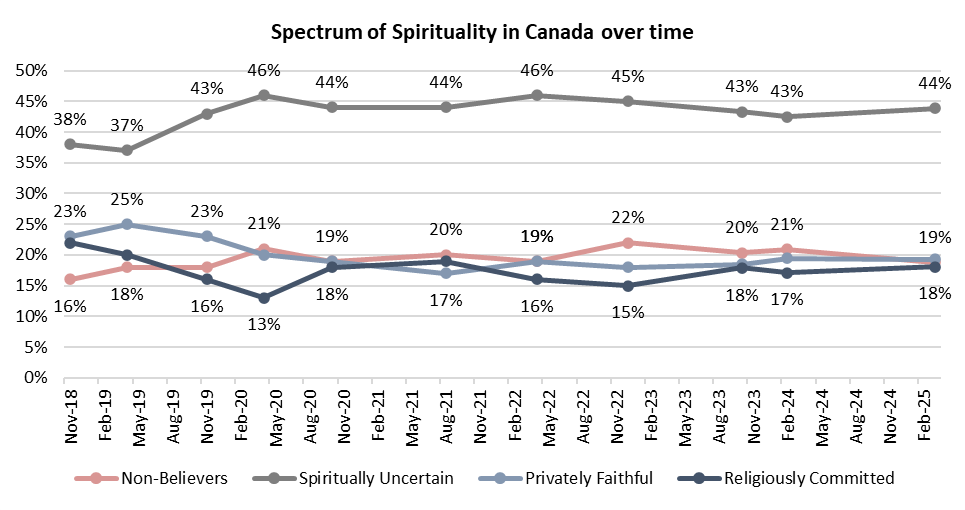
The largest group of Canadians is the Spiritually Uncertain, making up more than two-in-five of the population (44%). This group expresses doubts over the existence of God or life after death, but do not rule it out. However, three-quarters (77%) say they have feelings of faith and spirituality.
The three other groups make up near equal sized proportions: one-in-five (20%) are Non-Believers, while 18 per cent are Privately Faithful and 16 per cent are Religiously Committed.
The latter group, as the title suggests, near universally say religion is “very important” to their daily life (95%). Three-quarters (75%) say they pray to God or another higher power every day and a majority (57%) say they “experience God’s presence” daily.
While there have been subtle variations over time, the Spectrum has shown remarkable consistency over the years:
Part One: How does religiosity in Canada compare to the U.S.?
For the first time since the inception of the Spectrum of Spirituality, Cardus and the Angus Reid Institute fielded a parallel survey in the United States to gauge and compare responses between the two countries. Previous research has shown there is a big gap in religiosity in Canada and the United States. And these data find the same: Americans are much more likely than Canadians (27% vs. 14%) to say they attend religious services at least weekly, while Canadians are much more likely than Americans (42% vs. 30%) to say they never go.

Belief in God and the afterlife
There is also a gap in the number of Americans and Canadians who both believe God exists and are certain that’s the case. In fact, there are nearly as many Americans who say they “definitely” believe God exists (61%) as there are Canadians (64%) who say they do (36%) or might (28%) believe in the existence of God or a higher power. There are also nearly twice as many Canadians (36%) as Americans (19%) who doubt or reject the existence of a higher power:

The gap is smaller but still evident between Canadians and Americans on belief in the afterlife. Over time, a steady sized proportion of three-in-five Canadians report belief in the afterlife.
Related: Is there life after death? Majority of Canadians believe they may have more than one life to live
But that is outpaced by the nearly four-in-five (77%) Americans who say the same. Certainty is the existence of life after death is also much higher among Americans (49%) than Canadians (29%):

Faith in the public square
The difference between the U.S. and Canada when it comes to public proclamations of faith is evident in the two countries’ official mottos: for the U.S., “In God We Trust”; Canada’s is the Latin translation of “From sea to sea”. While the U.S. enshrined the separation of the church and state in its constitution – and Canada did not – in practice, the U.S. First Amendment has not prevented the American state from funding religious schools or allowing references to God in its official motto or Pledge of Allegiance.
Indeed, Americans are much more likely to say they are public about their faith (70%) than Canadians (56%):

Perhaps relatedly, Americans are also more open to people in public positions expressing and acting on their religious beliefs (56%) than Canadians (34%). Religion and politics rarely intercede in Canada and politicians typically avoid raising their beliefs on the campaign trail. Conversely, faith has played a persistent role in the White House.
Religion and the day-to-day
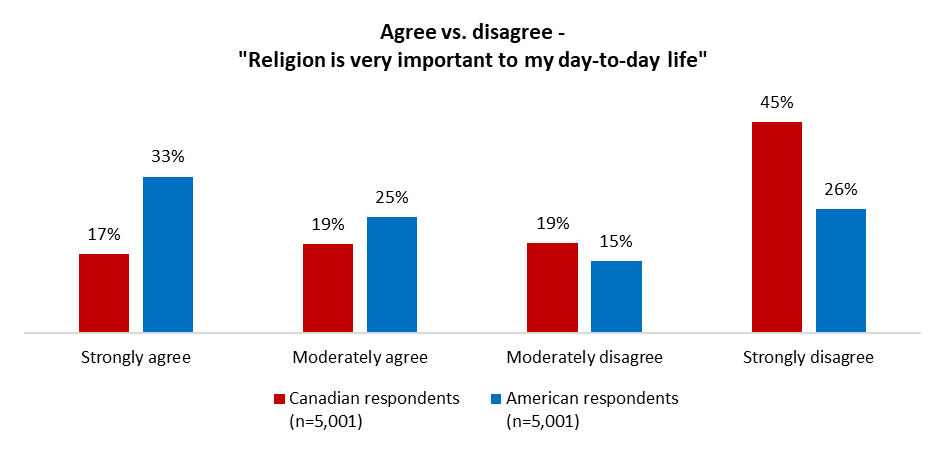
Most Canadians (64%) disagree that religion is important to their day-to-day life; approaching three-in-five Americans (58%) say faith plays a key role:
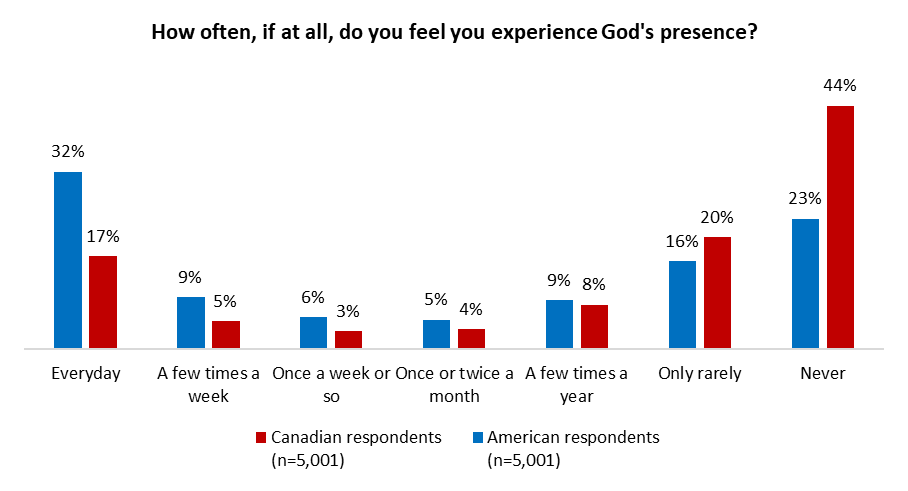
Americans’ closer relationship with faith and religion is also shown in how often they report experiencing God’s presence. For one-third (32%) of Americans, it is a daily occurrence, while another one-in-five (20%) say they experience God’s presence at least once a month. Canadians are nearly twice as likely (44%) as Americans (23%) to say they never experience the presence of God:
Part Two: Cross-border comparisons of the Spectrum of Spirituality
The gulf in religiosity between the countries is revealed when evaluating the whole of the Spectrum of Spirituality (see definition here). Two-in-five (37%) Americans are considered Religiously Committed by the Spectrum, double the number of Canadians in that group (18%). The number of Americans in the Non-Believers group (10%) is also half that of Canadians (19%).
What is notable is that on questions of religiosity not included in the index, there are many similarities between Canadians and Americans who fall in the same category of the Spectrum (see detailed tables for Canada; U.S.). But there are just many more Religiously Committed Americans than there are Canadians.
By age
Across all age groups, Americans are more likely to be Religiously Committed than Canadians. But there is a notable trend among the youngest adults in both countries. Canadians under 25 are the most likely (24%) to be Religiously Committed of any age group, followed by those aged 25 to 34 (23%).
While Americans older than 54 are the most religious according to the Spectrum (55-64s: 42%; 65+s: 43%), Americans under 35 appear to be more religious than those aged 35 to 54.
In the U.S., this has been noted as the reversal of a long decline from generation to generation of religious affiliation. Millennials have been labelled as the least religious American generation, but Zoomers don’t appear to be continuing that trend. These data are perhaps evidence that Canadian young adults are following their American counterparts towards a closer relationship with religion.

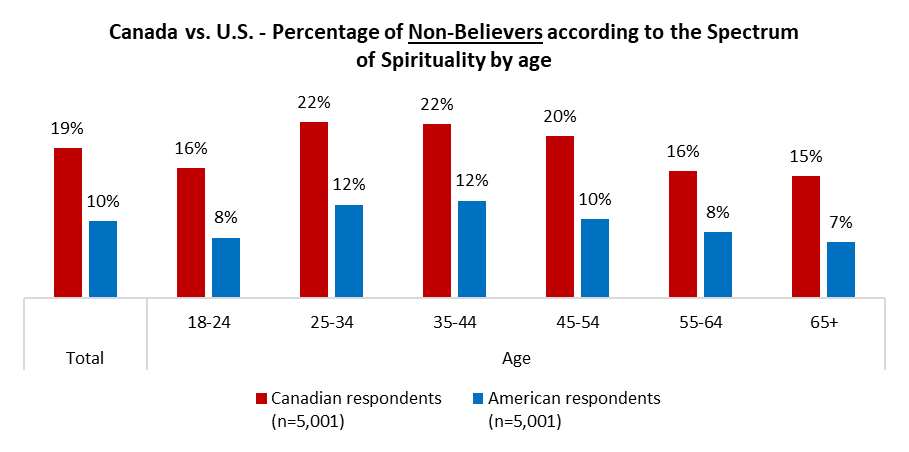
Looking at the other side of the Spectrum provides further evidence that young adults on both sides of the border are more open to religion than the generation that preceded them. Among both Americans and Canadians, those aged 25 to 44 are the most likely to be Non-Believers according to the Spectrum. The least likely are those older than 54, but the 18 to 24 age bracket is not far behind:
By gender
American men and women are distributed along the Spectrum of Spirituality at similar rates.
That’s not the case north of the border, where Canadian women are much less likely to be Non-Believers (16%) than men (22%):

By household income and education
In Canada, there is no meaningful difference between the percentage of Religious Committed according to the Spectrum by household income or education. In the United States, Americans with more education are more likely to fall into the Religiously Committed category of the Spectrum of Spirituality than those with less educational attainment. This echoes previously studies which found by some measures, highly educated Americans were more religious than others.

By political affiliation
On both sides of the border, those further to the political right are more likely to be Religiously Committed than other groups of party supporters. Notably, those who voted for the Democratic Presidential candidate, former Vice President Kamala Harris, are distributed along the Spectrum of Spirituality in similar proportions to past Conservative voters in Canada.
Current U.S. President Donald Trump has made strong overtures to religious Americans during his campaigns and while in office. Half (51%) of those who voted for him in 2024 fall into the Religiously Committed category on the Spectrum of Spirituality:

Survey Methodology:
The Angus Reid Institute and Cardus conducted an online survey from March 12-21, 2025, among a randomized sample of 5,001 Canadian adults who are members of Angus Reid Forum. The sample was weighted to be representative of adults nationwide according to region, gender, age, household income, and education, based on the Canadian census. For comparison purposes only, a probability sample of this size would carry a margin of error of +/- 1 percentage points, 19 times out of 20.
ARI and Cardus conducted a second online survey from March 12-21, 2025, among a randomized sample of 5,001 American adults who are members of Angus Reid Forum. The sample was weighted to be representative of adults nationwide according to region, gender, age, household income, and education, based on the American census. For comparison purposes only, a probability sample of this size would carry a margin of error of +/- 1 percentage point, 19 times out of 20.
Discrepancies in or between totals are due to rounding. The survey was self-commissioned and paid for jointly by ARI and Cardus.
For more information on our polling methods, click here.
For detailed results in Canada by age, gender, region, education, and other demographics, click here.
For detailed results in Canada by the Spectrum of Spirituality, click here.
For detailed results in the U.S. by age, gender, region, education, other demographics and the Spectrum of Spirituality, click here.
For PDF of full release, click here.
For questionnaire, click here.
MEDIA CONTACTS:
Shachi Kurl, President, ARI: 604.908.1693 shachi.kurl@angusreid.org @shachikurl
Daniel Proussalidis, Director of Media and Public Relations, Cardus: 613.899.5174 dproussalidis@cardus.ca