


Vast majority say Canada would be worse off without Alberta and Saskatchewan amid separation talk
May 14, 2025 – Prime Minister Mark Carney unveiled a new cabinet this week, but some of the key challenges for he and his ministers (and secretaries) are hardly unfamiliar.
Central among these will be assuaging separation movements in the Prairies by setting the agenda for resource development and environmental management. These priorities come to a head in perhaps no more obvious way than in dealing with new demands from Alberta Premier Danielle Smith.
New data from the non-profit Angus Reid Institute finds Canadians offering competing views of how to handle a suite of requests from Smith.
On some, residents offer a relatively clear preference for appeasing the premier and her province. Three times as many support than oppose offering Alberta guaranteed access to the east and west coasts for oil exports.
Canadians, and British Columbians more particularly, are less enthusiastic about repealing a ban on oil tanker traffic on B.C.’s northern coast, however, though a plurality do support this concept.
Further, Canadians are divided equally on each side of one of the key demands from Smith, repealing of the Impact Assessment Act, Bill C-69, also known as the “no new pipelines” law in some circles.

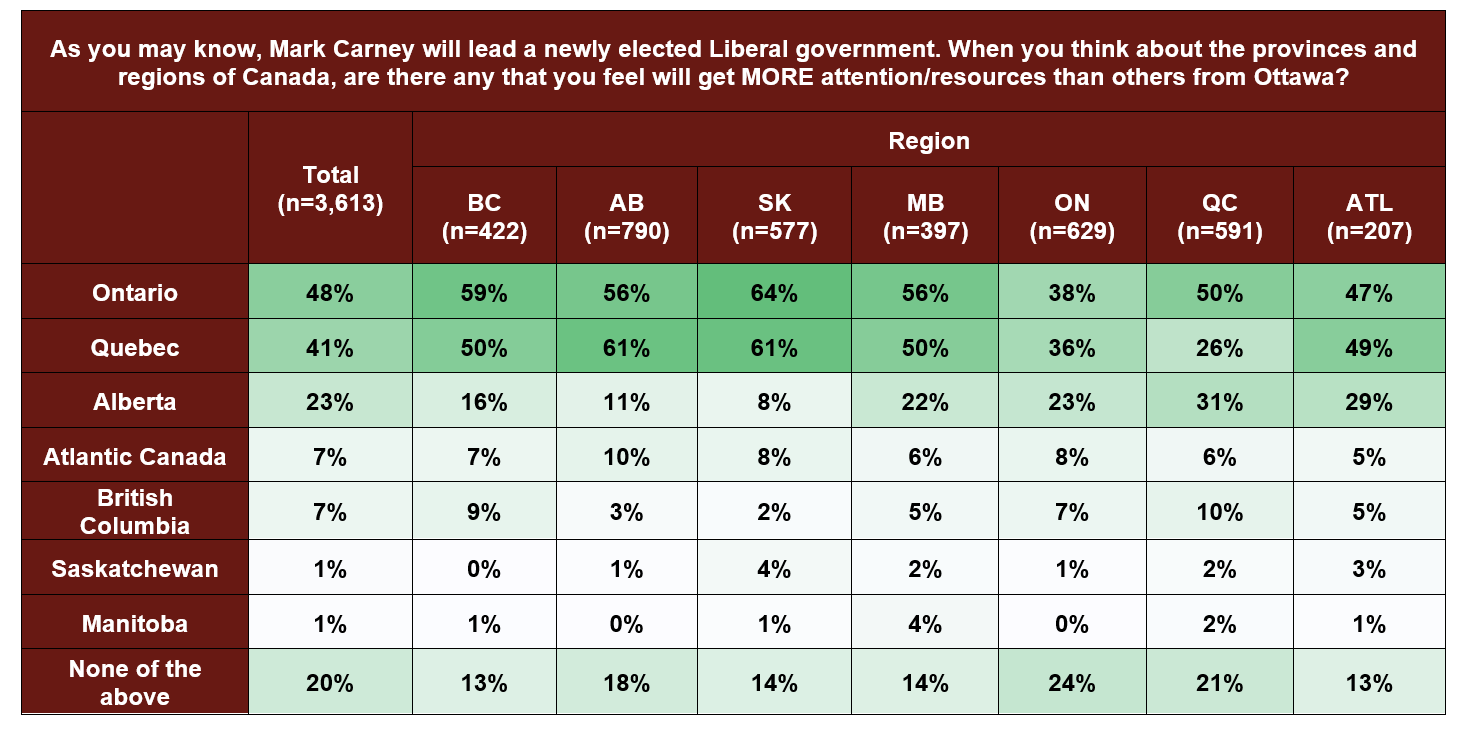
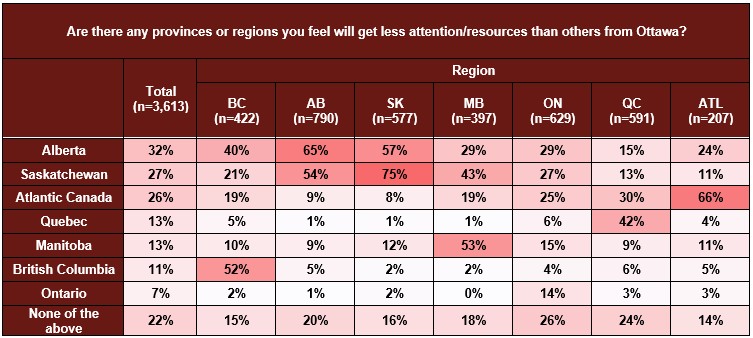
These tensions represent the micro of a macro issue in Canada, that is, the sense among many west of Ontario that Ottawa cares more about the priorities of central Canada than Alberta and Saskatchewan. Angus Reid Institute asked Canadians which provinces they feel will get greater attention and resources from the new Carney government (Ontario 48%, Quebec 41%) and which will get less (Alberta 32%, Saskatchewan 27%), finding regional perceptions largely following this intuition.
All told, Carney’s lift will be heavy in the early months. One-quarter of Canadians (24%) say the separation discussions burgeoning in Alberta and Saskatchewan are a national crisis, while half say they’re a problem (52%), but not at crisis level. Approaching one-in-five (17%) say this is just a passing phase.
More Key Findings:
- Asked how they feel about separatist sentiments in Alberta and Saskatchewan, Canadians are more hostile than they are sympathetic. Hostility is highest in Atlantic Canada (57%) and Ontario (52%).
- Separation in B.C. and Manitoba? One-in-10 in both provinces would “definitely” vote to leave, fewer than the number in Alberta (19%) and Saskatchewan (15%) who say the same
- Desire for separation in every province is driven primarily by those who supported the Conservative Party in April federal election
INDEX:
Part One: New government and Alberta’s demands
- Regional expectations for a Carney government
- Most supportive of east-west oil and gas access, but not sold on repealing Bill C-69
Part Two: Who else wants a referendum?
- Some interest in B.C., Manitoba, Quebec
- “Leave” vote fails to reach two-in-five anywhere
Part Three: How the rest of Canada feels about Alberta and Saskatchewan separation
- Canadians are more hostile than sympathetic to separatist sentiment
- Separation talk seen as a problem, but not as a national crisis
- Vast majority say Canada would be worse off without Alberta and Saskatchewan
Part One: New government and Alberta demands
The act of filling their cabinet is always a balancing act for an incoming prime minister. There needs to be considerations of not only skills and qualifications, but also political concerns such as regional balance. The first cabinet for Prime Minister Mark Carney post election includes both familiar ministers from the cabinets of his predecessor Justin Trudeau, but also new faces as Carney tries to forge his own path separate from what had become an unpopular regime.
As has historically been the case for Liberal governments, Carney had far fewer few Prairie MPs to choose from relative to MPs from other regions. The 2025 federal election resulted in two Liberal MPs from Alberta, one from Saskatchewan, and a half dozen from Manitoba.
Carney’s cabinet, including the more junior secretary of state positions, features five members from B.C., one from Alberta, one from Saskatchewan, one from Manitoba, 14 from Ontario, nine from Quebec, six from Atlantic Canada and one from the territories.
Regional expectations for a Carney government
With that in the background, Canadians were asked whether they believe certain regions or provinces receive more attention from the federal government than others. Half selected Ontario (48%), while two-in-five (41%) believe Quebec receives more federal resources than other provinces. Both of those provinces are much more selected by others than within them.
As separatist clouds gather in Alberta, one-quarter (23%) of Canadians believe that province receives more focus from the federal government than others. This belief is highest in Quebec (31%) and Atlantic Canada (29%):
There is less agreement when it comes to the inverse of that question – whether there are provinces or regions that get less attention than others from Ottawa. People in every province or region in the country – except Ontario – are most likely to select their own than others. Overall, one-third (32%) of Canadians believe Alberta receives fewer federal resources than other provinces. Saskatchewan (27%) and Atlantic Canada (26%) are close behind:
Most supportive of east-west oil and gas access, but not sold on repealing Bill C-69
On May 5, Alberta Premier Danielle Smith addressed her province and sent a message to new Prime Minister Mark Carney and his Liberal government. Smith called on the government to undertake several significant changes, including giving Alberta guaranteed access to tidewater, repealing the ban on tanker traffic in Northern B.C., and changes to equalization payments among other items.
Canadians are more supportive of the concept of east-west oil and gas shipping access and changes to equalization for Alberta. Smith criticized the equalization formula for offering payments to larger and more productive provinces – B.C., Ontario, and Quebec. That said, B.C. received no equalization in 2024. Payments are determined by comparing a province’s fiscal capacity to the national average, and adjustments are made for population. The government in Newfoundland and Labrador has also recently called for a change to the program to help the smaller province.
Less popular are Smith’s requests to change federal laws and environmental programs. Canadians are divided about repealing the so called “no new pipelines law” – Bill C-69. Proponents say the law ensures that environmental, social, Indigenous and other interests are all considered, while critics say the review process makes large projects nearly impossible to build. Slight majorities would eliminate the law in Alberta and Saskatchewan, but not elsewhere. The same is true of Smith’s request to cancel plans to create a net zero electricity-system in the country by 2050:

Part Two: Who else wants a referendum?
A referendum on Albertan independence appears inevitable, whether this year or next after the United Conservative Party lowered the number of signatures needed to force a provincial vote on the issue. In Saskatchewan, Premier Moe said he won’t stand in the way of a referendum if that’s what the public wants. Separatist sentiment in both of these provinces were dissected in detail in part one of this series, but how far does this desire for expression of separatist will extend in Canada?
Some interest in B.C., Manitoba, Quebec
Angus Reid Institute asked the other “western” provinces about separatism to fully understand the unfolding dynamic, as well as Quebec, where a separation movement has simmered and boiled over at various times in Canada’s history. On the question of whether they would support a referendum on the issue, Quebec approach Alberta and Saskatchewan levels of enthusiasm, though none of the provinces are home to a majority who would like to see the question put to a vote. In British Columbia, 35 per cent would support a referendum, while 31 per cent say this in Manitoba:

“Leave” vote fails to reach two-in-five anywhere
The desire to separate is not overwhelming in any of the five provinces. Among those who are “definite” leavers, Alberta and Quebec take top spot at approximately one-in-five. In B.C. and Manitoba about half that would strongly like to see their province separate, while soft supporters boost up the total that would be open to leaving. In all five provinces, by far the most prominent view is a strong desire to vote against separation:

Canadians are more hostile than sympathetic to separatist sentiment
While these are provincial and regional conversations, the expressions of any separation movement have the potential to impact all Canadians. This has been in particular focus recently as some premiers have been more committed than others to a unified Canadian response to President Donald Trump’s threats.

Separation talk seen as a problem, but not as a national crisis
These sprouting separatist movements are viewed as a problem by most Canadians, but the belief that it is a national crisis is held by only one-quarter (24%). Those living in two of the provinces most likely to want to hold a separation referendum – Alberta and Saskatchewan – are also most likely to view the issue of separatism as a national crisis:

Vast majority say Canada would be worse off without Alberta and Saskatchewan
Few believe there would be a positive outcome for Canada’s economy if Alberta and Saskatchewan left confederation. At least seven-in-ten in every province in Quebec say that Canada’s standard of living would be worse off if Alberta and Saskatchewan separate. In Quebec, a majority, but a smaller one than elsewhere, agree:

METHODOLOGY
The Angus Reid Institute conducted an online survey from May 6-8 2025, among a randomized sample of 3,613 Canadian adults who are members of Angus Reid Forum. The sample was weighted to be representative of adults nationwide according to region, gender, age, household income, and education, based on the Canadian census. For comparison purposes only, a probability sample of this size would carry a margin of error of +/- 1.5 percentage points, 19 times out of 20. Discrepancies in or between totals are due to rounding. The survey was self-commissioned and paid for by ARI. Detailed tables are found at the end of this release.
For detailed results by age, gender, region, education, and other demographics, click here.
For PDF of full release, click here.
For questionnaire, click here.
MEDIA CONTACT:
Shachi Kurl, President: 604.908.1693 shachi.kurl@angusreid.org @shachikurl
Dave Korzinski, Research Director: 250.899.0821 dave.korzinski@angusreid.org
Image Credit – Facebook Mark Carney