

E.U., Mexico lead as choices for closer trade ties, Japan, South Korea & SE Asia further down the list
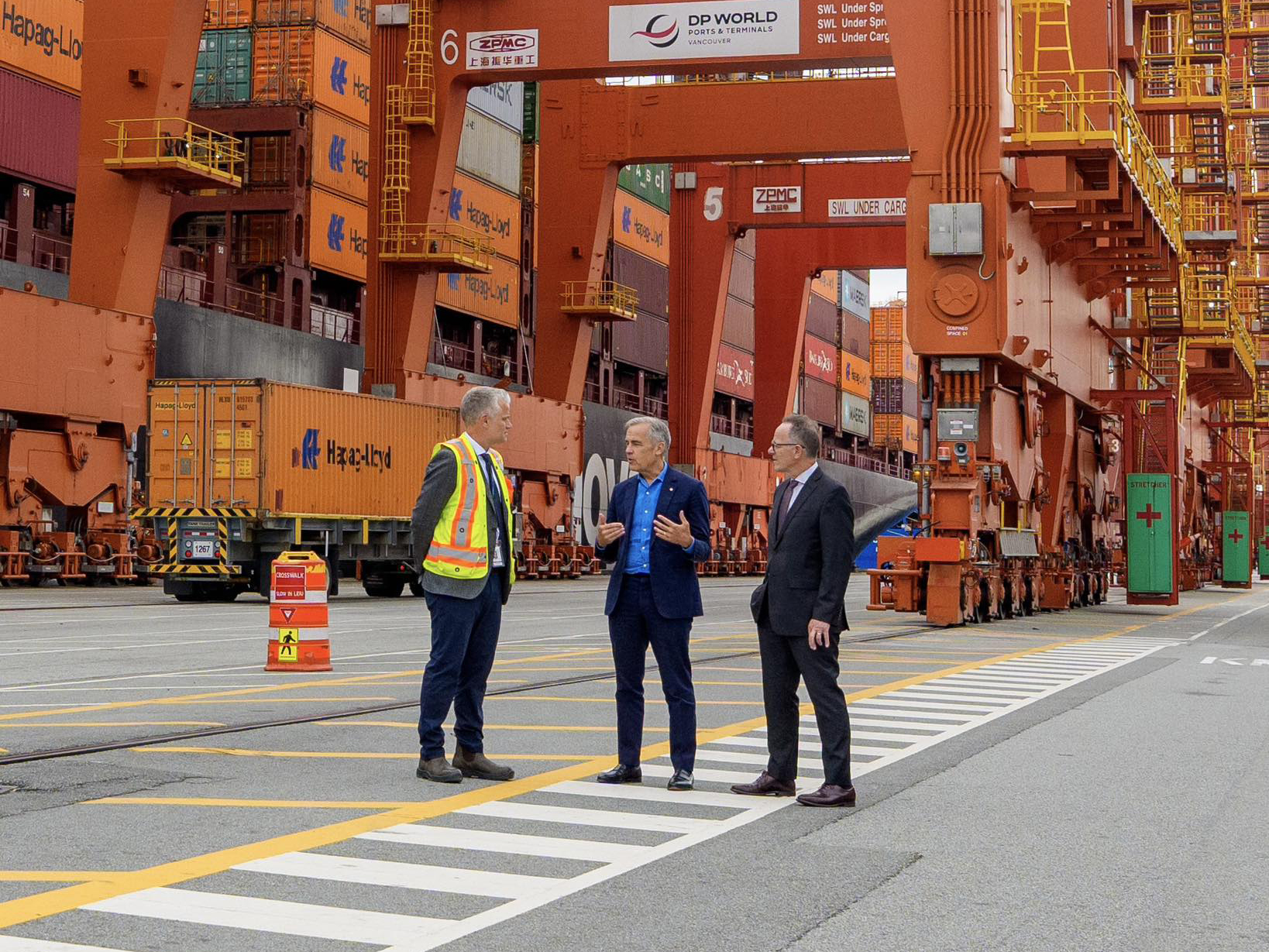
October 23, 2025 – As Prime Minister Mark Carney travels to Asia on a quest to build trade ties with more countries in the wake of an ongoing tariff war with the United States, new data from the non-profit Angus Reid Institute, in partnership with the Asia Pacific Foundation of Canada, finds favourable views from Canadians towards most Asian countries but little knowledge, especially when it comes to those in Southeast Asia.
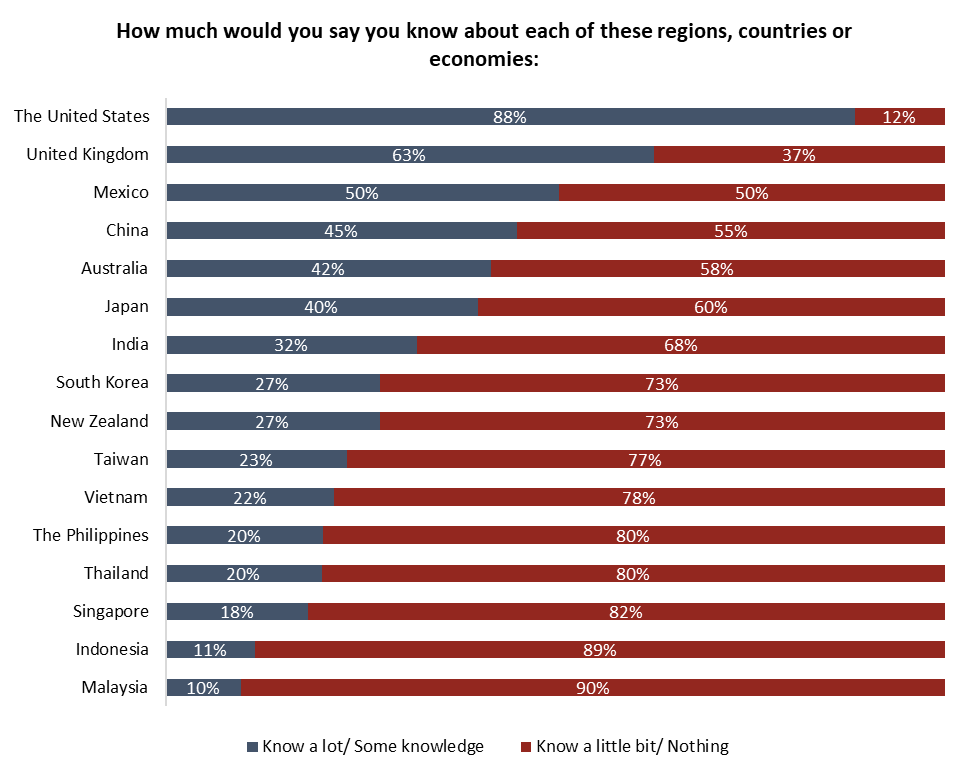
Carney plans to visit Malaysia, Singapore and South Korea. A majority of Canadians say they know little or nothing about each of those three countries (90%, 82%, 73% respectively). This extends to other potential partners in Asia, with most Canadians reporting little knowledge of Japan (60%), Taiwan (77%), Indonesia (89%), Thailand (80%) and Vietnam (78%).
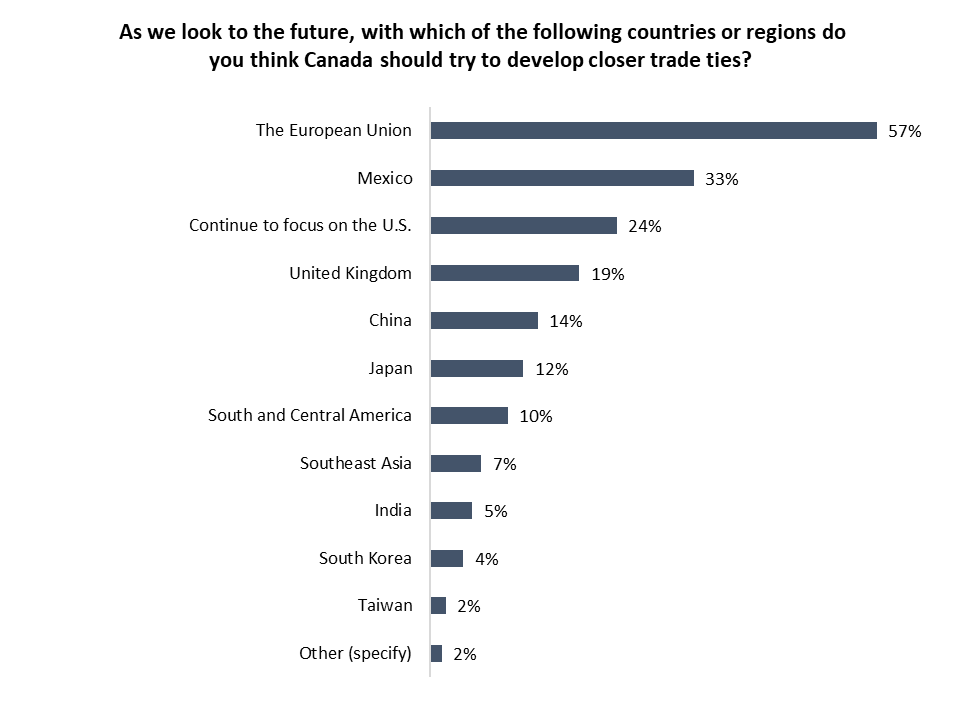
This lack of familiarity perhaps leads Canadians to look elsewhere when asked where they want their country to deepen trade ties. The top choice for closer trade connections is the European Union (57%), followed by Mexico (33%). More want Canada to continue focusing on the U.S. (24%) than explore potential trade avenues with Japan (12%), Southeast Asia (7%), South Korea (4%) or Taiwan (2%).
Still, there is evidently plenty of good will towards these countries from Canadians even if they lack knowledge. Across the board, excluding China, Canadians are more likely than not to want a friendly approach from their government towards countries in the Asia Pacific region.

More Key Findings:
- A high percentage of Canadians have favourable views of Japan (82%), Australia (80%), and New Zealand (77%). Favourability is lower, but still at a majority level for South Korea (62%), Taiwan (60%) and the Philippines (54%).
- Most say they view Japan (79%), South Korea (64%) and Taiwan (59%) as “as good a trade partner as any” rather than one Canada should do less business with.
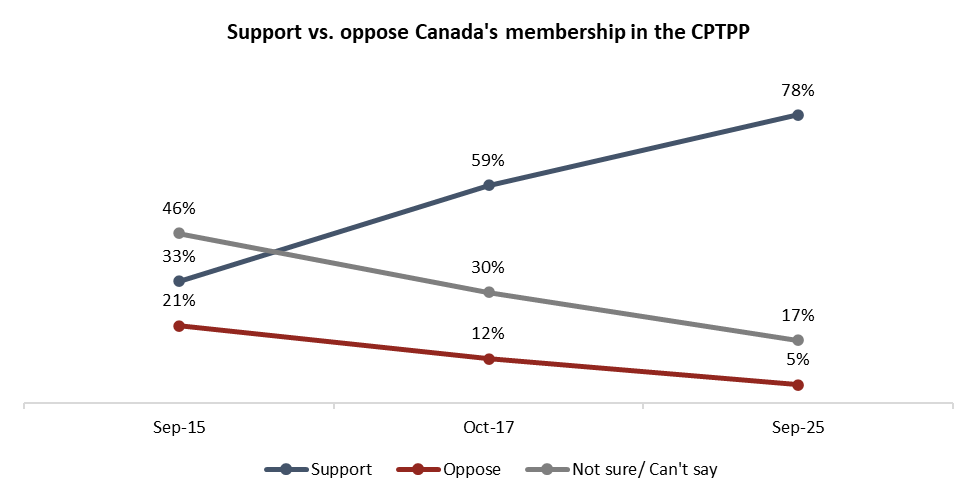
- Canada’s membership in the Comprehensive and Progressive Agreement for Trans-Pacific Partnership is supported by nearly four-in-five (78%), but few (2%) say they know ‘a lot’ about the trade deal signed in 2018. Most say they know nothing (70%).
- Three-in-five (57%) believe “Canada should focus on bilateral and regional network-building in Asia”.
About ARI
The Angus Reid Institute (ARI) was founded in October 2014 by pollster and sociologist, Dr. Angus Reid. ARI is a national, not-for-profit, non-partisan public opinion research foundation established to advance education by commissioning, conducting and disseminating to the public accessible and impartial statistical data, research and policy analysis on economics, political science, philanthropy, public administration, domestic and international affairs and other socio-economic issues of importance to Canada and its world.
About Asia Pacific Foundation of Canada
The Asia Pacific Foundation of Canada (APF Canada) is an independent, not-for-profit public institution focused on Canada’s relations with Asia. Its mission is to be Canada’s catalyst for engagement with Asia and Asia’s bridge to Canada. APF Canada is dedicated to strengthening ties between Canada and Asia through its research, education, and convening activities. APF Canada’s research provides high-quality, relevant, and timely information, insights, and perspectives on Canada-Asia relations for Canadians and stakeholders across the Asia Pacific. APF Canada also works with business, government, and academic stakeholders to provide Asia Competency training for Canadian organizations and students.
INDEX
Part One: Knowledge and favourability
-
Canadians say they know little of most countries across the Pacific
-
Japan leads the way, but views more favourable than not for most Pacific rim countries
-
Canadians want friendly approach from Carney government for most
-
Network building in Asia should be the focus, majority say
Part Two: Trade
-
Canadians positive towards more trade with South Korea, Japan
-
Preference for more familiar regions – E.U., North America – for further trade ties
-
Little knowledge of CPTPP deal but plenty of support
Part One: Knowledge and favourability
During the election campaign, the federal Liberals under Mark Carney promised to diversify Canada’s trading partners to offset the damage done by the trade war initiated by the United States under President Donald Trump. Now in the prime minister’s chair, Carney is setting his sights across the Pacific, travelling to Asia for the first time as Canada’s leader. He plans to visit Malaysia, Singapore and South Korea over a nine-day long trip that will include appearances at the Association of Southeast Asian Nations (ASEAN) Summit and the Asia Pacific Economic Cooperation (APEC) meeting.
Canadians say they know little of most countries across the Pacific
Back home, Canadians report little knowledge of the countries that are the focus of this partnership-building trip. Three-quarters say they know a little bit or nothing about South Korea (73%), the 14th largest economy in the world, while four-in-five (82%) say the same of Singapore and nine-in-ten (90%) say they know little if anything about Malaysia.
In fact, of the ASEAN member countries included in this survey, Canadians are most knowledgeable of Vietnam (22%), the Philippines (20%) and Thailand (20%). As a region, knowledge of Southeast Asia among Canadians is much lower than China (45%), Australia (42%) and Japan (40%):
Japan leads the way, but views more favourable than not for most Pacific rim countries
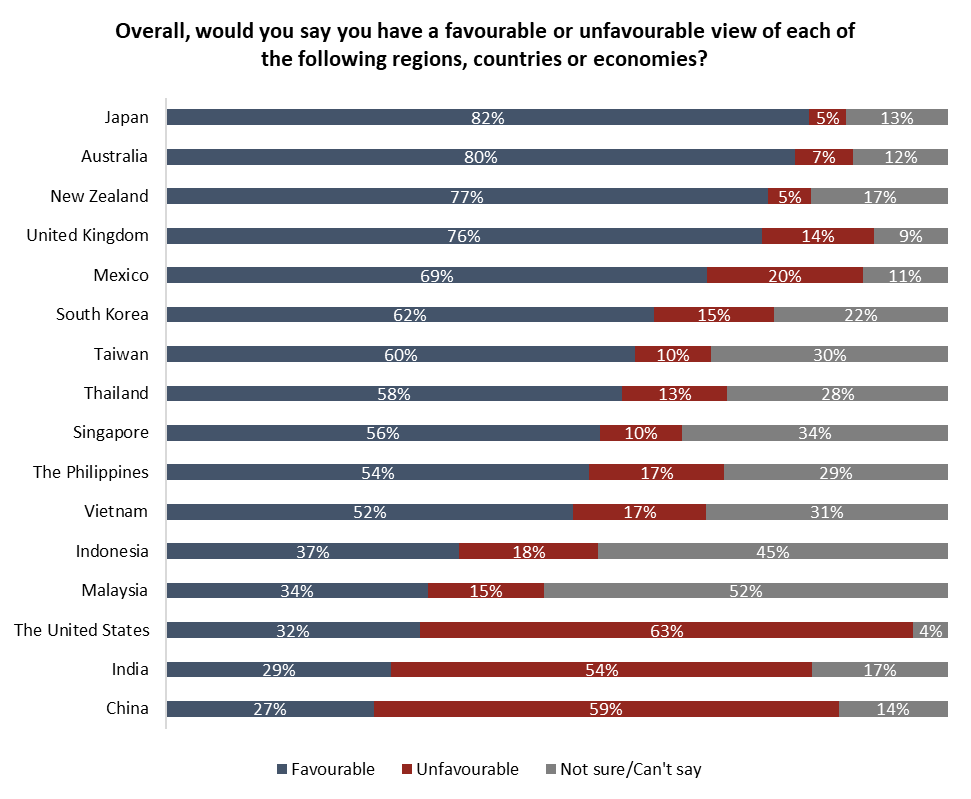
Despite a general lack of knowledge, Canadians’ views are more positive than not towards Southeast Asian countries and most of the Pacific Rim countries included in this survey. Japan (82%), Australia (80%) and New Zealand (77%) are the most favourably viewed, while a majority also have positive impressions of South Korea (62%), Taiwan (60%), Thailand (58%), Singapore (56%), the Philippines (54%) and Vietnam (52%). Many say they don’t know enough to say, but those that do are more positive than not towards Indonesia (37%) and Malaysia (34%).
Both receive more favourable views than nearby economic giants, China (27% favourable) and India (29%). For a deeper look into Canadians’ assessments of those two countries, please read the two earlier reports in this series:
- Half of Canadians say restoring diplomatic ties with India was ‘right move’ as economic issues take priority
- A slight thaw in the Sino-Canadian frost? Amid ongoing tension with the U.S., Canadian views of China warmer
Canadians want friendly approach from Carney government for most
As the Carney government reaches out to build economic partnerships across the Pacific, Canadians are more likely than not to want a friendly approach towards most Pacific-bordering countries. For Australia (88%), New Zealand (86%) and Japan (82%), an overwhelming majority of Canadians want a positive approach from their government to each. A majority believe that should also be the case for South Korea (67%), Taiwan (62%) and ASEAN members Thailand (61%), the Philippines (61%), Singapore (60%) and Vietnam (56%). There is less certainty when it comes to Indonesia and Malaysia, but Canadians are more likely to want a friendly approach in both cases than not.
Comparatively, and as noted in previous reports, Canadians express more desire for caution in their government’s approach to China and India:
Network building in Asia should be the focus, majority say
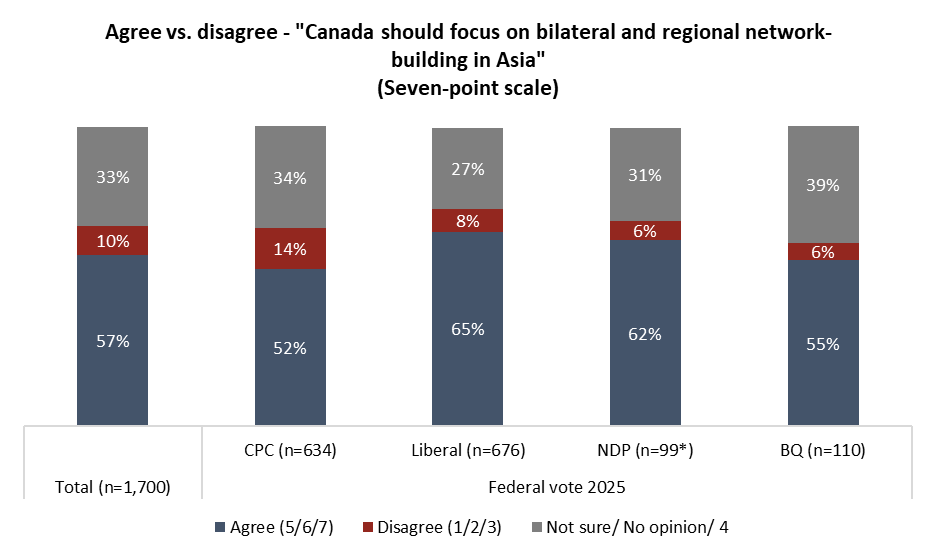
The goal of Carney’s Asia trip is to, among other things, “deepen trade relationships” and “unlock new opportunities for Canadian workers and businesses”, according to the release from the PMO. A majority (57%) of Canadians, including at least half of partisans of all stripes, believe their country should “focus on bilateral and regional network-building in Asia”:
Part Two: Trade
Canadians positive towards more trade with South Korea, Japan
Canada’s relationship with its largest trading partner – the United States – has been beset with barriers from the return of Trump to the Oval Office. It’s relationship with its second largest trading partner, China, also has had its share of issues, including tariffs. And while India may be a potentially large economy Canada can build trade with, the Canada-India relationship has recently been frosty.
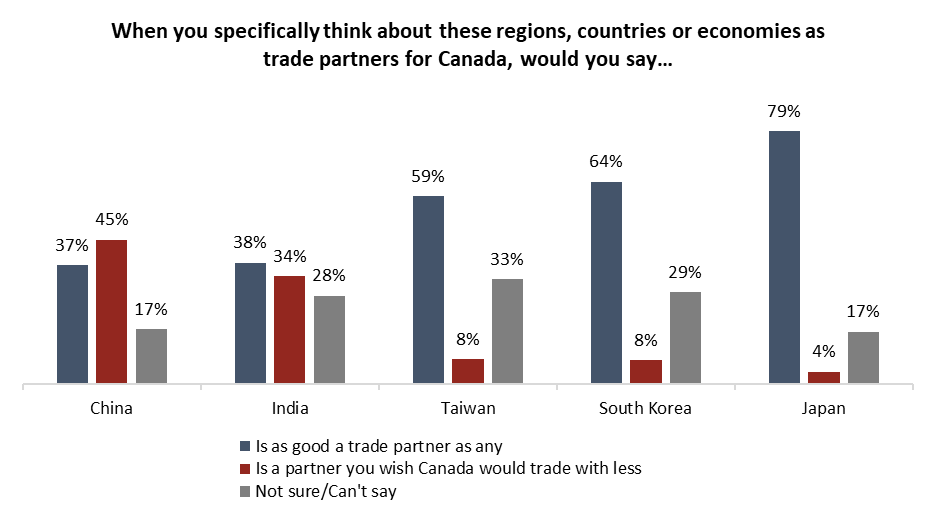
Both those latter nations draw reservations from Canadians when it comes to potential trade relations. Other large economies across the Pacific – Taiwan, Japan and South Korea – make up a fraction of current Canadian trade but are evidently areas Canadians are less hesitant to explore deeper ties. Most describe Taiwan (59%), South Korea (64%) and Japan (79%) as “as good a trade partner as any”, rather than one they wish Canada would trade with less:
Preference for more familiar regions – E.U., North America – for further trade ties
However, despite a general positive view of many Southeast Asian countries and perhaps owing to the lack of knowledge of those nations and their economic potential, Canadians prefer to look east rather than west when it comes to developing further trade connections. A majority (57%) believe Canada should develop closer trade ties with the E.U.; Mexico (33%), Canada’s partner in the USCMA trade agreement alongside the U.S., is the second most chosen option. Southeast Asia (7%) and Taiwan (2%) fall down the list.
In fact, depending on the options available, interest in further trade ties with Southeast Asia has declined over time:

Little knowledge of CPTPP deal but plenty of support
Canada has entered into a trade partnership with the Southeast Asian countries of Brunei, Malaysia, Singapore and Vietnam, alongside Australia, Chile, Japan, Mexico, New Zealand, Peru, and the United Kingdom with the Comprehensive and Progressive Agreement for Trans-Pacific Partnership (CPTPP). This trade agreement came into effect in 2018.
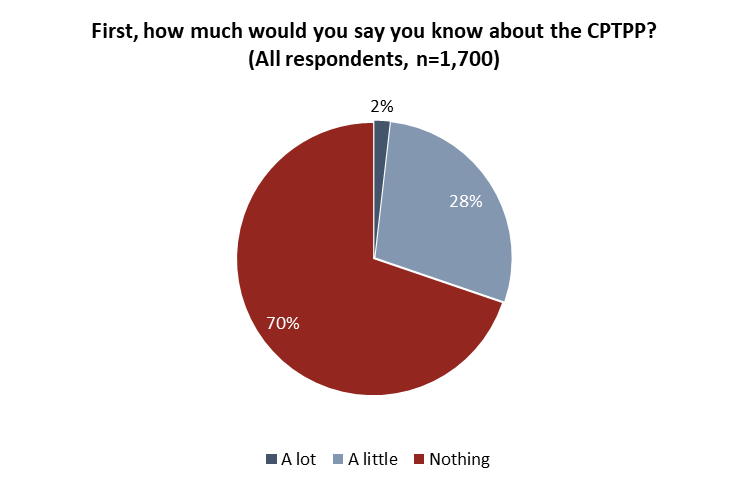
Seven-in-ten (70%) say they know nothing of this trade pact, while three-in-ten (28%) know a little and only a handful (2%) know a lot:
Still, support for Canada’s membership in the CPTPP has grown over time. In 2017, prior to the agreement being signed, three-in-five (59%) Canadians said they supported Canada’s potential membership in the trade deal. Eight years later, and seven years after its ratification, support has climbed to nearly four-in-five (78%):
Survey Methodology:
The Angus Reid Institute, in partnership with the Asia Pacific Foundation of Canada, conducted an online survey from Sept. 25-29, 2025, among a randomized sample of 1,700 Canadian adults who are members of Angus Reid Forum. The sample was weighted to be representative of adults nationwide according to region, gender, age, household income, and education, based on the Canadian census. For comparison purposes only, a probability sample of this size would carry a margin of error of +/- 2 percentage points, 19 times out of 20. Discrepancies in or between totals are due to rounding. The survey was commissioned and jointly paid for by ARI and APF Canada.
For more information on our polling methods, click here.
For detailed results by age, gender, region, education, and other demographics, click here.
For PDF of full release, click here.
For questionnaire, click here.
MEDIA CONTACTS:
Shachi Kurl, President, ARI: 604.908.1693 shachi.kurl@angusreid.org @shachikurl
Vina Nadjibulla, VP Research & Strategy, APF Canada: 917.593.1406 vina.nadjibulla@asiapacific.ca