


Nine-in-ten (87%) Canadians say they’re proud to see Canada represented at the Olympics. However, most (69%) don’t want a major city close to them to bid for the games. Perhaps that’s because the overwhelming majority (79%) believe the cost of hosting the Olympics is not worth it.

Equal numbers say the spying scandal embroiling the women’s soccer team is an embarrassment for Canada as a country (38%) and only Canada Soccer (42%). Few (12%) believe it’s “no big deal”.

Notably, those who have followed the scandal the closest are most likely to blame the coaches.

The Full Story
INDEX
Part One: Assessments of the Olympics
Pride in Canadian athletes, but little desire for their own city to bid on games
Scandals, commercialization diminish appeal for many
Part Two: The Canada Soccer drone
Few believe scandal not a ‘big deal’, two-in-five say it’s an embarrassment for Canada
Canadians most likely to blame coaching staff, few blame players
Equal sized groups say punishment ‘fair’ or ‘a little too harsh’
Part One: Assessments of the Olympics
There has been plenty to celebrate for Canada at the Olympics so far – including an incredible performance in the pool headlined by three golds for teenaged phenom Summer McIntosh and a positive start on the field led by golden performances by Canadian hammer throwers.
The CBC has brought wall-to-wall coverage of the Olympics to Canadians on TV and online, though the cost to the public broadcaster for the broadcast rights is not disclosed. Reportedly, more than a decade ago, the estimated cost for the rights for both the 2014 and 2016 games cost between $75 and $85 million. CBC owns the rights through the 2032 Olympics in what CBC described as not an “open bid” process. According to CBC, 74 per cent of Canadians tuned into some of the coverage of the 2020 Tokyo summer games, held in 2021 due to the pandemic, and 70 per cent into the 2022 winter Olympics in Beijing.
As these Paris summer Olympic games near their conclusion, half (52%) of Canadians say they are interested in the games, while the rest (48%) are not. Older Canadians are more likely to report interest than younger ones:

Pride in Canadian athletes, but little desire for their own city to bid on games
Most Canadians agree they feel a sense of pride when they see a Canadian athlete competing in Paris. Older Canadians are much more likely to strongly agree with this sentiment, while men under 55 are the most likely to disagree.
Pride in Canadian accomplishments are a driver of interest in the Olympics, it appears. Nearly all (98%) of those who say they are interested or very interested in the Paris Olympics say they are proud to see athletes from their country compete; fewer (64%) of those who are not at all interested agree (see detailed tables).

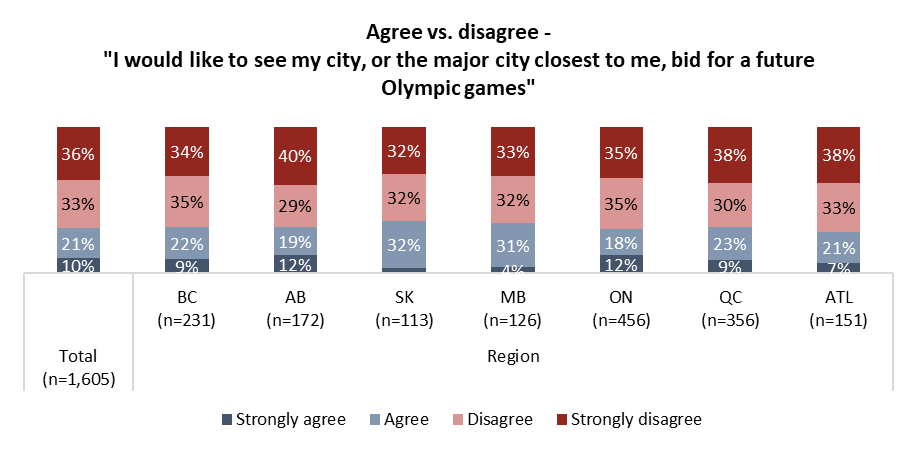
Still, despite this national pride Canadians feel during the Olympics, there are many who would prefer the games stay abroad. Those who say they would like to see a major city close to them bid for the Olympics (31%) are outnumbered by more than two-to-one by those who would not (69%).
In 2018, a bid for the Calgary Olympics was voted down by a plebiscite, with a majority voting against the city hosting the 2026 Olympics, which eventually were awarded to Milan, Italy. In 2022, the B.C. government decided not to support an Indigenous-led effort to bring the Winter Olympics back to Vancouver for 2030, after the city previously hosted the 2010 Olympics. The 2030 Winter Olympics will now be hosted in the French Alps.
Perhaps at issue for most Canadians is the prohibitive cost of hosting the games. Four-in-five (79%) agree that the Olympics “cost way too much to put on to be worth it for host cities” (see detailed tables).
Reportedly, the Paris Olympics will cost more than $10 billion USD to host, though organizers argue that is less than Summer Olympics in Rio de Janeiro, Tokyo and London have cost in previous years. The 2010 Vancouver Olympics cost between $7 and $9 billion CAD including the games themselves and the related projects, such as the Sea-to-Sky Highway expansion and the new SkyTrain line to the airport. Reportedly, when just looking at operating expenses, the 2010 Olympics broke even.
Scandals, commercialization diminish appeal for many
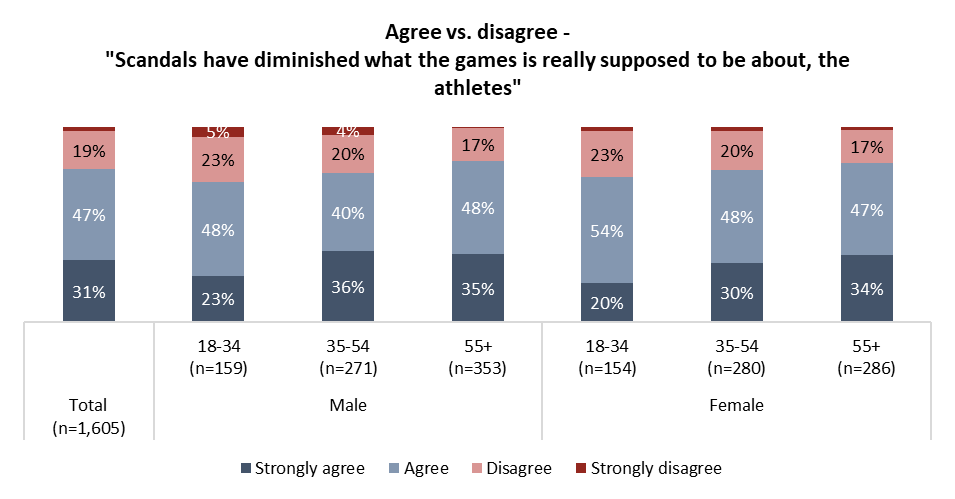
Besides the high financial cost of the games themselves, scandals have apparently diminished the Olympics in the eyes of many Canadians. Spying by the Canadian women’s soccer team is perhaps the most notable scandal so far of the Paris games – more on that in part two of this release. Other recent Olympics have been marred by doping allegations, bribery and bid-rigging. Most (78%) Canadians feel like these sorts of scandals have minimized athletic accomplishments at the Olympics in recent years.
Corporate sponsorships are rampant through TV broadcasts of the Olympics in Paris, though they play a role in financing the games – organizers of 2024 Olympics are hopeful these games will finance themselves. However rampant commercialization apparently takes the bloom off the Olympics for many Canadians. Seven-in-ten (69%) say the Olympic games have become more about sponsorships than athletic competitions. Notably, this sentiment is less common among those who describe themselves as “very interested” in the Olympics (45%) than those who say they are not interested at all (84%):

Part Two: The Canada Soccer drone
Despite a bevy of highs for Canada in Paris during the Olympics, the story of Canada’s games might be one of the lows – an early scandal embroiling Canada’s women’s soccer team.
The revelations that Canada’s soccer program had systematically spied on opponents dulled what was expected to be a highlight of the Olympics as the women’s team looked to defend their gold medal from the 2020 Tokyo Olympics. A majority of Canadians (59%) say they have been talking about the scandal, including a quarter (23%, see detailed tables) who say they have been following it closely as it unfolded alongside Canada’s run through the women’s soccer tournament which ended with the team eliminated by Germany in the quarterfinals.
Few believe scandal not a ‘big deal’, two-in-five say it’s an embarrassment for Canada
The sense from Canadians is that the scandal is an embarrassment, but they are split as to whether it is more embarrassing for Canada as a country (38%) or just Canada Soccer (42%). Those who feel it is not a big deal overall – one-in-eight (12%) – are severely outnumbered. Older Canadians are more likely to believe this incident has been an embarrassment for Canada as a country, while men under 35 are the most likely say the scandal has been overblown (18%):
Canadians most likely to blame coaching staff, few blame players
The players of the women’s national team have been adamant they were not involved. “It’s not us. We’re not cheaters. We’re damn good players,” defender Vanessa Gilles said in an emotional interview after the team beat the host nation France during the group stage of the tournament.
Canadians are much more likely to blame the coaching staff than the players. Half (53%) say the coaching staff deserves blame, while two-in-five (43%) point the finger at the head coach Bev Priestman, who was sent home from the tournament and suspended from coaching for one year as punishment. One-in-ten (9%) believe all of the players, the coaches and the Canada Soccer organization deserve the blame.
Notably, the closer someone has followed the story, the more likely they are to assign blame to the coaching staff specifically:
Equal sized groups say punishment ‘fair’ or ‘a little too harsh’
Besides the suspension of Priestman and two other assistant coaches, Canada was deducted six points from their total during the group stage of the competition, the equivalent of two wins and forcing the team to win all three group stage games to qualify for the knockout rounds. Near equal sized groups call the punishment “fair” (33%) and “a little too harsh” (30%), while one-in-five believe it went way too far (20%).
More than two-in-five (45%) 18- to 34-year-old men believe the punishment fit the scandal, the most of any age group. Older Canadians are more likely than others to say the punishment was “too harsh”:

Survey Methodology:
The Angus Reid Institute conducted an online survey from July 31 – Aug. 2, 2024 among a representative randomized sample of 1,609 Canadian adults who are members of Angus Reid Forum. For comparison purposes only, a probability sample of this size would carry a margin of error of +/- 2 percentage points, 19 times out of 20. Discrepancies in or between totals are due to rounding. The survey was self-commissioned and paid for by ARI.
For detailed results by age, gender, region, education, and other demographics, click here.
For detailed results by interest in the Olympics, click here.
For the full release including methodology, click here.
For the questionnaire, click here.
Jon Roe, Research Associate: 825.437.1147 jon.roe@angusreid.org