


However, majorities across political lines want more spending on health care, national defence
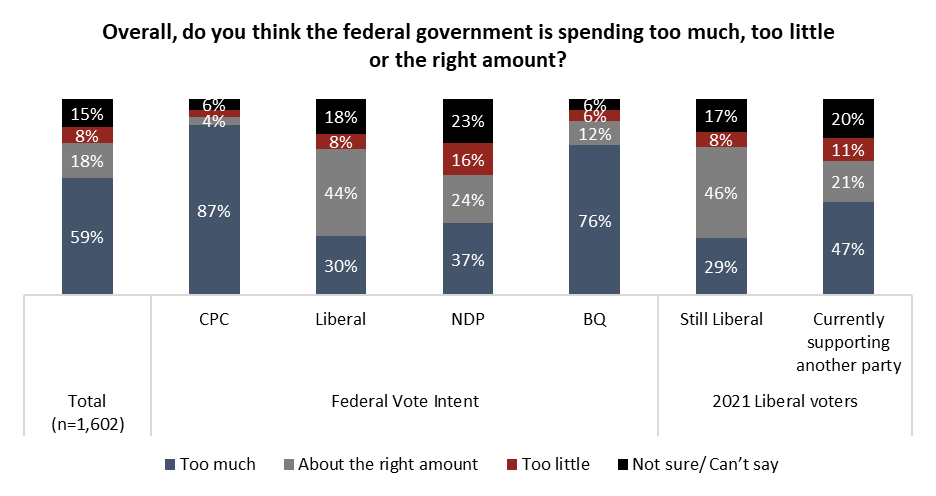
April 11, 2024 – Days ahead of a federal budget that’s had most of the mystery taken out of it with a series of high-profile spending announcements by the prime minister and senior members of his cabinet, new data from the non-profit Angus Reid Institute finds three-in-five (59%) Canadians saying even before the $18 billion in spending commitments were announced, federal finances had grown too large and that cuts are in order.
Political affiliation is key to understanding opinions of federal spending. Nine-in-ten (87%) current CPC voters say the federal government is spending too much overall. This from supporters of a party with a massive vote intention advantage.
Importantly, 2021 Liberal voters who still support the party are much less likely than those who have since changed their support to another party to say that government spending is too high (29% versus 47%). Still, that 29 per cent is nearly four times the proportion who say that they would spend more (8%). This suggests that the appetite for spending among Prime Minister Justin Trudeau’s previous supporters has waned considerably in the post-COVID environment.
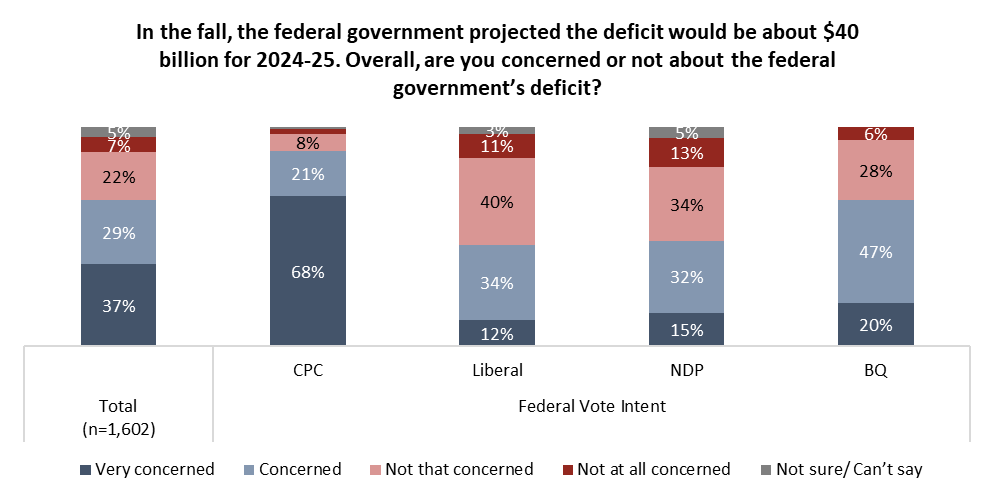
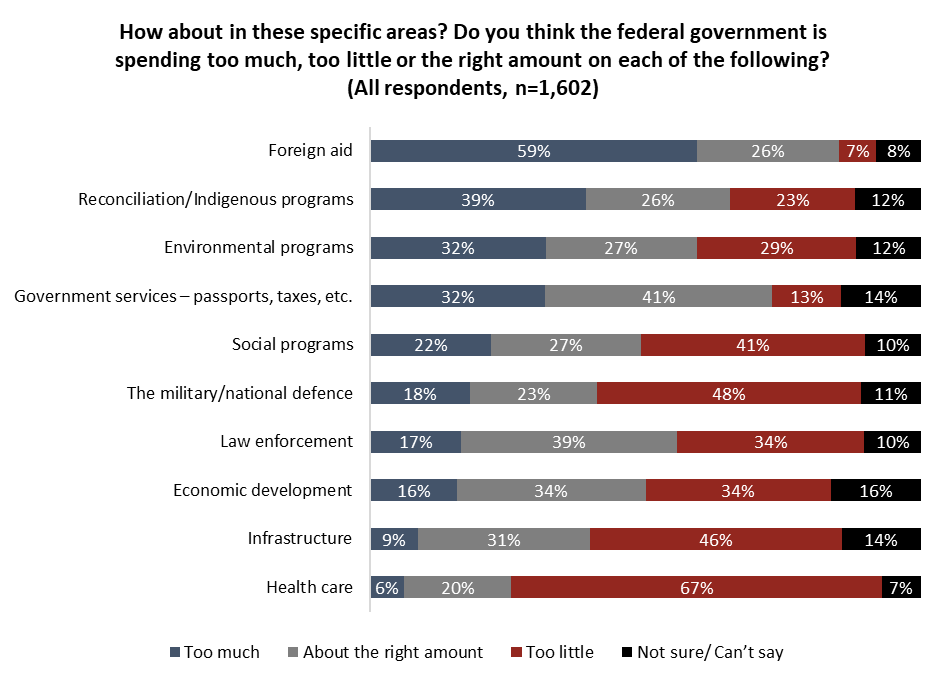
As Canadians eye growing federal government spending with some concern – two-thirds say they worry over the federal deficit – there are some areas where many would like to see cuts. Three-in-five (59%) would trim foreign aid. One-in-three or more also say that they would cut from government services (32%), environmental programs (32%) or Indigenous spending (39%).
That said, there are myriad other areas where Canadians say the federal government is not spending enough. Health care is an area where two-thirds (67%) would increase spending.
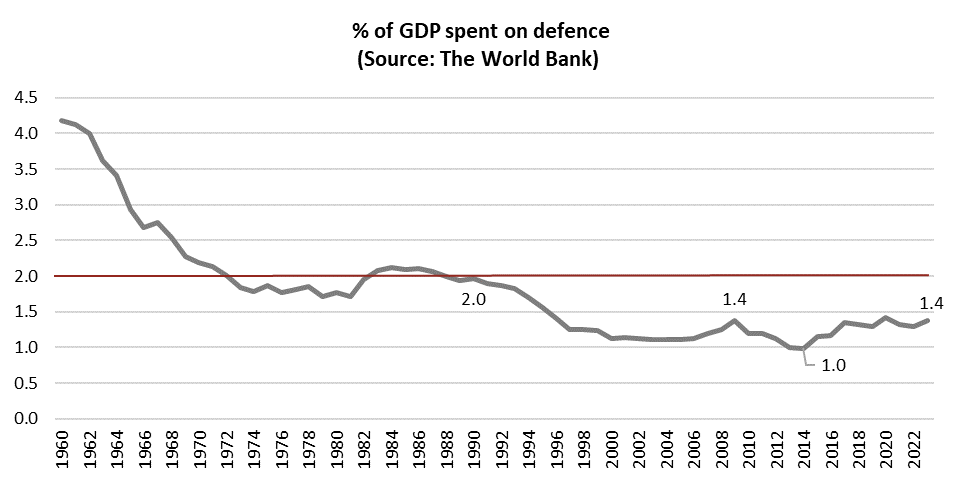
Further, half (48%) would increase spending on national defence – something the Liberal government announced on April 8 that it would do in the coming years. Canada has faced considerable pressure from NATO allies to spend two per cent of GDP on defence (something no Canadian federal government has done since 1991). New investments will bring spending from 1.4 per cent closer to 1.8 per cent.
Views of where to spend money also fall along political lines, with a few exceptions. All party supporters are more likely to say spending in health care should be increased and foreign aid should be decreased. There are sharp partisan divides, however, over Indigenous and environmental programs. While current CPC voters would cut from each, Liberal and NDP voters would sustain or increase them.

More Key Findings:
- Seven-in-ten (68%) current Conservative supporters say they are “very concerned” about the federal deficit, outnumbering current Liberal (12%), NDP (15%) and Bloc (20%) backers who say the same.
- At least half of all party supporters say they would follow through with both dental care and pharmacare, though they differ about how they would fund these programs.
About ARI
The Angus Reid Institute (ARI) was founded in October 2014 by pollster and sociologist, Dr. Angus Reid. ARI is a national, not-for-profit, non-partisan public opinion research foundation established to advance education by commissioning, conducting and disseminating to the public accessible and impartial statistical data, research and policy analysis on economics, political science, philanthropy, public administration, domestic and international affairs and other socio-economic issues of importance to Canada and its world.
INDEX
Part One: Federal government spending and deficit concerns
-
Most feel the federal government is spending too much
-
Majority say they’re concerned with federal deficit
Part Two: Policy priorities
-
Canadians say feds spend too much on foreign aid, not enough on health care
-
Liberals, Conservatives agree on increasing national defence spending
-
Those who say government spends too much still want more funds for health care
-
Most want to follow through on commitments, many would cut from existing programs
Part One: Federal government spending and deficit concerns
When the Trudeau government came to power in 2015, spending was a feature and a key promise, after years of tighter fiscal policy under the Harper Conservatives. After COVID-19, and amid historic inflation rates, whether spending was justified or not to guide the country through the crisis, criticism about it has grown. In 2015, Trudeau’s first year as prime minister, spending as a percentage of GDP was 14.6 per cent. It has risen to 16.7 per cent in 2023:

Most feel the federal government is spending too much
Public opinion and economic data swim in different pools but the undercurrents of each may influence the other. Just as spending was supported in 2015, shifting sentiment may in part be propelling the CPC to its current vote intention advantage. Consider that nearly nine-in-ten (87%) who would vote for the Conservatives say the Liberals are spending too much.
Among 2021 Liberals, half of those who have left the party and say they would support another believe the government is too loose with its purse strings, 18 points higher than those who say they would vote for the party again. Among this latter group, half say the government is spending the right amount (46%) or even too little (8%):
Majority say they’re concerned with federal deficit
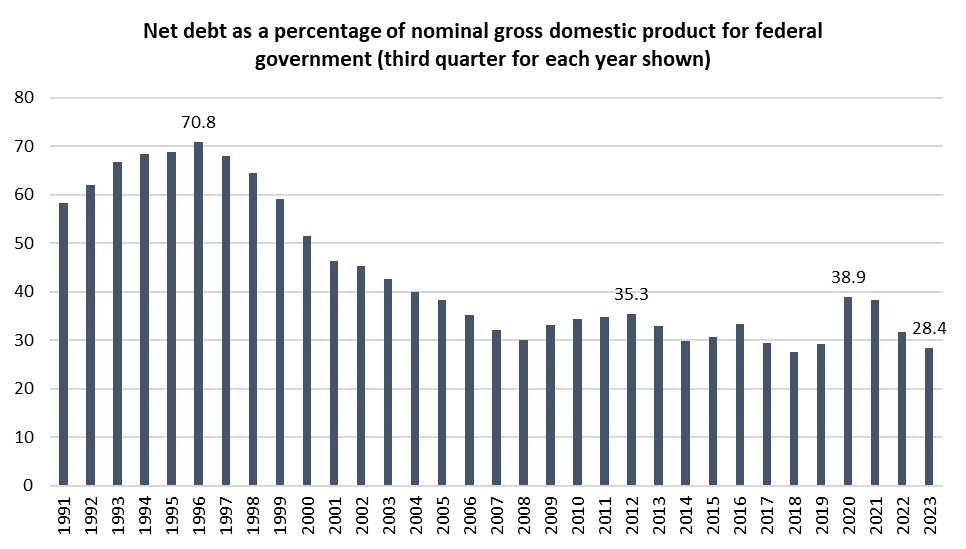
In the face of challenges related to the cost of living, climate change, health care, and housing affordability, concerns about the federal deficit have not risen to top issue status in ARI tracking. Still many Canadians have reservations. Asked specifically about their level of concern about the deficit, at least 46 per cent of all party supporters, and two-thirds of Canadians overall (64%) say they are concerned about Canada’s balance sheet. Canada’s accumulated deficit (debt) was reportedly $1.13 trillion at the end of 2021:
Canada’s net debt as a percentage of its gross domestic product shows year over year improvement from 2021 to 2023, with a significant spike in 2020 as spending increased and productivity was reduced. The Bank of Canada has recently warned that the country is seeing a productivity “emergency”. Productivity measures out in real gross domestic product per hour worked in the economy. This has dropped for six consecutive quarters. Economists continue to decry interprovincial trade barriers, weak research and development in the private sector, and other factors contributing to these challenges.
Meanwhile, there is some question as to whether the forthcoming budget will bring new taxes to pay for spending promises. Trudeau has only said taxes won’t be raised on the middle class, while Finance Minister Chrystia Freeland did not directly answer questions as to whether the budget will bring new taxes on corporations or wealthy Canadians, raising concerns from business groups.
Concern about the deficit registers at 63 per cent or higher in every region and is relatively consistent across age and income levels. Notably, those least likely to show concern are university educated Canadians (view detailed tables).
Part Two: Policy priorities
With tension in the public over federal expenditures, priorities take on a heightened importance. Canadians have no shortage of ideas about where to spend or not spend tax dollars.
Canadians say feds spend too much on foreign aid, not enough on health care
One of 2023’s biggest spending commitments was a 10-year, $46-billion heatlh care package announced by the Liberals in February. Perhaps emblematic of the scale of Canada’s health care crisis, presented with a list of areas of spending and asked to say whether they would prefer the government spend more or less, Canadians are most likely to believe health care funding should be increased. Some files are particularly divisive. For example, a close to equal number say the federal government is spending too much, the right amount, and too little, on environmental programs. Foreign aid and reconciliation/Indigenous programs are most likely to be viewed as areas to cut.
The federal government announced this week that it would increase defence spending to 1.76 per cent of GDP, still short of the two per cent target recommended by NATO, but at the cost of an additional $8.1 billion over the coming five years. This is the second most likely file to be chosen by Canadians as underfunded (48%):
Canada’s international assistance spending has increased in recent years, in part due to the ongoing conflict in Ukraine, and COVID-19 response measures.
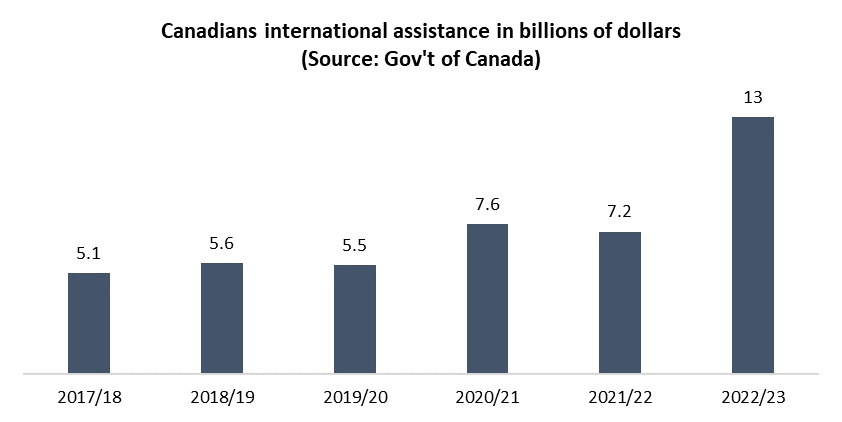
(Source: Government of Canada)
One of the key promises of the Trudeau government has been a commitment to Reconciliation and funding Indigenous programs. While former Assembly of First Nations national chief RoseAnne Archibald has claimed these programs continue to be underfunded, the expected expenditure estimates from government budgets have increased considerably:
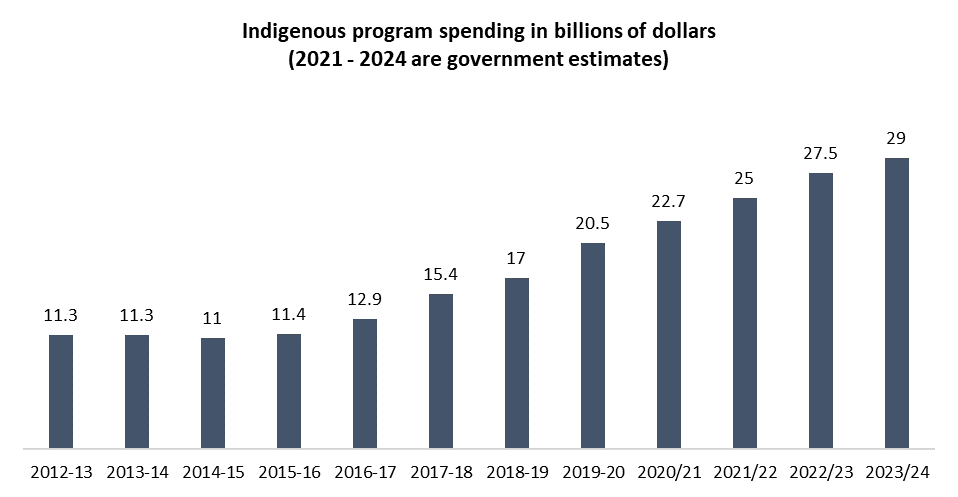
(Source: Government of Canada, Source: Fraser Institute, Source: Government of Canada)
Liberals, Conservatives agree on increasing national defence spending
Political agreements are few on priority areas. That said, among all party supporters cutting foreign aid spending and increasing health care funding are popular. A net measure, taking those who say the government is spending too much minus those who say too little, shows the scale of divergence. Conservative supporters are more critical of spending on foreign aid, environmental and Indigenous programs, while New Democrat supporters feel the government spends too much on law enforcement and national defence. That national defence file, however, is an area of agreement for both government and opposition supporters:

Those who say government spends too much still want more funds for health care
Notably, even among those who say the federal government is spending too much overall, the majority still say there should be more funding for health care. This group is also much more likely than others to say that the national defence spending budget is too small.

Most want to follow through on commitments, many would cut from existing programs
A new federal pharmacare program was announced in February. This followed an agreement on dental care in the fall, both were items on the NDP’s list of requirements for its support on Liberal confidence and supply measures. While details for the programs have been relatively sparse, they’re both programs that seven-in-ten Canadians would follow through on. Fewer, but still a majority, would follow through on a commitment made last July to spend two per cent of GDP on national defence as requested by NATO.
While affirming these programs is popular, using new taxation to furnish them is not. Canadians are much more likely to say that these programs should be funded with cuts to other areas, perhaps some of those discussed in the previous section of this release.

The federal government announced recently that it would increase defence spending to 1.76 per cent over the next four years. While this is significant increase in spending, it still does not reach the two per cent commitment that Canada has repeatedly promised to spend, though it is worth noting that no Canadian federal government has spent two per cent of GDP on defence since 1991:
Survey Methodology:
The Angus Reid Institute conducted an online survey from March 20-22, 2024 among a representative randomized sample of 1,602 Canadian adults who are members of Angus Reid Forum. For comparison purposes only, a probability sample of this size would carry a margin of error of +/- 2 percentage points, 19 times out of 20. Discrepancies in or between totals are due to rounding. The survey was self-commissioned and paid for by ARI.
For detailed results by age, gender, region, education, and other demographics, click here.
For detailed results by respondents’ beliefs on government spending and concern over the deficit, click here.
To read the full report, including detailed tables and methodology, click here.
To read the questionnaire, click here.
Image – Adam Scotti/PMO
MEDIA CONTACTS:
Shachi Kurl, President: 604.908.1693 shachi.kurl@angusreid.org @shachikurl
Dave Korzinski, Research Director: 250.899.0821 dave.korzinski@angusreid.org