


Just nine per cent of would-be voters say they support the Liberal party for what it stands for
January 22, 2024 – A new year is revealing a massive gap in enthusiasm between the two parties most likely to form government after the next federal election.
New data from the non-profit Angus Reid Institute finds the Conservatives maintain a significant advantage in both sheer vote intent numbers as well as motivation.
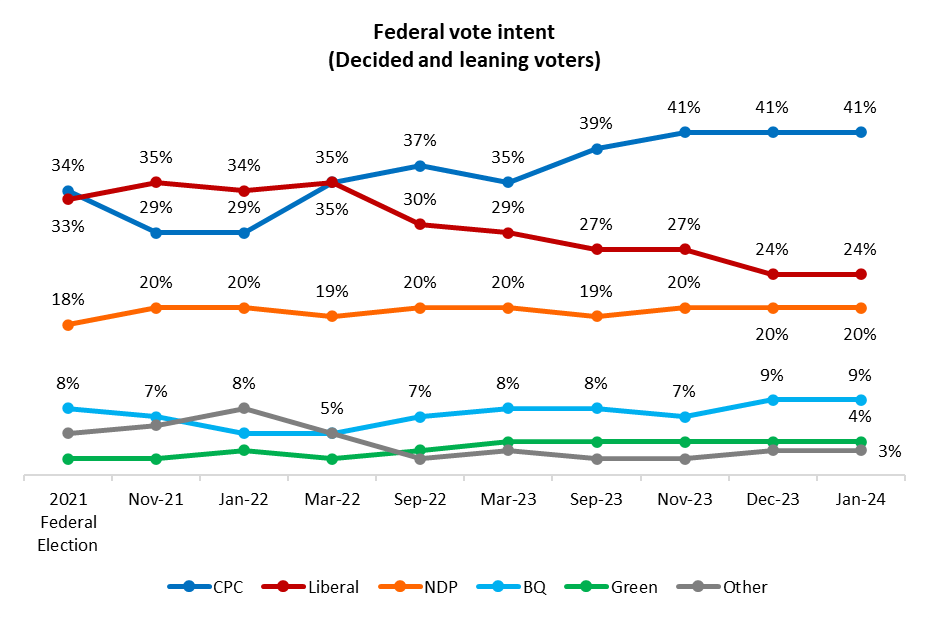
In a current election scenario, two-in-five (41%) would support Pierre Poilievre and the CPC while one-quarter (24%) would vote for Prime Minister Justin Trudeau and the Liberals. The Conservatives have maintained a double-digit vote lead since last September.
A look beyond the topline vote intention uncovers a significant gap in voter inspiration. Three-in-five (62%) CPC voters (one quarter of the electorate overall) say they intend to vote Conservative because they support the party, its leader and its policies, over blocking the formation of another Trudeau term. More disquieting for the Liberals: an inverse trend.
Three-in-five (63%) who intend to vote for Trudeau and the Liberals say they are much more motivated by stopping a CPC government rather than support for the party, leader, or policies. This means just nine per cent of the Canadian electorate is passionate about and inspired by the prospect of voting Liberal.
While a federal election is unlikely in the near term, the silver lining for the Liberals is that the CPC lead may not be as cavernous as it appears. More than one-third (36%) current NDP supporters and one-in-five (19%) current Bloc Québécois voters say they would switch their vote to the Liberals if the CPC were on the track to victory in an upcoming election. Others (30% of NDP supporters, 26% of BQ supporters) say it is something they would consider. In a world where the Liberals picked up these switchers, the gap between the two parties could narrow to seven points.
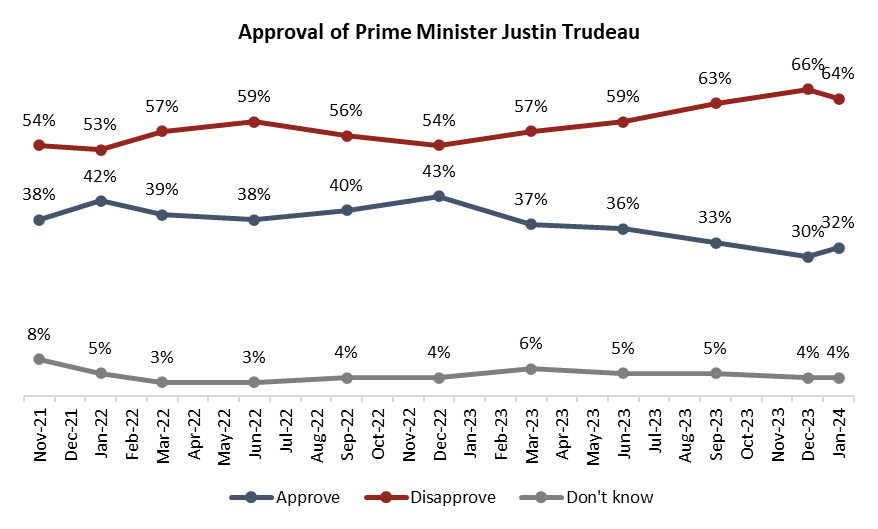
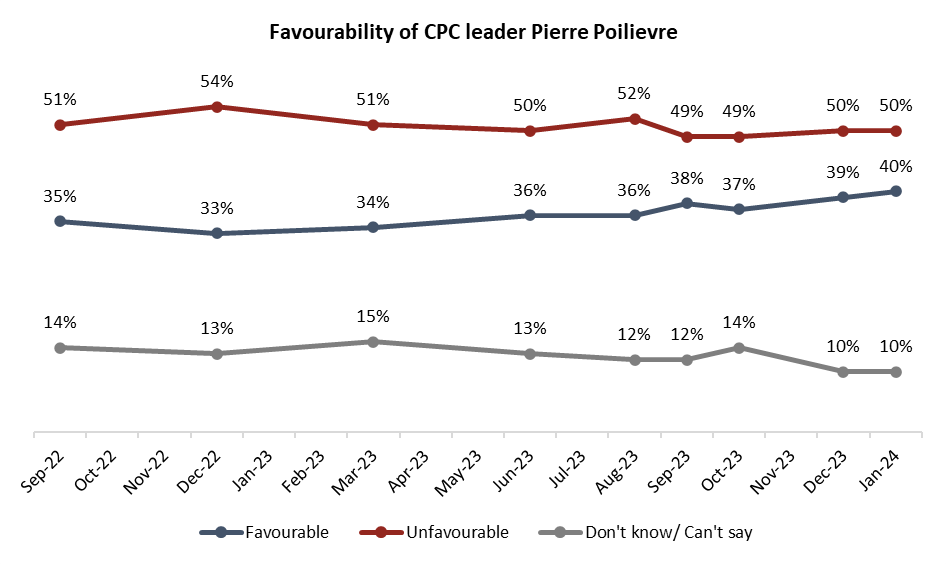
As the clock ticks down on this current government, both parties find themselves with leaders unappealing to much of the electorate. Two-thirds (64%) of Canadians, including at least three-in-five of men and women of all ages, say they disapprove of Trudeau. Poilievre fares better as two-in-five (40%) say they have a favourable view of the Conservative leader. However, there is a wide gender divide on the CPC leader. Poilievre is buoyed by men – a majority say they view him favourably – but is viewed poorly among women, who view him unfavourably by a two-to-one margin (57% unfavourable, 29% favourable).

About ARI
The Angus Reid Institute (ARI) was founded in October 2014 by pollster and sociologist, Dr. Angus Reid. ARI is a national, not-for-profit, non-partisan public opinion research foundation established to advance education by commissioning, conducting and disseminating to the public accessible and impartial statistical data, research and policy analysis on economics, political science, philanthropy, public administration, domestic and international affairs and other socio-economic issues of importance to Canada and its world.
INDEX
Part One: Vote intention
-
CPC leads in most of the country
-
Liberal retention continues to fall
Part Two: Voter motivation and strategic voting
-
In different ways, Poilievre motivates both Conservative and Liberal voters
-
One-quarter of non-CPC, non-Liberal voters would likely switch to block CPC
Part Three: Leadership favourability
Part One: Vote intention
The Conservative Party of Canada continues to enjoy a significant advantage over the Liberals in vote intention in the early weeks of 2024. Two-in-five (41%) Canadians say they would vote for Pierre Poilievre and the CPC if an election were held today, while one-quarter (24%) say the same of the Liberals. One-in-five say they would place their vote with the NDP. This represents a holding pattern for the major parties, with little movement since September last year:
CPC leads in most of the country
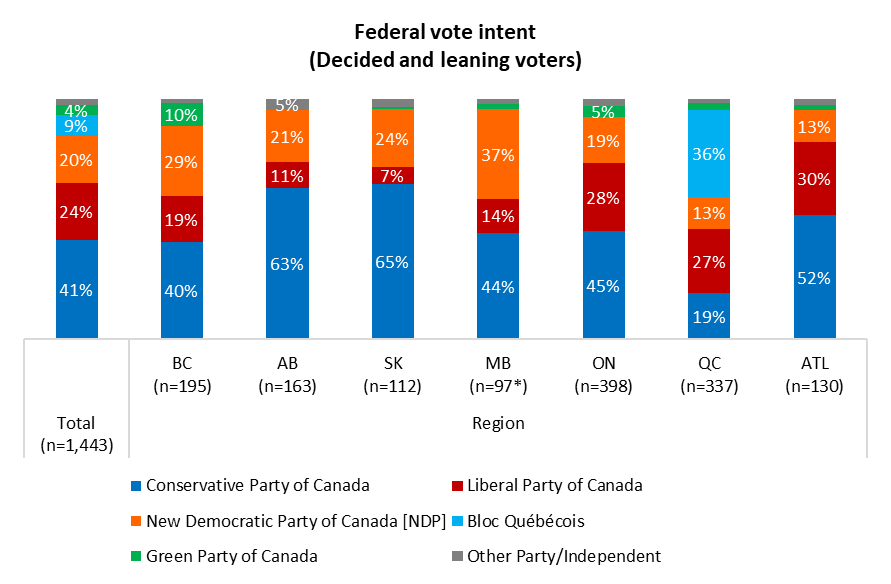
The Conservatives hold an advantage over the Liberals in all regions of the country except Quebec, where the Liberals trail the leading Bloc Québécois, and the CPC runs a distant third. The Liberals also find themselves behind the NDP in B.C., a province that has typically been a three-way race in recent years:
*Smaller sample size, interpret with caution
Once a strong point for Justin Trudeau and the Liberal Party, vote intention among women is now poor. At most, three-in-ten (31%) women older than 54 say they will vote Liberal. Support for the Liberals falls below one-quarter for other age and gender groups. Men of all ages are far more likely to be Conservative supporters:

Liberal retention continues to fall
The Liberals have much work to do to convince past supporters to return to the party. Fewer than three-in-five (57%) of those who voted Liberal in 2021 say they would repeat their vote for the party. Comparatively, nine-in-10 (90%) 2021 CPC voters and 67 per cent of 2021 NDP voters say the same, suggesting that the Liberals are dealing with a foundational issue heading into the next electoral contest.
For the Liberals, the most common destination is the NDP for those who have stopped supporting the party. One-in-six (16%) of 2021 Liberal voters say they now intend to vote NDP. The Conservatives, with one-in-eight (12%) past Liberal voters, are close behind:

Part Two: Voter motivation and strategic voting
In different ways, Poilievre motivates both Conservative and Liberal voters
While there certainly is a significant amount of distaste for Trudeau among the Canadian public, that does not appear to be the strongest motivating factor for those who intend to vote for the Conservative Party. Instead, three-in-five (62%) CPC supporters say they are more likely to vote because they want to support Poilievre and what the party stands for. Across the aisle, those who intend to vote Liberal view blocking Poilievre as stronger motivation. In fact, more than half of would-be Liberal voters say they are supporting the party to stop the Conservatives, more than out of an affinity for the Liberal vision:

One-quarter of non-CPC, non-Liberal voters would likely switch to block CPC
One wildcard in this equation is the potential for strategic voting. Many NDP voters appear to be willing to support the Liberals in the event the CPC are on the track to victory. More than one-third (36%) say they’d be likely to switch and a further three-in-ten say it’s something they’d consider. Others say it is unlikely (19%) or not going to happen (15%). This would be a catastrophic loss of support for Jagmeet Singh and his party, which increased its support from 16 to 18 per cent from 2019 to 2021.
Those who intend to vote Bloc Québécois are less open to switching to the Liberals to stop a potential CPC government, but still 35 per cent say either it’s a possibility (26%) or likely to happen (19%).

Overall, Likely Switchers – those who say they would most likely support the Liberals to prevent a Conservative government – make up approximately one-quarter of the non-CPC, non-Liberal vote (see detailed tables). If those voters did, indeed, “switch” in the proportions shown above the Liberal Party would find itself in a much more competitive situation, with 34 per cent of vote intention. That said, even in this case the party would trail by a seven-point margin.
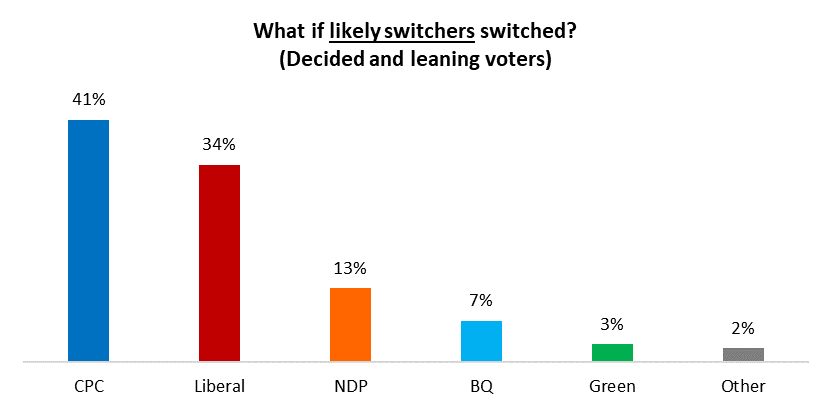
Notably, there remain another one-in-three non-CPC, non-Liberal voters who say it is “possible” they would switch. If this group supported the Liberals, they would be statistically tied with the CPC. There are many factors in play when it comes to Canadians’ vote intentions, but this suggests that the gap between the two parties may not be as large as it currently stands.
Part Three: Leadership favourability
Much has been made in January of a trip to Jamaica taken by Trudeau and his family over the holidays. Critics have claimed that the trip set a bad image for the PM as Canadians struggle with the cost-of-living crisis at home, and that the official line about where Trudeau stayed and how much it cost has changed a number of times. Others have noted that conflict of interest rules were considered and followed, and that Trudeau stayed with a family friend.
The ongoing debate has not had any observable impact on Trudeau’s approval, which remains hovering around three-in-10, largely unchanged in the past six months:
Poilievre, too, deals with high levels of disapproval. Half of Canadians have consistently held this view since he assumed the CPC leadership, and though his long-term trendline has improved in approval, he, too, has seen his ratings largely unchanged since the fall:
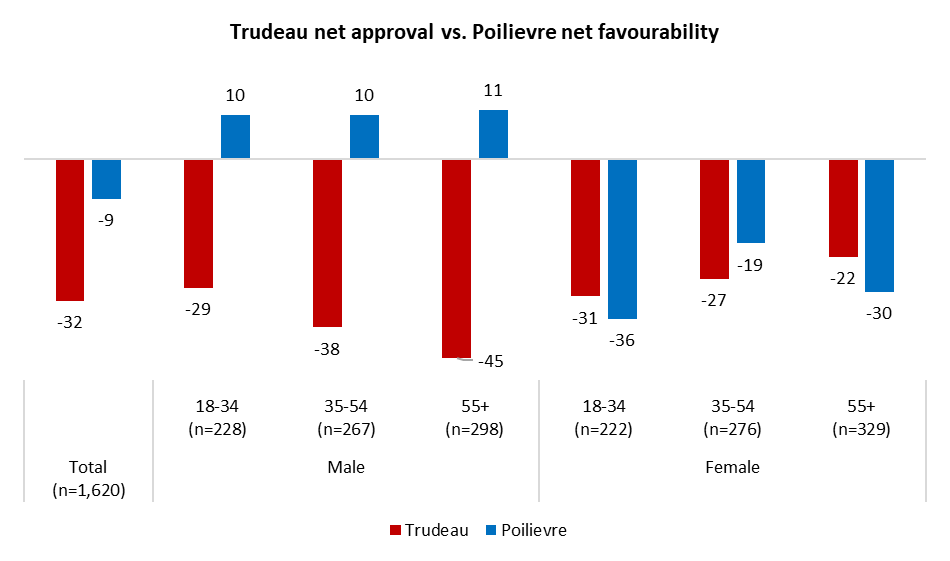
Across age and gender groupings, Poilievre has a clear advantage among men of all ages but joins Trudeau in struggling to resonate with women. The CPC leader nets out at a minus 36 when taking favourable minus unfavourable ratings among young women (34 and under), and a minus 30 among women over the age of 54. Meantime, Trudeau is a staggering minus 38 and minus 45 among men 35 to 54 and 55 and older. As noted previously, nearly half of young women (47%) and three-in-10 between the ages of 35 and 54 would currently vote for the NDP – the highest support levels for the party among age and gender combos:
Trudeau’s approval has declined across all demographics in recent years, but it his drop among women that is perhaps the most notable. From the onset of the pandemic in 2020 until September of last year, at least two-in-five women approved of Trudeau. Currently only one-in-three women approve of the prime minister:
Poilievre’s views among women has been consistently poor since he became leader of the Conservative party in September 2022. However, his views among those older than 54 have climbed:
Survey Methodology:
The Angus Reid Institute conducted an online survey from Jan. 16-17, 2024 among a representative randomized sample of 1,620 Canadian adults who are members of Angus Reid Forum. For comparison purposes only, a probability sample of this size would carry a margin of error of +/- 2 percentage points, 19 times out of 20. Discrepancies in or between totals are due to rounding. The survey was self-commissioned and paid for by ARI. Detailed tables are found at the end of this release.
For detailed results by age, gender, region, education, and other demographics, click here.
To read the full report, including detailed tables and methodology, click here.
To read the questionnaire, click here.
Image – Adam Scotti/PMO; John Lehmann/Pierre Poilievre Facebook
MEDIA CONTACT:
Shachi Kurl, President: 604.908.1693 shachi.kurl@angusreid.org @shachikurl
Dave Korzinski, Research Director: 250.899.0821 dave.korzinski@angusreid.org @davekorzinski