


Half say social media negatively affects them personally, while ¾ say the same its of impact on society
April 13, 2026 – Once hailed as the future and saviour of communication for society, the ills of social media have become readily apparent to many Canadians, even as they continue to like, share, and scroll.
New data from the non-profit Angus Reid Institute finds that Canadians are still overwhelmingly enmeshed in the social media environment, but that many aren’t sure about the impact it’s having on them, personally, and on broader society.
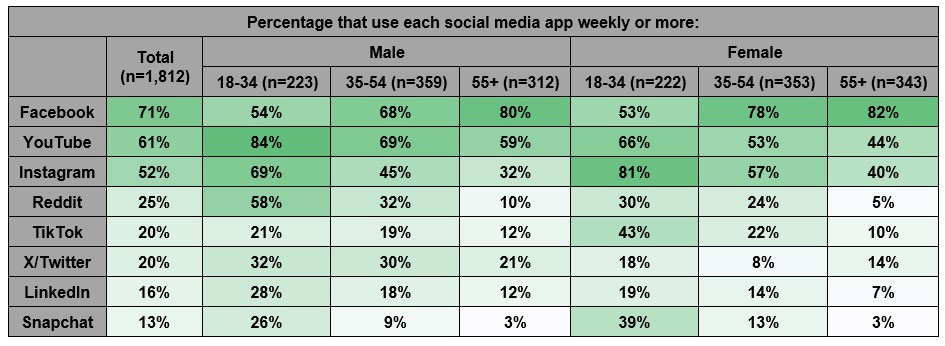
At least half say they use Instagram (52%), YouTube (61%), and Facebook (71%), multiple times per week. But three-quarters (74%) also say social media companies are having a net negative impact on society, while approximately three-in-10 users of both Facebook (28%) and Twitter (28%) say they dislike the experience of using each.
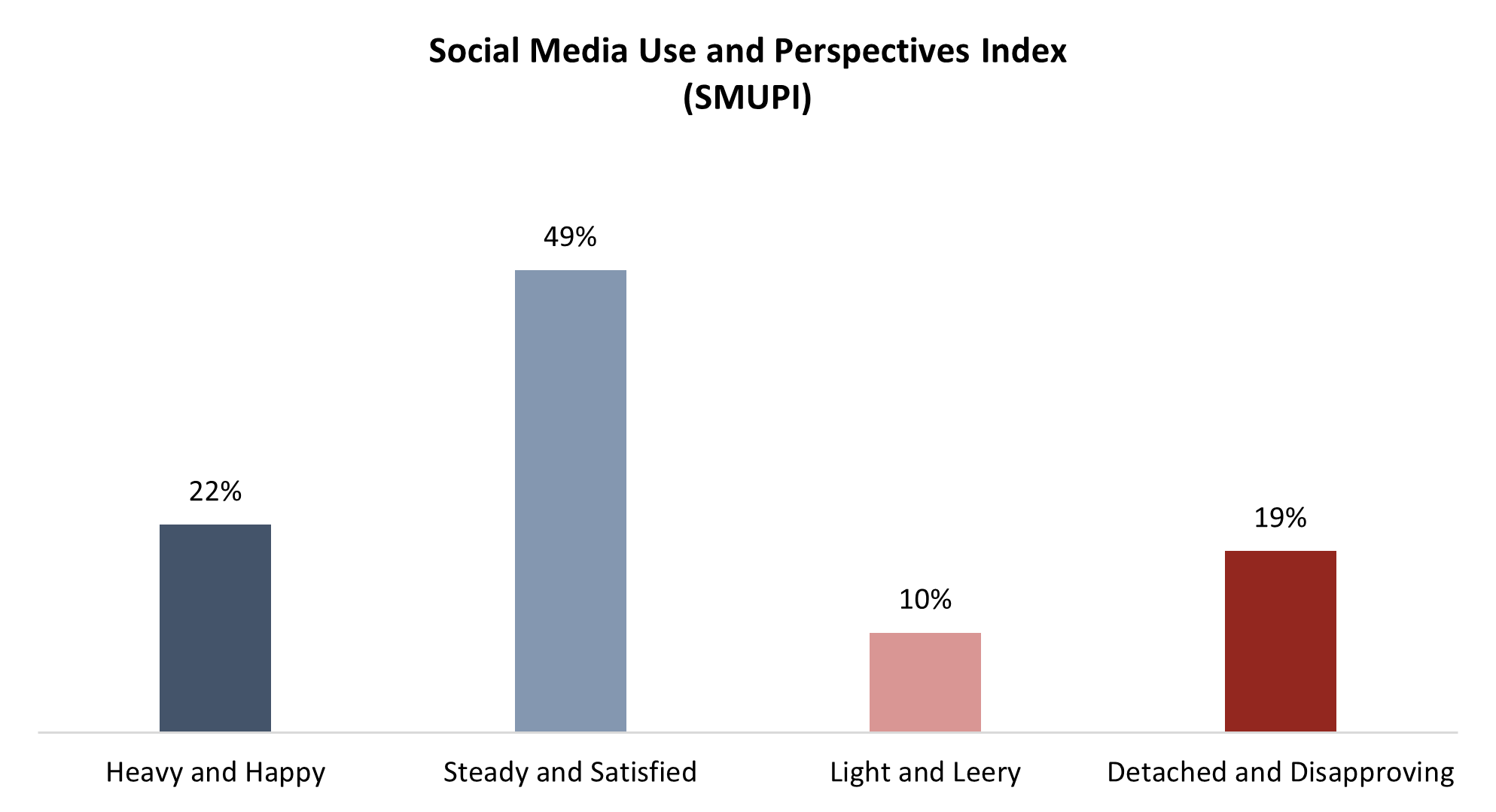
Angus Reid Institute created an index based on responses to a number of questions about use and satisfaction with social media. One-in-five Canadians are Heavy and Happy users (22%). They nearly all use four or more social media platforms multiple times a week, and many use six or more. They have net positive views of all eight platforms discussed in this survey. On the other end of the spectrum are a similar sized group, the Detached and Disapproving (19%). Nearly two-thirds of the DD use one or no social media apps on a weekly basis. They are overwhelmingly critical of the impact of the technology and the companies alike. Their less critical and more active spiritual compatriots are the Light and Leery (10% of Canadians). This group is still wary of getting too attached to social media, but do not meet the overly critical bar set by the Detached and Disapproving.
The largest group of Canadians fit into a sort of middle ground as those who use two to four platforms regularly but don’t love them – the Steady and Satisfied. They’re more critical of Twitter/X and TikTok than they are of YouTube, Facebook, or Instagram.
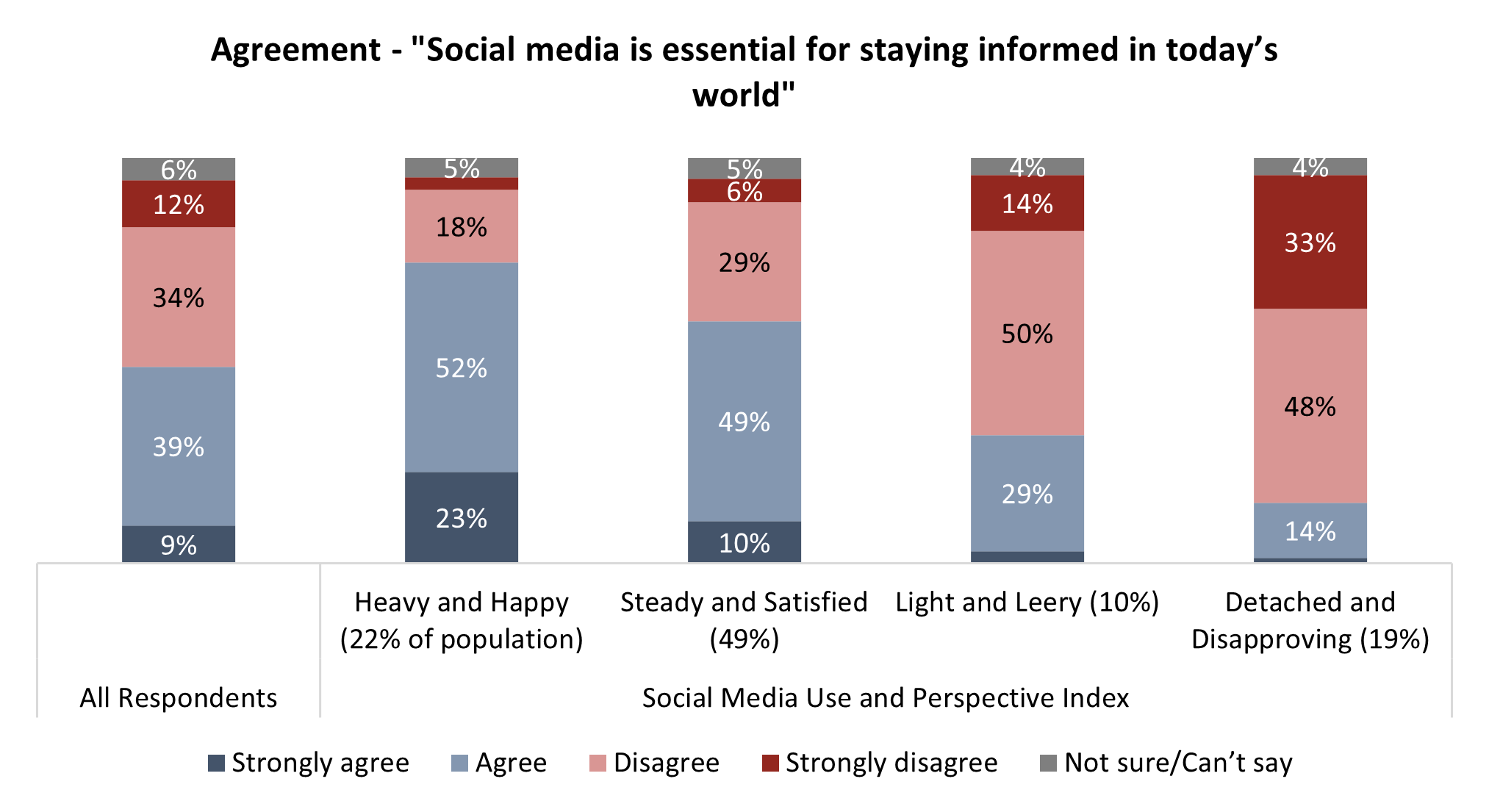
One of the biggest disagreements among Canadians in this debate is social media’s necessity in staying up to date on their world. Half (48%) say it is integral and necessary, while the same number disagree (46%). Each of the four groups has distinct opinions that range from absolute necessity to totally unnecessary across the spectrum.
More Key Findings:
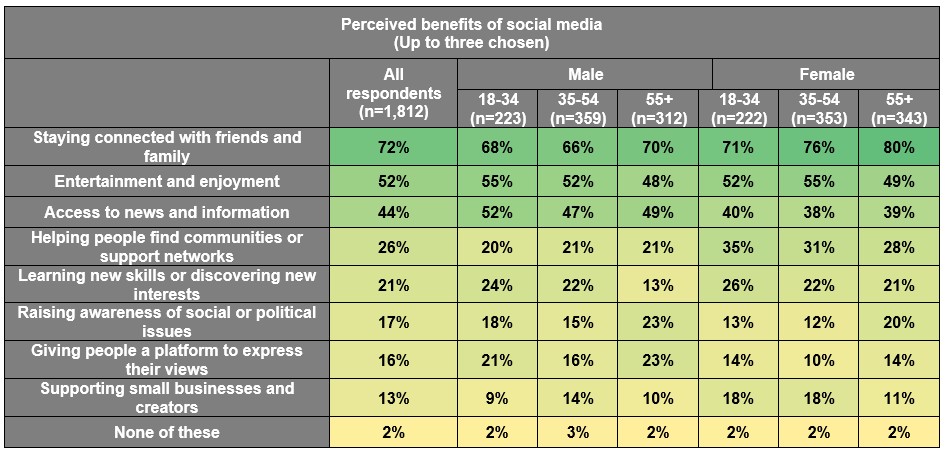
- The top benefits of social media, as chosen by Canadians, are staying connected with family and friends (72%), entertainment (52%), and access to news (44%)
- Misinformation (70%) is by far the top negative perception surrounding social media use, with excessive screen time and addiction (43%), and mental health issues (36%) rounding out the top three concerns
- Facebook remains the top option for weekly use (71%), ahead of YouTube (61%) and Instagram (52%).
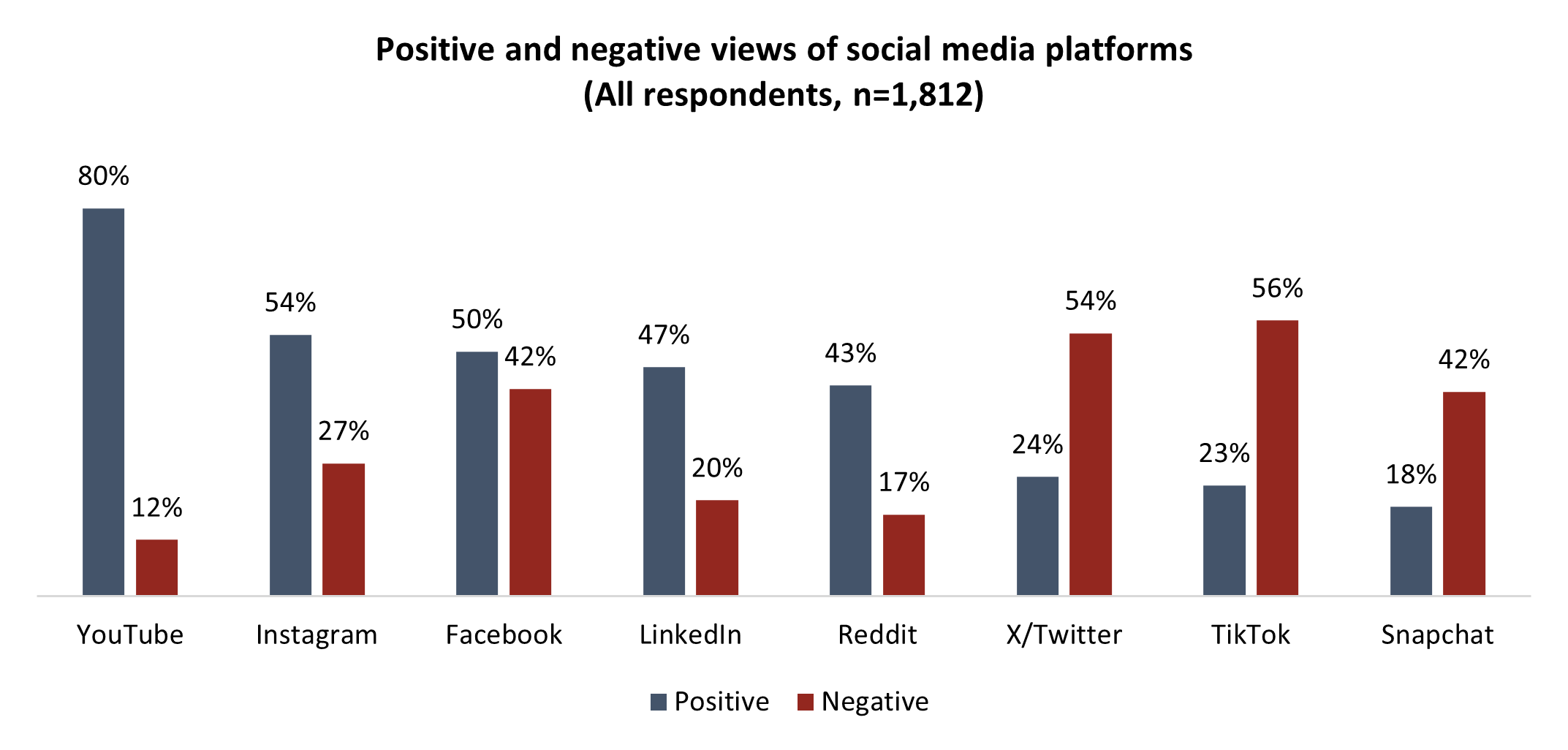
- Eight-in-10 Canadians (80%) have a positive view of YouTube, well head of Instagram (54%), and Facebook (50%), suggesting some resentment of heavily used platforms. Twitter/X is viewed positively by just 24 per cent and negatively by 54 per cent
- Women, and especially those older than 54, are more likely to see the benefit of social media in staying connected with friends and family than men. More men view access to information as a key benefit of social media than women.
INDEX
Part One: Social media in 2026
- Facebook holds top spot, while Instagram shows most growth over last decade
- But the vibes aren’t great for many platforms
Part Two: Social media’s impact on society
- The Pros
- The Cons
- Overall impact viewed as more negative than positive
Part Three: The Social Media Use and Perspectives Index
- Who’s having a good time?
- Is social media “essential” to being informed?
- Usefulness and misinformation most likely to cause users to leave
Part One: Social media in 2026
Facebook holds top spot, while Instagram shows most growth over the decade
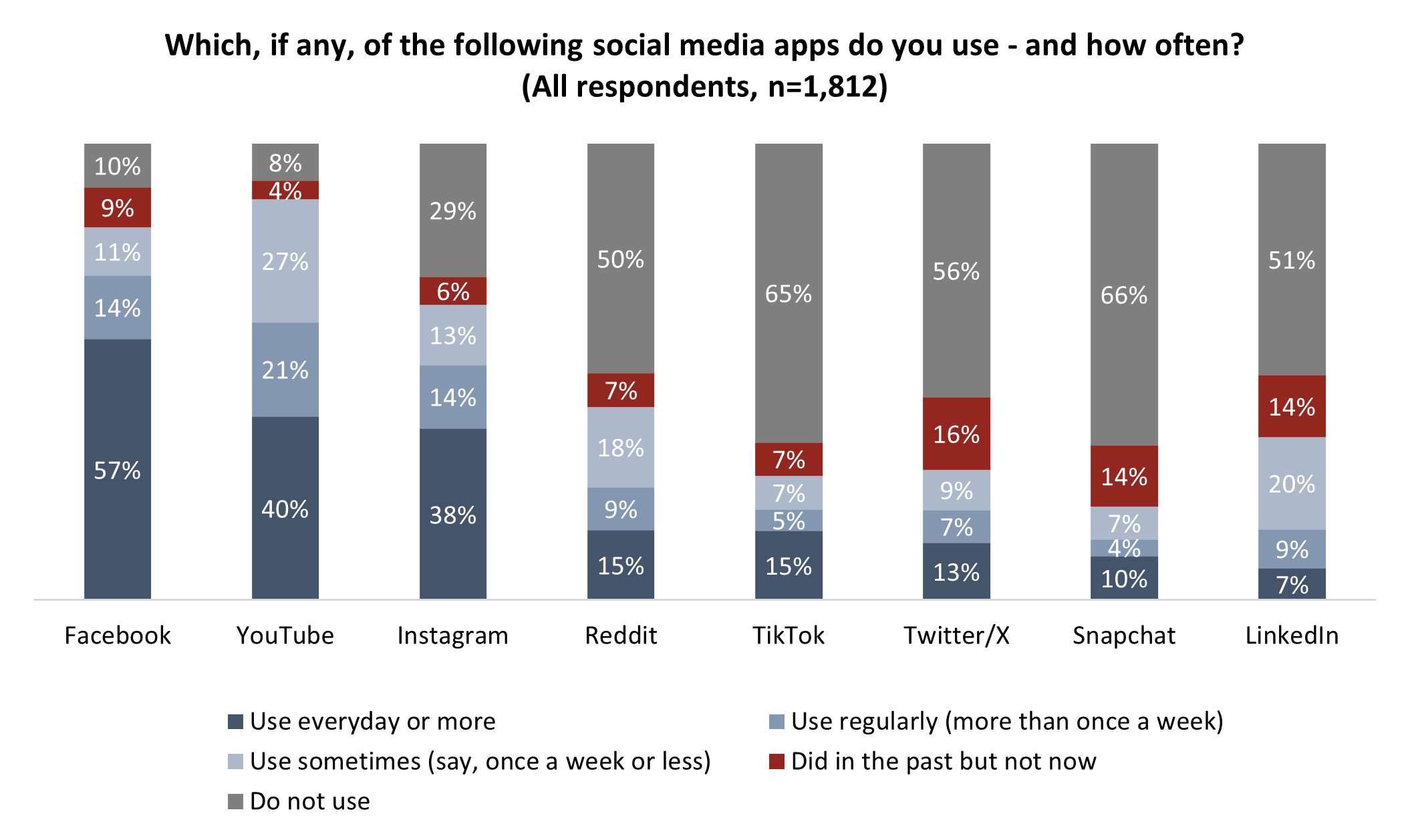
While social media platforms have come and gone since the medium began to take over the communication habits of the globe – consider Vine, MySpace, Tumblr and others – Facebook continues to be a mainstay. Sure, gone are the days of curated friend-based streams, replaced by Marketplace scouring and suggested content, but Facebook still dominates in regular usage among its peers. Even with news-based restrictions in place in Canada, three-in-five (57%) say they use Facebook daily, while another 14 per cent use it multiple times a week. YouTube and Instagram trail behind, but stand out as a clear second-tier against other options:
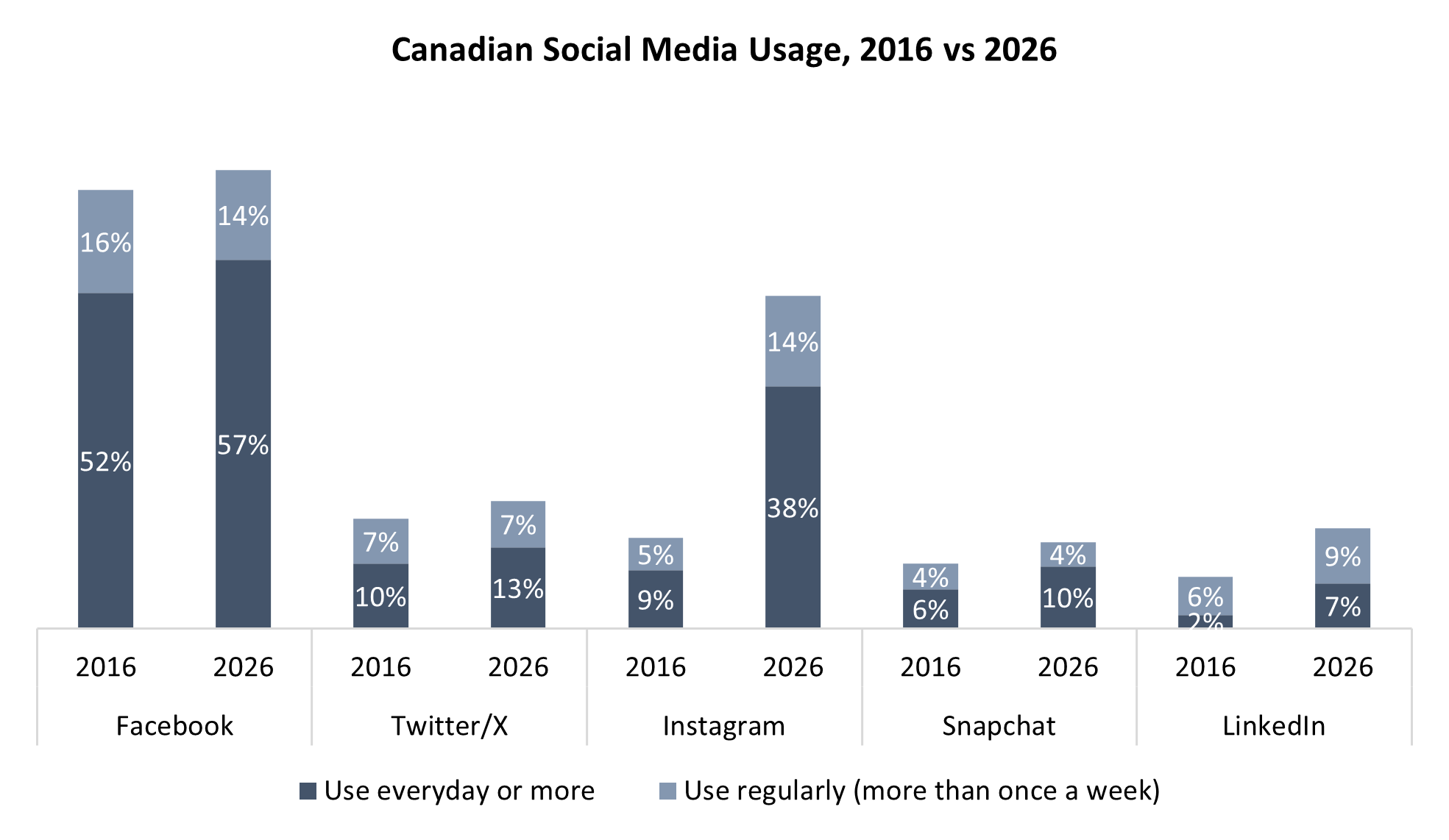
Facebook use has increased slightly compared to a decade ago, as has adoption of other apps like Twitter/X, Snapchat and LinkedIn, but the clear growth leader over this period is Instagram, which was purchased by purchased by Facebook (now Meta) in 2012. Instagram introduced its shortform video option – Reels – in 2020, and has seen significant uptake, as just 14 per cent of Canadians said they used it regularly in 2016, compared to half now:
Usage varies considerably across age and gender groups. Those 55 years of age or older are heavy Facebook users, while younger generations have evidently moved away from that platform, toward Instagram. YouTube use for young men is the highest uptake of any app in any age and gender group. Men of all ages are also much more likely than women to be on Twitter/X, while young women are twice as likely as young men to frequent TikTok:
But the vibes aren’t great for many platforms
Canadian assessments of the various social media platforms vary from the overwhelmingly positive – 80 per cent say they have a positive view of YouTube – to the majority negative – X/Twitter (54%) and TikTok (56%). Notably, TikTok was the subject of a two-year investigation by the Canadian federal privacy commissioner centred on national security concerns, though these have been mitigated by the app’s former Chinese owner selling to a U.S. company. Snapchat joins X and TikTok as the only other social media platform viewed more negatively than positively.
Some of the most used platforms are found in between the high- and low-end assessments. By a two-to-one margin, Canadians say they have a good impression (54%) of Instagram rather than a bad one (27%). Meanwhile, Facebook is viewed more positively than negatively (50% vs. 42%) but ranks high on the latter score:
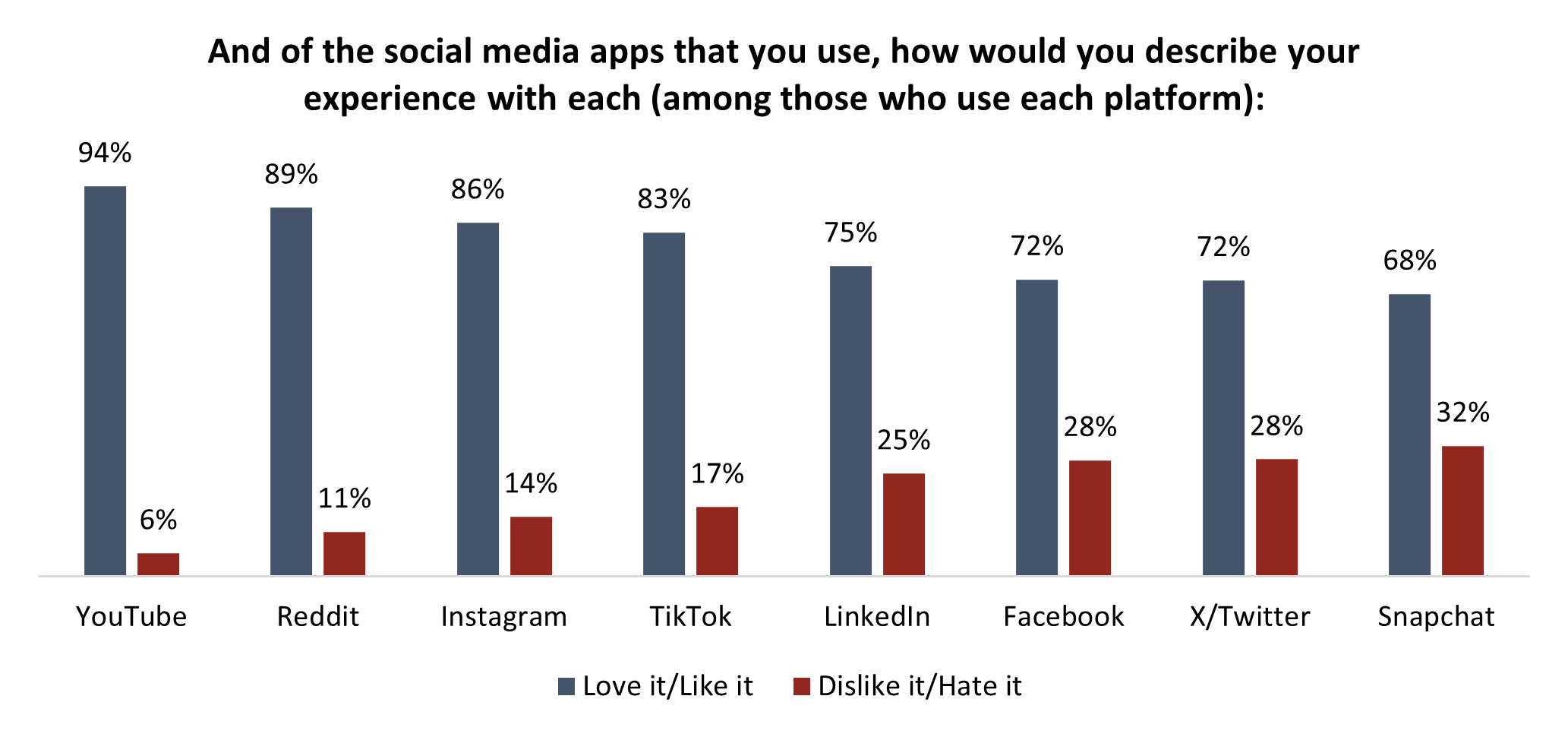
Those who use the apps in question have a different perspective. YouTube (94%), Reddit (89%), Instagram (86%) and TikTok (83%) users are the most likely to say they enjoy their experiences on the app, the latter standing in stark contrast to Canadians overall impressions of TikTok. Negative assessments rise, but are still in the minority, for LinkedIn, Facebook, X/Twitter and Snapchat users.
Part Two: Social media’s impact on society
The Pros
Social media has changed the world in many ways, but perhaps most notably by offering the ability to stay connected with family, friends and acquaintances regardless of physical location. That is viewed as the top benefit of social media, selected by three-quarters (72%) of Canadians. Entertainment (52%) and access to news and information (44%) are also viewed as top benefits.
Fewer people see social media as an important way to find communities (26%), discover new interests (21%), raise awareness of political issues (17%), as platforms for people to express their views (16%), and supporting small businesses (13%).
Women, and especially those older than 54, are more likely to see the benefit of social media in staying connected with friends and family than men. More men view access to information as a key benefit of social media than women:
The Cons
There have also been negative societal changes wrought by social media. The power of social media to amplify messages to a wide audience has been weaponized by disinformation campaigns. Some have described this new era of mass disinformation as the “post-truth” era, with many putting U.S. President Donald Trump at the forefront of this movement.
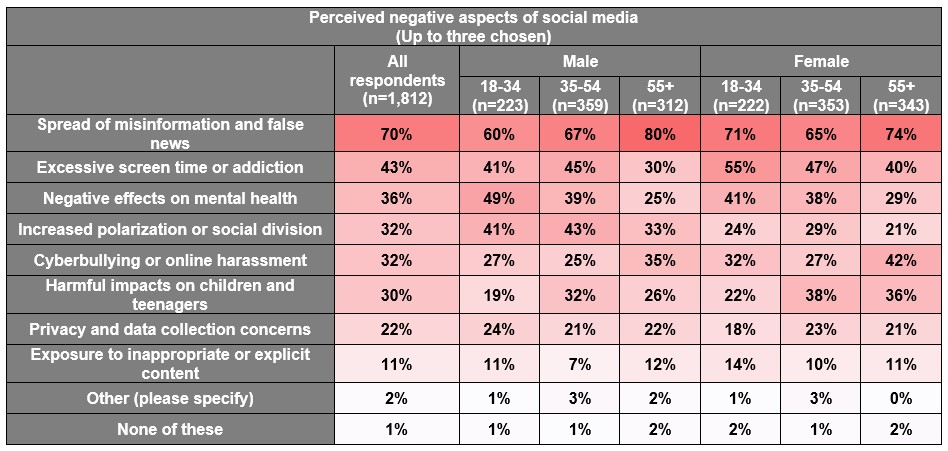
The spread of fake news is selected by Canadians as the top negative aspect of social media (70%). Otherwise, Canadians are split between various social media concerns, including screen time addiction (43%), the negative impact on mental health (36%), polarization (32%), online harassment (32%) and harmful impacts on under-18s (30%) are all selected by at least three-in-ten Canadians.
While the spread of misinformation is selected by a majority of all age groups as the top negative aspect of social media, it is a higher concern among Canadians older than 54. Younger Canadians are more likely to select the negative impacts on mental health and excessive screen time:
Overall impact viewed as more negative than positive
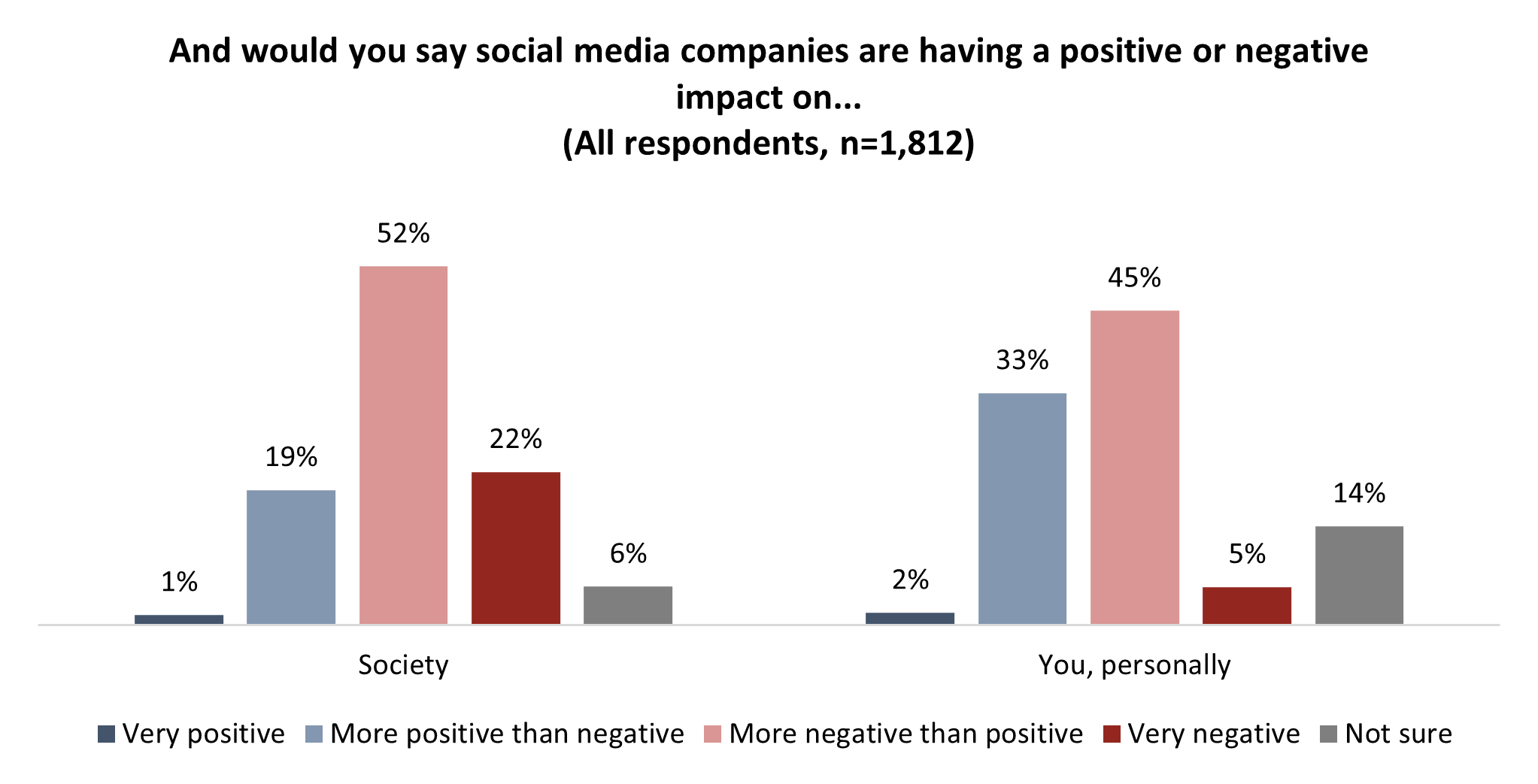
Taken all these aspects together, Canadians are more likely to view the net effect of social media as negative than positive. Three-quarters (77%) believe social media companies are having more negative than positive effects on society, while half (50%) say the impact of social media on themselves personally is negative. In fact, there are more who describe the impact of social media companies as very negative (22%) than positive at all (20%).
However, it is worth pointing out that Canadians are more likely to say social media has had a positive impact on themselves (35%) than society (20%):
Part Three: The Social Media Use and Perspectives Index
Clearly there is a tension between use and enjoyment for some Canadians. In order to better understand this dynamic, Angus Reid Institute used a number of questions in this survey to create the Social Media Use and Perspectives Index. For the scoring of this index, click here.
So how many people are really enjoying themselves?
At the positive end of the spectrum are those who use social media regularly and who evidently have few, if any, poor experiences to note. These are Heavy and Happy users, about one-in-five Canadians (22%). These users are on multiple platforms, almost always, and report few complaints. The average Canadian is more likely to fall into one big group of about half of the population – the Steady and Satisfied. These individuals check in less regularly, more likely two or more times a week, but not necessarily every day. They’re not overwhelmingly negative about social media, but they’re more alive to the drawbacks than the Heavy and Happy.
The smallest group are those who dabble in social media and view it with a skeptical eye – the Light and Leery. A group twice their size, and far more negative when it comes to social media, are the Detached and Disapproving. This group is filled with rare- and non-users who hold negative views of most platforms and their impact on society:
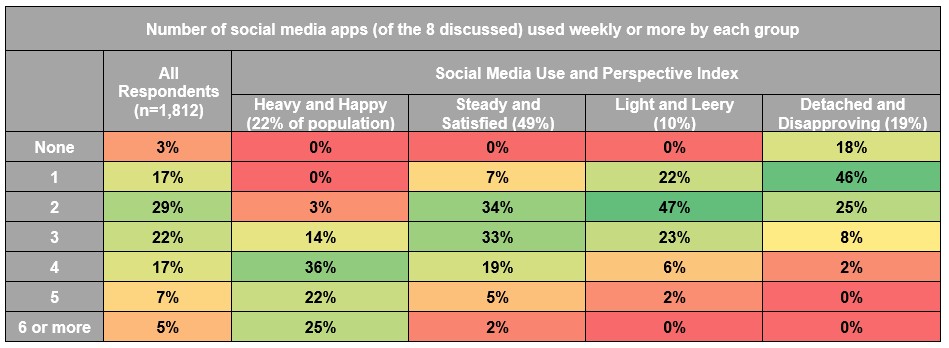
The first part of the definition on the SMUPI is use, and one can see from the table below the sliding scale of adoption by each group. The Heavy and Happy are enmeshed in social media apps, with the vast majority using four or more regularly. The Steady and Satisfied are largely concentrated on two to four apps, while the Light and Leery are most likely to use two, and the Detached and Disapproving most likely to use one (Facebook).
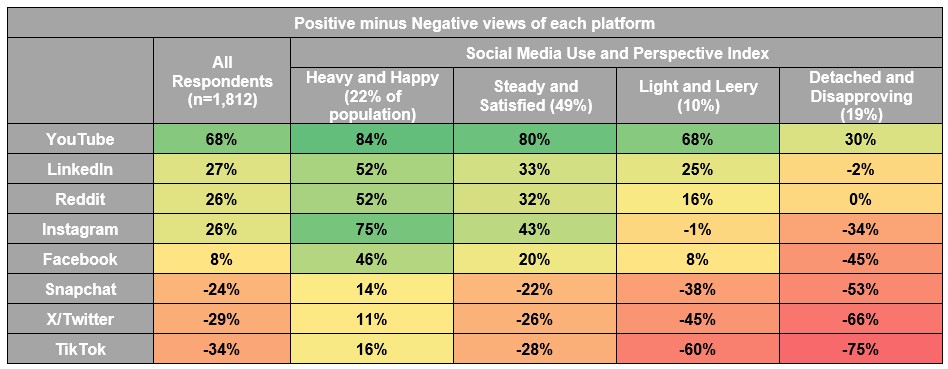
Comparing these groups, one can see the positivity with which the Heavy and Happy distinguish themselves. Nearly all platforms receive majority positive appraisal from the HH, whereas the other three groups are more united in their negative views of X/Twitter, TikTok, and Snapchat:
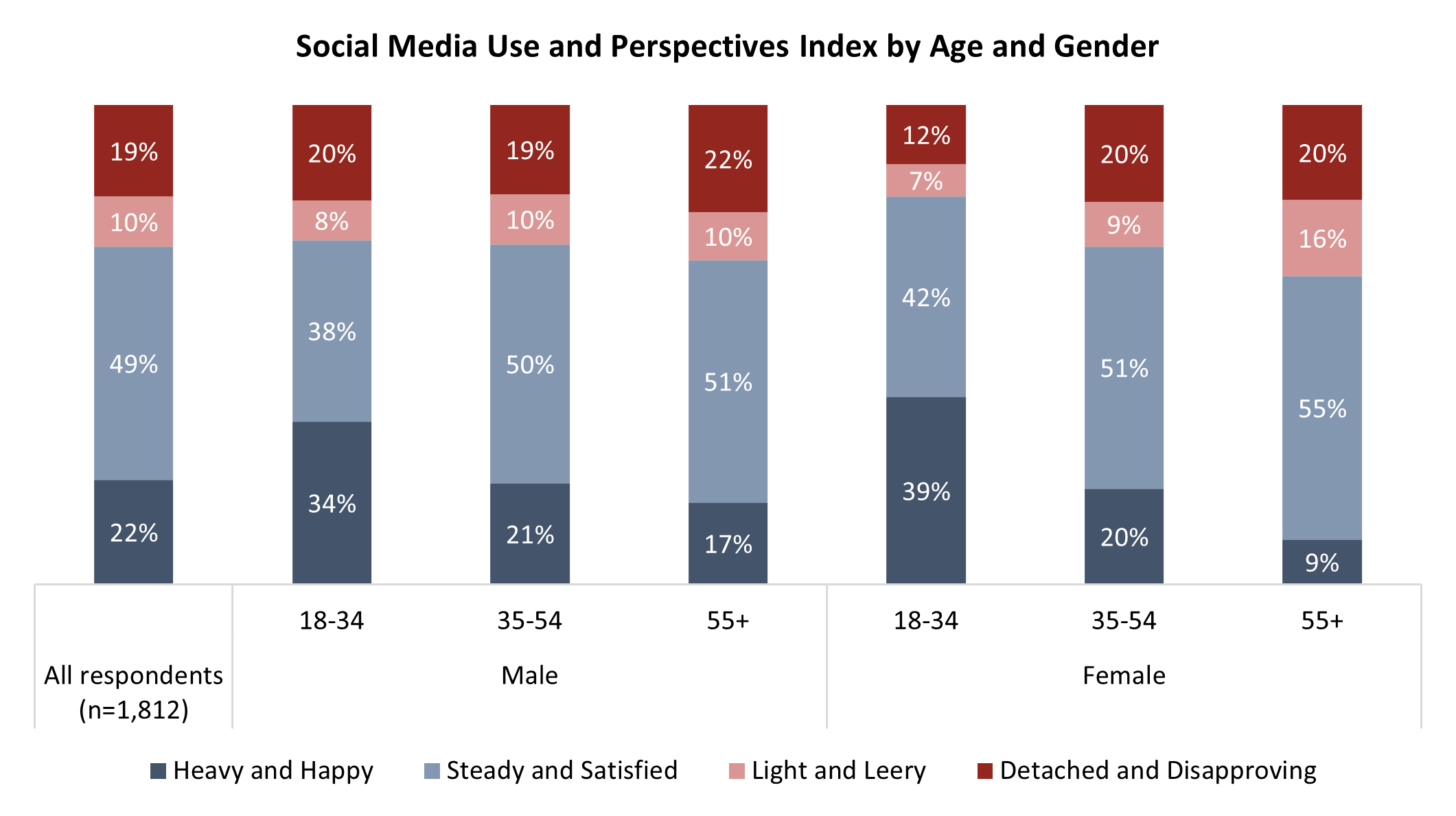
The Heavy and Happy users tend to be younger, with women under 35 making up the largest proportion within any age and gender pairing. Notably, the Detached and Disapproving users make up one-in-five across all age groups other than these young women:
Is social media “essential” to being informed?
People within these groups disagree to a significant degree about just how necessary social media is in order to stay informed about the world. Overall, an equal number agree (48%) and disagree (46%) with that idea, with Heavy and Detached users appearing as inversions of each other. One can see the difference between Steady and Light users as well on the core question:
Usefulness and misinformation most likely to cause users to leave
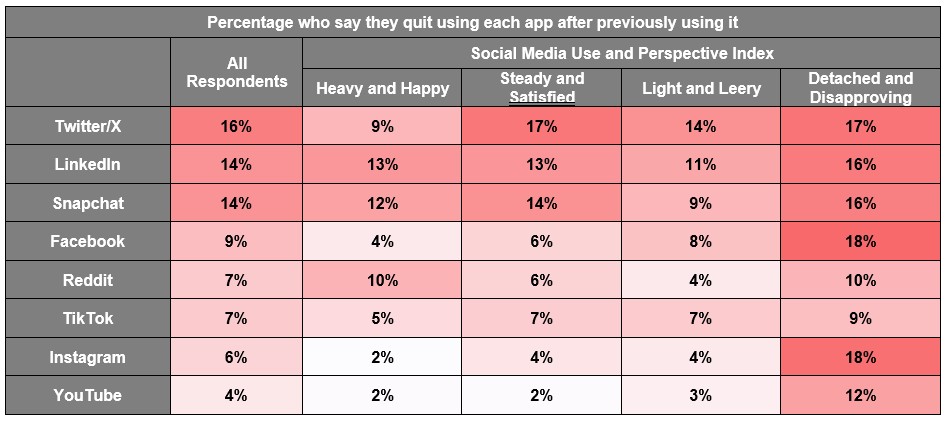
Twitter/X is the most cast aside social media platform among former users. Overall, 16 per cent of Canadians say they have used it and stopped, near-doubling Facebook. It is worth noting, however, just how many more platforms the Detached and Disapproving have tried and quit.
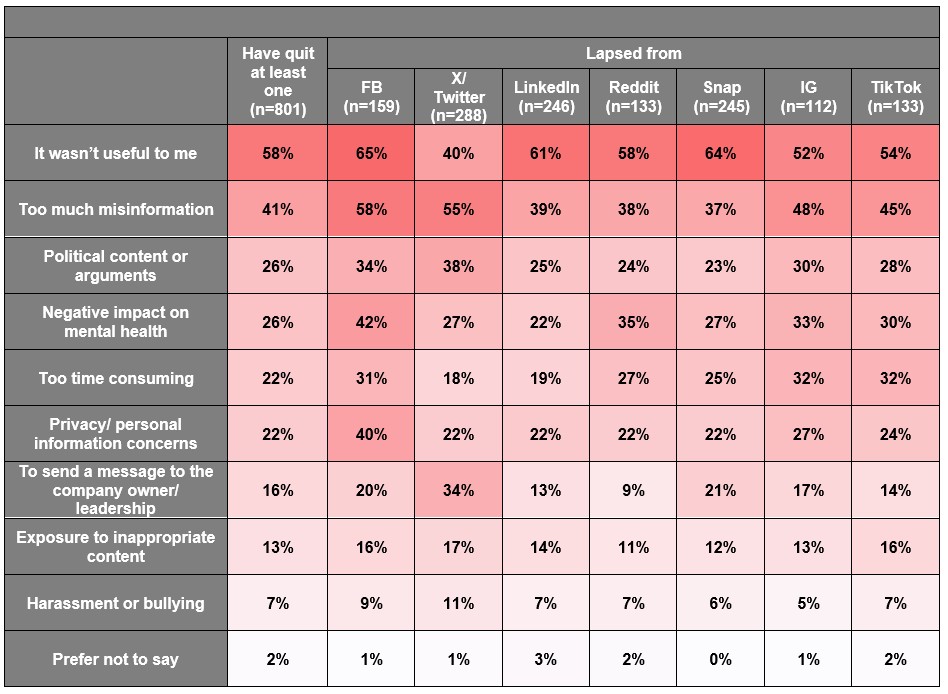
Misinformation and a lack of usefulness are the main reasons that most users step away from social media. The former is particularly a concern for those who have left Facebook or Twitter/X. Notably, too, the Elon Musk factor appears to be relevant for one-third of those who left Twitter:
| METHODOLOGY:
The Angus Reid Institute conducted an online survey from March 2-6, 2026, among a randomized sample of 1,812 Canadian adults. Respondents are drawn from the Angus Reid Forum, a large-scale online panel developed to include Canadian residents in each of the 343 federal ridings in Canada and representative of the Canadian population by age, gender, family income, ethnic status and education. The sample was weighted to be representative of adults nationwide according to region, gender, age, household income, and education, based on the Canadian census. For comparison purposes only, a probability sample of this size would carry a margin of error of +/- 2 percentage points, 19 times out of 20. Discrepancies in or between totals are due to rounding. The survey was self-commissioned and paid for by ARI. Detailed tables are found at the end of this release.
For more information on our polling methods, click here. |
For detailed results by age, gender, region, education, and other demographics, click here.
For PDF of full release, click here.
For questionnaire, click here.
MEDIA CONTACTS:
Shachi Kurl, President: 604.908.1693 shachi.kurl@angusreid.org @shachikurl
Dave Korzinski, Research Director: 250.899.0821 dave.korzinski@angusreid.org