


Quebecers largely at odds with Rest of Canada over bilingualism rule for judges
November 14, 2024 – Canada’s Supreme Court has shaped the country through monumental decisions in recent years – among them establishing the right to Medical Assistance in Death (MAID), establishing the constitutionality of gay marriage, and numerous rulings surrounding Indigenous rights – but perhaps does not grab as many headlines as its counterpart in the United States. Look no further than the campaigning over Roe v Wade in this year’s Presidential election for evidence of this.
New data from the non-profit Angus Reid Institute finds Canadians less knowledgeable about its top court than Americans are of theirs, but more likely to place confidence in the Supreme Court and believe it is impartial in its decision making.
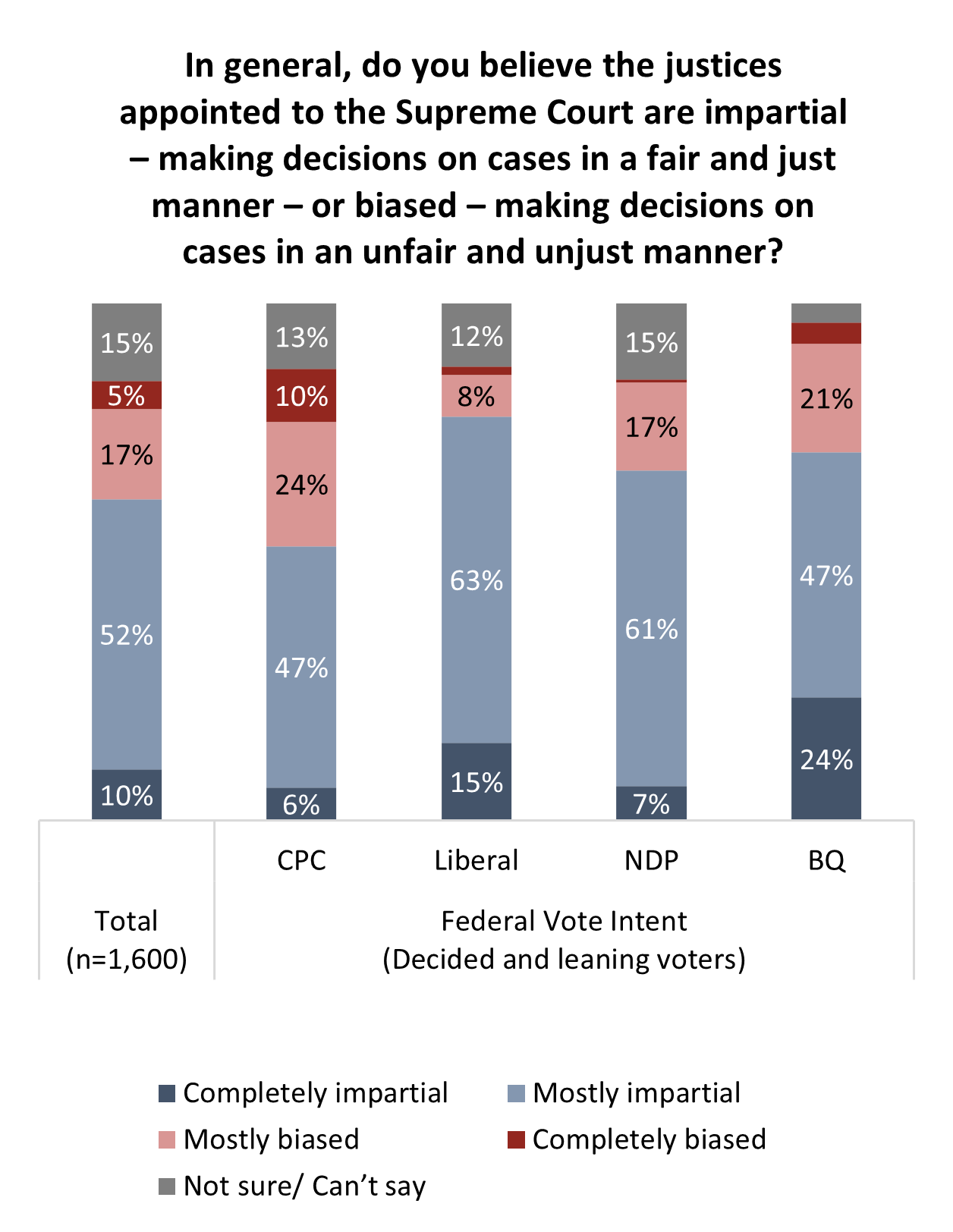
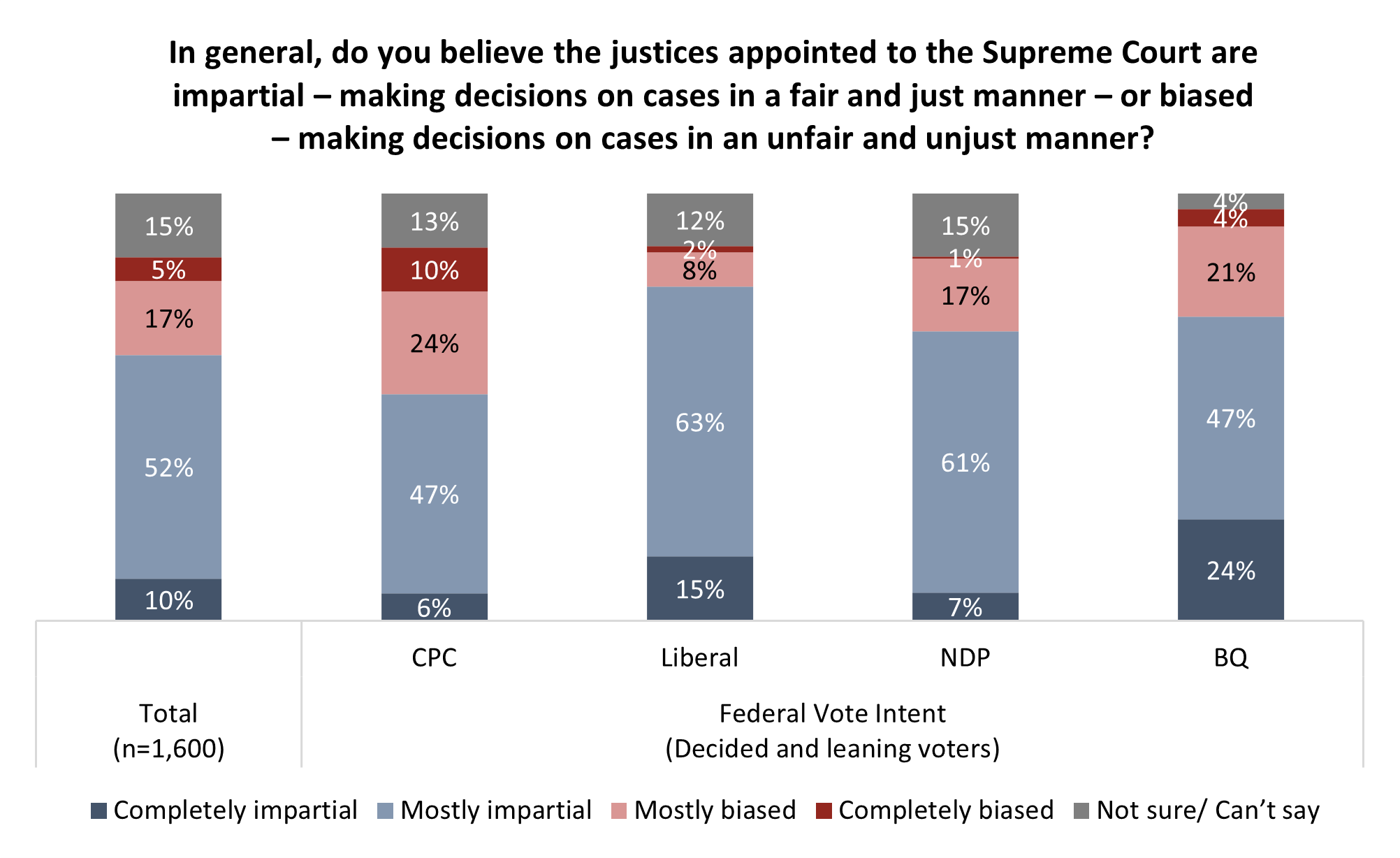
A majority of Canadians (62%) believe their Supreme Court is “impartial”, three-times the number who instead call it “biased” (22%). Two-thirds (65%) also say law rather than politics is “the greater consideration” when it comes to how Supreme Court justices rule on cases.
Despite the majority belief in the court’s impartiality, overall, just half (49%) of Canadians say they have confidence in the country’s top court, while two-in-five (42%) do not.
Click below to see Key Takeaways from the data
In Quebec, four-in-five (82%) believe that rule should stay as it is, while Canadians elsewhere in the country lean towards believing the rule should be relaxed (47%).

There are many who believe the process for selecting Supreme Court justices is more political than it is. More than one-third (36%) believe justices are appointed for their political leanings, while three-in-ten (29%) aren’t sure if that’s the case or not.

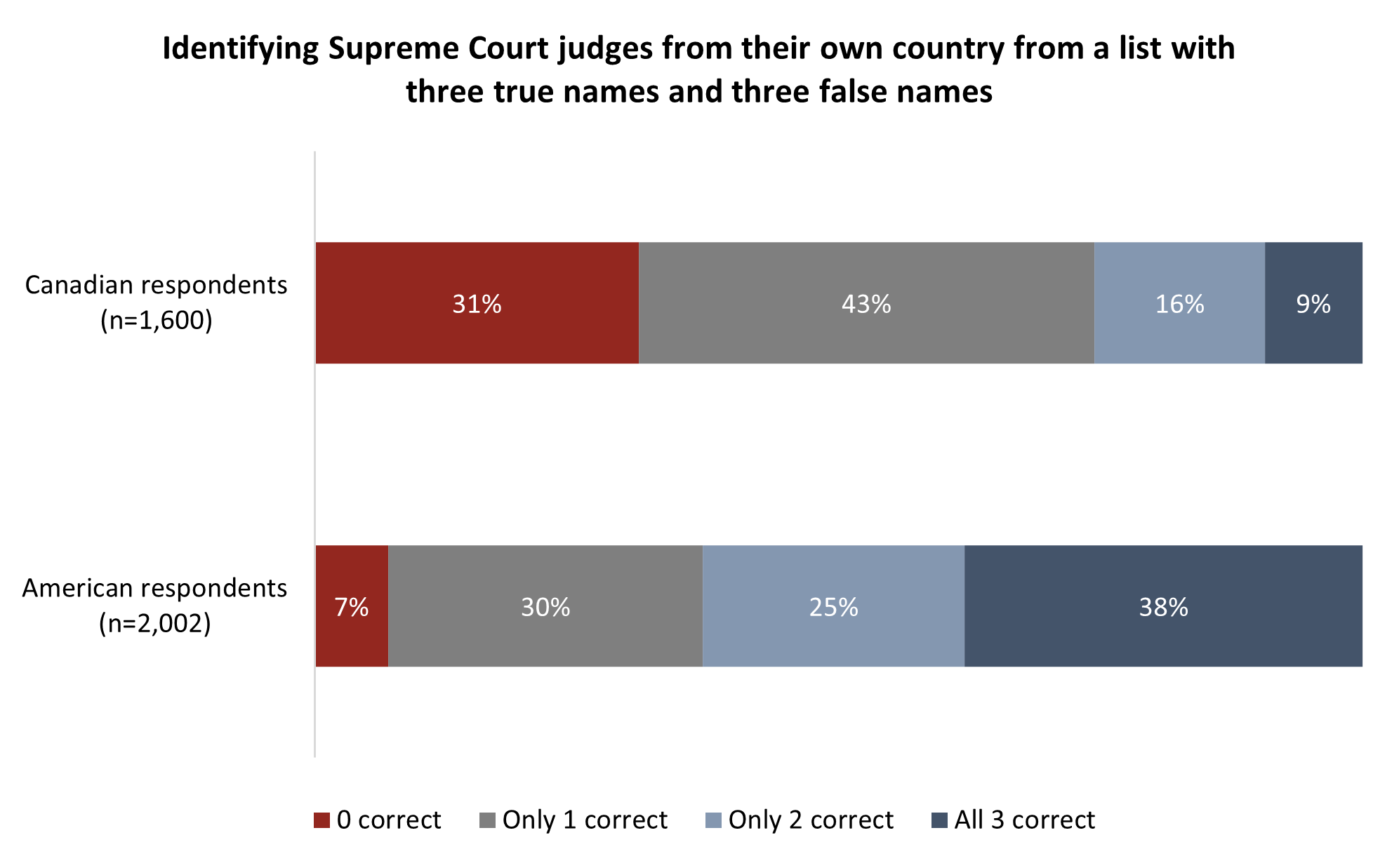
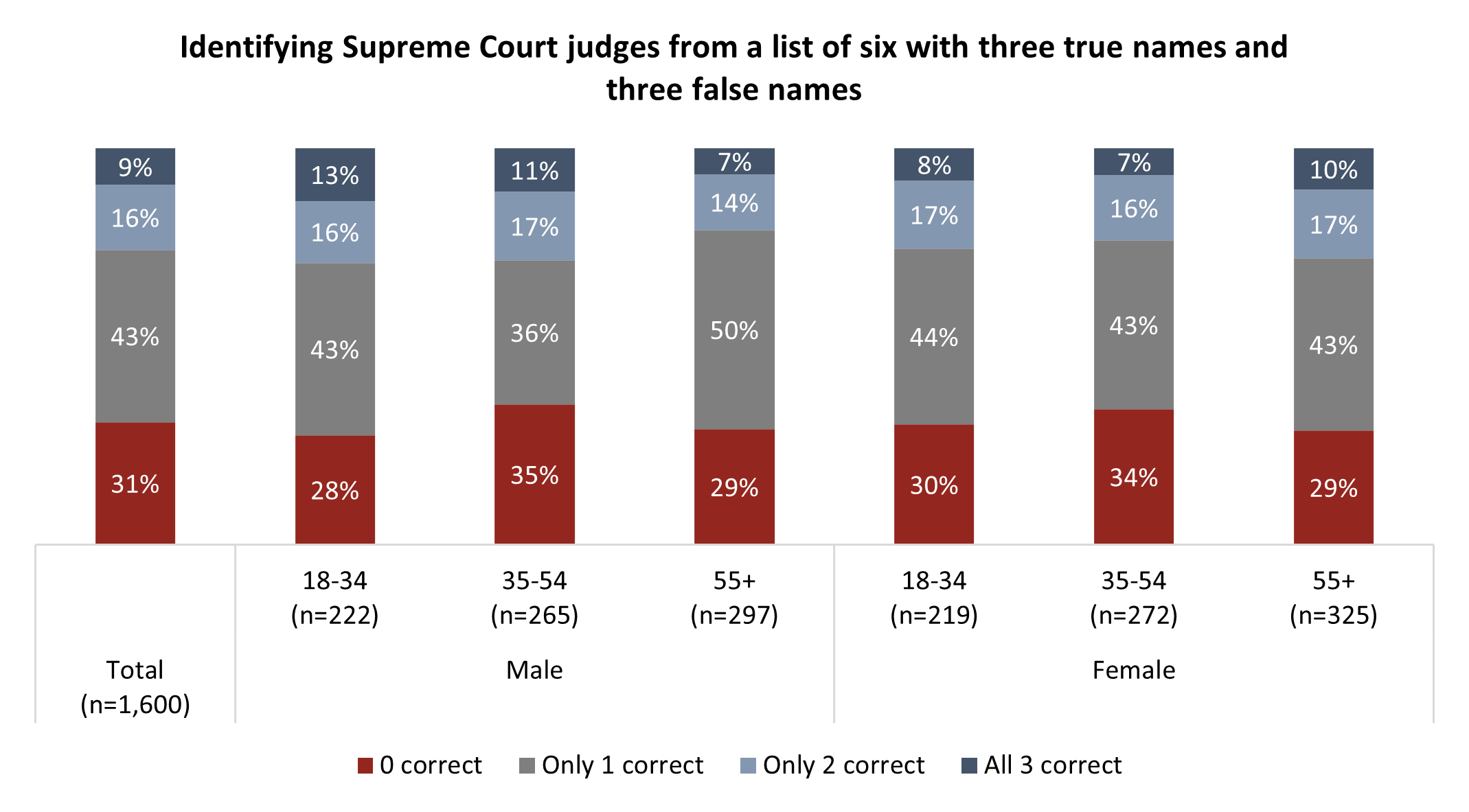
When presented with a list of names containing three Supreme Court justices and three decoy names, three-in-ten (31%) Canadians could correctly identify none of the justices and two-in-five (43%) could only identify one.
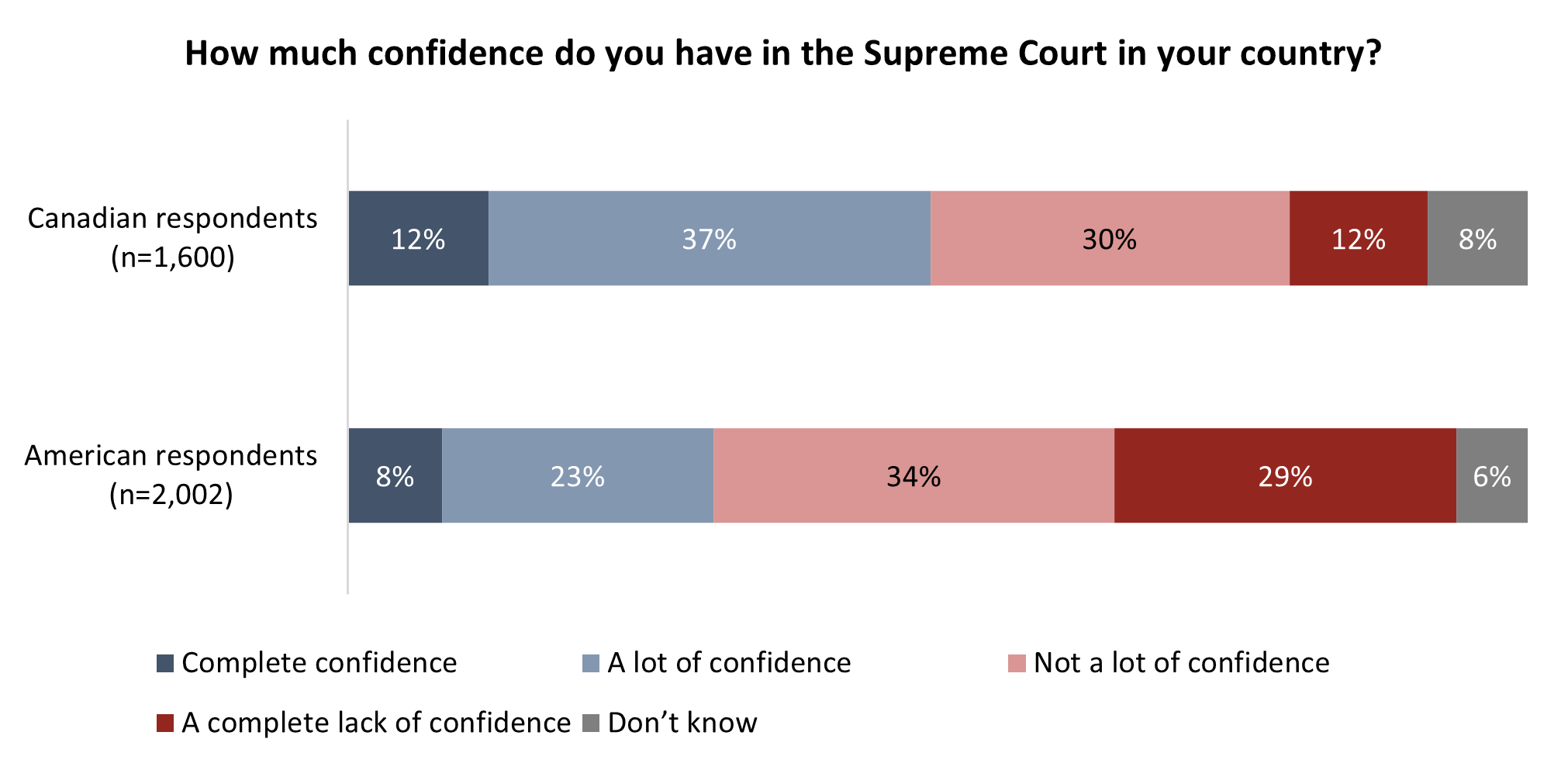
Overall, Canadians are slightly more confident (49%) than not (42%) in Canada’s highest court. Though not a enthusiastic endorsement, Canadians express more confidence in their Supreme Court than Americans do in theirs (31% “complete” or “a lot of” confidence):
The Full Story
INDEX
Part One: Knowledge about the Supreme Court
• Many Canadians uncertain about ethics code of Supreme Court justices
• Half of likely CPC voters say politics determines who is appointed
• Canadians much less likely to identify justices than Americans
Part Two: Views on the Supreme Court’s impartiality
• Majority describe Supreme Court as ‘impartial’
• Do Canadians view the Supreme Court as leaning one way or the other politically?
• ‘Activist’ judges and the Supreme Court
• Canadians more confident than Americans in their Supreme Court
Part Three: Supreme Court reforms
• Division outside of Quebec over functional bilingualism rule
• Age limits or term limits?
Part One: Knowledge about the Supreme Court
Canada’s Supreme Court is a key institution in the fabric of this nation. While serving as the country’s final court of appeal, it also decides questions on Canada’s constitution and other complicated matters in private and public law. Despite its important place in Canada’s legal hierarchy, it generates far fewer headlines than the comparable body south of the border. Some of this may be because Canadian Supreme Court justices are guided by the Ethical Principles for Judges published by the Canadian Judicial Council. Though “not intended as a code of conduct,” the principles are the “ethical frame of reference to which all judges aspire.” The Judges Act also requires judges to forgo political activity and “devote himself or herself exclusively to those judicial duties”.
After numerous ethics scandals embroiling the United States Supreme Court that institution adopted a code of ethics for the first time in November, though it was quickly criticized because it lacked enforcement. This prompted U.S. President Joe Biden to include an enforceable code of conduct as part of sweeping reforms he proposed to the court, although any changes will likely have to wait until after the country’s election in two weeks time.
Related: SCOTUS: Biden reforms widely supported as majority say they lack confidence in court
Many Canadians uncertain about ethics code of Supreme Court justices
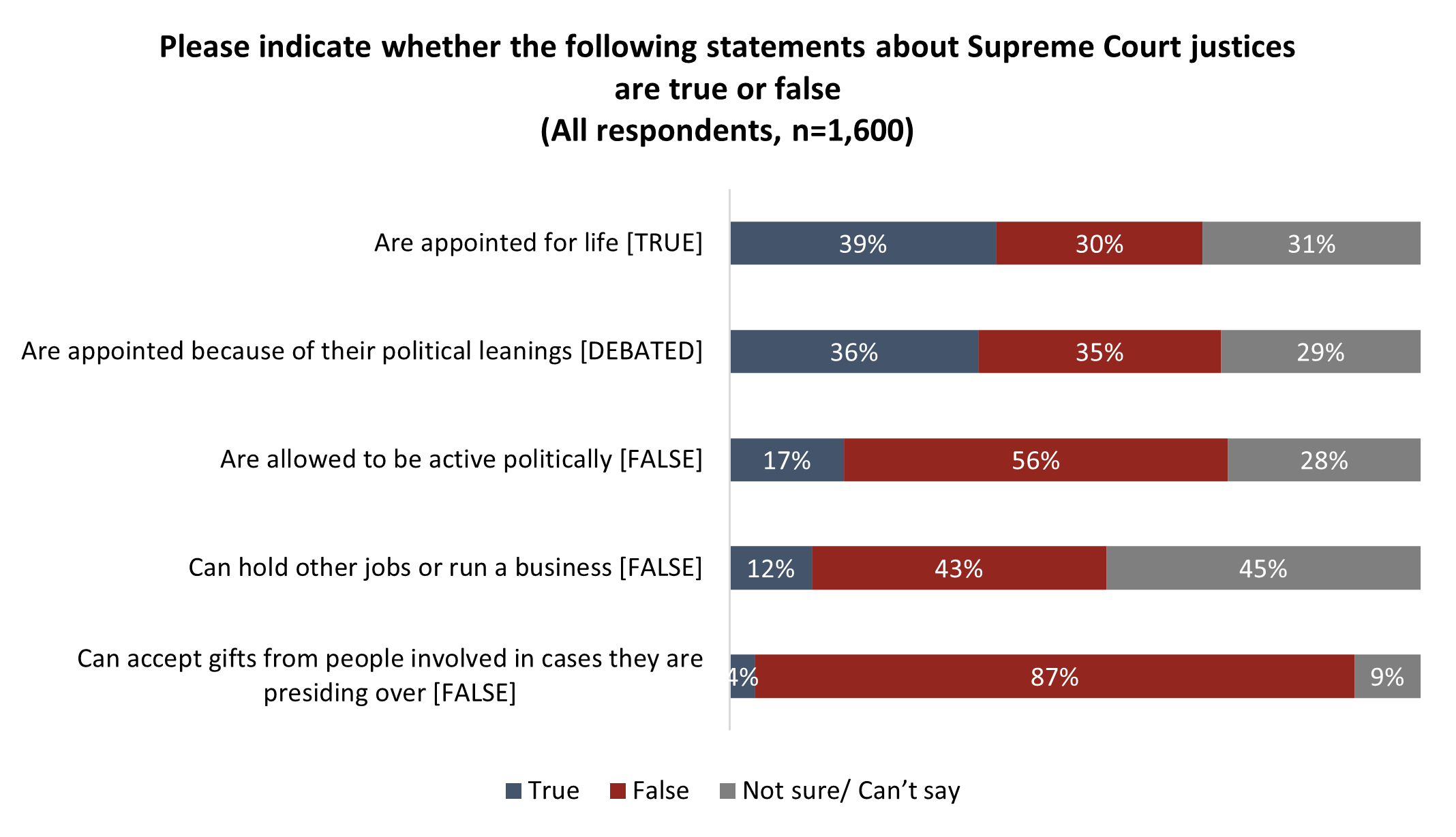
Institute researchers presented a series of statements and asked respondents to identify whether they are true or false. Most Canadians correctly say it’s “false” that judges are allowed to be active politically (56%) and can accept gifts from people involved in cases they are presiding over (87%). On other matters, there is more uncertainty. More than half believe either judges can hold other jobs (12%) or are unsure (45%) and that judges are appointed for life (39%) or didn’t know about the term limits (31%).
One-third (36%) of Canadians believe Supreme Court justices “are appointed because of their political leanings”, while three-in-ten (29%) did not know if that was the case:
Half of likely CPC voters say politics determines who is appointed
The belief that political leanings play into selection to the Supreme Court is higher among those who say they would vote Conservative in an upcoming election. Half (52%) of would-be Conservative supporters believe judges on the Supreme Court “are appointed because of their political leanings”. Two-in-five (41%) likely Bloc Québécois voters agree. Liberal (24%) and NDP (21%) supporters are less likely to think that is the case. Notably, while the Prime Minister ultimately chooses who is to be appointed to the Supreme Court, an independent, non-partisan Advisory Board made up of eight individuals are tasked with choosing candidates. This statement is, thus, up for debate. That said, judges are not allowed to be politically active:

Canadians much less likely to identify justices than Americans
The Canadian Supreme Court Justices, in their relative quietness compared to their southern counterparts, are evidently less well known to Canadians. Most (63%) Americans can correctly identify at least two justices from the U.S. Supreme Court from a list containing three names of justices and three decoy names. Fewer Canadians – one-quarter (25%) can do the same. Three-in-10 (31%) could not identify any justice, while a plurality (43%) could only identify one of the correct options.
Canadian justices most known among Canadians are Suzanne Cote (51%) and Richard Wagner (51%), who were identified by half of those who saw those name. All other judges fell below that mark, and some were selected less than the decoy names presented (see detailed tables).
Women older than 54 and men under 54 are most likely to identify at least two Canadian Supreme Court justices correctly. More than one-third of 35- to 54-year-olds cannot identify any of a group of three justices:
Part Two: Views on the Supreme Court’s impartiality
Majority describe Supreme Court as ‘impartial’
One of the most important aspects of the Supreme Court, definitionally, is that it be impartial. For most but not all Canadians this is perceived as a reality of Canada’s highest court. That said, only 10 per cent feel this is entirely the case. Half say the Supreme Court is mostly impartial (52%), though would-be CPC voters are less likely to agree:
Do Canadians view the Supreme Court as leaning one way or the other politically?
This evident Conservative aversion is apparently due to a feeling among that group that the court leans to the left among its members. The sense among the rest of the public is largely one of uncertainty, with two-in-five (41%) saying they don’t really know:

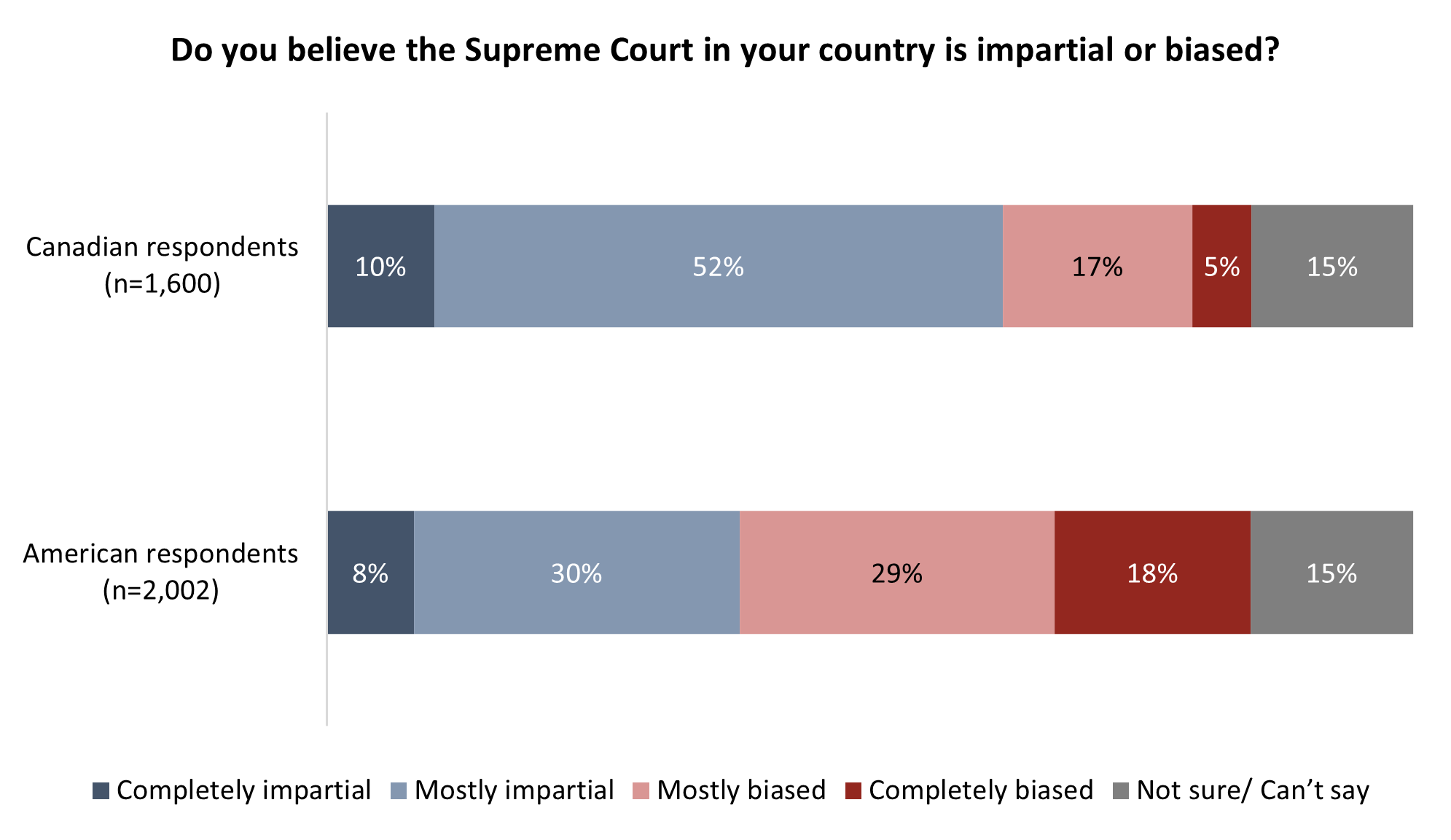
By a three-to-one ratio, Canadians believe their Supreme Court is impartial (62%) than biased (22%). Americans are much more likely to say their court is biased in its decision making (47%):
Conservative Party supporters are also least likely to feel like the law is the greatest consideration when Supreme Court rulings are made. One-in-three (32%) feel politics is the primary driver. Fewer than 15 per cent of other party supporters feel this is the case:
‘Activist’ judges and the Supreme Court
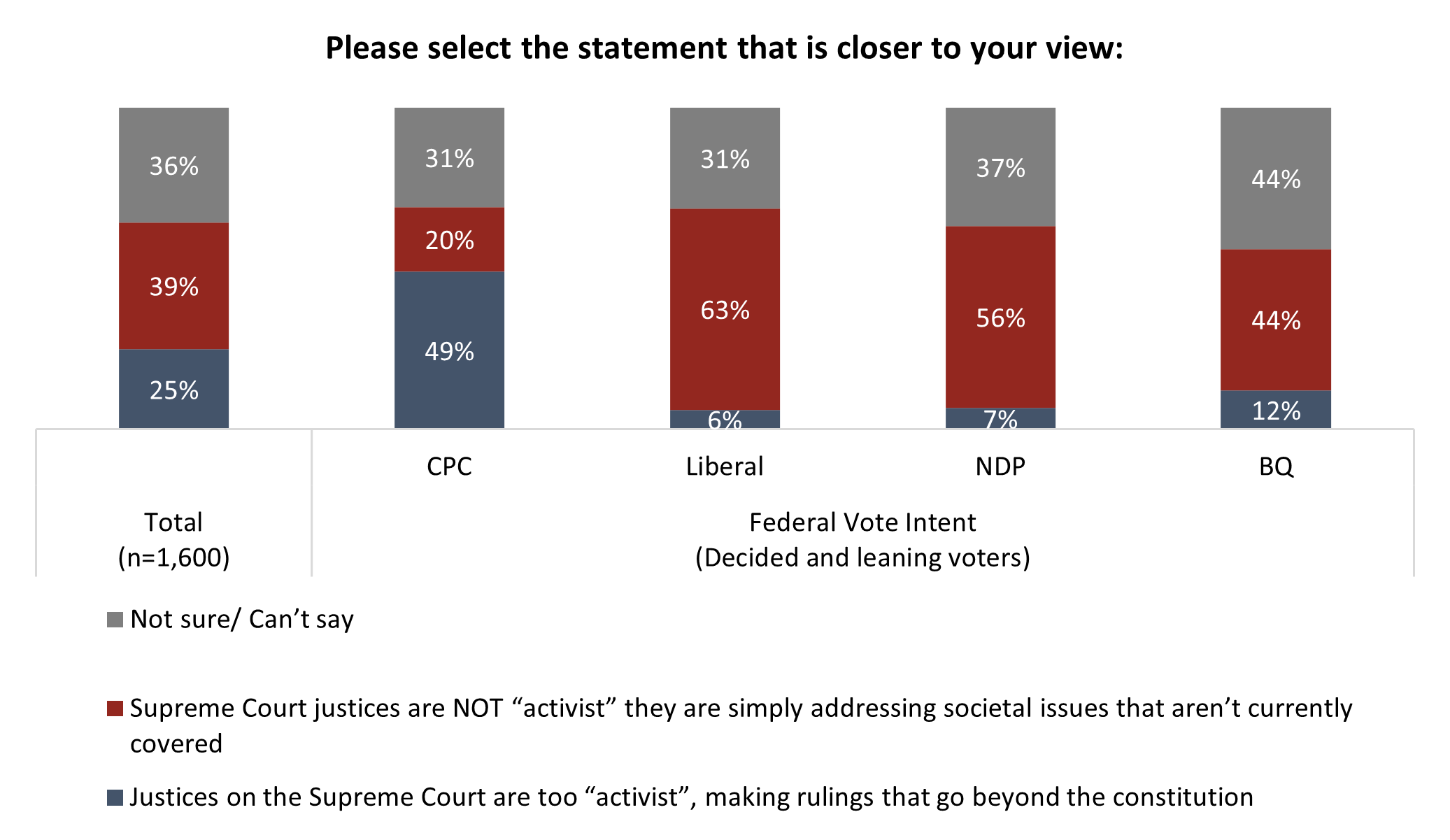
This issue of “activist” judges on Canada’s Supreme Court has been bubbling in the pages of the nation’s opinion sections and academic literature. Former chief justice Beverley McLachlin, who was labelled an “activist judge” during her time on the bench, argued her job was to “apply the law to rectify inequalities that were not justifiable under the Charter”. Others have accused the Supreme Court of rewriting the constitution and law in some recent decisions rather than interpreting laws as passed.
Many Canadians (36%) are uncertain if Supreme Court justices are “activist” or not. Those who have an opinion lean towards believing justices are “addressing societal issues that aren’t currently covered” (39%) than “making rulings that go beyond the constitution” (25%).
Likely Conservative voters are much more likely (49%) than other party supporters to believe the latter:
Canadians more confident than Americans in their Supreme Court
Overall, Canadians are slightly more confident (49%) than not (42%) in Canada’s highest court. Though not a enthusiastic endorsement, Canadians express more confidence in their Supreme Court than Americans do in theirs (31% “complete” or “a lot of” confidence):
Part Three: Supreme Court reforms
Division outside of Quebec over functional bilingualism rule
In 2023 an update to the Official Languages Act created a new prerequisite for Supreme Court justices must be able to hear cases in both English and French without the assistance of an interpreter. This norm had already been largely an important condition when considering candidates but had not yet been codified. Some observers argue that this is a necessary prerequisite to ensure that both official languages are respected, while others say that, particularly when seeking new justices from Western Canada, this will reduce the pool of strong candidates. When Prime Minister Justin Trudeau needed to replace former Supreme Court Justice Russell Brown after Brown’s resignation, there were fewer than a dozen candidates to choose from in Western Canada because of the bilingual requirement. The requirement has also been criticized for creating a barrier for potential Indigenous justices.
In Quebec, this is a source of enthusiasm, with 85 per cent saying the rule should be in place. In the rest of the country, the proportion holding this view is half that (43%) with slightly more (47%) saying that one official language should be enough to be eligible to serve on the nation’s top court:
This relatively new language requirement is something that a majority of partisans outside of the Conservative Party support. Indeed at least 55 per cent of those who would vote for the Liberals, NDP, or Bloc Quebecois say bilingualism should without translation should be codified as necessary in the role. Half of CPC voters (53%) disagree (see detailed tables).
Age limits or term limits?
Another topic of recent discussion is term limits. In the United States, President Joe Biden has proposed 18-year term limits for Supreme Court Justices, as some in the country have grown concerned over both the increasing politicization of appointments and age of justices. In Canada, justices are required to retire by the age of 75 from the court, which is not the case in the United States.
For Canadians, an equal number say the status quo is fine (33%) or that term limits of some sort are needed (33%). One-quarter say the age limit should be reduced to 65, while almost no one would raise it another 10 years to 85:
