


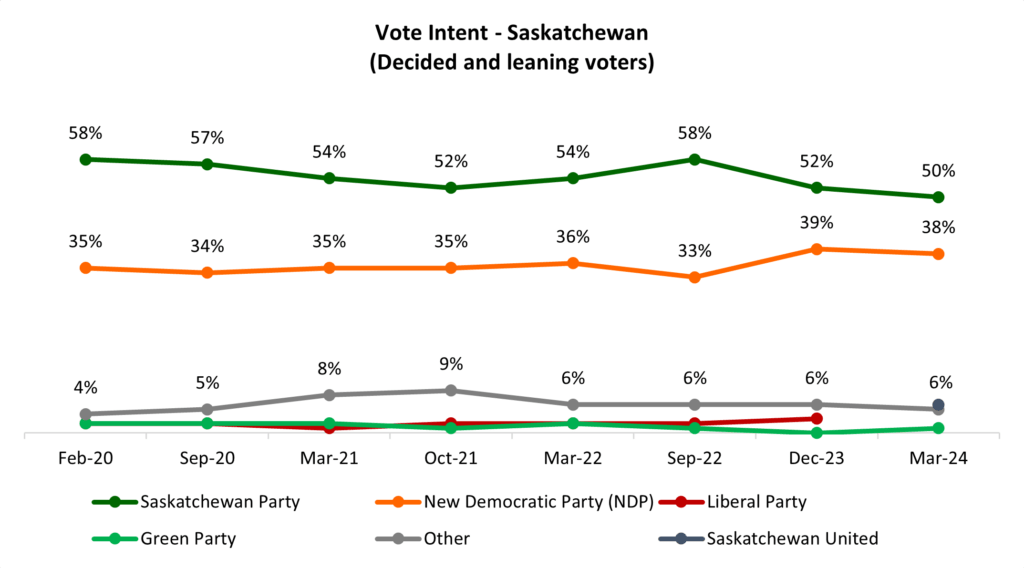
Despite 50%-38% lead over opposition NDP, Saskatchewan Party support at lowest point in four years
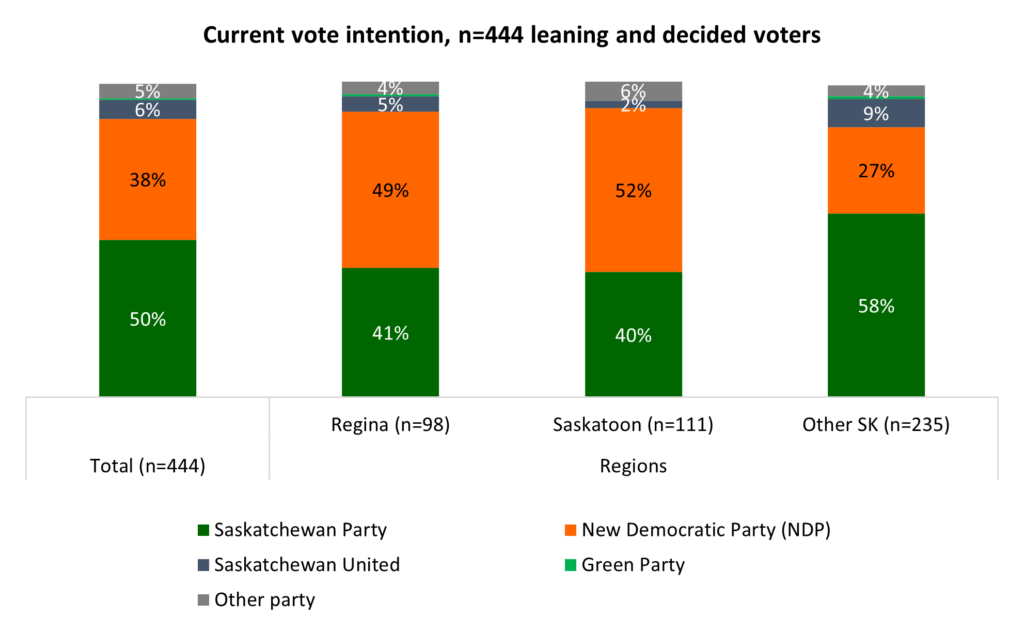
March 15, 2024 – New data from the non-profit Angus Reid Institute find the incumbent Saskatchewan Party facing a competitive situation in the province’s two largest urban spaces – Regina and Saskatoon – but dominating regions outside those two cities, to hold a 12-point advantage provincially.
Moe and his government maintain a clear advantage, after comfortably winning a majority government in 2020 but carry weaknesses into the campaign.
On three top issues chosen by Saskatchewan residents, the government is facing significant criticism. On its handling of the cost-of-living file, three-in-five (62%) say Moe and cabinet have done a poor job, compared to one-in-three (33%) who offer praise. A similar, in fact slightly worse, ratio is found when assessing the government on health care (30% good job, 65% poor job).
Another top issue for which the government faces criticism is education. Here, 35 per cent say the Sask. Party is performing well, while 62 per cent say the opposite. As ongoing strike action among the Saskatchewan Teacher’s Federation continues, this appears to be the NDP’s strongest issue. Asked which party is better suited to deal with education, 41 per cent choose the NDP and 38 per cent the current government. On other top issues, however, including cost of living, health care, and the economy, the Saskatchewan Party holds an advantage.
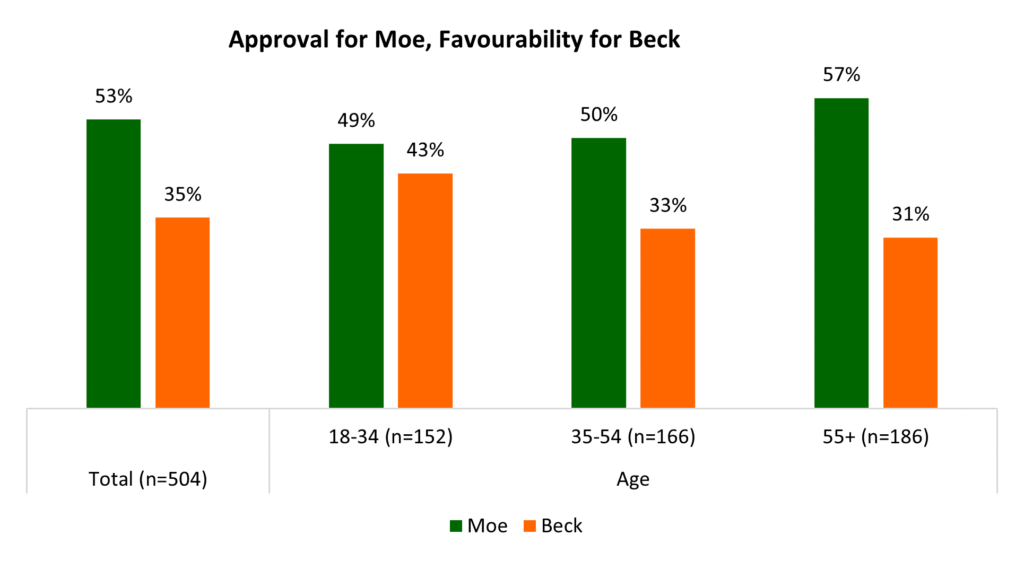
Beck and her party will have time to share their own vision for the province over the coming months, and the relatively new leader will attempt to ingratiate herself with the one-in-five Saskatchewan residents (18%) who have yet to form an opinion of her. Scott Moe holds a distinct advantage on personal appeal, with 53 per cent saying they approve of him at this point, while 35 per cent offer a positive view of Beck.
Ultimately, Beck and the NDP’s political fortunes will rely on convincing voters outside of the cities that the party is a solid alternative, and to expand the base beyond what is now largely support from residents younger than 35.
More Key Findings:
- The Saskatchewan Party holds a 31-point advantage over the NDP in regions outside of Saskatoon and Regina. Within those two cities, the NDP hold smaller but significant leads (+8 in Regina, +12 in Saskatoon)
- The economic file is a key strength for the incumbents. Half of residents (52%) say that Moe and the Sask. Party are best to lead on the economy, compared to 30 per cent for Beck and the NDP.
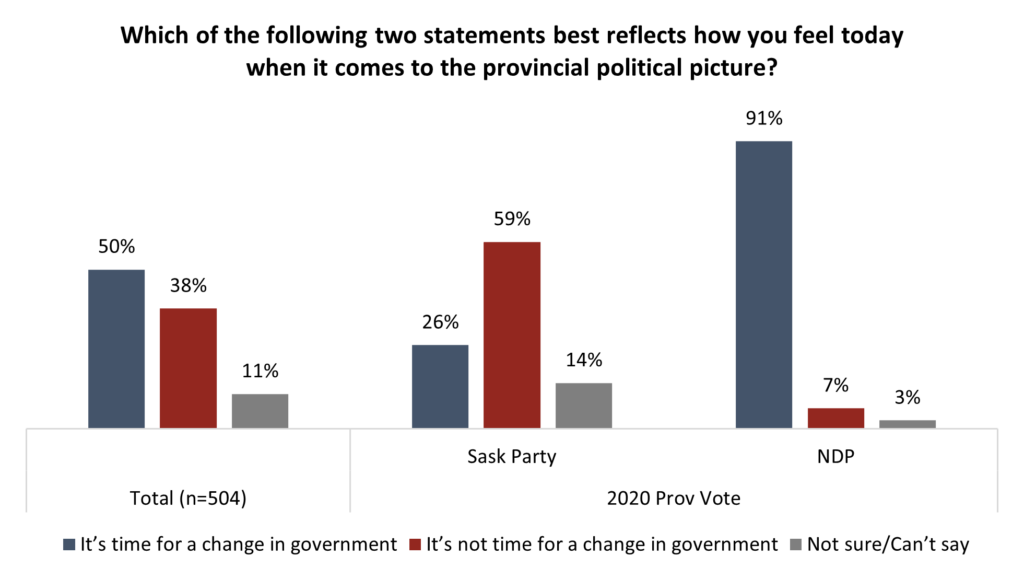
- Half of Saskatchewan residents say that it is time for a change in government at the provincial level (50%).
About ARI
The Angus Reid Institute (ARI) was founded in October 2014 by pollster and sociologist, Dr. Angus Reid. ARI is a national, not-for-profit, non-partisan public opinion research foundation established to advance education by commissioning, conducting and disseminating to the public accessible and impartial statistical data, research and policy analysis on economics, political science, philanthropy, public administration, domestic and international affairs and other socio-economic issues of importance to Canada and its world.
INDEX
Part One: The leaders
-
Regional strengths and weaknesses
-
Older voters show clear preference for Moe
Part Two: The issues
-
Cost of living, health care top concerns for residents
-
Strong performance on economy/energy, criticism on health care/cost of living
Part Three: Which party is best on top five issues?
-
Health care and cost of living
-
Party preferred on economic file, NDP on education
Part Four: Vote intention
-
Half say “time for a change”
-
Saskatchewan Party still garners 50 per cent vote share
-
Most voting “for” a party, two-in-five voting “against” one
Part One: The leaders
Saskatchewan Party leader and Premier Scott Moe had a bit of a surprise last week, when he was booed at the Brier curling final in Regina. For Moe, long among the most popular leaders in the country, this may be a small but notable concern in an election year. As it stands, the provincial “house” could be viewed as more crowded in 2024 than in recent elections, but the Saskatchewan Party clearly still has the hammer.
The good news for Moe and Co. is that he still holds a personal public opinion advantage over NDP leader Carla Beck – whose connection to Regina may have played a part in Moe’s cold reception. Half (53%) say they approve of Moe, while 35 per cent say they hold a favourable view of Beck, who has held the NDP leadership since the midpoint of 2022.

Regional strengths and weaknesses
NDP leader Carla Beck is clearly formidable in her hometown of Regina. Here she matches Moe in positive opinion. She is competitive in Saskatoon as well but is dwarfed outside of these two major urban centres. With one-in-five residents (18%) saying they are yet unsure what to think of her, “room to grow” may be a motto at provincial NDP headquarters:

An equal, if not more important, challenge for the NDP is their leader’s favourability among voters over the age of 34. Here just one-in-three offer a positive opinion. Older voters tend to come out at higher rates, which would yield an advantage to the incumbents:
Part Two: The issues
Cost of living, health care top concerns for residents
The post-pandemic era has been defined by two issues across the country and Saskatchewan is no exception. While other issues certainly play a part in the voter calculus, health care and the cost of living are paramount. Perhaps the most high-profile debate surrounding the cost of living has centred on the federal carbon tax. Moe announced that his government would no longer collect the tax on natural gas. Federal Natural Resources Minister Jonathan Wilkinson responded that the province’s residents would no longer receive a rebate. Some lower-income residents have voiced concerns that they will lose out on a much-needed source of income.
Meanwhile, the forthcoming budget is expected to carry $450 million in health care funding to address pressures on the system.

Strong performance on economy/energy, criticism on health care/cost of living
The government’s overall handling of energy policy is a bright spot according to residents. On that issue, as well as on economic performance more broadly, a majority say the government has performed well. Some long held political theories would suggest that this bodes well for the incumbent party seeking re-election. As a counterbalance to that, however, the government’s performance on three other highly prioritized issues is rated as poor:

Part Three: Which party is best on top four issues?
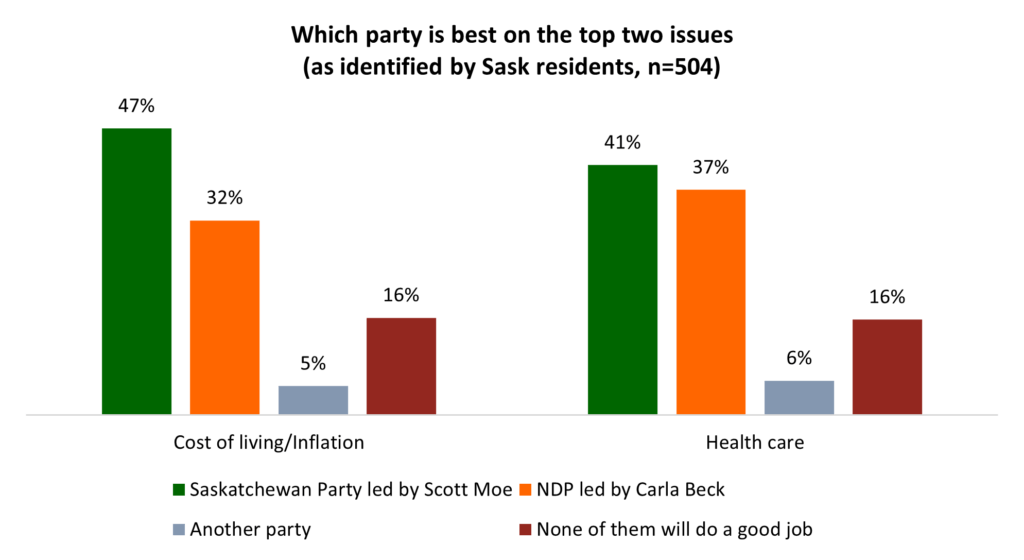
The question thus beckons, which party is best to lead on these core issues? Angus Reid Institute asked residents about the four top issues and which party they would prefer to lead.
Health care and cost of living
Perhaps the most notable finding in these data is the Saskatchewan Party’s relative strength on issues for which it garners significant criticism. While more than three-in-five residents say the government is handling the cost of living and health care files poorly, when asked which party they trust most, the incumbents still retain top spot. When it comes to health care, however, that advantage is minimal, and represents a near-even divide among potential voters:
Sask. Party preferred on economic file, NDP on education
As noted in the prior section, the economy is a strong point for the government, and on this file, it dominates in a faceoff. With respect to education, however, residents offer a slight advantage to the NDP. That is perhaps notable as the province is embroiled in a labour dispute with teachers as the Saskatchewan Teachers’ Federation looks for a new contract.

Part Four: Vote intention
Half say “time for a change”
The mood of the province is one perhaps at odds with the vote intention narrative. Consider that half of residents currently say it is time for a change in government. This includes 27 per cent of those that supported the Saskatchewan Party in 2020. Thus, while the Saskatchewan Party is poised for electoral success, one-in-two residents is concerned about the direction of the province:
Saskatchewan Party still garners 50 per cent vote share
The Saskatchewan Party has won each of the best two provincial elections in dominating fashion, garnering more than 60 per cent of the popular vote. Currently, the party holds a smaller but formidable 50 per cent of the vote share. The NDP are chosen by two-in-five, a mark it has yet to surpass in the past four years:
The Saskatchewan NDP is poised to show strongly in the major urban centres of Regina and Saskatoon. That said, more than half of the population resides outside of those two metropolitan areas, and in those spaces, the Saskatchewan Party dominates, holding a 31-point lead:
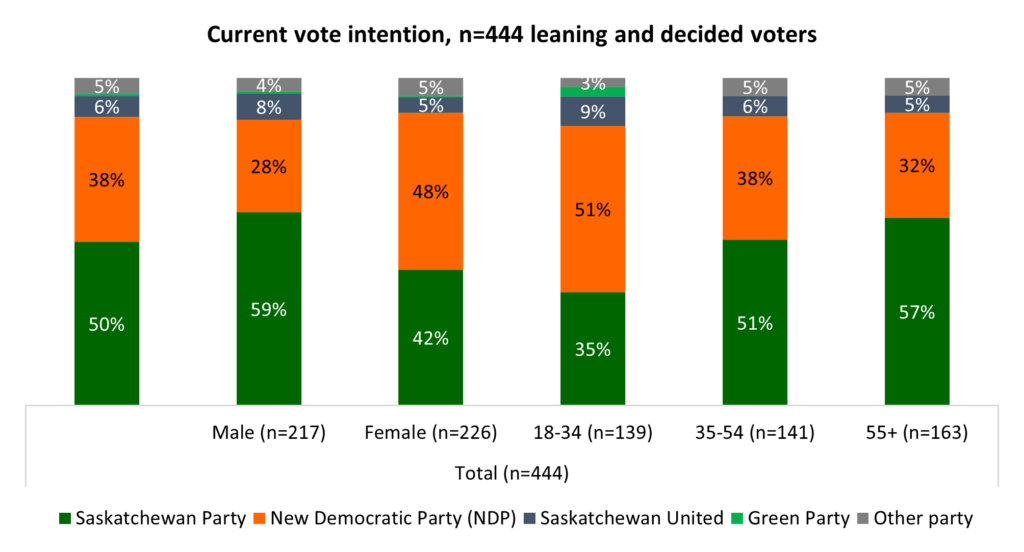
Men offer a strong preference toward the Saskatchewan Party, by a margin of more than two-to-one, while women offer a slight advantage to the NDP. The turnout of younger voters may be a key to the ultimate result, as half of those under 35 say they would vote for the NDP, with one-in-three supporting the Saskatchewan Party:
Most voting “for” a party, two-in-five voting “against” one
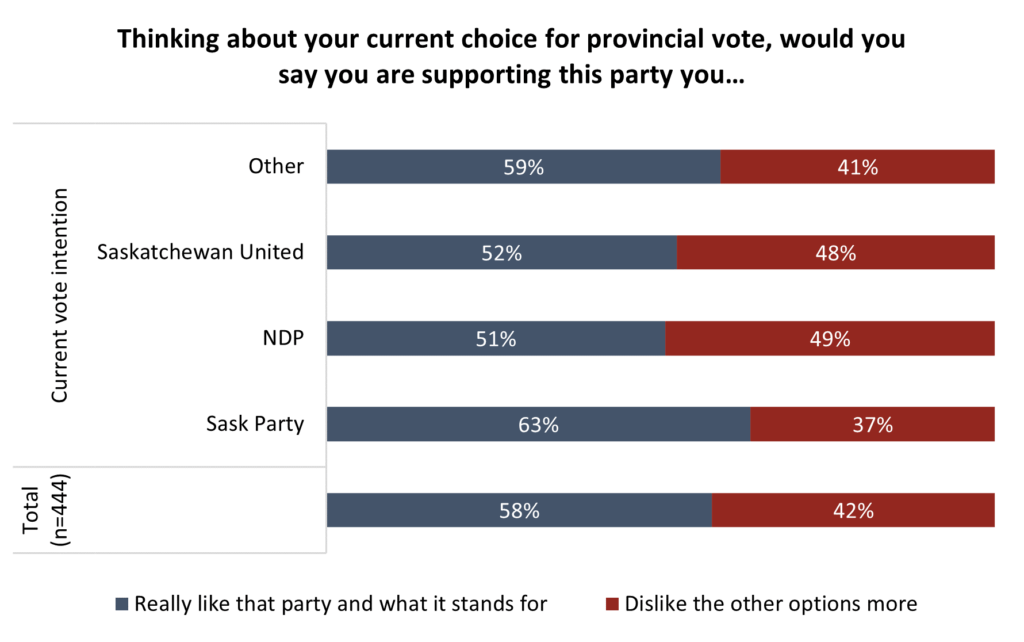
Another factor to watch in the months left to unfold is voter motivation. Currently, three-in-five voters (58%) say that they are voting for a party that they really like, including 63 per cent of Sask. Party supporters. For New Democrats, half say they are voting for a party, while half say they are voting against one. With “other” and Saskatchewan United voters comprising 12 per cent of the vote currently, movement among these voters may impact results come Election Day:
| METHODOLOGY:
The Angus Reid Institute conducted an online survey from February 28 – March 12, 2024 among a representative randomized sample of 504 Saskatchewan adults who are members of Angus Reid Forum. For comparison purposes only, a probability sample of this size would carry a margin of error of +/- 4 percentage points, 19 times out of 20. Discrepancies in or between totals are due to rounding. The survey was self-commissioned and paid for by ARI. Detailed tables are found at the end of this release. |
For detailed results by age, gender, region, education, and other demographics, click here.
CONTACT: Dave Korzinski, Research Director: 250.899.0821 dave.korzinski@angusreid.org