


Majority of past CPC voters voice support; most past NDP voters, public sector union members opposed
January 26, 2024 – In the wake of a year of labour strife, and with some Canadians questioning the costs of union membership, data from the non-profit Angus Reid Institute finds Canadians near evenly split on importing union-weakening labour laws from the United States into their country.
Two-in-five (43%) say they support “right-to-work” laws, which allow employees to join union work environments but opt out of paying union dues, while two-in-five (41%) oppose them. The federal Liberal government appears to be moving in the other direction when it comes to unionized workplaces as it pushes forward with legislation to ban replacement workers, or “scabs”, in federally regulated sectors.
Right-to-work laws have spread across the United States, but only been rarely discussed in Canada.
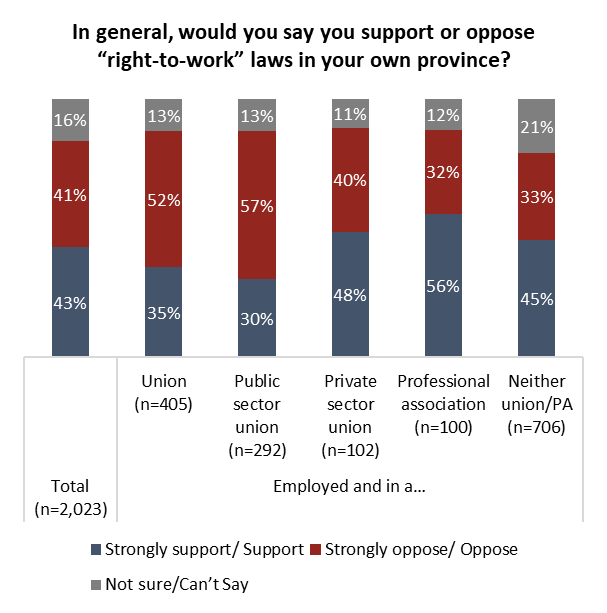
Canadians who are members of private sector unions (48%) and those outside of them (45%) are more likely to support than oppose their province adopting right-to-work laws. A majority in public sector unions (57%) stand in opposition.
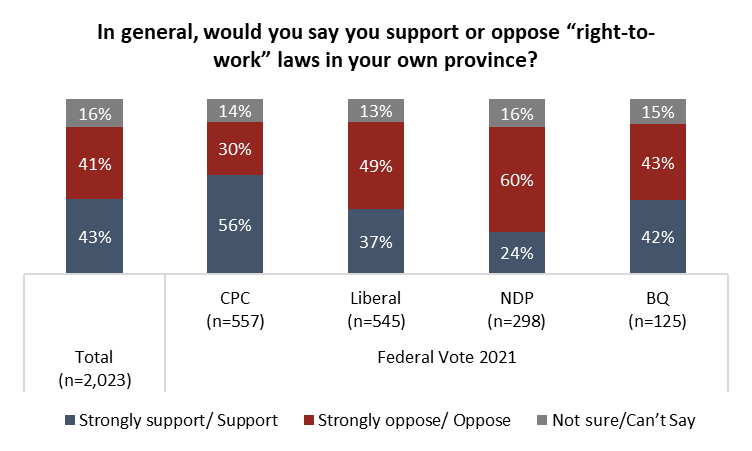
Along political lines, those who voted Conservative in 2021 (56%) are the most in favour of right-to-work laws, while past NDP voters (60%) are most opposed.
About ARI
The Angus Reid Institute (ARI) was founded in October 2014 by pollster and sociologist, Dr. Angus Reid. ARI is a national, not-for-profit, non-partisan public opinion research foundation established to advance education by commissioning, conducting and disseminating to the public accessible and impartial statistical data, research and policy analysis on economics, political science, philanthropy, public administration, domestic and international affairs and other socio-economic issues of importance to Canada and its world.
Introduction
Right-to-work laws refer to the right for workers to opt out of unions and not pay dues in unionized workplaces. The right-to-work movement originated in the United States, where 27 states currently have laws on the books that allow workers to opt-out of union dues. In recent years, there have been discussions about repealing those laws in Arizona and Michigan, which repealed its right-to-work law in March 2023. Proponents of right-to-work laws say it increases the freedom of workers because they aren’t forced to become union members if they want to work in a unionized workplace. Opponents argue that right-to-work laws reduce unions’ collective bargaining power and lowers workers’ benefits, protections and wages.
In Canada, workers who work in unionized workplaces must join the union and pay full dues. There are no provinces in Canada with right-to-work laws on the books. However, it has been discussed by the United Conservative Party in Alberta after being adopted as a party policy at the UCP’s 2020 annual general meeting.
By age and gender
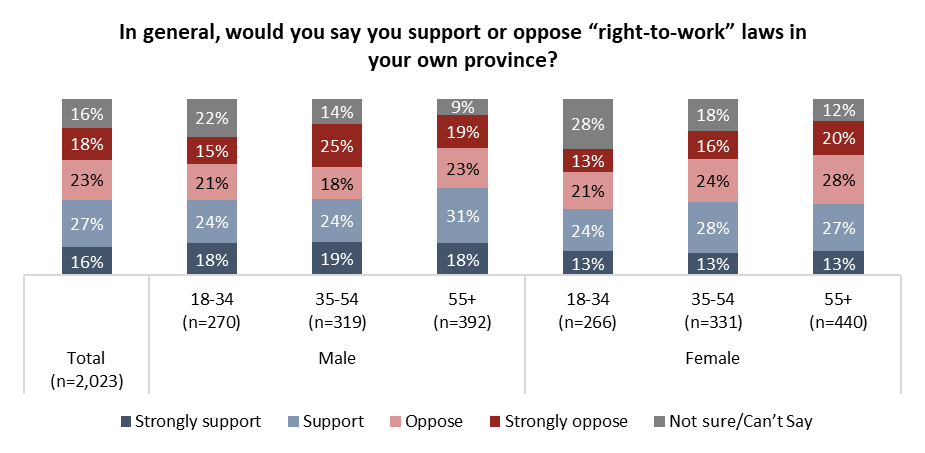
Men older than 54 are the most enthusiastic about their own province enacting right-to-work laws; half (49%) say they support such a measure. However, a sizable minority, 42 per cent, in that demographic are also opposed. There is much division on the matter across all age and gender groups:
By region
Across the country, there is little consensus. Support rises to a majority level – albeit a slim one (51%) – only in Saskatchewan. In neighbouring Manitoba, where half (49%) are against right-to-work, opposition is highest. Elsewhere, near equal-sized groups oppose and support right-to-work laws:

By politics
A majority (56%) of those who voted Conservative in 2021 say they would support right-to-work laws being passed in their province. Current Conservative leader Pierre Poilievre also once proposed federal workers should be allowed to opt out of union dues after the Public Service Alliance of Canada endorsed the sovereigntist Parti Québécois in the 2012 Quebec election.
A majority of past NDP voters (60%) are opposed to right-to-work laws being adopted in their province. Those who voted Liberal in 2021 lean towards opposing right-to-work laws, but a sizable group of nearly two-in-five support them:
By union status
Public union members are much more resistant to right-to-work laws than their private sector counterparts. Three-in-five (57%) in a public sector union oppose right-to-work laws, while half (48%) in private sector unions support them. Previous Angus Reid Institute research showed private sector union members were more likely than their public sector counterparts to believe unions in Canada were too powerful.

Survey Methodology:
The Angus Reid Institute conducted an online survey from Aug. 25-29, 2023 among a representative randomized sample of 2,023 Canadian adults who are members of Angus Reid Forum. For comparison purposes only, a probability sample of this size would carry a margin of error of +/- 2 percentage points, 19 times out of 20. Discrepancies in or between totals are due to rounding. The survey was self-commissioned and paid for by ARI.
For detailed results by age, gender, region, education, and other demographics, click here.
For detailed results by union membership, click here.
To read the full report, including detailed tables and methodology, click here.
Image – Photo 256699190 | © Meunierd | Dreamstime.com
MEDIA CONTACT:
Shachi Kurl, President: 604.908.1693 shachi.kurl@angusreid.org @shachikurl
Dave Korzinski, Research Director: 250.899.0821 dave.korzinski@angusreid.org @davekorzinski