

In Quebec, where proposed ban is widely supported, crucifix & Star of David are still seen as acceptable
November 21, 2018 – Amid protests over his party’s plan to ban some public employees from wearing religious symbols while on the job, new Quebec Premier François Legault has suggested that his Coalition Avenir Quebec government will delay introducing a bill on the matter until spring.
Whenever it’s introduced, the legislation is likely to enjoy widespread support from Quebecers – despite the vocal minority who oppose it – according to a new public opinion poll from the Angus Reid Institute.
Two-thirds of Quebec residents (65%) support the CAQ’s proposal, while fewer than three-in-ten (28%) oppose it.
That said, not all religious symbols are viewed equally. Both in Quebec and outside the province, majorities believe public employees should be allowed to wear a crucifix or a star of David while working.
Residents of all provinces, meanwhile, are inclined to believe public employees should be prohibited from wearing a niqab or carrying a kirpan – the ceremonial dagger worn by observant Sikhs – at work.
More Key Findings: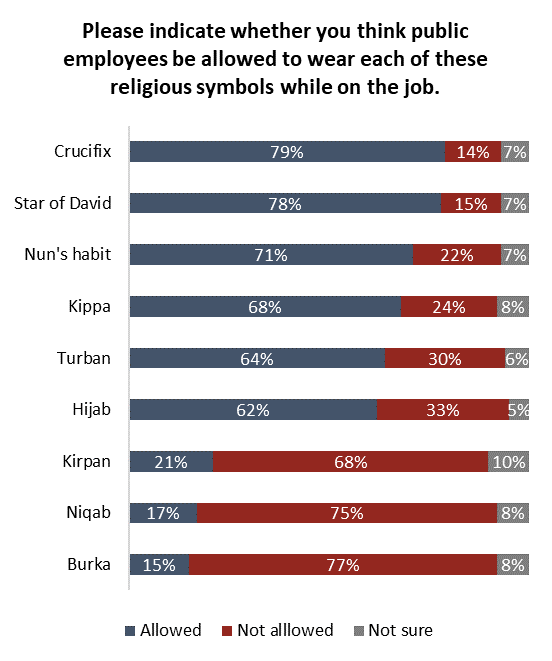
- Out of nine religious symbols asked about in this survey, only three (the aforementioned crucifix and star of David, plus a nun’s habit) are acceptable to more than half of Quebecers. Elsewhere in Canada, majorities see six of the nine symbols as acceptable
- Both in Quebec and outside of it, young people are less supportive of a potential ban on public employees wearing religious symbols, while older respondents are more so
- Political partisanship is also a key driver of views, with past Conservative Party of Canada voters mostly supporting a religious symbols ban in their province, while majorities of past Liberal and New Democratic Party voters are opposed
INDEX:
-
Which symbols would Canadians prohibit public employees from displaying?
-
Support for religious symbols ban in Quebec, divisions elsewhere
Which symbols would Canadians prohibit public employees from displaying?
Critics of the Legault government’s planned legislation argue that it amounts to discrimination against non-Christians in the province – especially Muslim women.
While the CAQ bill – like legislation tabled by previous governments – would likely be written to apply to symbols from all religions, public perspectives on this issue vary significantly by the type of symbol in question.
Shown images of nine different symbols and asked whether they should be allowed in the workplace for public employees, Canadians are most amenable to the Judeo-Christian items on the list:
- Crucifixes
- Nun’s habits
- Stars of David
- Kippas
Each of these three items enjoy more than two-thirds support.
Symbols from Sikhism and Islam are less favourably viewed, particularly if they cover the face (such as a niqab or burka) or – as some argue – could be considered a weapon (as in the case of the kirpan). Turbans and hijabs are OK for public employees in the eyes of six-in-ten Canadians, as seen in the preceding graph. Quebec residents differ significantly from the rest of Canada in their assessments of this question.
While majorities across all provinces feel that public employees should not be allowed to wear a burka, niqab, or kirpan at work, the percentage saying this for other religious symbols drops significantly in regions outside Quebec.
Within Quebec, majorities are opposed to public employees wearing hijabs (57%) and turbans (55%), and nearly half (48%) oppose public servants wearing the Jewish kippa. Responses by region are summarized in the table that follows:

Support for religious symbols ban in Quebec, divisions elsewhere
For more than a decade, successive Quebec governments have grappled with questions of “reasonable accommodation” for religious minorities in the province. The issue has been particularly salient in Quebec, some argue, because the province has long functioned as a distinct society, itself a minority within Canada.
This, coupled with the staunch secularism that has pervaded Quebec politics and society since the Quiet Revolution, has led to significant debate about wearing religious garments or symbols while conducting the business of – or simply interacting with – government.
Legault is the fourth Quebec premier – and the CAQ the third different governing party – to attempt to address these issues through legislation. Like the proposals of his immediate predecessors, Legault’s plan has been met with harsh criticism, even as a majority of Quebecers voice support for it.
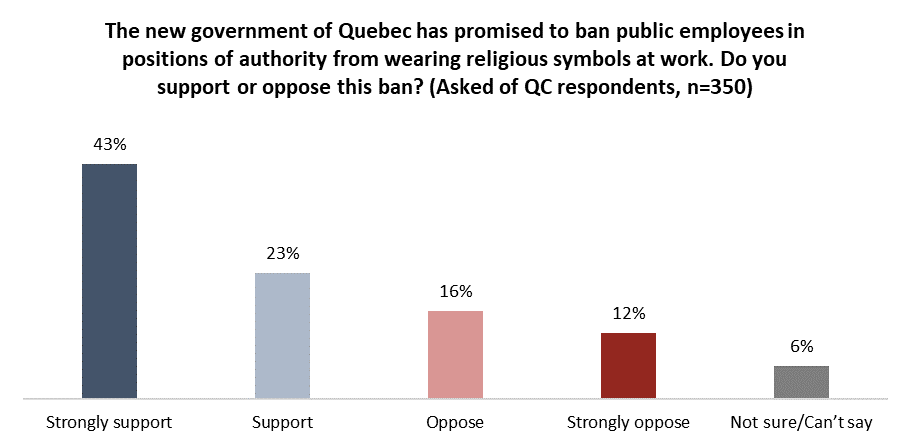
Almost two-thirds of Quebec residents (65%) say they support the CAQ’s proposal to ban public employees in positions of authority – a group that includes police, judges, and teachers, among others – from wearing religious symbols while at work. Indeed, four-in-ten (43%) strongly support such a ban:
Residents of other regions are considerably more divided when asked about implementing such a ban in their province.
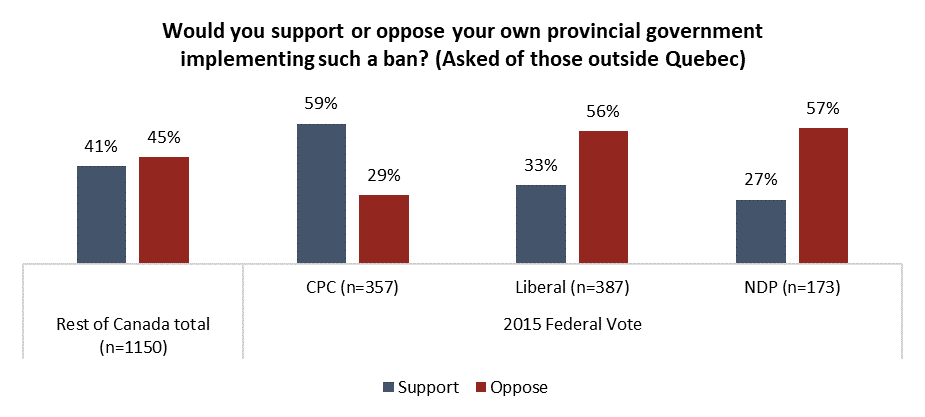
Overall, 41 per cent of residents of the rest of Canada would support a ban on public employees wearing religious symbols where they live, while 45 per cent are opposed. The rest (14%) are uncertain.
Support is highest in Alberta and Saskatchewan and lowest in British Columbia, Manitoba, and Atlantic Canada, as seen in the graph that follows.

The higher support in Alberta and Saskatchewan may, in part, be a reflection of those provinces’ political leanings. Canadians outside Quebec who voted for the Conservative Party of Canada in 2015 are much more likely than those who voted for other parties to support a ban like the one the CAQ has proposed where they live:
Note that the preceding graph shows only respondents outside of Quebec. Within Quebec, those who supported the federal Liberals in 2015 are more likely to support than oppose the CAQ’s proposed ban (51% versus 43%). Support bases for the other major federal parties in Quebec (i.e. the CPC, NDP, and Bloc Quebecois) are too small to draw statistically reliable conclusions about their opinions on the proposal.
Age is also an important factor in shaping opinion on this issue both in Quebec and elsewhere in Canada. Though majorities across all age groups support the proposal in Quebec, respondents under the age of 35 do so by only a small majority (56%), while those ages 35 and older support it at a roughly seven-in-ten rate.
In the rest of Canada, meanwhile, support for a ban on religious symbols outpaces opposition among those in the 35-plus age categories, while a majority of younger respondents (56%) are opposed:

The Angus Reid Institute (ARI) was founded in October 2014 by pollster and sociologist, Dr. Angus Reid. ARI is a national, not-for-profit, non-partisan public opinion research foundation established to advance education by commissioning, conducting and disseminating to the public accessible and impartial statistical data, research and policy analysis on economics, political science, philanthropy, public administration, domestic and international affairs and other socio-economic issues of importance to Canada and its world.
For detailed results by age, gender, region, education, and other demographics, click here.
Click here for the full report including tables and methodology
Click here for the questionnaire used in this survey
Image Credit: Government of Quebec
MEDIA CONTACT:
Shachi Kurl, Executive Director: 604.908.1693 shachi.kurl@angusreid.org @shachikurl
Ian Holliday, Research Associate: 604.442.3312 ian.holliday@angusreid.org