


Four-in-five say government is doing a poor job on each of the top three issues facing the province
April 2, 2024 – As Ontario’s Progressive Conservative government releases its 2024 budget, some residents may be dealing with sticker shock. The budget is forecast to be the largest in Ontario’s history, with $214.5 billion in new spending. For Doug Ford and his party, the goal of new spending will be, at least in part, to turn around cratering satisfaction levels in the province on a host of issues.
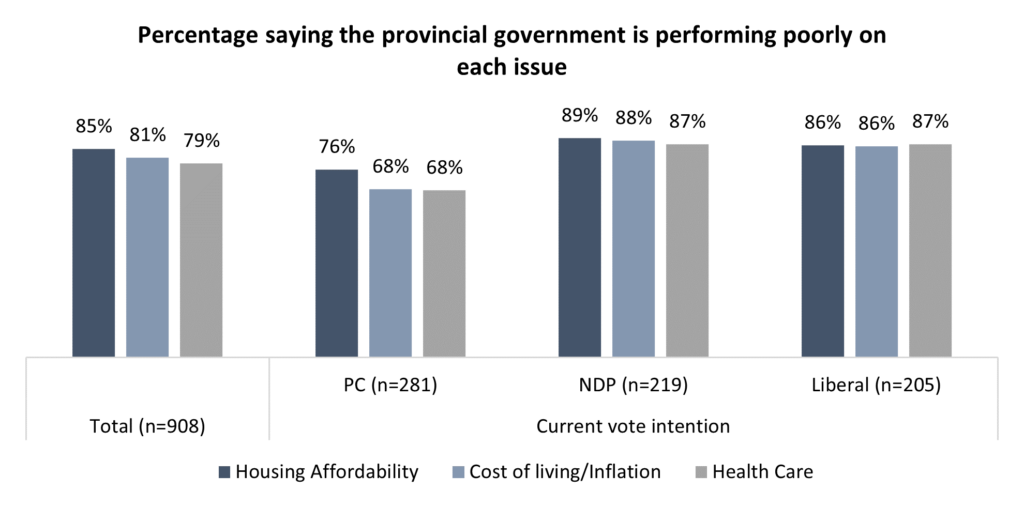
New data from the non-profit Angus Reid Institute finds four-in-five residents criticizing the government’s handling of health care and the cost of living – the two top issues in the province as identified by Ontarians. The 2024 budget carries billions in health care spending, which will be injected into the system to help tackle overtaxed emergency rooms and access challenges. Criticism on this issue is notably non-partisan, with even seven-in-10 of those who say they would vote for the Progressive Conservatives currently saying that health care has been poorly handled.
One challenge that may increase over the coming years, after Ford’s government made a $10-billion adjustment to its financial forecast, is perceived handling of the provincial deficit. Last year the government projected a $200-million surplus for the 2024/25. This has been replaced by a new projection of a $9.8 billion deficit. Even before this announcement Ontario residents were more than twice as likely to criticize the government’s handling of the deficit than to praise it (61% poor job, 25% good job).
There are, however, some recent policy announcements that have broad support in Ontario. As a part of its “Get It Done Act”, the government announced a ban on new tolls on provincial highways, and automatic licence plate renewals for drivers in good standing. Both are supported by more than seven-in-10.
More controversial are two additional policies. Half say they support the move to require a referendum on a future provincial carbon pricing program, while one-quarter oppose it and one-quarter are unsure. Another decision to classify new highway projects as “low risk” to speed up environmental assessments, divides Ontarians. With more than $27 billion over 10 years allocated in the 2024 budget for highway expansion and rehabilitation, this issue will likely draw considerable attention throughout the year.
More Key Findings:
- Ontario’s Progressive Conservative government scores second worst in the country on the Government Performance Index (23), which compiles an average performance score across all provincial issues. Only New Brunswick (22) fares worse, against a national average of 31.
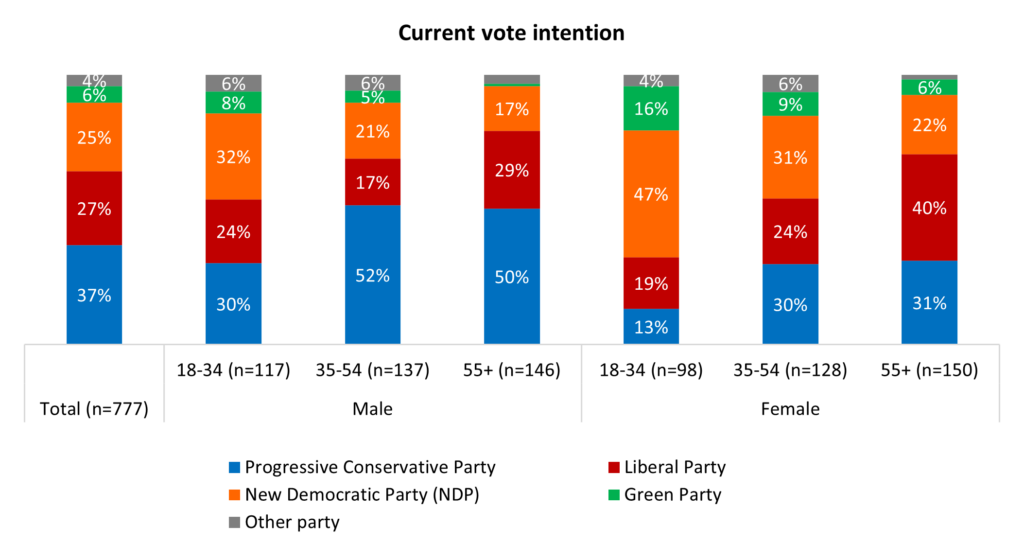
- The Progressive Conservatives hold a 10-point lead in vote intention over the second place Liberals (27%) and the third place NDP (25%).
About ARI
The Angus Reid Institute (ARI) was founded in October 2014 by pollster and sociologist, Dr. Angus Reid. ARI is a national, not-for-profit, non-partisan public opinion research foundation established to advance education by commissioning, conducting and disseminating to the public accessible and impartial statistical data, research and policy analysis on economics, political science, philanthropy, public administration, domestic and international affairs and other socio-economic issues of importance to Canada and its world.
INDEX
Part One: Top issues and government performance
-
Core priorities include cost of living, health care and housing
-
Performance ranks among lowest in the nation
Part Two: The Get It Done Act
-
Enthusiasm for some new legislative measures
-
Regional views on highway classification
Part Three: Vote intention sees three parties competitive
Part One: Top issues and government performance
Core priorities include cost of living, health care and housing
Ontarians join every other region of the country in offering two core priorities for their government to address: the cost of living and health care. Measures in the 2024 Ontario budget are aimed at tackling affordability challenges, including an extension of a tax cut on fuel, and subsidies for electricity bills, but critics including Green Party leader Mike Schreiner say the budget is not doing enough to address the rising cost of living.

Performance ranks among lowest in the nation
Criticism is not just coming from competing party leaders in Ontario, though those voices have been quick to comment on perceived missed opportunities in the budget. Residents themselves give the Ford government among the worst ratings in the nation on the Angus Reid Government Performance Index, which averages the number of provincial residents who say their government is doing a “good job” on key issues such as health care, inflation, housing affordability, education and more. Only Blaine Higgs’ Progressive Conservative government in New Brunswick matches the Ford government’s score. The good news for the Ontario PCs is that they do not face an election until 2026, unlike Higgs and his party who face an electoral contest this October:

Note: Because its small population precludes drawing discrete samples over multiple waves, data on Prince Edward Island is not released.
On nearly every issue canvassed a majority say that they feel the Progressive Conservatives have done a poor job. This is most starkly the case for key top issues as identified by Ontarians themselves, such as housing affordability (85% say poor job), the cost of living (81%), and health care (79%). With a budget deficit of more than $9 billion now forecast for the coming year, residents’ assessment of government spending will merit watching in the coming months:

Perhaps most problematic for the government: even those who say they would vote for the party currently if an election were held say they are doing a poor job. Criticism from NDP and Liberal supporters is near unanimous:
Part Two: The Get It Done Act
Enthusiasm for some new legislative measures
Prior to the budget, the government released details of the “Get It Done Act”, a piece of legislation with a range of policies related to streamlining infrastructure and highway projects, future carbon tax changes, and driver’s licence renewals. The government ran on the Get it Done slogan in the 2022 election and stated that these policies are designed to follow through on campaign promises.
Angus Reid Institute asked residents about four aspects of this new legislation, finding some policies relatively uncontroversial and others deeply divisive. The one item that does not receive majority support is perhaps the most controversial: a change to classification of new highway projects as “low risk” in order to shorten environmental assessments. The government claims this is needed to speed up important projects, such as Highway 413, while critics claim it will give the government extra powers to expropriate land and bypass important aspects of environmental impact assessment:

Across the provincial political spectrum, changes to vehicle registration and banning new tolls on provincial highways enjoy cross-partisan support. NDP and Liberal supporters express more hesitation about mandating a referendum for future carbon pricing programs in the province and majority opposition to new “low risk” classification for highway projects:

Regional views on highway classification
Changes to highway classification are popular among those who would vote for the Progressive Conservatives currently, but across the province this policy is divisive. In the 905 outskirts of the Greater Toronto Area, residents voice equal support (40%) and opposition (38%) to changes that would in theory facilitate Highway 413 in a timelier fashion.

Part Three: Vote intention sees three parties remain strong
Doug Ford’s Progressive Conservatives occupy a familiar place when it comes to vote intent. Despite poor ratings across the board for its performance, the PCs hold a double-digit vote advantage. This, as both the Liberal Party and NDP are chosen by one-in-four. The provincial Liberals are strongest in the 905 and competitive in downtown Toronto, while the PCs hold larger advantages in the rest of the province:

Men and particularly men over the age of 34 form the Progressive Conservative base, while young men and women offer the NDP significant levels of support. Liberal support is notably concentrated heavily among women over 54 years of age:
| METHODOLOGY:
The Angus Reid Institute conducted an online survey from Feb. 28 to March 6, 2024 among a representative randomized sample of 908 Ontarian adults who are members of Angus Reid Forum. For comparison purposes only, a probability sample of this size would carry a margin of error of +/- 3 percentage points, 19 times out of 20. Discrepancies in or between totals are due to rounding. The survey was self-commissioned and paid for by ARI. Detailed tables are found at the end of this release. |
For detailed results by age, gender, region, education, and other demographics, click here.
To read the full report, including detailed tables and methodology, click here.
To read the questionnaire, click here.
MEDIA CONTACTS:
Shachi Kurl, President: 604.908.1693 shachi.kurl@angusreid.org @shachikurl
Dave Korzinski, Research Director: 250.899.0821 dave.korzinski@angusreid.org
Image Credit – Facebook, FordNation