


Opposition leaders struggle to generate enthusiasm; at least three-in-10 ‘don’t know’ Crombie, Stiles
October 3, 2024 – New data from the non-profit Angus Reid Institute finds the PCPO increasing its vote advantage over the opposition despite mounting criticism from Ontarians on the government’s performance on key issues, not to mention widespread disapproval of Premier Doug Ford.
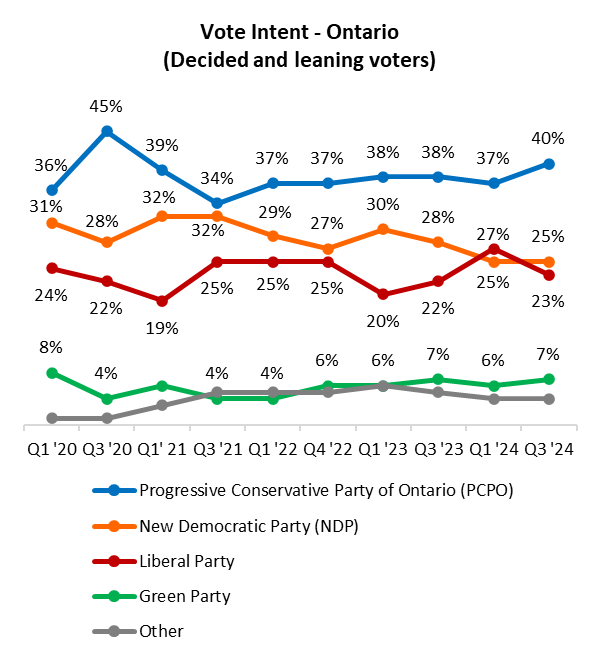
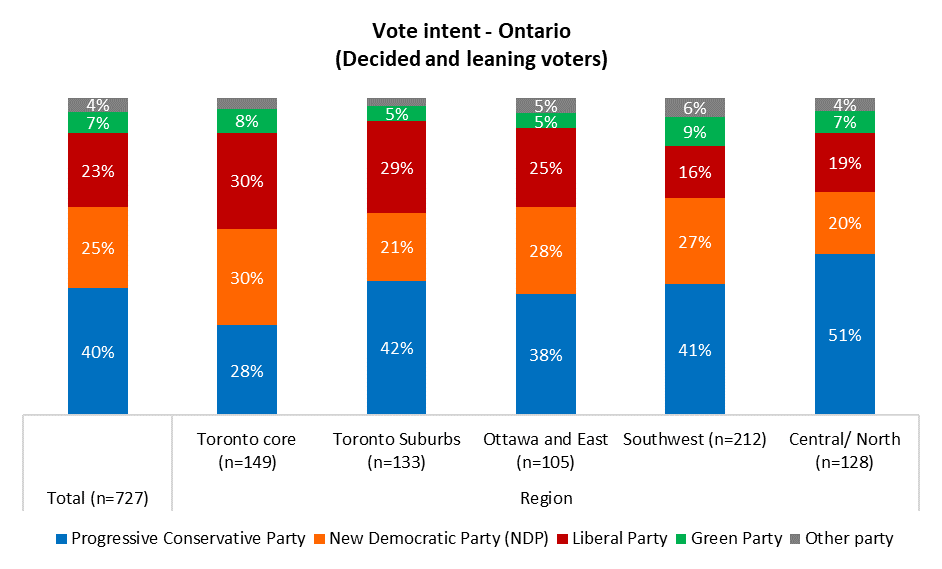
Two-in-five (40%) Ontarians would vote for the PCs if an election were held today, while statistically equal groups of one-quarter say they would vote NDP (25%) or Liberal (23%).
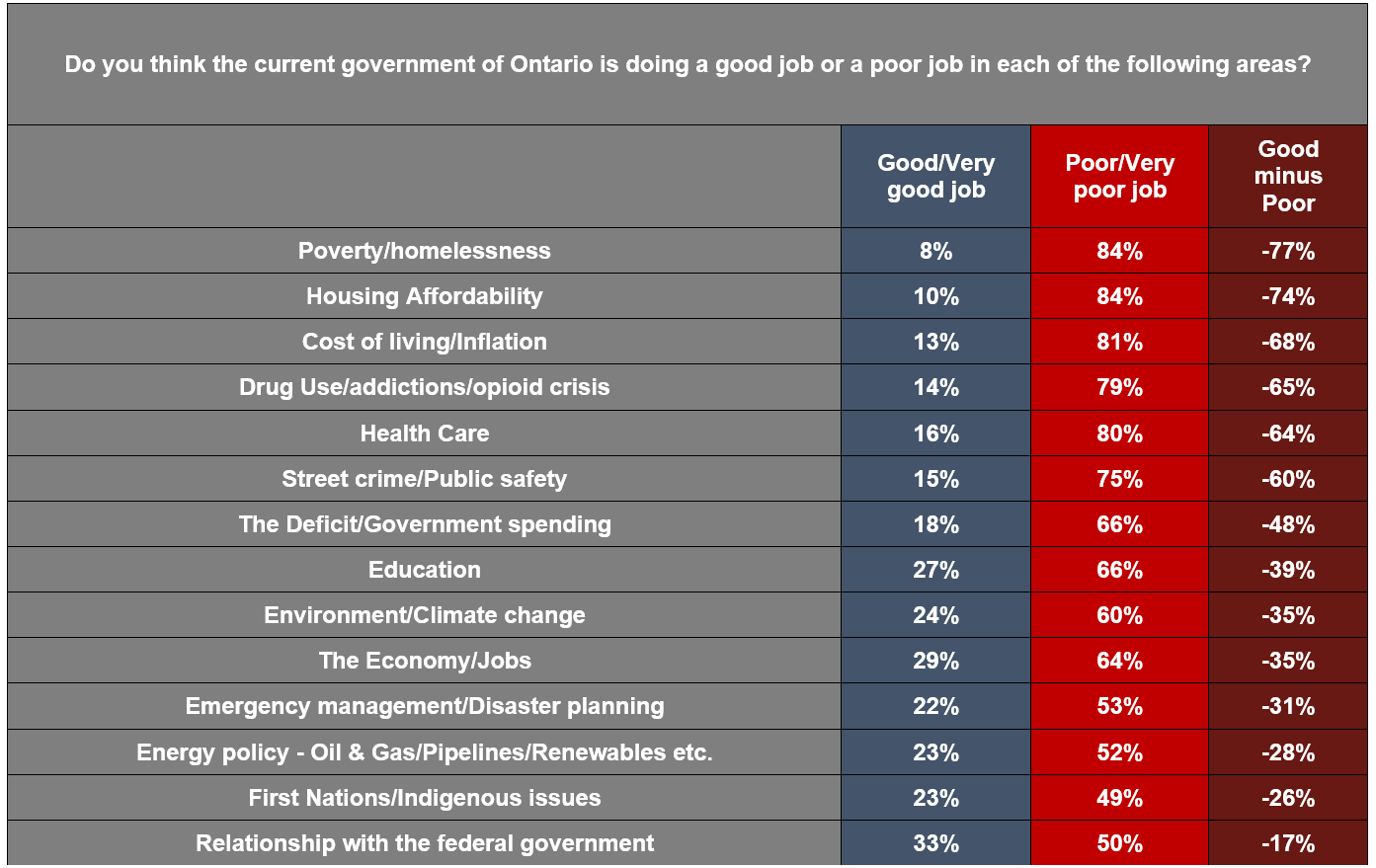
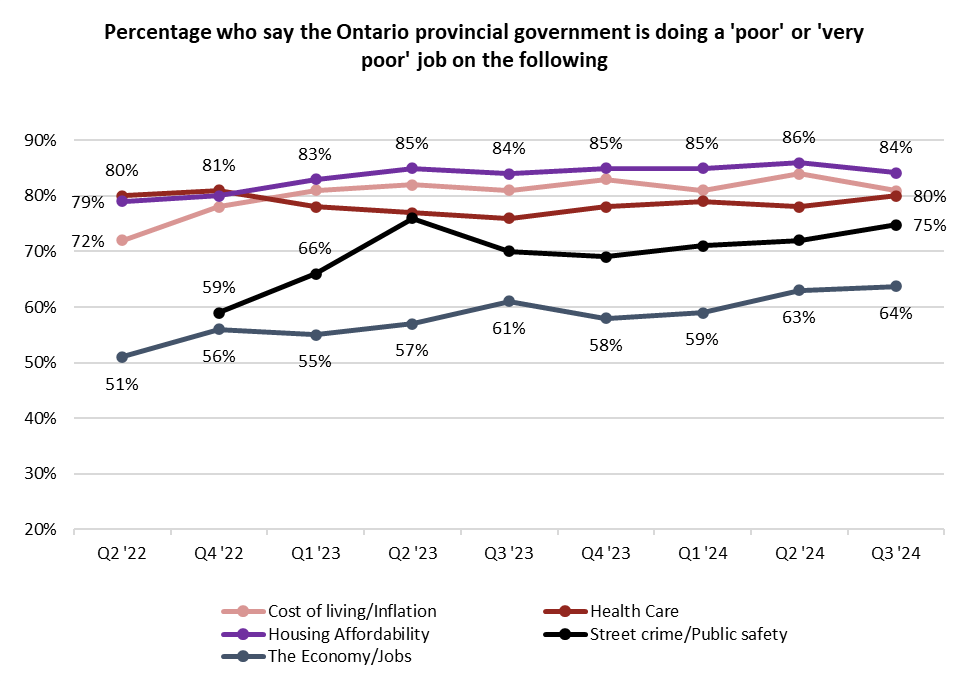
Ford’s party continue to hold a vote intention advantage despite more than four-in-five residents believing it has performed poorly on health care (80%), the rising cost of living (81%) and housing affordability (84%), the top three issues as selected by Ontarians. In fact, since the fall of 2022, more than seven-in-ten Ontarians have said the government has performed poorly on all three top issues. Despite this, Ford and co. remain well ahead of their rivals.
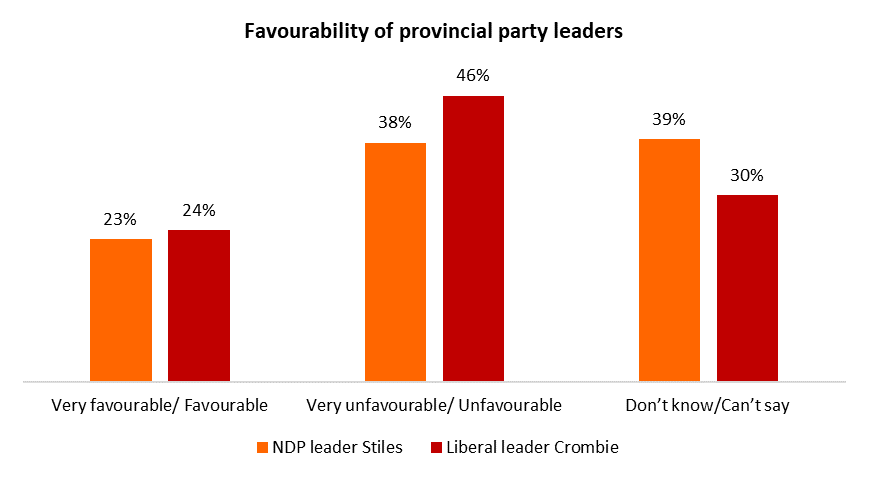
Perhaps at issue is that the NDP and Liberals have struggled to generate momentum after changes in leadership since the last provincial election. Three-in-10 (30%) Ontarians say they don’t know enough to evaluate Liberal leader Bonnie Crombie, while two-in-five (39%) are not familiar enough with NDP leader Marit Stiles to offer an opinion. For those who do assess either leader, their opinion is more negative than positive (Crombie, -22 net favourability; Stiles, -15).
And while Ford also is viewed negatively among Ontarians generally (-33 net approval), he remains popular among 2022 PC Party voters. Seven-in-10 (69%) among this cohort say they approve of his performance as premier, more than double the provincial average (31%).
About ARI
The Angus Reid Institute (ARI) was founded in October 2014 by pollster and sociologist, Dr. Angus Reid. ARI is a national, not-for-profit, non-partisan public opinion research foundation established to advance education by commissioning, conducting and disseminating to the public accessible and impartial statistical data, research and policy analysis on economics, political science, philanthropy, public administration, domestic and international affairs and other socio-economic issues of importance to Canada and its world.
INDEX
Part One: Issues and government performance
Part Two: Leadership
Part Three: Vote intent
-
Age and gender
-
Region
Part One: Issues and government performance
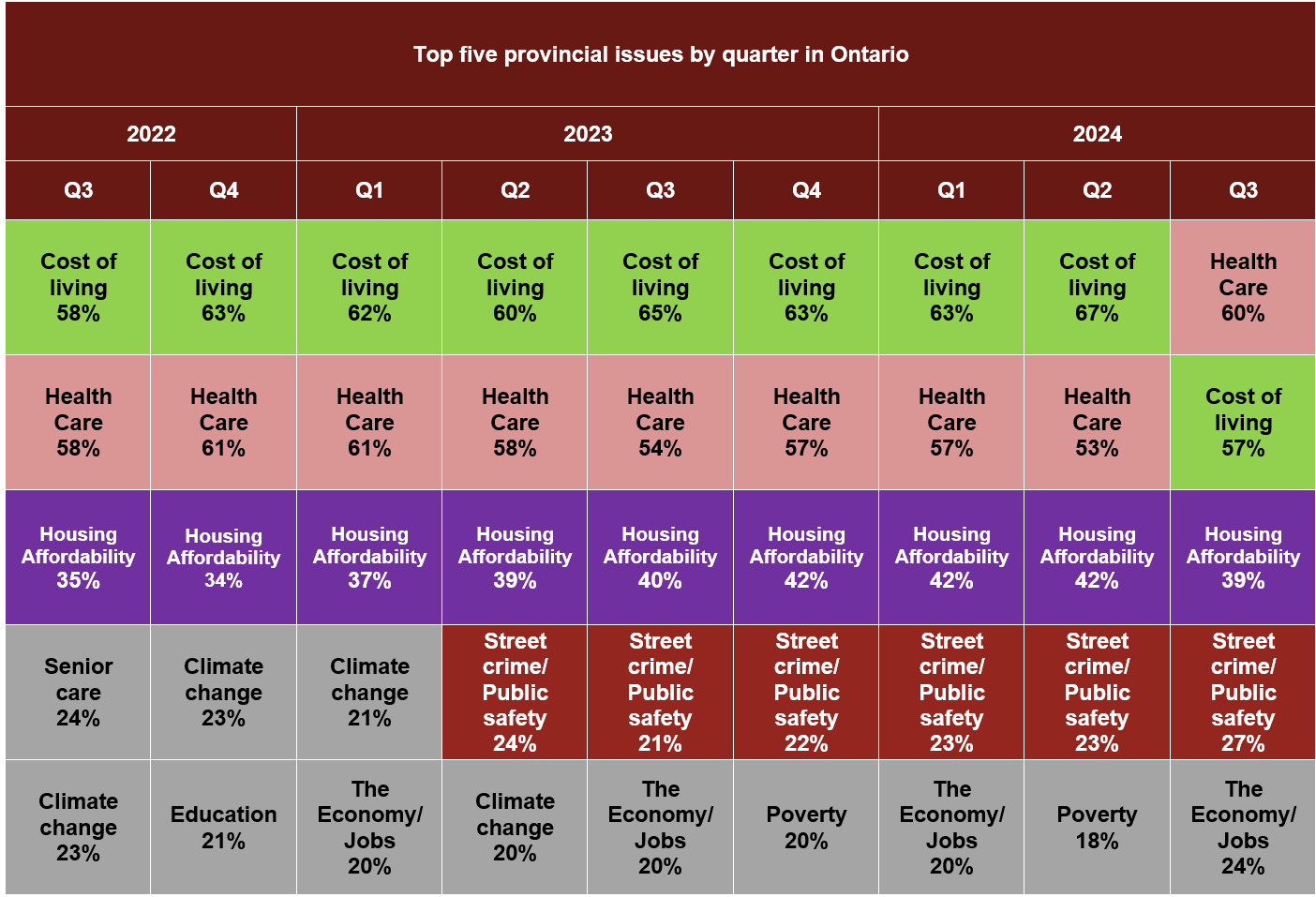
Ontarians last went to the polls in the summer of 2022, though an upcoming election is perhaps closer than the June 2026 scheduled date. Ontarians have voiced concerns over several issues consistently since Premier Doug Ford and the PC party won a majority government. Since the fall of 2022, the top three issues in the province have been the rising cost of living, health care, and housing affordability. Street crime and public safety has been the fourth most selected issue since last summer:
These consistent top issues have also been paired with high levels of criticism of the Ontario government from residents. At least half of Ontarians believe the Ford government has performed poorly on all issues included in the survey. And on the top issues selected by residents – cost of living, health care, housing affordability, street crime – at least three-quarters say the PCs have done a bad job handling those files:
On these top files, residents’ assessments have either remained highly negative or worsened since the PCs won a renewed majority mandate two summers ago.
The health-care system has continued to struggle despite billions of dollars of investment by the provincial government. Instances of so-called “hallway health care” in the province’s hospitals have reached new highs under Ford. Meanwhile, 2.5 million in Ontario reportedly don’t have access to a family doctor. However, these issues with the health-care system are not unique to Ontario.
Related:
- Access to Health Care: Free, but for all? Nearly nine million Canadians report chronic difficulty getting help
- After a ‘decade of decline’ in health care, Canadians not convinced that money is enough to solve the crisis
Ford set a target to build 1.5 million new homes by 2031, and took steps to address the province’s housing affordability crisis by setting aside $1.6 billion for key infrastructure for new homes and adding a $1.2 billion pool of money for municipalities to access if they hit certain targets for new constructions. Yet house construction has slowed from 2023, and the province is only halfway to the pace needed to hit Ford’s 1.5 million goal.
Ford has taken a tough-on-crime approach to address rampant auto theft and repeat offenders in the province. The Ontario government said it would suspend licences for convicted auto thieves, in a move that some have criticized for doing little to deter theft. Ford also promised to appoint judges who would be less lenient with bail, in a move that has been derided for eroding judicial independence.
The Ford government has also been criticized for the expansion of alcohol sales into convenience stores, the still ongoing Greenbelt scandal and the closure of the Ontario Science Centre. And it is worth noting that data for this survey was taken prior to Ford told the province’s homeless to “get off your A-S-S and start working like everyone else”.
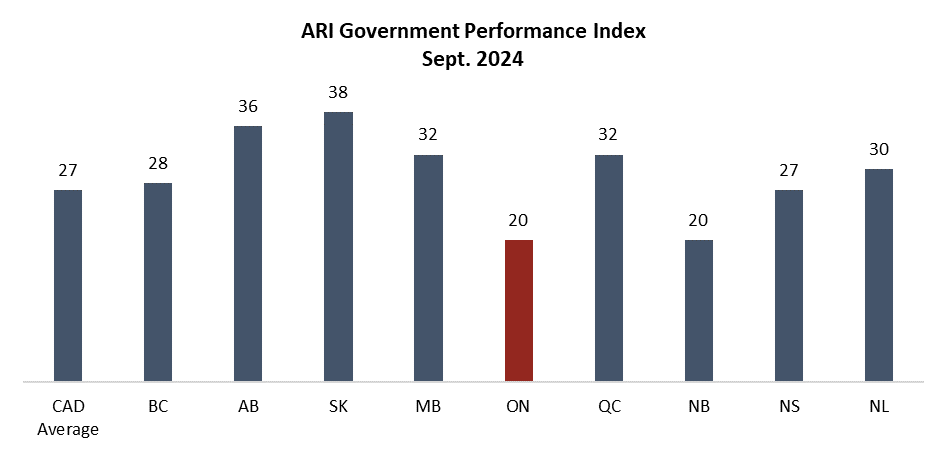
Ontario’s government performance – as judged by its citizens – is tied with New Brunswick for the lowest score on the Angus Reid Institute’s Government Performance Index, which averages the number of residents who believe the province is doing a “good job” across 14 different issues:
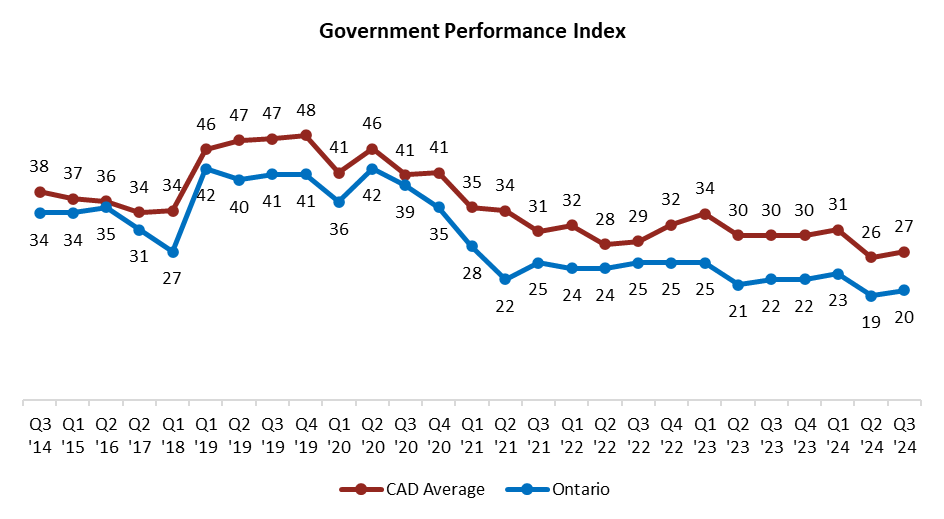
This has also consistently been the case since Ford took office in 2018. Even when the Ontario government was perceived to be performing better on the issues of the day, it still lagged most other provinces:
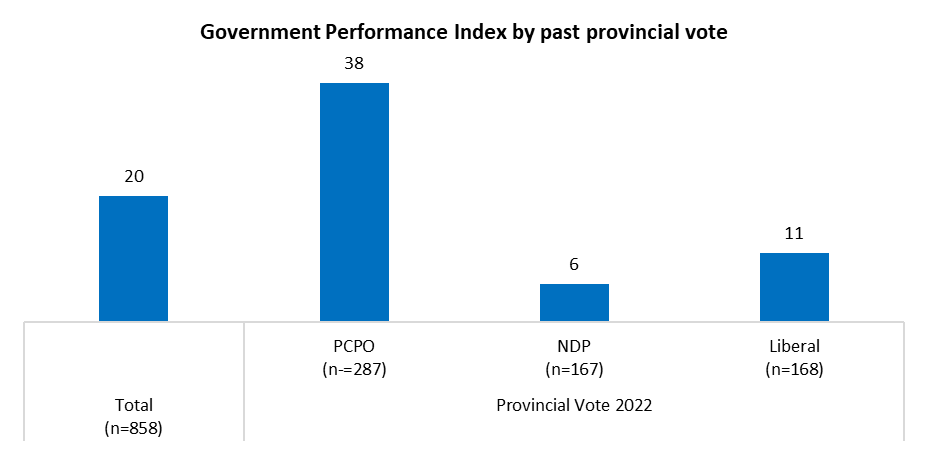
While past Progressive Conservative voters offer more praise of the provincial government than those who voted NDP or Liberal in 2022, there are many areas where PC voters are critical. Majorities of 2022 PC voters say the government has performed poorly on health care (64%), inflation (65%), housing affordability (68%), and street crime (68%). They are more positive when it comes to the economy (53% good job) and issues such as education (54%) and relationship with the federal government (55%), which are further down residents’ priorities (see detailed tables).
Part Two: Leadership
Through the mounting criticism of the government’s performance, Ford remains popular among his PC base even as many other Ontarians say they hold negative views of the premier. Seven-in-10 (69%) 2022 PC voters say they approve of Ford, more than double the rate (31%) of the provincial average. Nearly all past provincial NDP (92%) and Liberal (90%) voters disapprove of the premier’s performance.

Ford will face two new opponents whenever the next election is held, but neither NDP leader Marit Stiles or Liberal leader Bonnie Crombie have gained much traction since they took the helm of their party in February 2023 and December 2023 respectively. Two-in-five (39%) say they don’t know enough to evaluate Stiles, while three-in-10 (30%) say the same of Crombie. For both leaders, perhaps the greater issue is that Ontarians are more likely to view them unfavourably than favourably:
Part Three: Vote intent
The unpopularity of the premier among a majority of Ontarians, and the heavy criticism of the government from residents on most files, has done little to impact the vote intention picture in Ontario. The PCs are the preferred choice of a plurality, giving them a more than double digit lead on both the NDP (25%) and Liberals (23%). The Green Party garners the vote intention of seven per cent in the province:

Age and gender
Older Ontarians are the largest source of the PC’s support. The Liberals fare better among older Ontarians than younger ones, but max out at 30 per cent of vote intention among any demographic. The NDP are most popular among younger Ontarians and women:

*Smaller sample size, interpret with caution
Region
The Progressive Conservatives are the plurality choice in all regions but Toronto’s downtown core, where the party is in a three-way race with the NDP and Liberals. That is also where the NDP and Liberals perform best, as neither party tops 30 per cent support elsewhere in the province:
Survey Methodology
The Angus Reid Institute conducted an online survey from Sept. 12-18, 2024 among a representative randomized sample of 858 Ontarian adults who are members of Angus Reid Forum. For comparison purposes only, a probability sample of this size would carry a margin of error of +/- 3 percentage points, 19 times out of 20. Discrepancies in or between totals are due to rounding. The survey was self-commissioned and paid for by ARI.
For detailed results by age, gender, region, education, and other demographics, click here.
For the full release including methodology, click here.
For the questionnaire, click here.
Image – Ford Nation/ Facebook
Shachi Kurl, President: 604.908.1693 shachi.kurl@angusreid.org @shachikurl
Dave Korzinski, Research Director: 250.899.0821 dave.korzinski@angusreid.org
Jon Roe, Research Associate: 825.437.1147 jon.roe@angusreid.org @thejonroe