


Two-thirds of past NDP voters either unsure who would make best leader, or don’t know candidates
March 25, 2026 – Voting is open in the federal NDP leadership race, with five candidates hoping to lead the party into an uncertain future. The leader will be announced at the convention in Winnipeg on Sunday, and the first task after winning will evidently be introducing themselves to many would-be voters.
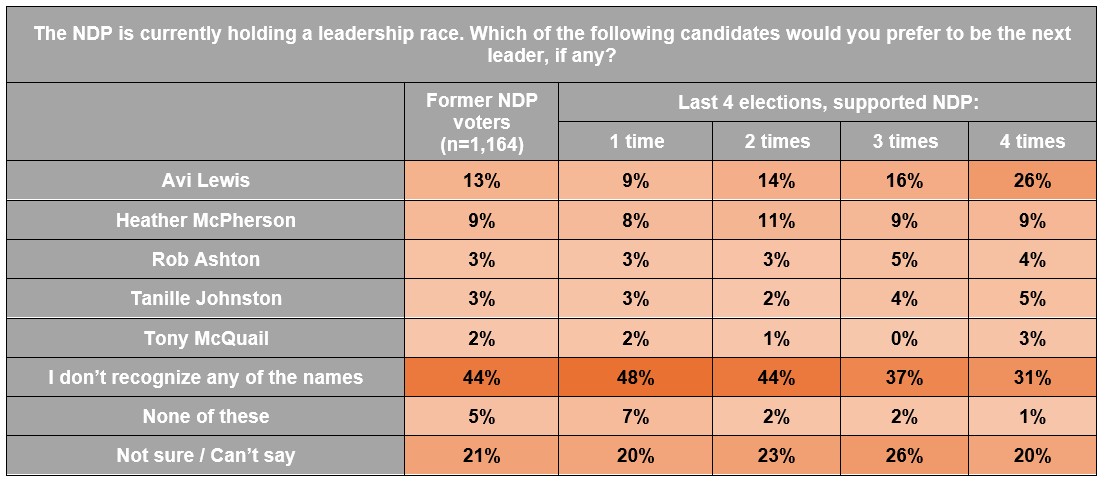
New data from the non-profit Angus Reid Institute examines the views of more than 1,100 Canadians who voted for the NDP at least once in any of the past four federal elections, finding 44 per cent of them say they don’t know any of the leadership candidates, and another one-in-five are uncertain who would make the best leader.
Fundraising frontrunner Avi Lewis leads with 13 per cent support among this cohort interviewed by ARI. Heather McPherson is chosen by nine per cent of these past supporters.

In many ways, the uncertainty and lack of enthusiasm enveloping the race mirrors the party’s current position, as it seeks to establish relevance. After gaining status as the official opposition in 2011 under Jack Layton and flirting with government-forming levels of vote intention during the 2015 campaign under Thomas Mulcair, the party faltered under Jagmeet Singh, losing official status last year and returning just seven MPs to Ottawa. After a floor-crossing defection last month, the current caucus stands at six.
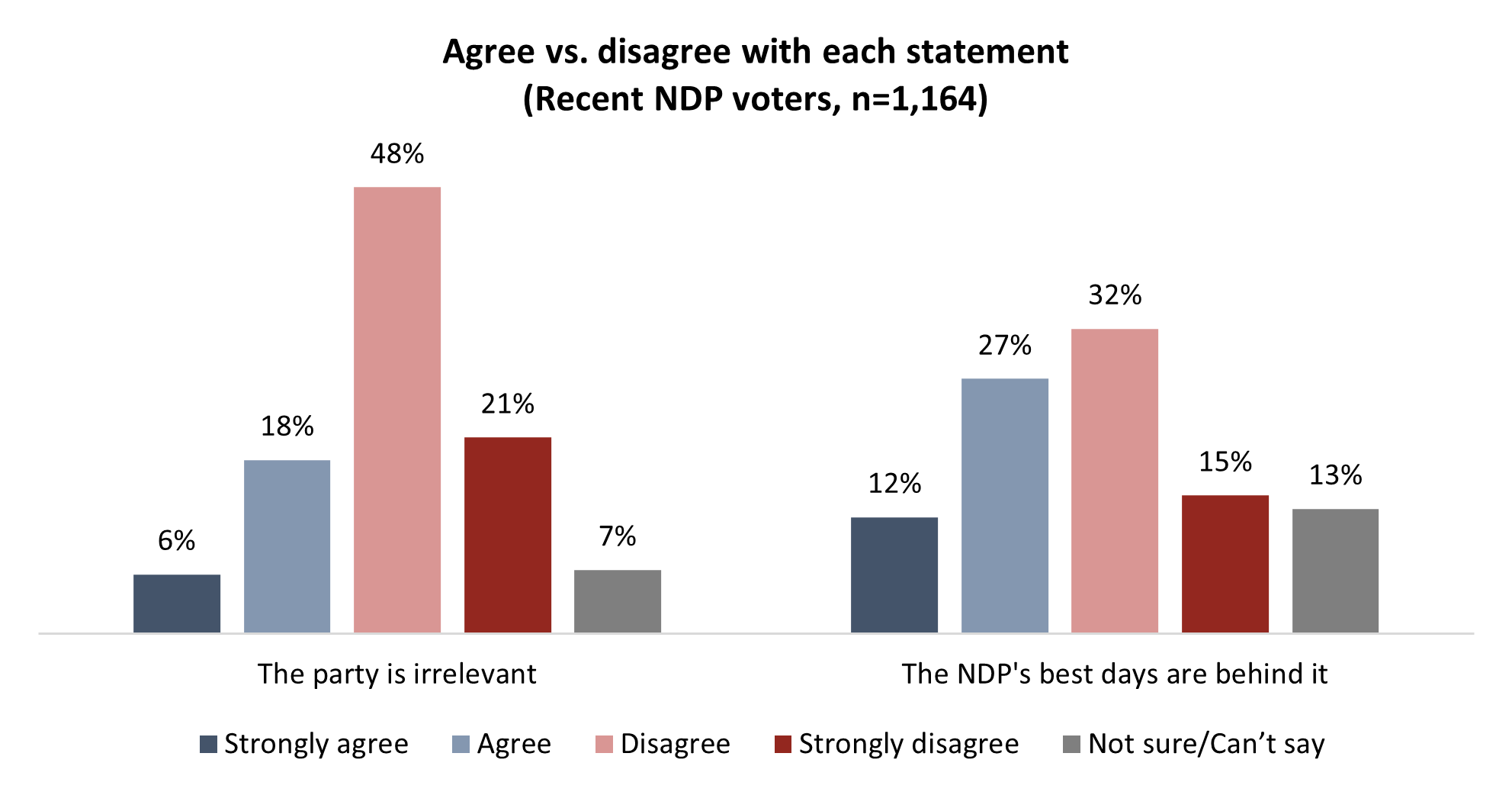
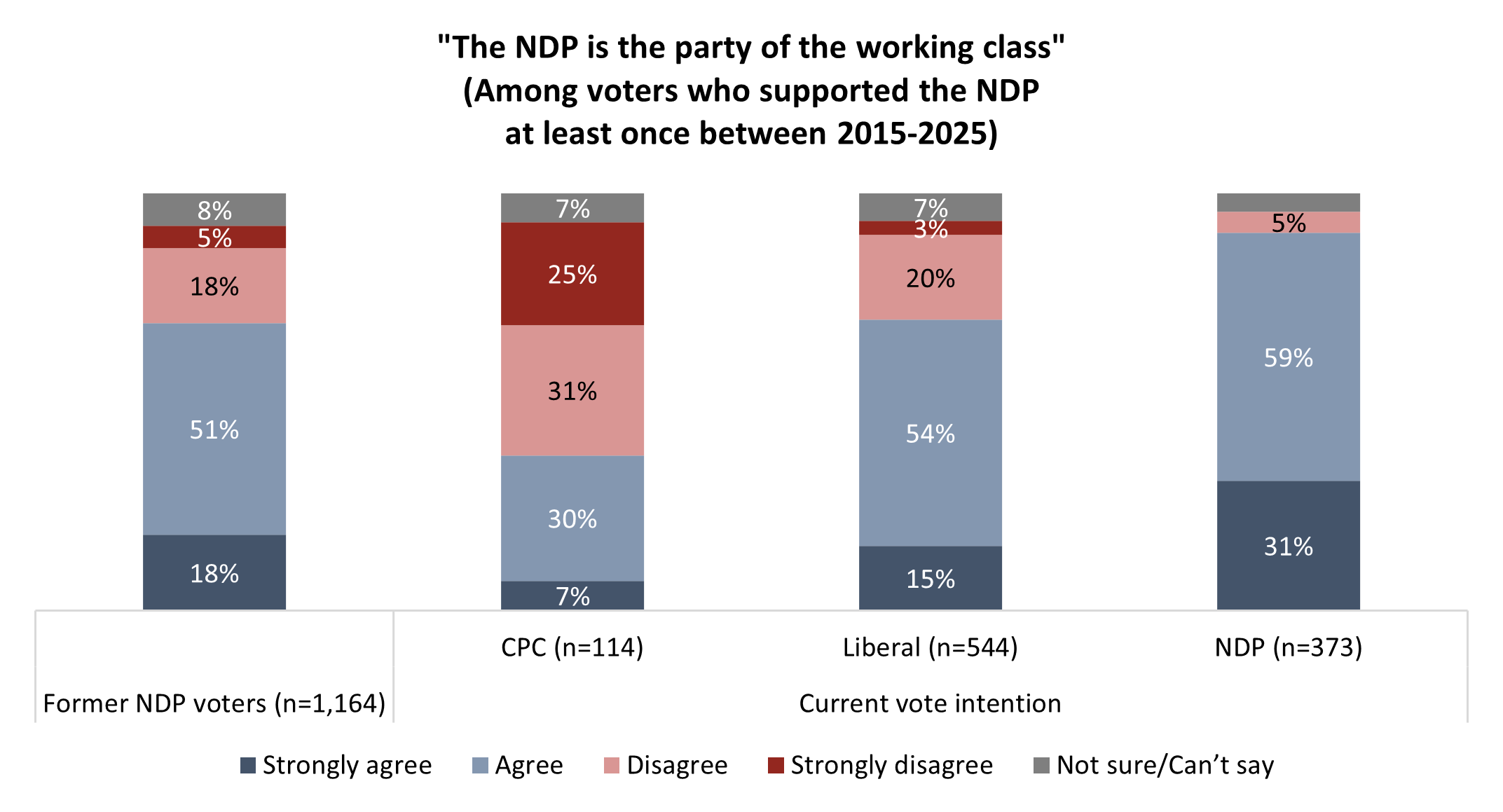
Fully one-quarter of these past New Democrat voters say the party is irrelevant (24%). More say its best days are in the past (40%). Whomever is tasked with the job of rebuilding will likely be focused on returning to the party’s roots as the federal avatar for the working class, something it spent decades building through cooperation with organized labour. One-quarter of past New Democrats in this survey disagree that the NDP is the party of the working class (23%). Those who previously supported the NDP but voted Conservative in 2025 are most likely to feel this way.
INDEX
Part One: The NDP since 2015 – how we got here
Part Two: The party’s future and foundations
- Past voters aren’t certain the NDP is the party of the working class anymore
- Is the party’s future bright?
- Half past voters would consider NDP again, is that enough?
Part Three: Muted response to leadership race
Appendix: NDP voter demographics
Part One: The NDP since 2015 – how we got here
Since its first era under Tommy Douglas, who led the party in four federal elections, third and fourth place in the parliamentary seat standings have largely been the standard for the NDP. That said, the party has proven able to capture lightning in a bottle with the right moment and the right leader. Under Jack Layton, the NDP formed the official opposition in 2011, scoring a record 103 seats 30.6 per cent of the vote.

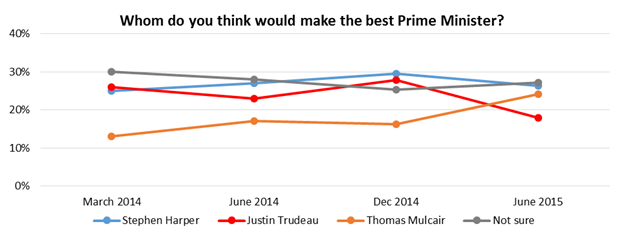
After Layton’s death, his successor Thomas Mulcair appeared ready to take the next step in 2015. For several waves of pre-election polling, in a faceoff against Stephen Harper’s Conservatives and Justin Trudeau’s Liberals, Mulcair and the NDP led in vote intention. Mulcair was competitive with Harper and bested Trudeau on the question of “best Prime Minister” during that campaign:
The Mulcair Moment did not come to pass. Trudeau and the Liberals, in some ways, “out progressived” the NDP, with messaging on embracing deficit spending, while Mulcair was committed to balanced budgets. The Liberals also ran on creating a new tax bracket for wealthier Canadians, and more generous spending on a new Canada Child Benefit, among other popular policies. Trudeau ended the campaign with more “hearts” on his side than Mulcair, a key indicator of the inspiration and charisma factor that characterized his early political successes.
Related: Promises, Promises. Key 2015 campaign debates favoured Liberals
Mulcair and the NDP won 44 seats and returned to third place. A weakened Liberal Party was largely to the benefit of the Conservative Party in subsequent elections, and the NDP were unable to generate positive momentum, losing a small amount of vote share compared to 2015, but a significant number of seats in both 2019 and 2021. In 2019, Singh saw his approval rise significantly throughout the campaign on the strength of debate performance, but strategic voting kept many soft NDP voters from supporting his party.
Related: 2019 Study shows Liberals benefitted most from strategic voting
In 2021, a similar story played out, with the Liberals again squeaking out a minority government in an election where more than one-in-three voters said they were voting to block a party from forming government, rather than supporting one they liked. Singh again proved unable to convert his majority favourability and his place as the leading “heart or gut” candidate into electoral gains.
After the ’21 campaign, Singh’s NDP and the Liberals signed a supply-and-confidence agreement to keep the government afloat in exchange for New Democrat priorities. The deal helped to deliver legislative wins, including, perhaps most prominently, a new national dental care program, but made Singh and his caucus a repeated target from both inside the NDP’s traditional base and out, for propping up the Trudeau Liberals.
While he had garnered some good will, Singh’s leadership marked a clear shift away from the class-first, labour-oriented politics that had long defined the party. While traditional economic priorities such as affordability and pharmacare remained, the party increasingly framed its agenda through lenses of identity, representation, and systemic inequality, with a growing focus on urban, diverse, and younger voters. That evolution broadened its appeal in some metropolitan areas but came at a cost. The party lost support in resource regions and among parts of its traditional working-class base.
Singh ended the agreement in September 2024 but was unable to garner momentum in the subsequent federal election after Mark Carney’s ascent to Liberal leader. The party fell to 6.3 per cent of the vote share and seven seats, leaving it without official party status.
Now, with a leadership race ongoing, the NDP has an uphill battle to convince would-be voters that it has a bright future ahead, and that it still represents the working class Canadians who have long been a part of its roots.
Part Two: The party’s future and foundations
Past voters aren’t certain the NDP is the party of the working class
In this new, nationwide survey, Angus Reid Institute asked Canadians about their past voting habits and found that one-quarter of respondents say they have supported the party in at least one election since the 2015 general election. For more on those voters’ habits, see detailed tables.
The NDP’s foundation as the party of labour is by no means uncontested. Most, but by no means all, recent NDP voters are ready to say that the NDP is the part of the working class. One-quarter of recent NDP voters disagree that this is the case, while one-in-five feel strongly that this is still the NDP’s position:

Notably, many of the most likely to disagree with this statement are those who have been NDP voters in the past but currently support the Conservative Party of Canada. Recently, a number of commentors have noted this trend, that the CPC had been targeting and in some cases winning over “working class” Canadians. Previous Angus Reid Institute data, too, had identified this trend.
Those who have supported the party in the past and still do currently are more unanimous in feeling that the NDP is the party of the working class. Those who have supported the party previous but voted for the CPC in 2025 largely disagree that the NDP best represents the working class:
Is the party’s future bright?
The NDP leadership race is as much about rebuilding the party as it is choosing who will lead the party into the future. The candidates can take hope from the fact that most (69%) of the party’s pool of previous voters believe the party is still relevant. One-quarter (24%) of those who voted for the NDP in one of the last four elections disagree.
However, there appears to be doubt that there are better days ahead for the party. Among those past NDP voters, two-in-five (39%) believe the party’s best days are behind it; half (47%) disagree.
Part of the challenge for the next NDP leader will be convincing voters along the margin that the party is relevant to the national political conversation. Likely voters overwhelmingly (84%) believe the NDP have an important place in the conversation; respondents who describe themselves as not likely to vote for the NDP in a future election are much more likely to believe the party is “irrelevant” (43%) (see detailed tables).
Likewise, former NDP voters who are not likely to consider the party in a future election are more likely (59%) than the party’s core base (25%) to say that the best days of the NDP are behind it. Whoever is elected as NDP leader will need to convince those voters who once supported the party that the NDP have something to say.

Half past voters would consider NDP again, is that enough?
The NDP will be building to the next election starting from their lowest pool of support in the past 60 years. They’ll need not only voters from the recent past but new supporters to take them back to their previous highs. The most ardent supporters – those who voted for the party in each of the past four elections – are likely consider supporting the party again (90%). But there is declining enthusiasm even among three-time voters (41% very likely, 33% likely), two-timers (26% very likely, 36% likely) and single-time voters (11% very likely, 24% likely).
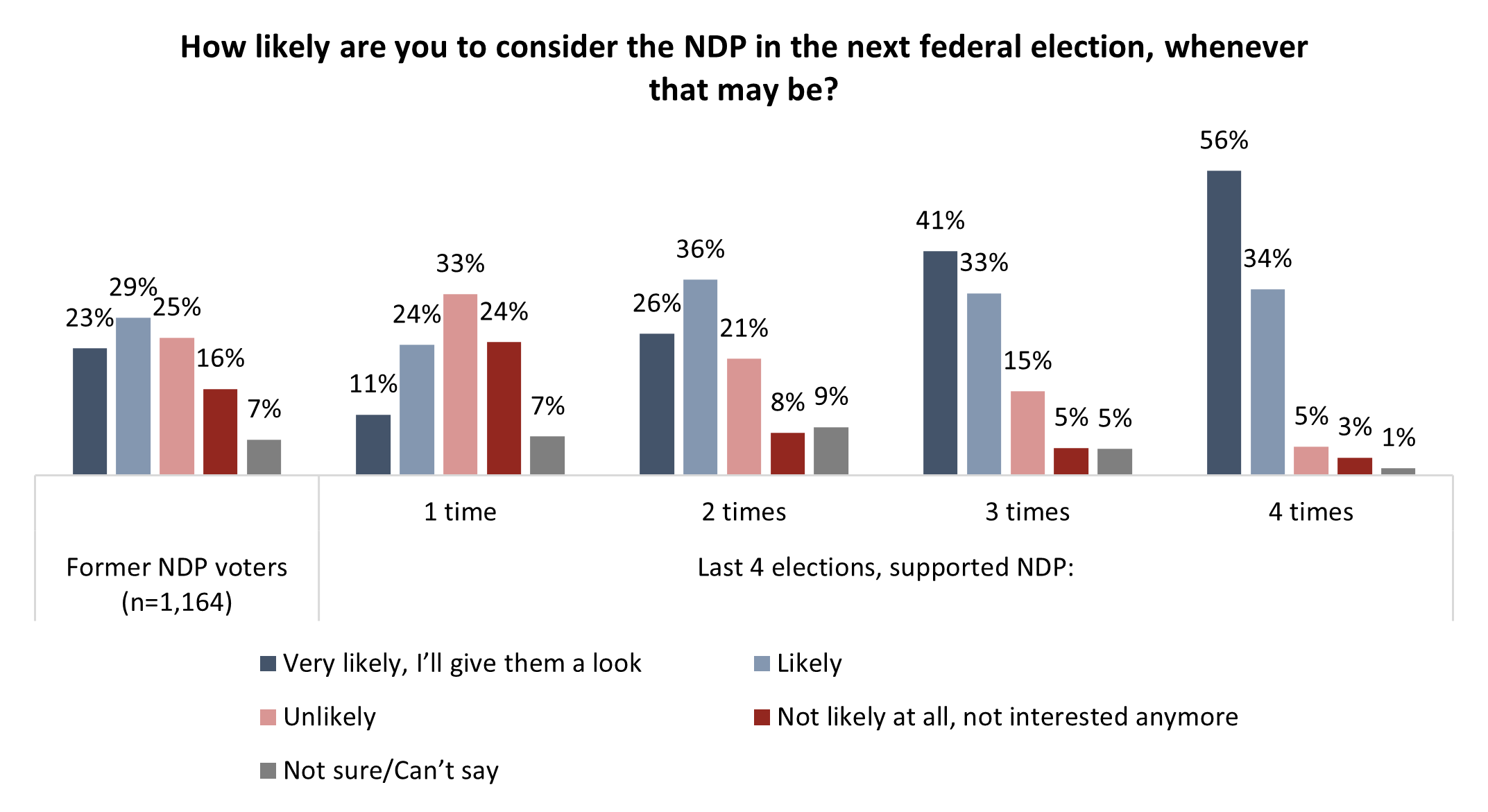
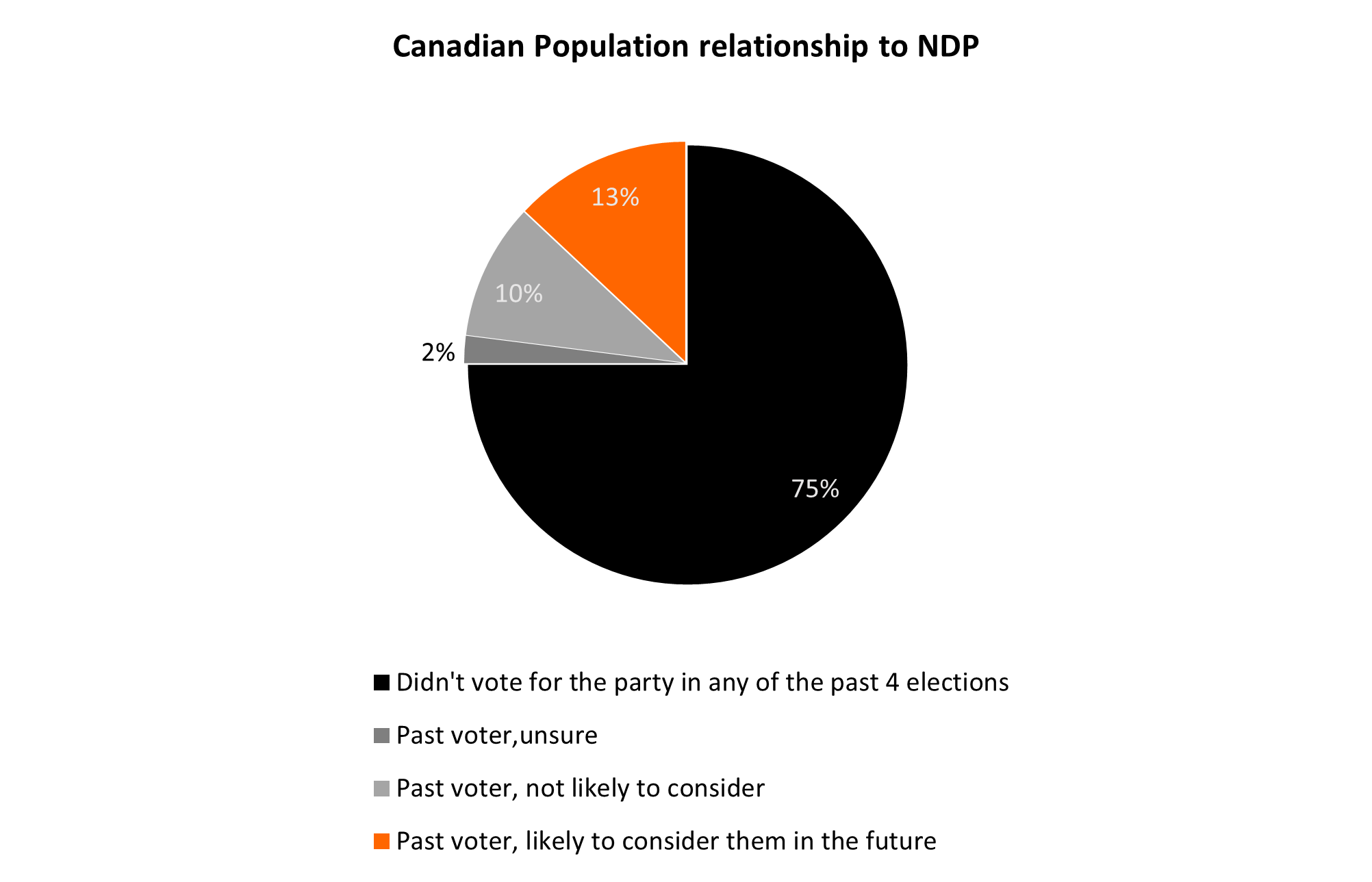
Herein lays the challenge. Across the population of potential voters, the accessible pool and the likely pool are much different in reality. While 25 per cent of current Canadian voters have supported the party in one of the past four federal elections, just 13 per cent of say they are likely to give them a look in the next one. The new leader, whomever it may be, will have some hard work ahead of them, in first securing those who will give the party a chance, and regaining some seats and voters lost in the 2025 contest:
Part Three: Muted response to leadership race
And there is evidently much work to be done to put the NDP back on the radar of even those who have supported the party at least once in the past decade. More than two-in-five (44%) of those who have voted for the NDP in at least one of the past four elections say they don’t recognize any of the names of the current leadership candidates. Knowledge is better among consistent NDP voters, but still three-in-ten (31%) of those who voted for the party four elections in a row say they don’t recognize the candidates.
Among those with an opinion, Avi Lewis (13%) and Heather McPherson (9%) are the preferred choices for the party’s next leader. Lewis’ advantage is much higher (26%) among those who have voted for the NDP in each of the past four elections:
Appendix: NDP voter demographics
How many supported the NDP at least once since 2015?
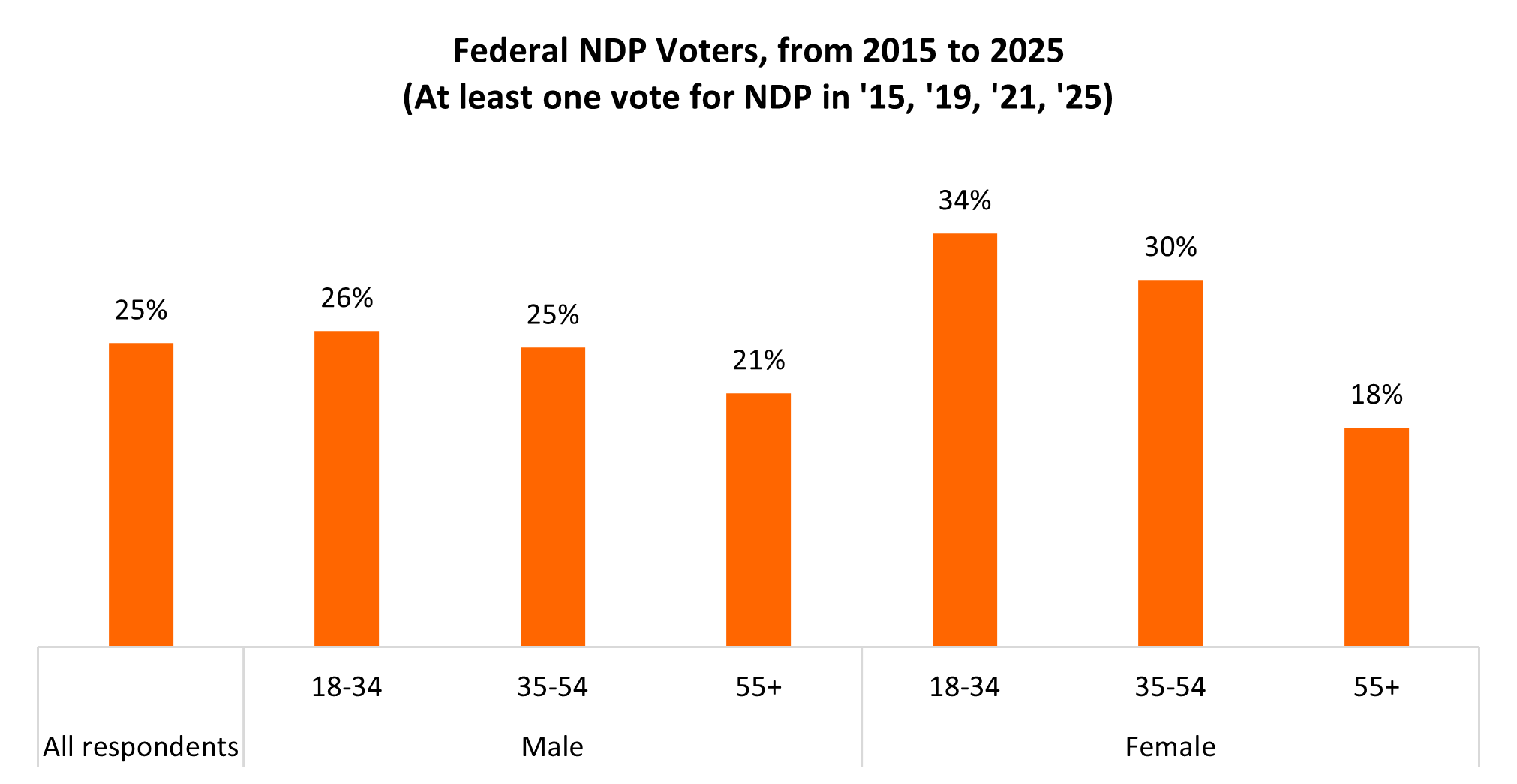
The NDP have historically performed best among younger voters, apparent from the demographics of past voters. Those under 35 are more likely to have voted for the NDP at least once since the 2015 election. The NDP also has more past support from women than men overall:
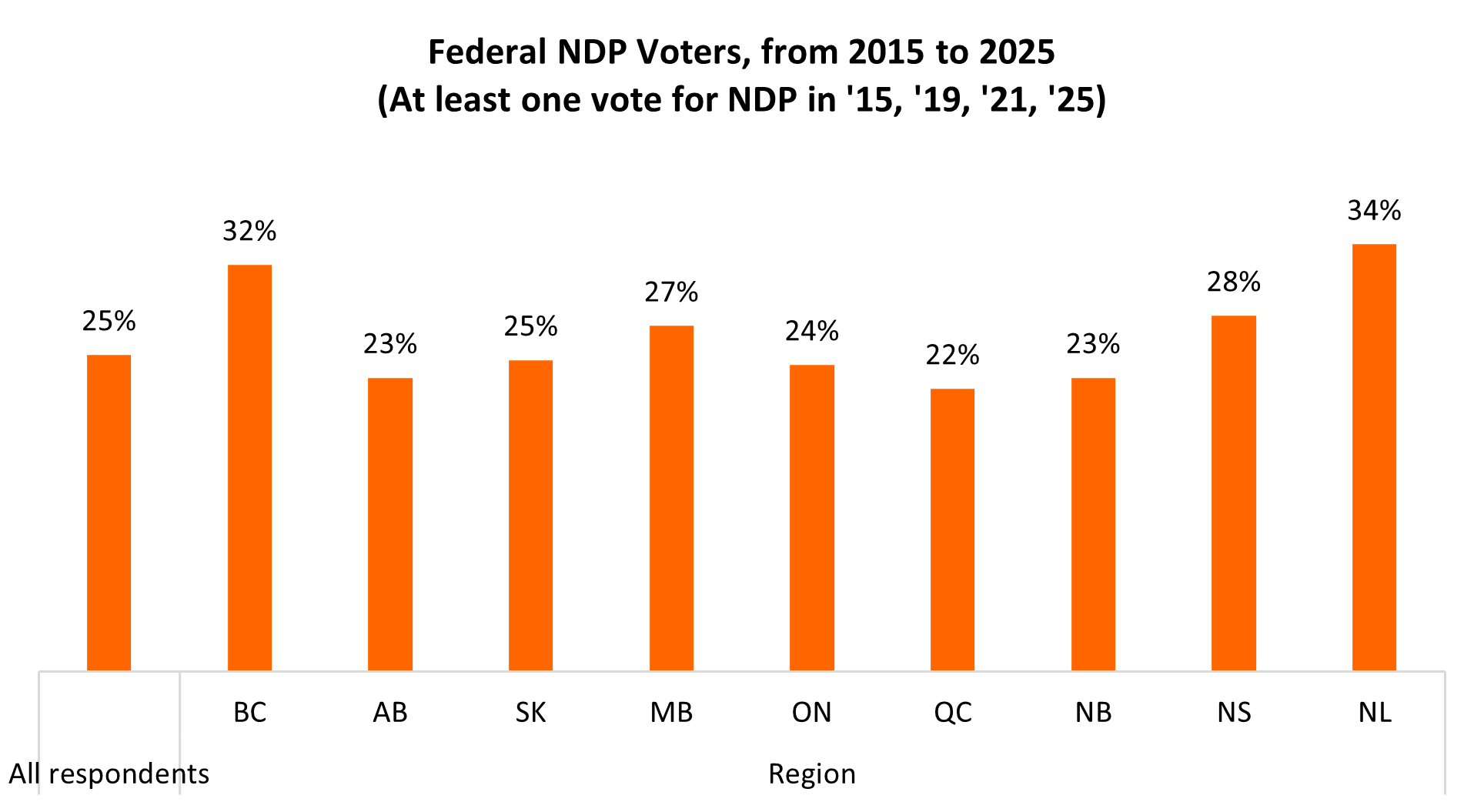
The NDP at least have a geographically diverse base to work with. At least one-in-five in all regions of the country have previously voted for the NDP at least once in the past four federal elections.
It is worth noting that the NDP’s best result in its history came during the Orange Wave during the 2011 election, driven in part by a surge in support in Quebec, where the party earned 59 seats, a 58-seat improvement over the 2008 election. The party has been criticized for not making it a requirement for the next leader to be bilingual, which will make it a challenge to build a base in Quebec. And as it stands, Quebec is home to the fewest past voters for the party:
How many are repeat voters?
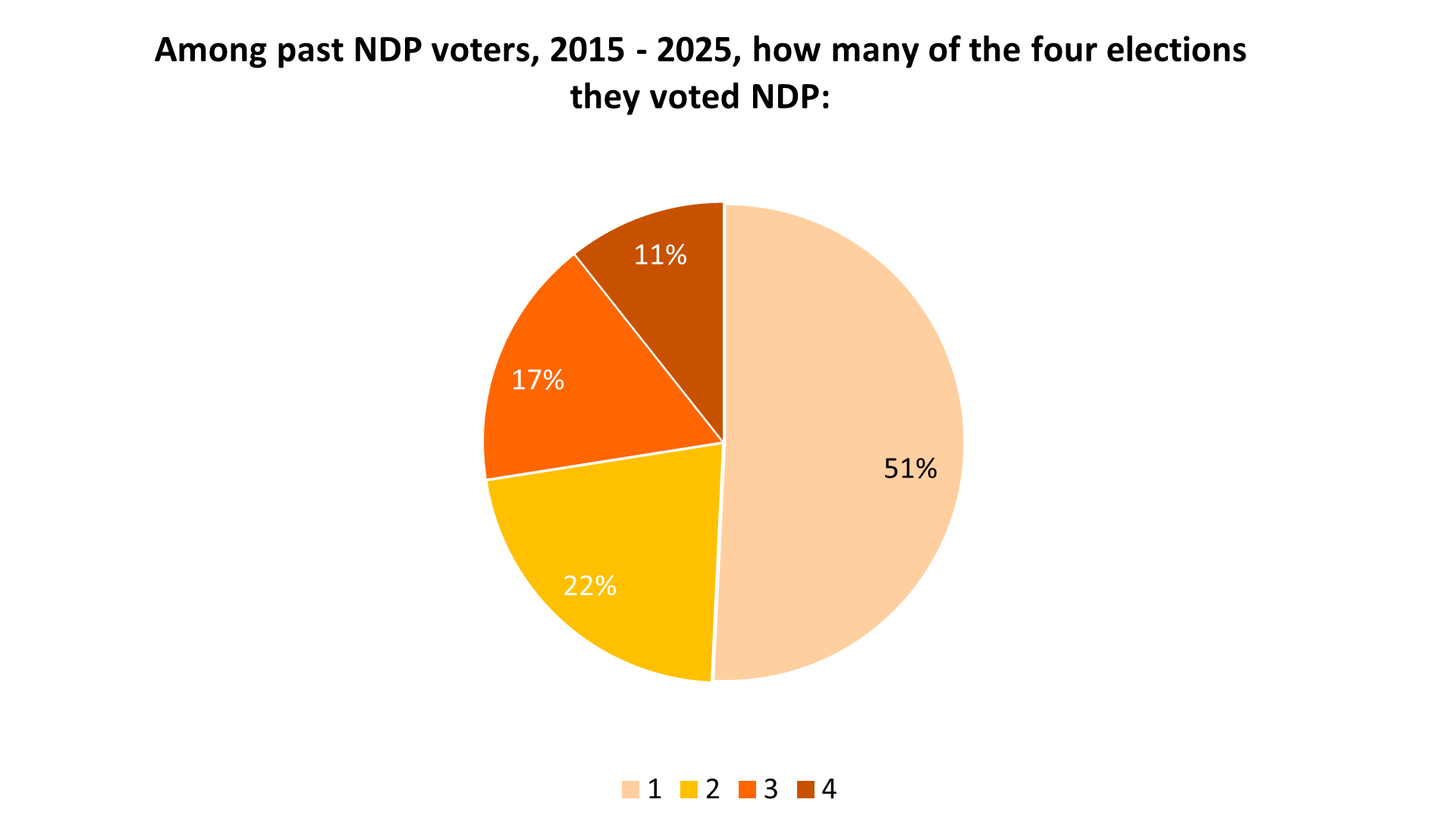
Among past NDP voters, there is a core of approaching three-in-ten (28%) who have either voted for the party each of the past four elections or three of the past four. Half (49%) have voted for the party two or more times since 2015. The other half (51%) have only voted for the party once in the previous four federal elections:
METHODOLOGY
| The Angus Reid Institute conducted an online survey from March 11-17, 2026, among a randomized sample of 4,005 Canadian adults. Respondents are drawn from the Angus Reid Forum, a large-scale online panel developed to include Canadian residents in each of the 343 federal ridings in Canada and representative of the Canadian population by age, gender, family income, ethnic status and education. The sample was weighted to be representative of adults nationwide according to region, gender, age, household income, and education, based on the Canadian census. For comparison purposes only, a probability sample of this size would carry a margin of error of +/- 1.5 percentage points, 19 times out of 20. Discrepancies in or between totals are due to rounding. The survey was self-commissioned and paid for by ARI. Detailed tables are found at the end of this release.
For more information on our polling methods, click here. |
For detailed results by age, gender, region, education, and other demographics, click here.
For PDF of full release, click here.
For questionnaire, click here.
MEDIA CONTACT:
Shachi Kurl, President: 604.908.1693 shachi.kurl@angusreid.org @shachikurl
Dave Korzinski, Research Director: 250.899.0821 dave.korzinski@angusreid.org