

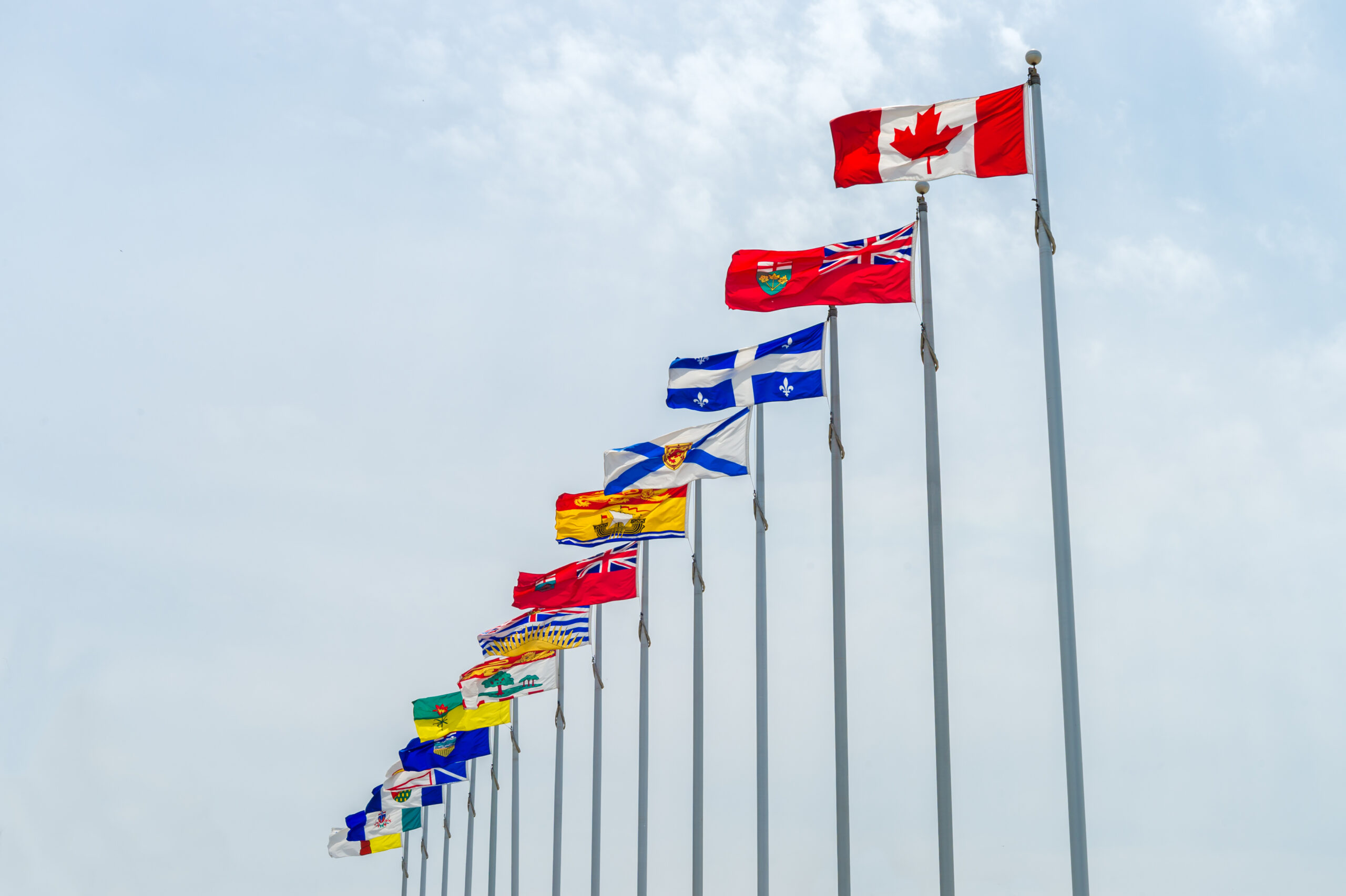
If it were possible, vast majority of Canadians would block QC (71%) or AB (79%) from separating
February 23, 2026 – The likelihood of Canada losing either Alberta or Quebec from its federation appears low for now – given that a strong majority of residents in both provinces say they have no interest in the idea – but it certainly has the rest of the country talking, and alive to the potential consequences of separation.
New data forming the last of a three-part series from the non-profit Angus Reid Institute on national unity and separation finds Canadians saying that losing either Alberta or Quebec would be a negative if not significantly problematic economic hit to the nation.
Other releases in this series:
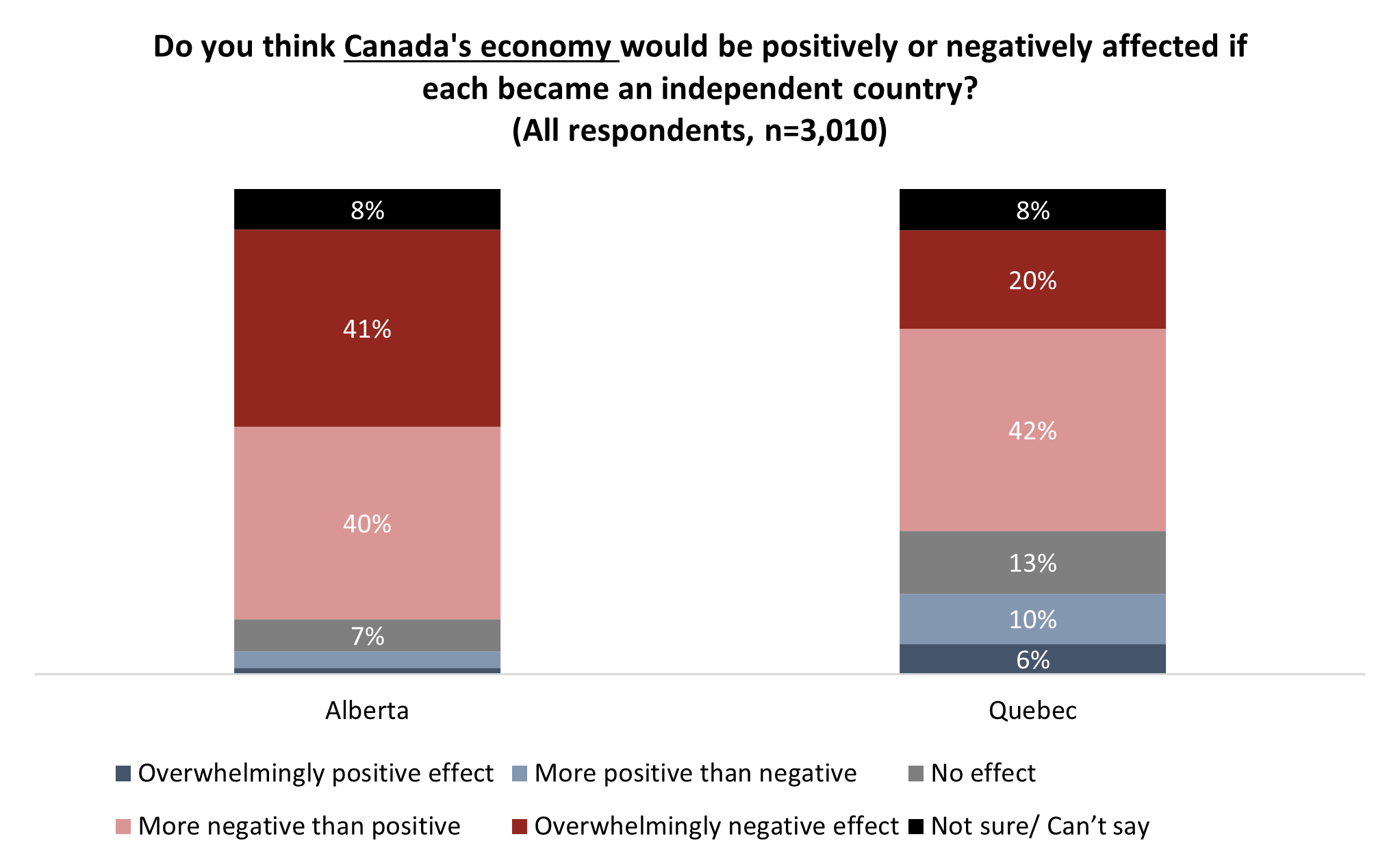
In the case of Alberta, two-in-five (41%) say the loss would be overwhelmingly negative, as that province’s oil and gas sector drives a large portion of that nation’s economy. In fact, that number is twice as many as say the same of losing Quebec (20%). While losing either would be presumably catastrophic for Canada, Quebec is responsible for one-fifth of the nation’s GDP, while Alberta’s economy represents 15 per cent.
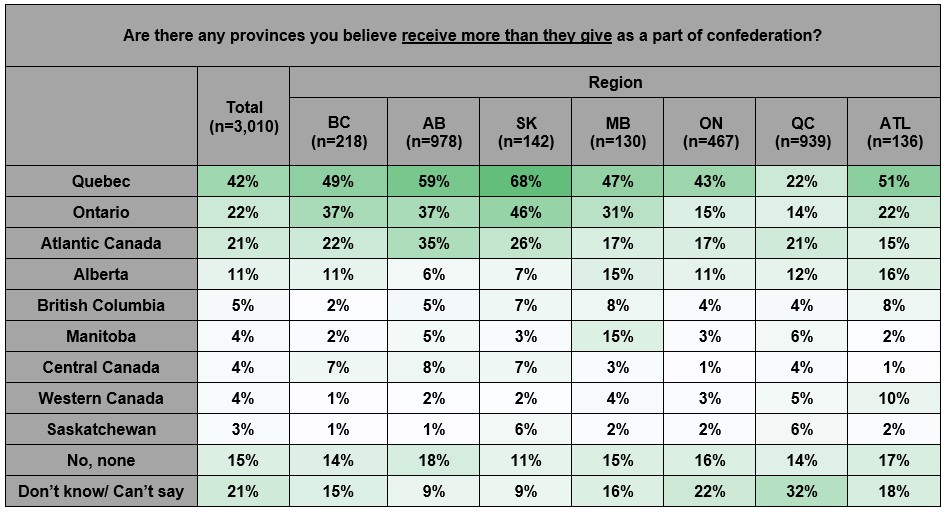
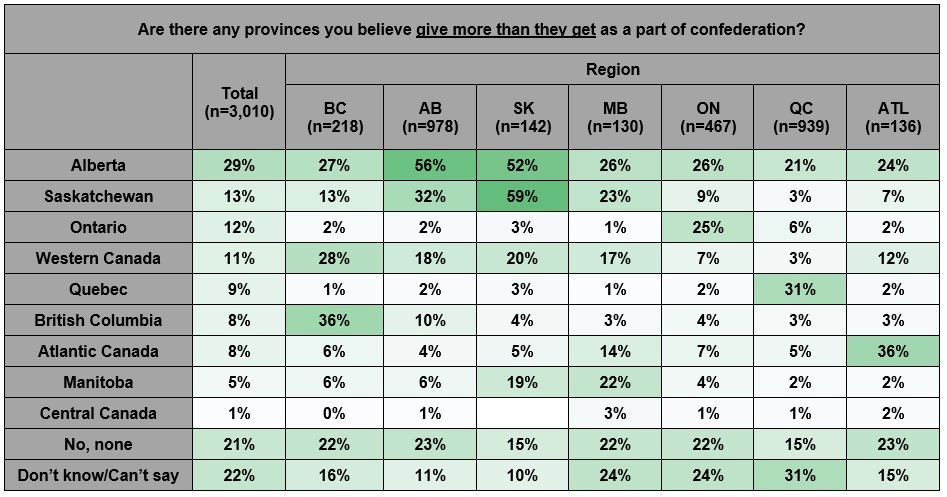
The well-trodden argument from Albertans, which is believed by both those who wish to leave and stay, is that the province gives out more than it gets as a part of confederation. For many, this is a fair critique. Indeed, 29 per cent of Canadians say Alberta gives more than it gets, well ahead of any other province or region, with Saskatchewan second at 13 per cent. On the other side of the equation, Canadians are most likely to say that Quebec benefits more than others (42%), well ahead of second place Ontario (22%).
If either were to separate, the common sentiment is that the United States would apply significant pressure to absorb or influence the new independent nation.
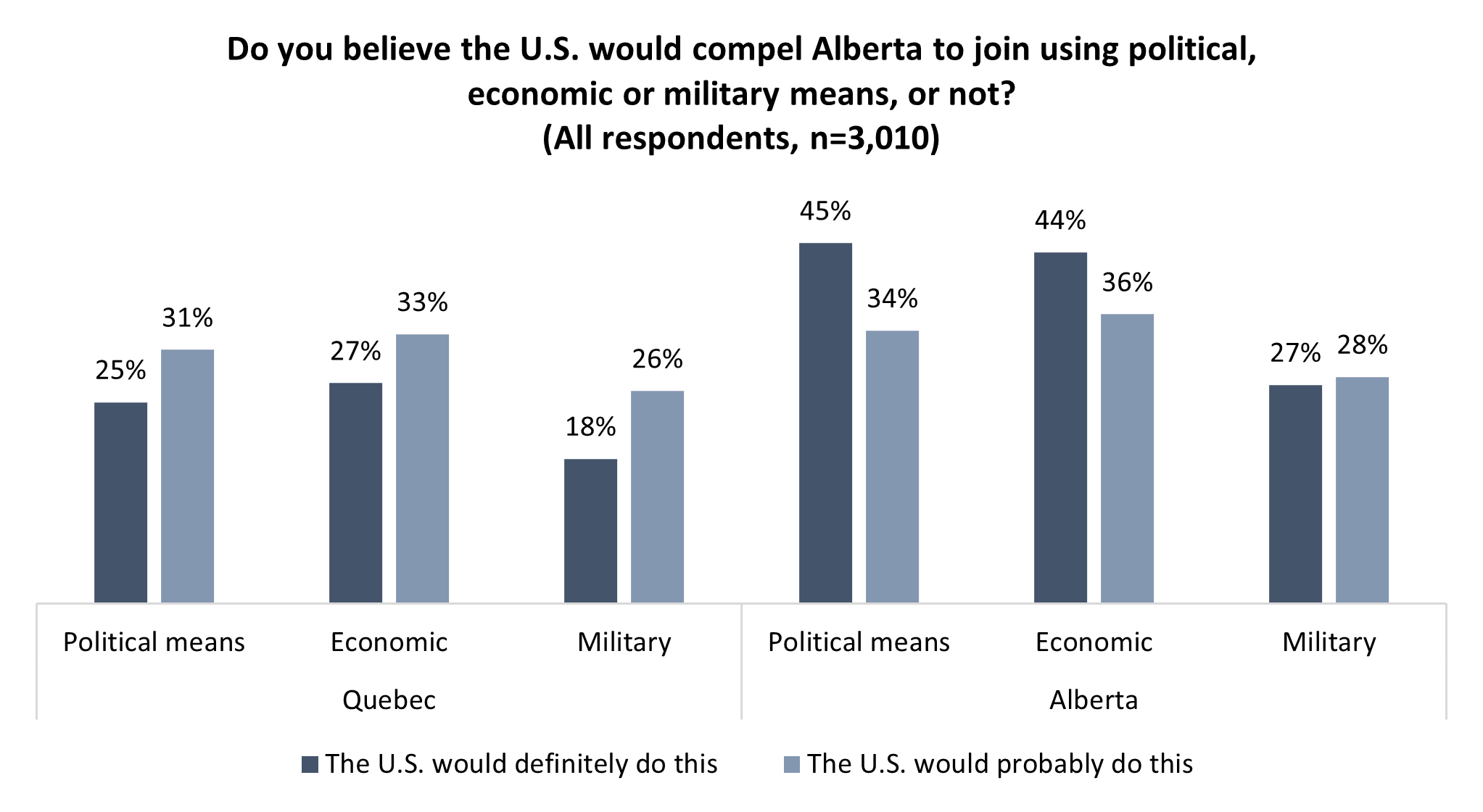
Nearly half say they U.S. would “definitely” try to economically and politically pressure Alberta to join as a new state. Another one-third say this would “probably” happen. Canadians are less sure this would happen to Quebec, but half feel it is likely.
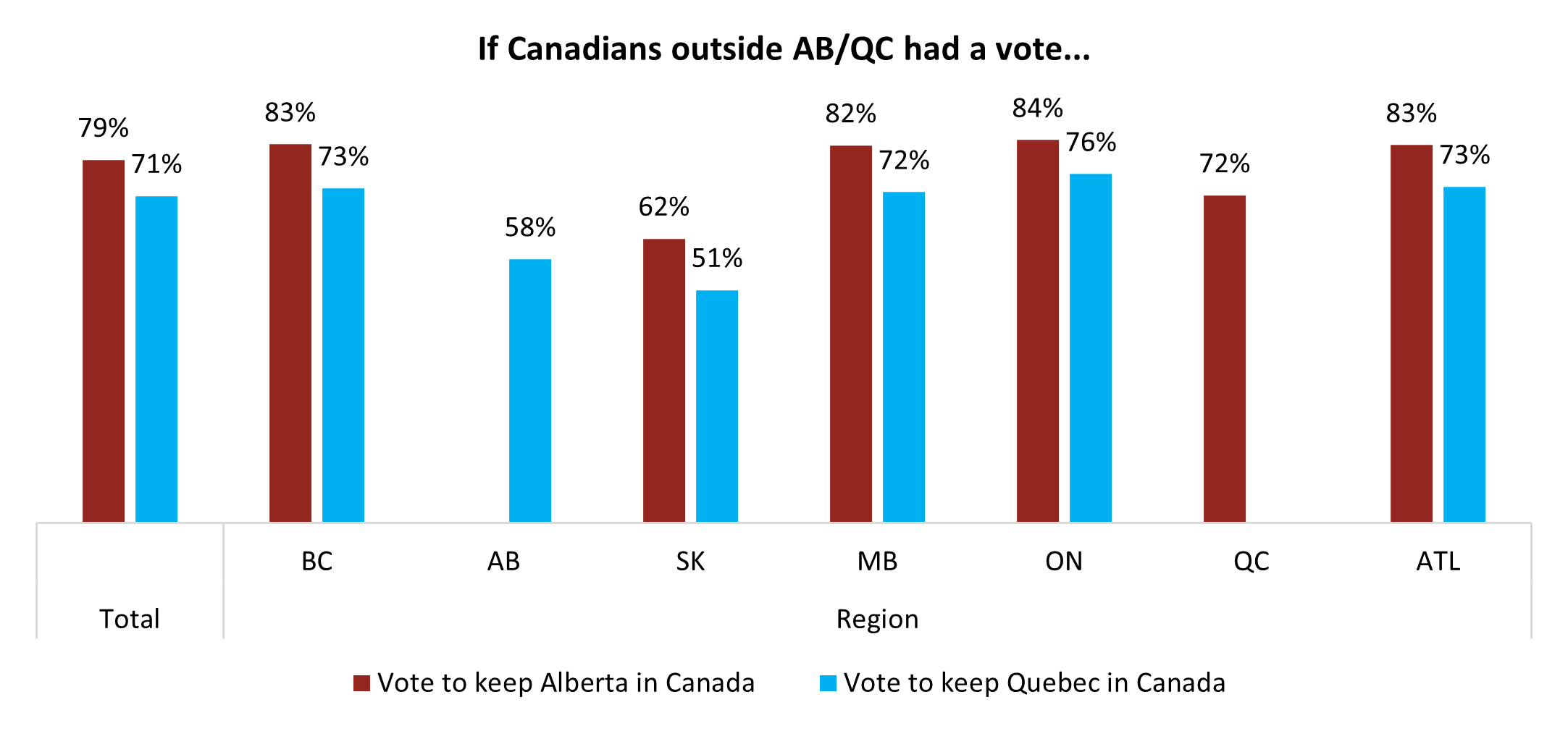
Notably, the vast majority of the country has little interest, evidently, in losing either province. Seven-in-10 say if they had a vote, they would block Quebec from leaving (71%) while four-in-five (79%) would do the same to Alberta. Notably, Quebecers are much more likely to want to block Alberta separatism than the other way around. While they may not have a direct vote on the matter, a constitutional amendment for provincial separation would need the approval of at least seven provinces representing at least 50 per cent of the population.
More Key Findings:
- Pride in country has dropped again after peaking in the early days of Donald Trump’s annexation threats. Last March, 47 per cent said they were very proud, which has dropped to 39 per cent.
- One-quarter of Canadians (24%) say Alberta’s provincial economy would improve with separation, while three-in-five (61%) say the impact would be negative.
- Fewer (10%) say that Quebec’s economy would improve, while three-quarters (75%) say it would worsen
INDEX
Part One: The state of confederation
- Two-in-five say Quebec takes more than it gives
- Three-in-10 say Alberta gives more than it receives
- Pride in country
Part Two: What would it mean to lose Alberta or Quebec?
- Impact on Canada’s economy
- Impact on AB, QC economies
- More think U.S would try to pressure Alberta than Quebec
- If you could vote to allow them to stay or leave… how would you vote?
Part One: The state of confederation
The parallel separatist movements in Alberta and Quebec have elevated the grievances in those two provinces to the national conversation, but the perceived issues are long standing. Read more about some of the issues driving the separatist mindset in both provinces in the first two parts of this three-part series.
Related: Unity or Separation: Quebec, Alberta & Canada’s future
- In Alberta, a divided right dampens the sovereignty spark
- PQ voters drive Quebec separatist push that majority oppose
Two-in-five say Quebec takes more than it gives
In Alberta, a perceived issue of confederational fairness has long been a political talking point. Equalization payments have long been a point of contention and a source of continuous heated debate. The program is designed to address fiscal disparities between provinces and ensure that each province can “provide reasonably comparable levels of public services at reasonably comparable levels of taxation,” according to the Canadian Constitution. Alberta has not received equalization payments since the 1960s, which is viewed as unfair by some in the province.
On the other side of the equation is Quebec, a province which typically receives equalization payments. In Alberta, this is often characterized as Quebec benefitting from taxes and revenue raised in Alberta.
A plurality of Canadians view Quebec as receiving more than it gives as part of confederation, including a majority in Alberta (59%) and Saskatchewan (68%). Quebecers are much less likely to agree (22%) and more likely to say they’re not sure (32%) if any one province benefits more than it contributes:
Three-in-10 say Alberta gives more than it receives
The view that Alberta is a net contributor is held by many in Alberta (56%) and Saskatchewan (52%) but fewer Canadians overall (29%). Three-in-ten (31%) in Quebec believe their province is giving more than they get from being a part of Canada, but again many (31%) are uncertain:
Pride in country
Although there may be some grievances in how the confederation is managed, a majority in most provinces, and half in Quebec, say they are “proud” or “very proud” to be Canadian. At most, one-in-five in Alberta (21%), Saskatchewan (22%) and Quebec (20%) describe themselves as “not proud”:

Perhaps the Milano-Cortina Winter Olympics will generate more pride in Canadians, but after a surge in this sentiment in the early days of Donald Trump’s annexation threats, the proportion of those describing themselves “very proud” has fallen eight points from 47 to 39 per cent and still lag behind figures seen in polling in the 1980s and 1990s.

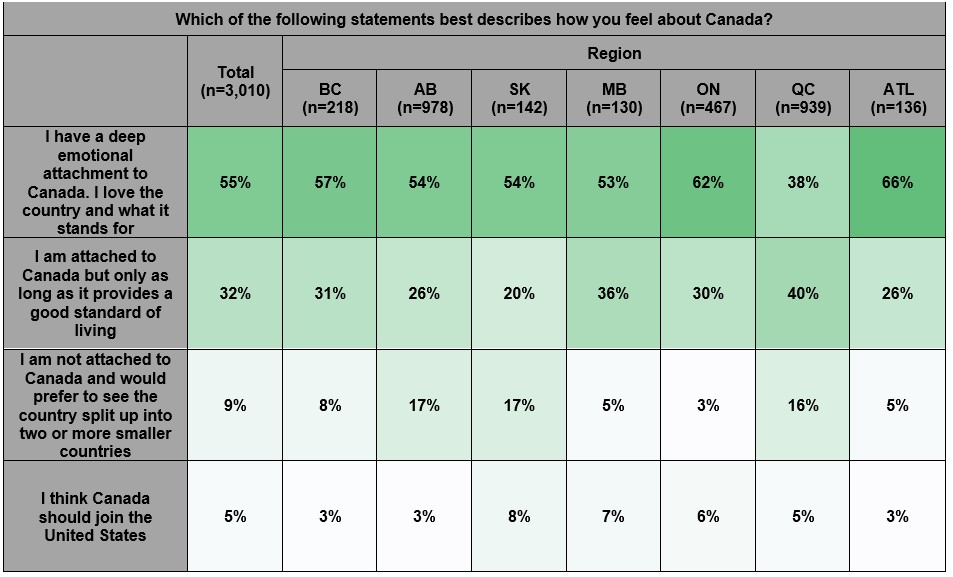
A majority say they have a deep emotional attachment to Canada in most provinces – with Quebec once again the outlier. There are more in Quebec (40%) than elsewhere who say their attachment to Canada is contingent to the country providing a good standard of living.
Notably, in Alberta (17%), Saskatchewan (17%), and Quebec (16%) at least one-in-six say they are not attached to Canada and would prefer the country to be split up. The view that Canada should join the United States is held by only a handful (5%) across the country:
Part Two: What would it mean to lose Alberta or Quebec?
Impact on Canada’s economy
Quebec (20%) and Alberta (15%) hold the second and third largest share of Canada’s GDP by province behind Ontario, and together represented more than one-third of Canada’s economy in 2024. Per capita, Alberta punches above its weight as the province with the highest GDP per person. Quebec, meanwhile, ranks sixth among provinces by that metric, below all but Manitoba, P.E.I., Nova Scotia and New Brunswick.
A majority of Canadians believe losing one or the other would negatively affect Canada’s economy as a whole. But there are more Canadians who say Alberta would be an overwhelmingly negative loss (41%) to Canada’s economy than say so of Quebec (20%):
Impact on AB and QC economies
A majority of Canadians also say that Alberta or Quebec leaving confederation would be detrimental to the economies of those provinces. However, with the data noted above on the belief that Alberta gives more than it gets from confederation, there are one-quarter (24%) who say Alberta would experience more economic positives than negatives if it were to go its own way:
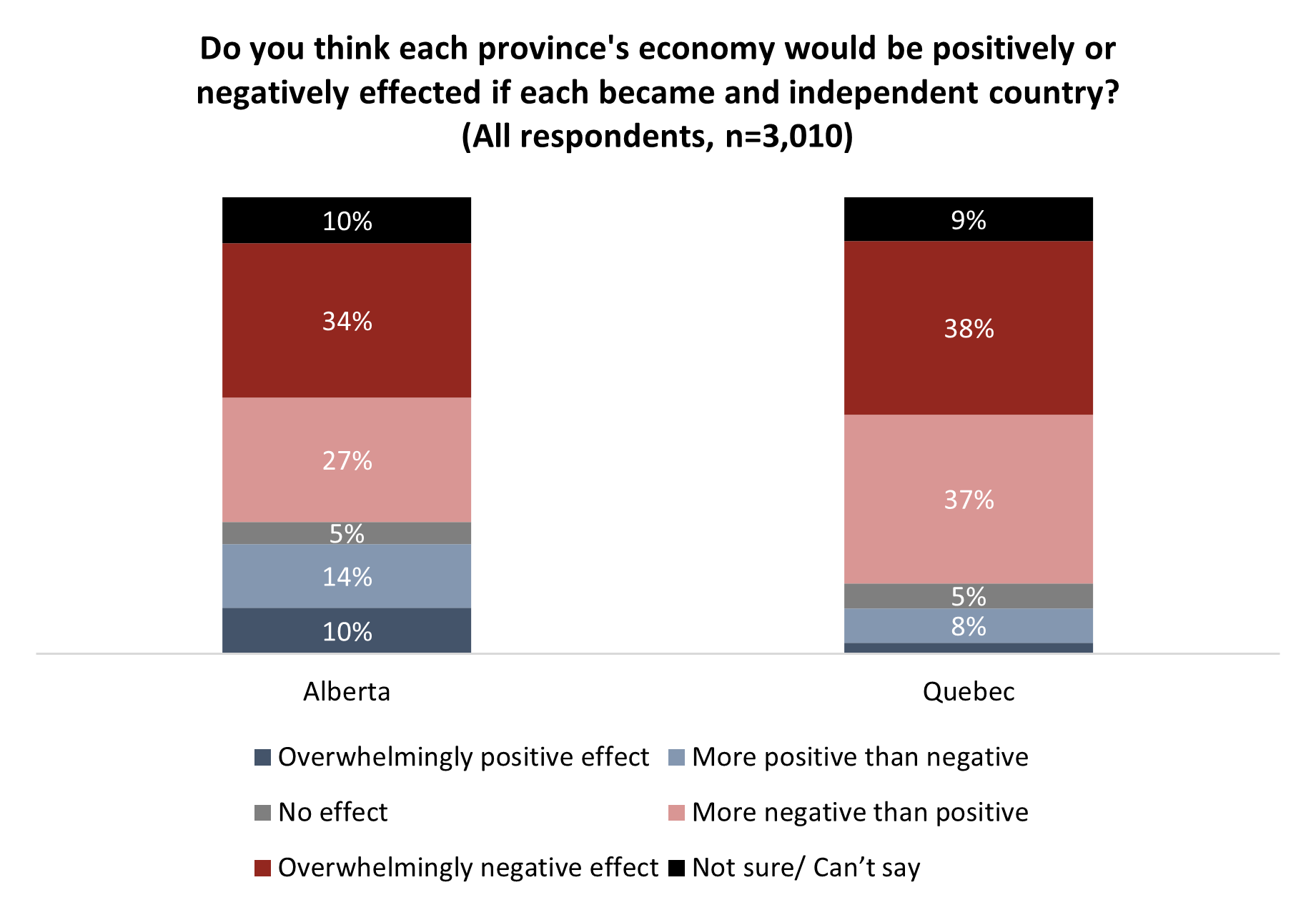
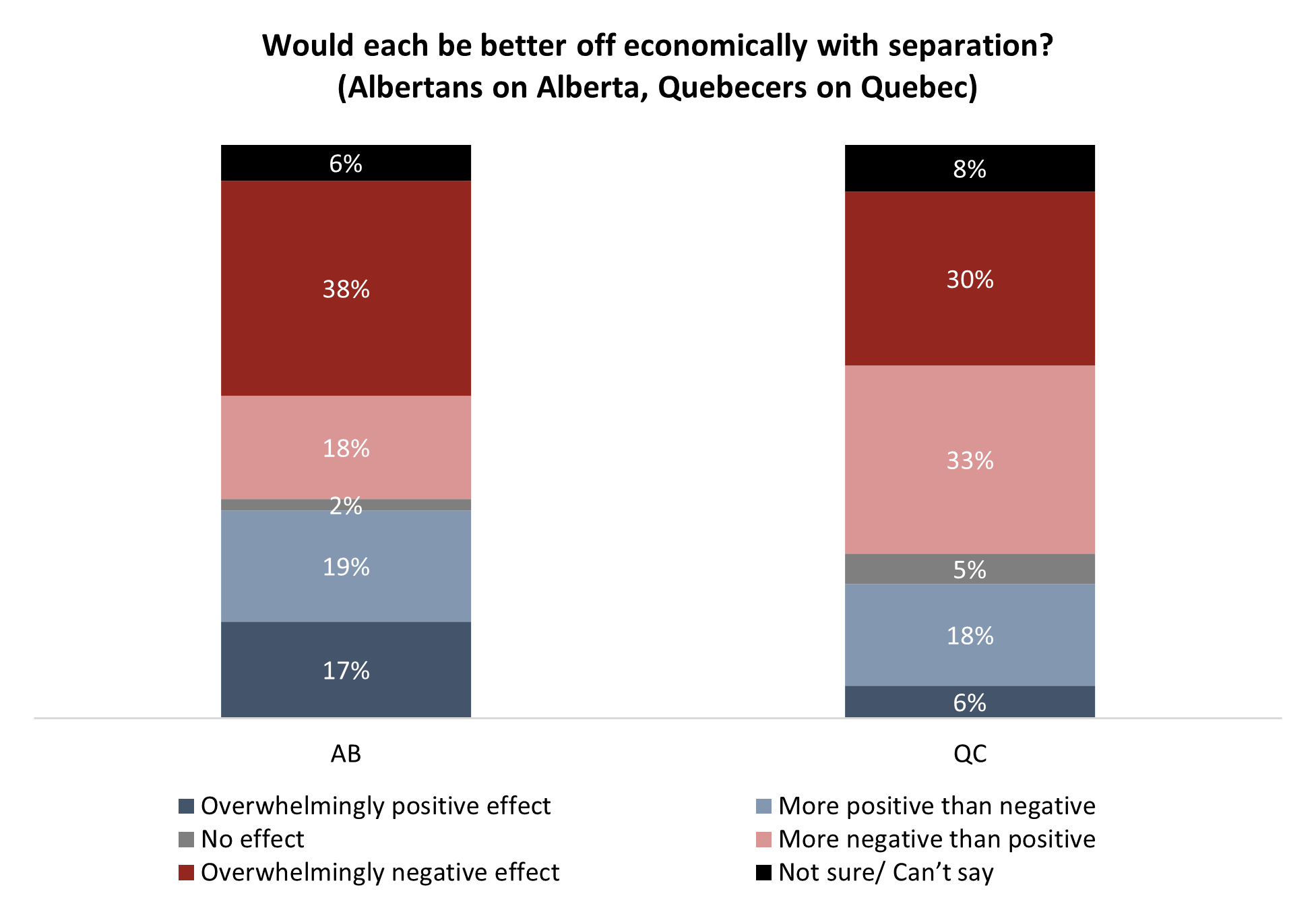
And that belief Alberta might be better off by itself is held by more than one-third (36%) of Albertans. But they are still outnumbered by the 56 per cent who disagree.
There are also one-quarter (24%) in Quebec who believe the province could flourish independent of Canada, but that is also a minority opinion in that province where three-in-five (63%) say there would be more economic negatives than positives in separation:
More think U.S would try to pressure Alberta than Quebec
One other aspect of independence, particularly in the case of Alberta, is the role that the United States may play. Already, members of an organization pushing for a separate Alberta have met with officials from the Trump administration, though members of the U.S. State Department downplayed the importance of the meeting. Many Canadians expect that the Trump administration would lean on an independent Quebec or Alberta in efforts to acquire them, though this is much more the case for Alberta.
If you could vote to allow them to stay or leave… how would you vote?
If Alberta or Quebec were to vote to separate through a referendum, this would be only the first step in a multi-year process. Negotiations between the provinces and First Nations as well as the federal government would be complicated, and a constitutional amendment would be required, in which the other provinces would have their own say. That is, the “deal” would likely need to be approved by the House of Commons, the Senate, and at least seven provincial legislatures representing at least 50 per cent of the population of all provinces. As a thought experiment, the Angus Reid Institute asked Canadians how they would vote on such a decision, if they were representing their own province.
The vast majority of the country has little interest, evidently, in losing either province. Seven-in-10 say they would block Quebec from leaving (71%) while four-in-five (79%) would do the same to Alberta. Notably, Quebecers are much more likely to want to block Alberta separatism than the other way around:
METHODOLOGY:
| The Angus Reid Institute conducted an online survey from Feb. 2-6, 2026, among a randomized sample of 3,010 Canadian adults. Respondents are drawn from the Angus Reid Forum, a large-scale online panel developed to include Canadian residents in each of the 343 federal ridings in Canada and representative of the Canadian population by age, gender, family income, ethnic status and education. The sample was weighted to be representative of adults nationwide according to region, gender, age, household income, and education, based on the Canadian census. For comparison purposes only, a probability sample of this size would carry a margin of error of +/- 3 percentage points, 19 times out of 20. Discrepancies in or between totals are due to rounding. The survey was self-commissioned and paid for by ARI. Detailed tables are found at the end of this release.
For more information on our polling methods, click here. |
For detailed results by age, gender, region, education, and other demographics, click here.
For PDF of full release, click here.
MEDIA CONTACT:
Shachi Kurl, President: 604.908.1693 shachi.kurl@angusreid.org @shachikurl
Dave Korzinski, Research Director: 250.899.0821 dave.korzinski@angusreid.org
Jon Roe, Senior Research Associate: 825.437.1147 jon.roe@angusreid.org