


Seven-in-10 say those opposed to childhood vaccination are irresponsible, but one-quarter disagree
May 29, 2025 – Alberta Health Minister Adriana LaGrange had a message for her province earlier this month, “don’t get measles; get immunized”. This, as outbreaks of the highly contagious disease continue, appearing in nine provinces so far, with the vast majority occurring in that province and in Ontario.
The good news for health officials is that the outbreak appears to have increased support for mandatory childhood vaccinations, with seven-in-10 Canadian adults – and three-in-five (60%) in Alberta – now saying it should be a requirement for children to attend daycare or school. Both represent increases in support for mandatory childhood vaccinations from last year, when 55 per cent of Canadians and 48 per cent of Albertans said the same.

The bad news is that the 95 per cent immunization rate needed to provide herd immunity widely surpasses the number who are supportive of childhood vaccination. Among parents with children younger than 12, 37 per cent feel this should be the parents’ choice, and more than one-in-five (22%) of those with children under 18 can be classified as either hesitant (13%) or opposed (9%) to inoculating their child with the recommended vaccines.
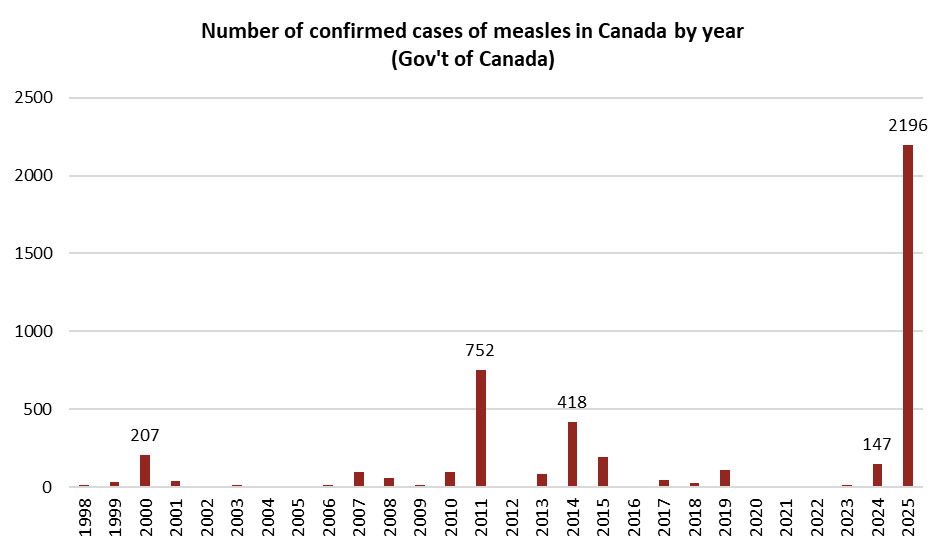
These data also underscore the perceived seriousness of measles, which has seen four-times more cases already in 2025 than any year since 1998 – the year the disease was considered “eliminated”. Just one-in-10 Canadians agree with the statement “measles isn’t as bad as people think it is”, though this rises closer to one-in-five (18%) among those who voted for the Conservative Party in the April federal election and is a nearly non-existent opinion for other party supporters.

*Smaller sample size, interpret with caution
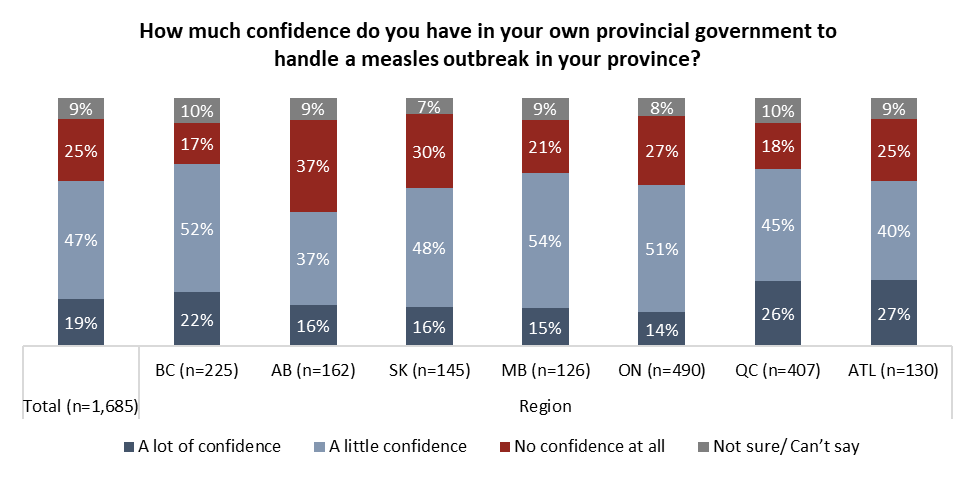
As to the practical and political aspects of responding to measles, many Canadians lack confidence in their provincial government to adequately respond. One-quarter (25%) say they have no confidence in their province, rising to 37 per cent in Alberta, 30 per cent in Saskatchewan, and 27 per cent in Ontario.
More Key Findings:
- Nine-in-ten (91%) Canadians believe vaccines are effective at protecting the individual getting vaccinated. A similar number (89%) say they are effective at reducing the spread of disease in the community. These figures have been at around this level since 2015.
- Three-in-ten (30%) Canadians believe “there is a real risk of serious side effects from these vaccinations”. Recent Conservative voters are much more likely (50%) than other political supporters to say this.
- The percentage of Canadians who believe “the science on vaccinations isn’t quite clear” has shrunk from 29 per cent in 2019 and 2024 to 23 per cent now.
About ARI
The Angus Reid Institute (ARI) was founded in October 2014 by pollster and sociologist, Dr. Angus Reid. ARI is a national, not-for-profit, non-partisan public opinion research foundation established to advance education by commissioning, conducting and disseminating to the public accessible and impartial statistical data, research and policy analysis on economics, political science, philanthropy, public administration, domestic and international affairs and other socio-economic issues of importance to Canada and its world.
INDEX
Part One: Ongoing measles concerns
-
Four-in-five disagree with argument that measles not a serious concern
-
One-quarter lack confidence in province to handle an outbreak
Part Two: Childhood vaccination
-
Is opposition to childhood vaccination irresponsible?
Part Three: Broader trends in vaccine views
-
Effectiveness
-
Science and side-effects
Part One: Ongoing measles concerns
A measles outbreak that reportedly began in New Brunswick in October of last year, has spread in Alberta and Ontario this year, leading to more than 2,000 confirmed cases of the highly contagious disease. This, after the disease was considered eliminated in 1998, six years after this goal was set at a 1992 Consensus Conference on Measles.
The resurgence of measles in Canada follows the downward trend in childhood vaccination rates in Canada. Uptake of both doses of the childhood two-dose measles, mumps and rubella (MMR) vaccine has declined from 86 per cent in 2019 to 76 per cent in 2023. There have been infection breakouts over the years, but the 2025 surge is by far the most significant in this post-’98 period:
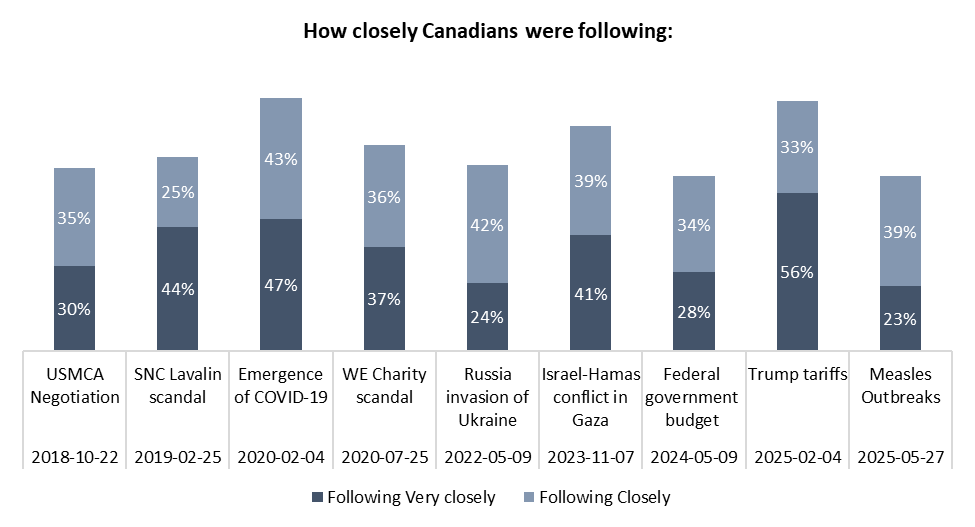
Despite these outbreaks, which have also occurred in the United States with cases in 31 states, though primarily in Texas, just one-quarter of Canadians say they have been following the issue closely and discussing it. Twice as many were following COVID-19 at this level in early February 2020, for example, while 56 per cent said this of the U.S. tariff issue earlier in 2025:
Four-in-five disagree with argument that measles not a serious concern
Some have posted online claiming that measles does not pose a serious risk, instead claiming that the vaccine is much more dangerous. This has been a significant issue in the United States as Health and Human Services Secretary Robert F. Kennedy Jr. has downplayed the outbreak and spread false claims about the MMR vaccine, while also endorsing it, leading many to claim his advice on the issue has been unclear.
In Canada, most reject the idea that measles “isn’t as bad as people think it is”. Two-thirds strongly disagree with that statement, while another 18 per cent moderately disagree. Measles commonly occurs as a rash and a fever but can have significant complications. There have been 187 hospitalizations at time of release in Canada in 2025.
Note that while just 10 per cent agree with that idea, nearly all of them voted for the Conservative Party in the April federal election. Agreement is highest in Alberta (13%) and Saskatchewan (12%) and lowest in British Columbia (6%, see detailed tables).
The seriousness of the disease has not been matched with a serious response, according to residents in the provinces with the two largest outbreaks – Ontario and Alberta. In both, half believe more needs to be done across all levels of health management, from the premier to the chief medical officer of health to the provincial government more broadly (see detailed tables).
*Smaller sample size, interpret with caution
One-quarter lack confidence in province to handle an outbreak
In Ontario, Premier Doug Ford has expressed public frustration over a lack of willingness to vaccinate among some residents. He called the measles vaccine a “no-brainer”, hoping that parents would step up to fight the spread. In Alberta, Premier Danielle Smith has taken a more muted approach, leading some to question if her silence has been due to potential political backlash from her base in the post-COVID-19 vaccine mandate environment. The provincial government did not hold a press conference until May, despite cases rising in March and spiking in April:
Part Two: Childhood vaccination
In most provinces, vaccinations are optional for children. The exceptions are Ontario and New Brunswick, where proof of immunization is required for children in those provinces to attend school. Experts have called for vaccines to be mandatory in the face of low vaccination rates specifically for measles. Dr. Jim Kellner, an infectious disease expert, told the CBC in 2019 that the “persistence of low levels of immunizations” made Canada “at risk for having a significant outbreak”.
Seven-in-ten (69%) Canadians believe vaccinations should be mandatory for children to attend school, outnumbering those who believe it should be the parent’s choice (25%) by nearly three-to-one. However, opinions vary among those with kids in household – who are more likely to believe it should be left to the parent to decide if their child should be vaccinated – and those without – who are most likely to believe vaccinations should be mandatory. Parents with children under 12 are the most likely to be resistant to mandatory vaccinations for children in school:

With the recent measles outbreak making headlines, the proportion of Canadians who support mandatory childhood vaccination has rebounded to pre-pandemic levels. In 2024, Canadians were more likely to say that childhood vaccinations should be the decision of the parents and not mandatory for kids to attend school. Vaccine skepticism increased in the wake of the COVID-19 pandemic after taking root in the 1990s due to a later retracted study that linked the MMR vaccine to autism.

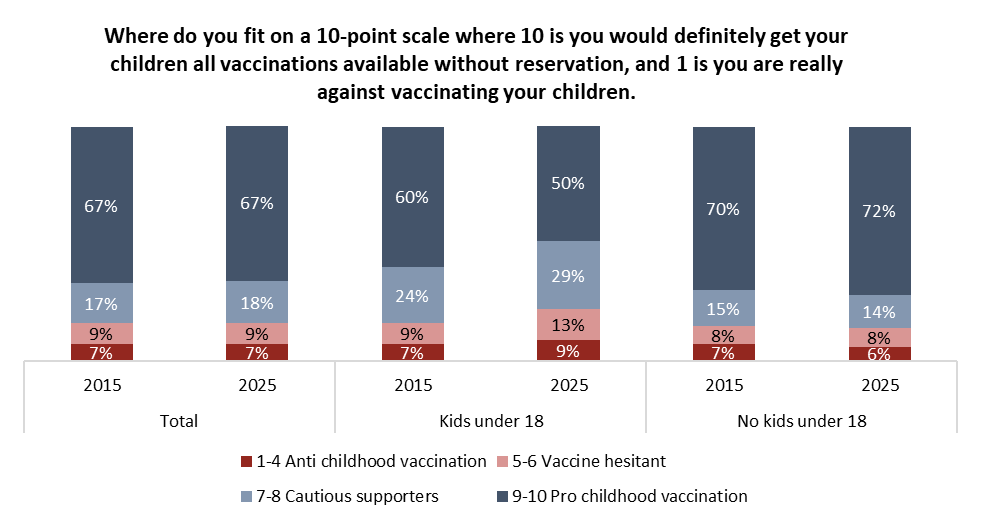
Despite declining rates of childhood vaccinations noted above, Canadians’ attitudes towards vaccinating their own children has held steady since 2015. When asked to rate themselves on a 10-point scale, with 10 representing no reservation to vaccinating their child and 1 representing complete opposition, two-thirds (67%) in both 2015 and 2025 placed themselves at either 9 or 10. One-in-12 (7%) placed themselves at the opposite end of the scale.
However, it appears attitudes have shifted among parents with children under 18. A decade ago, one-in-six (16%) parents with kids under 18 fell into the hesitant or anti vaccine groups; one-in-five (22%) do so now. At the same time, the proportion of parents with school-aged children who express little to no hesitation with vaccinating their children has fallen by 10 points:
Is opposition to childhood vaccination irresponsible?
Most, but nowhere near all, Canadians say that opposition to childhood vaccination is irresponsible. Seven-in-ten (72%) feel this way, while more than one-in-five (23%) disagree. The group who disagree that this position is irresponsible are much more likely to have been CPC supporters in the past federal election, continuing a trend of anti-vaccination concentration among that group:

*Smaller sample sizes, interpret with caution
Part Three: Broader trends in vaccine views
Effectiveness
Nine-in-ten (91%) Canadians view vaccinations as very or mostly effective at protecting the individual getting vaccinated, a similar figure to the 88 per cent seen in 2015. However, Canadians are more likely to describe them as “very effective” at protecting the vaccinated individual now (61%) than they were a decade ago (52%):

A similar trend is seen when asking Canadians about the effectiveness of vaccines at protecting the community. In 2015, half (49%) of Canadians described them as “very effective” while a further 37 per cent said vaccines were mostly effective at reducing the spread of disease in the community. Now those figures are 57 per cent and 32 per cent respectively:

Science and side-effects
Vaccine hesitancy is perhaps driven by concern over potential side effects. While a majority (66%) of Canadians disagree that vaccinations come with the risk of serious side effects, there are three-in-ten (30%) for whom this is a concern. This minority concerned with the side effects of vaccinations has ranged from 26 per cent in 2019 to 34 per cent in 2024.
Politics appears to be a factor as recent Conservative voters are much more likely to believe vaccinations have the potential to cause serious side effects than other groups of voters:

*Smaller sample size, interpret with caution
But those concerned with the side effects of vaccinations are concerned with the COVID-19 vaccine more so than any other. Two-thirds (63%) of those who believe vaccines have the real risk of serious side effects say the COVID-19 vaccine is a risk to those who receive it. Side effects have been reported from the COVID-19 vaccine, but are exceedingly rare. The distrust of the COVID-19 vaccine specifically perhaps speaks to the effect of misinformation during the pandemic.

In 2015, two-in-five (39%) Canadians believe the science on vaccination was unsettled. That proportion has shrunk over time but still one-quarter (23%) believe there is uncertainty around the science of vaccines:

Survey Methodology:
The Angus Reid Institute conducted an online survey from May 20-23, 2025, among a randomized sample of 1,685 Canadian adults who are members of Angus Reid Forum. The sample was weighted to be representative of adults nationwide according to region, gender, age, household income, and education, based on the Canadian census. For comparison purposes only, a probability sample of this size would carry a margin of error of +/- 2 percentage points, 19 times out of 20. Discrepancies in or between totals are due to rounding. The survey was self-commissioned and paid for by ARI.
For detailed results by age, gender, region, education, and other demographics, click here.
For detailed results by parents with kids, click here.
For PDF of full release, click here.
For questionnaire, click here.
MEDIA CONTACT:
Shachi Kurl, President: 604.908.1693 shachi.kurl@angusreid.org @shachikurl
Dave Korzinski, Research Director: 250.899.0821 dave.korzinski@angusreid.org
Jon Roe, Research Associate: 825.437.1147 jon.roe@angusreid.org