


Opposition to war rises 10 points among MAGA, +16 among non-MAGA Republicans, since early March
April 23, 2026 – More than seven weeks into the conflict with Iran, the fighting has slowed but not stopped, as President Donald Trump extends a fragile ceasefire amid ongoing negotiations and a continued U.S. military buildup in the region. Despite repeated assurances from the administration that the operation is nearing its end, there is little sign of a decisive resolution.
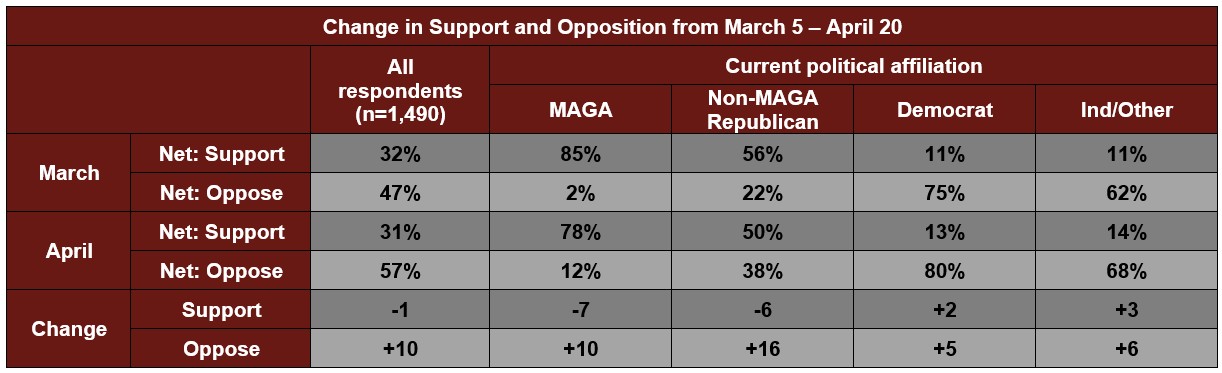
New data from Angus Reid USA finds support for the war effort has remained largely unchanged since early March, with 32 per cent currently supporting it, compared to 31 per cent in March. Opposition, meanwhile, has climbed by 10 points, driven in part by those who were uncertain in the early days. That shift is most pronounced among Republicans: opposition is up 10 points among MAGA supporters and 16 points among non-MAGA Republicans, suggesting growing unease within the president’s political base.
This evolving public sentiment comes as the timeline for the conflict remains unclear. Just one-in-ten Americans believe the war will end within a month — unchanged since March — while more now expect a longer horizon. One-in-five say the conflict will last one to six months, and 45 per cent say it will take more than six months to resolve.
When the war does end, there is tepid confidence that the United States will accomplish its stated goals. Two-in-five say the U.S. will end Iran’s nuclear program, one of the few clearly articulated objectives of the operation. Half say the U.S. will successfully open the Strait of Hormuz, which has been either closed or functionally unusable since the conflict began.
INDEX:
- Opposition to war has jumped 10 points since the start
- After more than 7 weeks of conflict, little change in timeline expectation
- Tepid confidence in U.S. accomplishing stated goals
- Ground troops would be a tough sell to the public
- One-third worried nuclear war is inevitable
Opposition to war has jumped 10 points since the start
After weeks of escalating strikes and mounting tensions, the Iran war has entered a temporary pause, with President Donald Trump extending a fragile ceasefire to allow for continued negotiations. Despite the halt in fighting, few expect the conflict to end anytime soon, as military forces remain in place and key disputes unresolved. Against this backdrop, public opinion is shifting, with growing opposition to the war emerging — even among segments of Trump’s political base.
Angus Reid asked Americans in the first week of the conflict about their support levels and returned to this question again over the past week. While support is unchanged, with one-in-three voicing this view, opposition has risen 10 points, largely drawn from those who were uncertain at the outset:

The largest moves in public opinion against the war have – troublingly for President Trump – been from Republicans. Among those who identify as MAGA, opposition is 10-points higher now, while among those Republicans who do not align with the MAGA movement, this number has risen 16-points.
After more than 7 weeks of conflict, little change in timeline expectation
When the war began, timelines were not easy to garner from the administration. On March 1, Trump was pressed by the New York Times and said the war would likely be over in four to five weeks. The next day he repeated this timeline but also said that it could go longer. Since then, Trump has stated that the operation is “ahead of schedule” that it has already been won, and that the end is “getting very close” at various times. Much like when Angus Reid asked in early March, few Americans say the end is near.
Overall, one-in-ten say they feel the war will be over within month, the same number that said this more than six weeks ago. The largest movement has been to swell the number who believe one to six months is the correct timeline:

Tepid confidence in U.S. accomplishing stated goals
In the early days of the conflict, and to a certain extent in an ongoing fashion, many Americans were unsure of what the United States’ goals were in this war. Since then, Secretary of Defense Pete Hegseth has publicly stated several of these, including opening the Strait of Hormuz, which Iran shut down when the conflict began, and ending Iran’s nuclear weapons program for good. Half of Americans or fewer say that any of four different goals will be accomplished, with the Strait of Hormuz being the one generating the most confidence. With respect to Iran’s nuclear program, 48 per cent say the U.S. will not be able to put an end to it, while 38 per cent say the operation will secure this goal:

Ground troops would be a tough sell to the public
Support for the war has not been strong at any point, and the Trump administration risks exacerbating poor public opinion by including ground troops in Iran. Well over 50,000 troops are already in the region, with thousands more arriving last week. With the ceasefire reportedly extended, time will tell what strategy the military will deploy, but just one-quarter of Americans say they would support putting boots on the ground. While 78 per cent of MAGA supporters and 50 per cent of non-MAGA Republicans support the war effort currently, those numbers drop to 61 per cent and 38 per cent respectively for the idea of putting U.S. soldiers on Iranian soil:

One-third worried nuclear war is inevitable
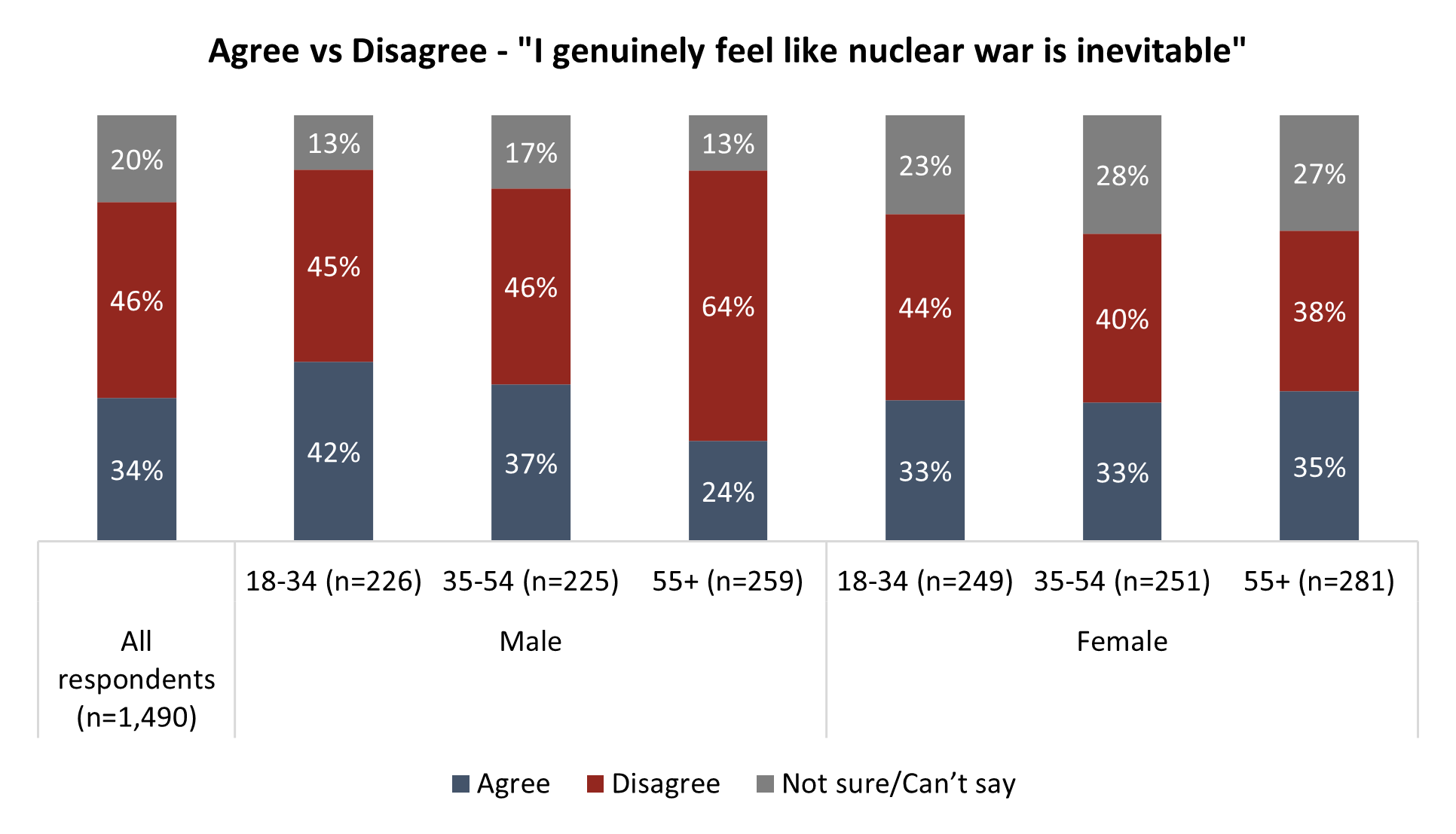
The worst-case scenario would be nuclear escalation. Some were concerned about this when President Trump stated that “a whole civilization will die tonight, never to be brought back again” on April 7. Perhaps because of some of the escalation in rhetoric, one-third of Americans (34%) say they feel a nuclear strike is inevitable at some point in the future. Young men are most likely to say this:
METHODOLOGY
Angus Reid Institute conducted an online survey from April 15 – 20, 2026 among a representative randomized sample of 1,490 American adults who are members of Angus Reid Forum USA. For comparison purposes only, a probability sample of this size would carry a margin of error of +/- 2.5 percentage points, 19 times out of 20. Discrepancies in or between totals are due to rounding. The survey was self-commissioned and paid for by Angus Reid USA. Detailed tables are found at the end of this release.
For more information on our polling methods, click here.
For detailed results by age, gender, region, education, and other demographics, click here.
For PDF of full release, click here.
CONTACT:
Shachi Kurl, President: 604.908.1693 shachi.kurl@angusreid.org @shachikurl
Dave Korzinski, Research Director: 250.899.0821 dave.korzinski@angusreid.org