

Half say ad helps Americans understand counterview to Trump tariff policy, but impact viewed as ‘small’
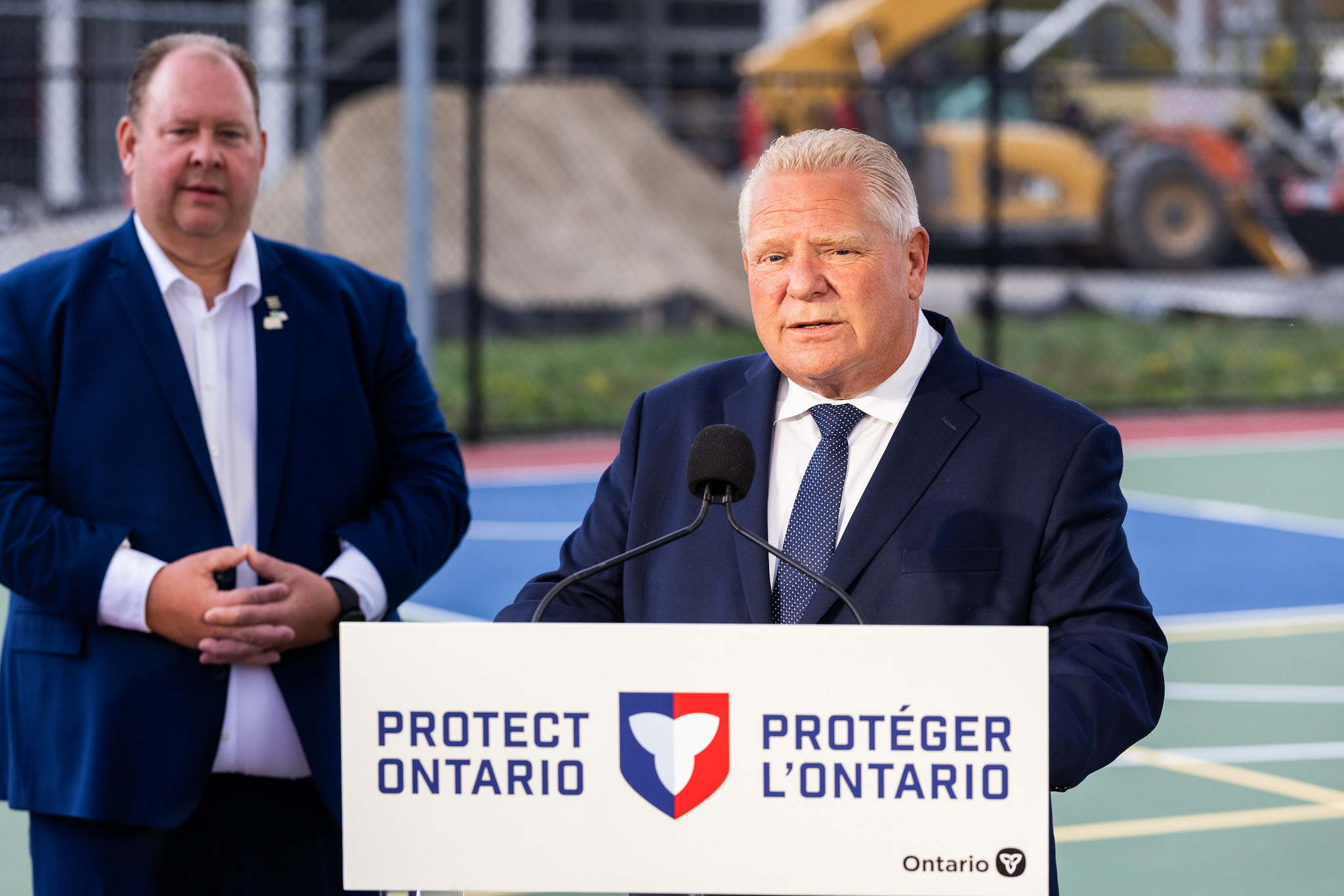
October 31, 2025 – As if the Toronto Blue Jays weren’t providing enough drama this October, even the commercial breaks in the World Series have caused the political and economic equivalent of dirt-kicking at the plate. This, after the Ontario government followed through with running an ad featuring former President Ronald Reagan espousing views of tariffs in contradiction to those of current President Donald Trump.
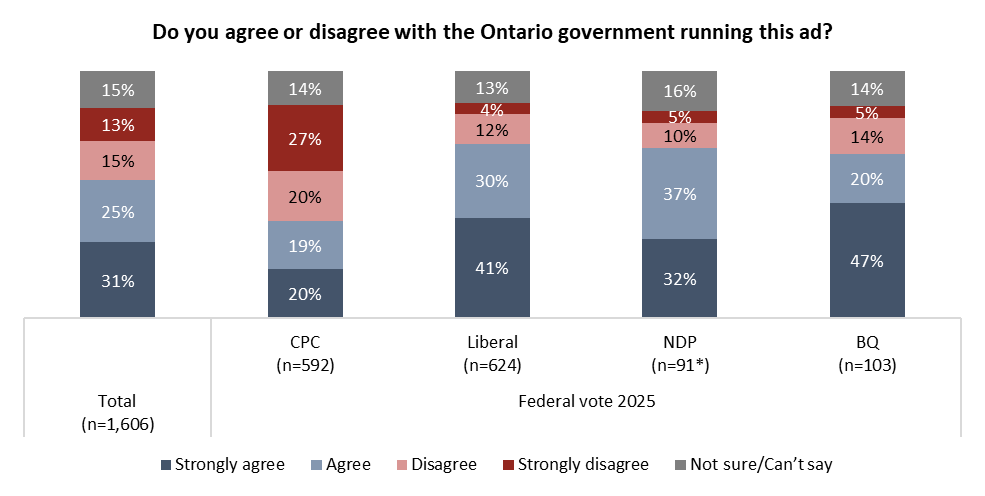
New data from the non-profit Angus Reid Institute finds that despite Trump’s claim that he will raise tariffs on Canada by 10 per cent in response to the ad running, Canadians are supportive of the decision from Premier Doug Ford’s government. Indeed, twice as many say they strongly agree (31%) with the decision than strongly disagree (13%). Views in Ontario align with the national average, with 57 per cent agreeing and 27 per cent disagreeing. Notably, Conservatives at the federal level are much more likely to disagree with the ad running (47%), which some say was an unnecessary agitation of a notoriously fickle negotiating counterpart.
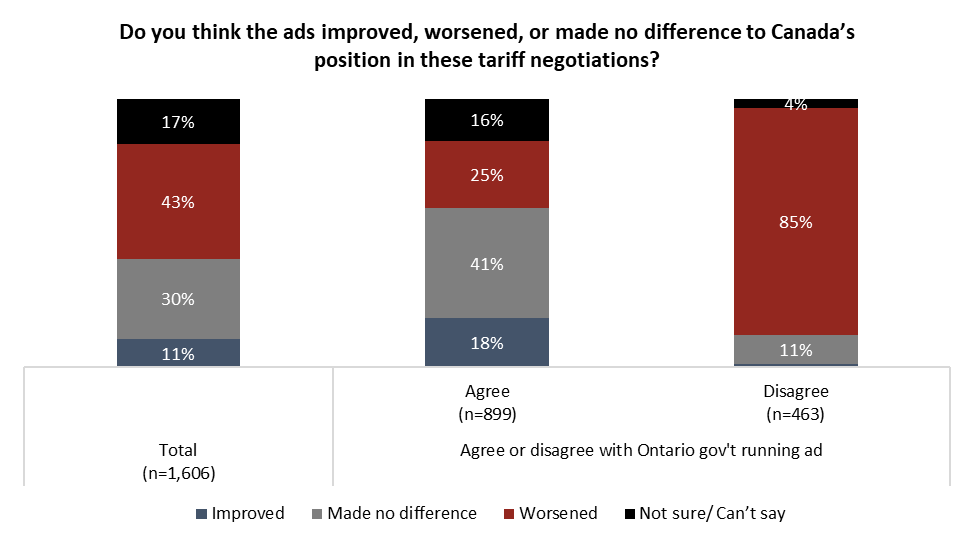
Canadians are evidently of two minds over the whole saga. While the majority agree with running the ad, many concede that it likely put Canada in a worse negotiating position. Two-in-five (43%) say this, while 11 per cent say Canada’s position improved and three-in-10 say it didn’t change.
The idea put forth by Trump that the ad was “fraudulent” and “fake” doesn’t pass muster in this country. Canadians are six-times as likely to say that it was an accurate representation of Reagan’s views (60%) than those who agree with the president (10%). The veracity of the ad has also been confirmed by third parties, though that doesn’t seem to have swayed Trump.
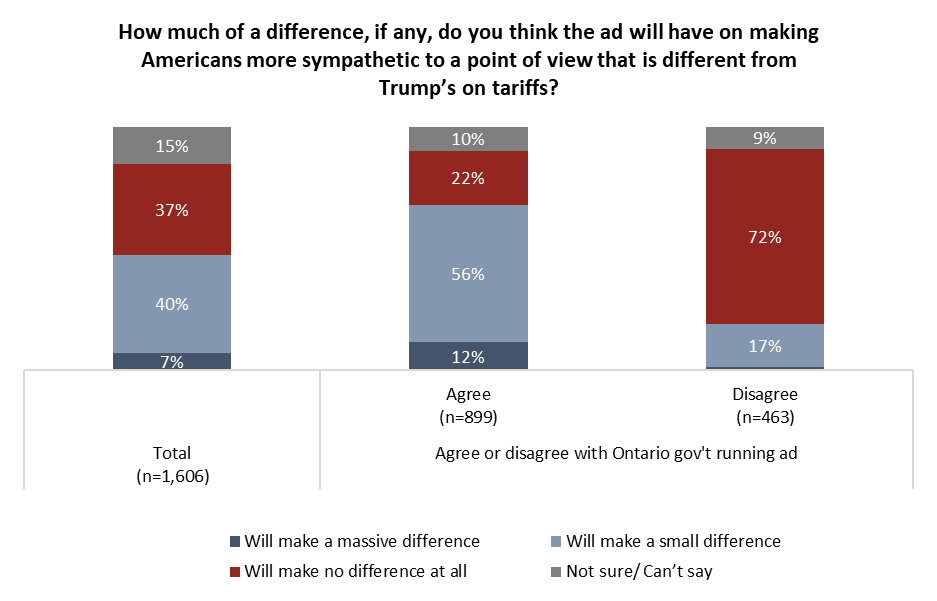
If the goal of the ad was to change public opinion in south of the border, many Canadians feel this has been partially accomplished. Approaching half (47%) say that it will have an impact in terms of bringing Americans closer to the Canadian view of these tariffs and away from Trump’s. That said, few feel this will be a major impact (7%) versus a smaller one (40%). More than one-in-three (37%) say it likely will have no impact.
More Key Findings:
- Millions of Canadians say they have seen the ad, in part or in full. Nearly two-thirds say this, with 35 per cent saying they watched the whole thing and 28 per cent viewing a portion.
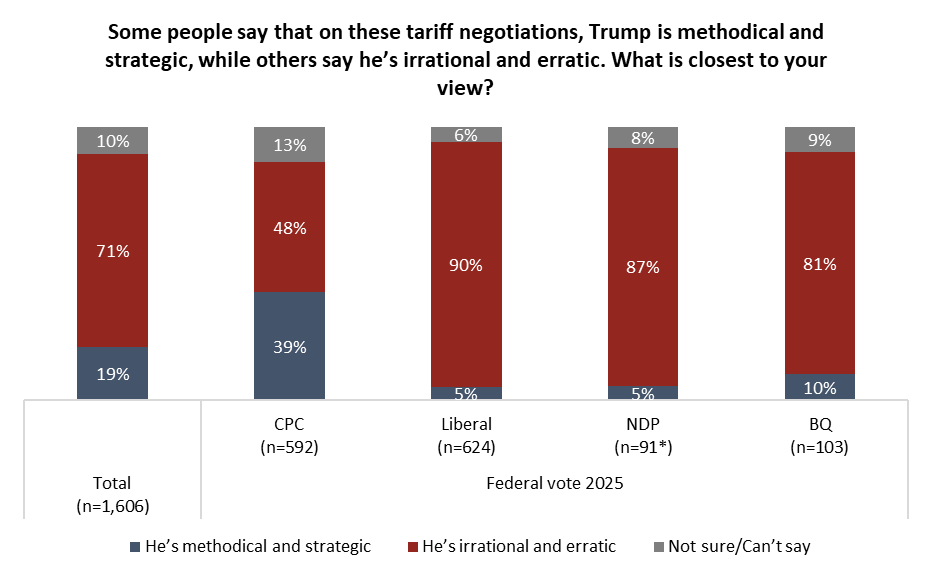
- Seven-in-10 (71%) say that broadly they don’t feel Trump has any real plan for these negotiations, calling him “irrational and erratic”. One-in-five (19%) give him more credit, saying he’s “methodical and strategic”. This view is held by a much larger portion of Conservatives in Canada (39%).
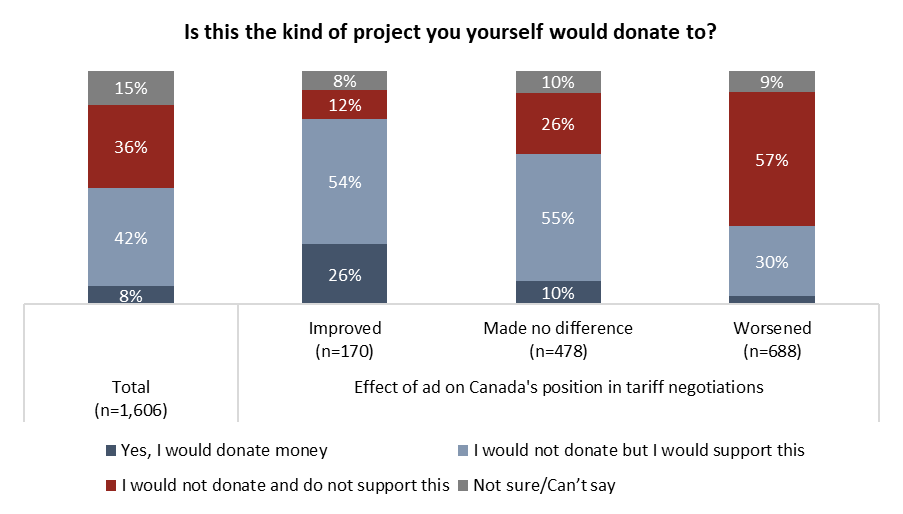
- Half of Canadians (50%) would support a group of people in this country coordinating a similar ad campaign to run in the U.S. That said, only 8 per cent say they would donate their own money to such a project.
INDEX
Part One: Reaganomics?
-
Two-thirds have seen the Ford ad featuring Reagan
-
Three-in-five believe ad was ‘accurate’ representation of Reagan’s words
-
Most agree with Ontario gov’t running ad; CPC voters more likely to disagree
Part Two: Assessments of its impact
-
Two-in-five say ad ‘worsened’ Canada’s trade negotiating position
-
Those who agree with ad being run split as to whether it will impact Canada’s position
-
Will it change Americans’ views?
-
Half would support private efforts to run similar ads in U.S.
Part Three: Does Trump have a plan?
-
Most say Trump ‘irrational’ in negotiations; CPC voters more likely to say he’s ‘strategic’
Part One: Reaganomics?
Two-thirds have seen the Ford ad featuring Reagan
The 2025 trade negotiations between the U.S. and Canada took another turn last week after the Ontario government paid for ads questioning the wisdom of U.S. President Donald Trump’s tariffs on Canada using the words of former U.S. President Ronald Reagan.
“When someone says, ‘Let’s impose tariffs on foreign imports,’ it looks like they’re doing the patriotic thing by protecting American products and jobs,” Reagan said in the 1987 radio address quoted in the ad. “And sometimes for a short while, it works. But only for a short time. But over the long run, such trade barriers hurt every American worker and consumer.”
The ads, which aired in the U.S. during Games 1 and 2 of the World Series featuring Major League Baseball’s only Canadian team, the Toronto Blue Jays, had “one billion views” according to Ontario Premier Doug Ford, who called it the “most successful ad in the history of North America,” with a Trumpian flourish.
The ad was viewed by millions in Canada, at least in part. Approaching two-thirds (63%) in Canada say they’ve seen all or a portion of it, including 68 per cent in Ontario:

Three-in-five believe ad was ‘accurate’ representation of Reagan’s words
Trump called the ad “fraudulent” and “fake” after the Reagan Foundation said it used “selective audio and video” which “misrepresents” what Reagan said. Although the words used in the ad are taken out of chronological order, assessments by third parties in the United States have asserted that they are an accurate representation of Reagan’s views on tariffs. Trump, however, has continued to assert, with no proof, that the ad was using AI when quoting Reagan.
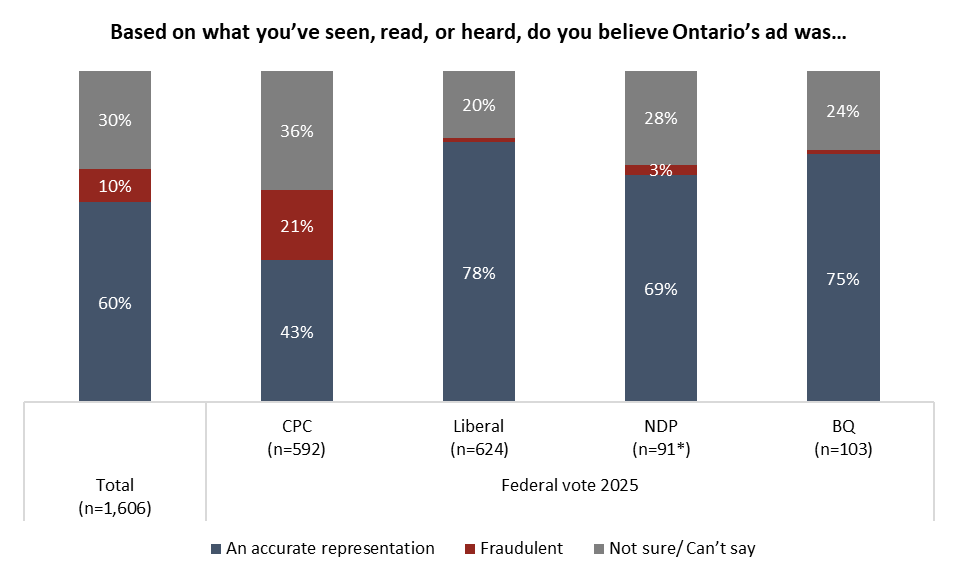
By a six-to-one margin, Canadians disagree with Trump’s assessment that the ad was “fraudulent”. Those who do agree with the U.S. president are almost entirely comprised of those who voted CPC in the spring election. However, even among CPC voters, the view that the ad was inaccurate is a minority one (21%):
*Smaller sample size, interpret with caution
Most agree with Ontario gov’t running ad; CPC voters more likely to disagree
The ad had an immediate impact on U.S.-Canada trade negotiations, with Trump saying they were off and that he would increase tariffs on Canada by 10 per cent. Despite Trump’s proclamation, Canada and U.S. representatives are still in discussion, according to Canada’s ambassador to the United States.
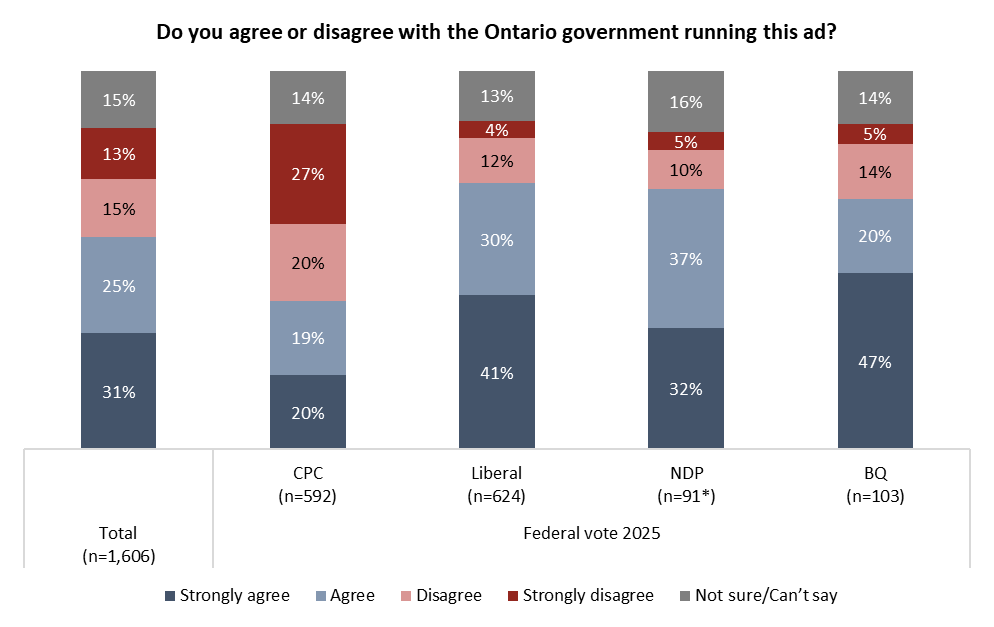
Even with Trump’s response in mind, a majority (56%) agree with Ford’s government running the ad. Those who voted CPC in the spring election are more divided than other political party supporters. Half (47%) of recent CPC voters disagree with running the ad, while two-in-five (39%) support it:
*Smaller sample size, interpret with caution
Part Two: Assessments of its impact
Two-in-five say ad ‘worsened’ Canada’s trade negotiating position
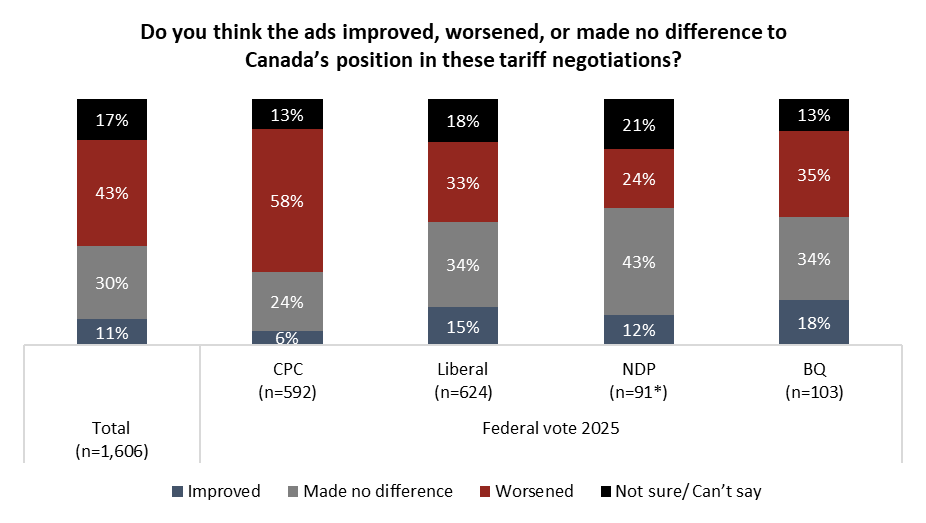
Although there is majority agreement with running the ad noted above, the view that the ad worsened Canada’s position in trade negotiations is more common (43%) than the view that the ad had a positive impact (11%). Recent CPC voters (58%) stand out as being more likely to be in the former group than those who voted Liberal (33%), NDP (24%) or Bloc Québécois (35%) in the spring:
*Smaller sample size, interpret with caution
Those who agree with ad being run split as to whether it will impact Canada’s position
Agreeing that the ad should be run, and believing it had a positive impact, are not exactly correlated positions. Two-in-five (41%) who support Ontario running the ad believe it “made no difference” to Canada’s negotiating position with the United States. In that group, those who believe it did make a difference, are more likely to say it worsened Canada’s position (25%) than strengthened it (18%).
More than four-in-five (85%) of those who disagree with the ad being run believe it has negatively impacted Canada’s stance in the U.S. trade negotiations:
Will it change Americans’ views?
Ford said the ad accomplished its goal because it “generated a conversation that wasn’t happening in the U.S.”
“The message is very clear,” Ford said, “protectionism does not work.”
Half (47%) of Canadians believe that the ad will make a difference in “making Americans more sympathetic to a point of view that is different from Trump’s on tariffs”. However, the impact is more likely to be viewed as “small” (40%) than “massive” in that group. Two-in-five (37%) believe the ad won’t have any impact on that front.
Those who agree with the ad being run by the Ontario government are more likely than others to believe the ad will have an impact on Americans’ understanding of the counterpoint to Trump’s views on tariffs. However, only a handful in that group believe the impact will be massive (12%):
After Trump’s termination of tariff negotiations with Canada, Ontario paused the ads. However, Canadians would support similar ads being run even if it weren’t an official effort of government. Half (50%) say they would get behind a project to run similar ads, including eight per cent who would donate to such efforts.
Even among those who believe the ads had no impact on Canada’s negotiating position support similar ads at a two-thirds (65%) majority.
Question text:
“Putting aside for a moment what politicians or governments do, suppose a group of individual Canadians were to raise money and run similar types of ads in the U.S. themselves, separate from any official communication efforts.
Is this the kind of project you yourself would donate to?”
Part Three: Does Trump have a plan?
Most believe Trump ‘irrational’ in negotiations; CPC voters more likely to say he’s ‘strategic’
The Ontario ad evidently struck a nerve with Trump. A Guardian columnist described his response as “an expression of pique far outweighing the apparent scale of the insult”.
As the target of Trump’s ire, Canadians are viewing his approach to these trade negotiations as more madness than method. Seven-in-ten (71%) believe Trump is “irrational and erratic”, while one-in-five (19%) say he’s “methodical and strategic”. Past Conservative voters are most of the latter group:
*Smaller sample size, interpret with caution
Survey Methodology
The Angus Reid Institute conducted an online survey from Oct. 29-30, 2025, among a randomized sample of 1,606 Canadian adults who are members of Angus Reid Forum. The sample was weighted to be representative of adults nationwide according to region, gender, age, household income, and education, based on the Canadian census. For comparison purposes only, a probability sample of this size would carry a margin of error of +/- 2 percentage points, 19 times out of 20. Discrepancies in or between totals are due to rounding. The survey was self-commissioned and paid for by ARI.
For more information on our polling methods, click here.
For detailed results by age, gender, region, education, and other demographics, click here.
For PDF of full release, click here.
For questionnaire, click here.
MEDIA CONTACTS:
Shachi Kurl, President: 604.908.1693 shachi.kurl@angusreid.org @shachikurl
Dave Korzinski, Research Director: 250.899.0821 dave.korzinski@angusreid.org
Jon Roe, Research Associate: 825.437.1147 jon.roe@angusreid.org