

Sask. Party remains close to the top in government performance, but at its own lowest level in five years
Sept. 12, 2025 – When he returns home from China this week, Saskatchewan Premier Scott Moe hopes to have made progress on removing tariffs on a multi-billion-dollar canola industry in the province. And while his constituents offer him the highest approval in the country on economic management, other key challenges face the province.
New data from the non-profit Angus Reid Institute finds half of Saskatchewan residents saying the provincial government is doing a good job in handling the economy. This represents an 11-point advantage over any other province surveyed on that issue. That said, on the top two issues facing the province, as chosen by residents, criticism is much higher.
On the cost of living and health care, by far the two top priorities for people in Saskatchewan, seven-in-10 say the government is doing a poor job.
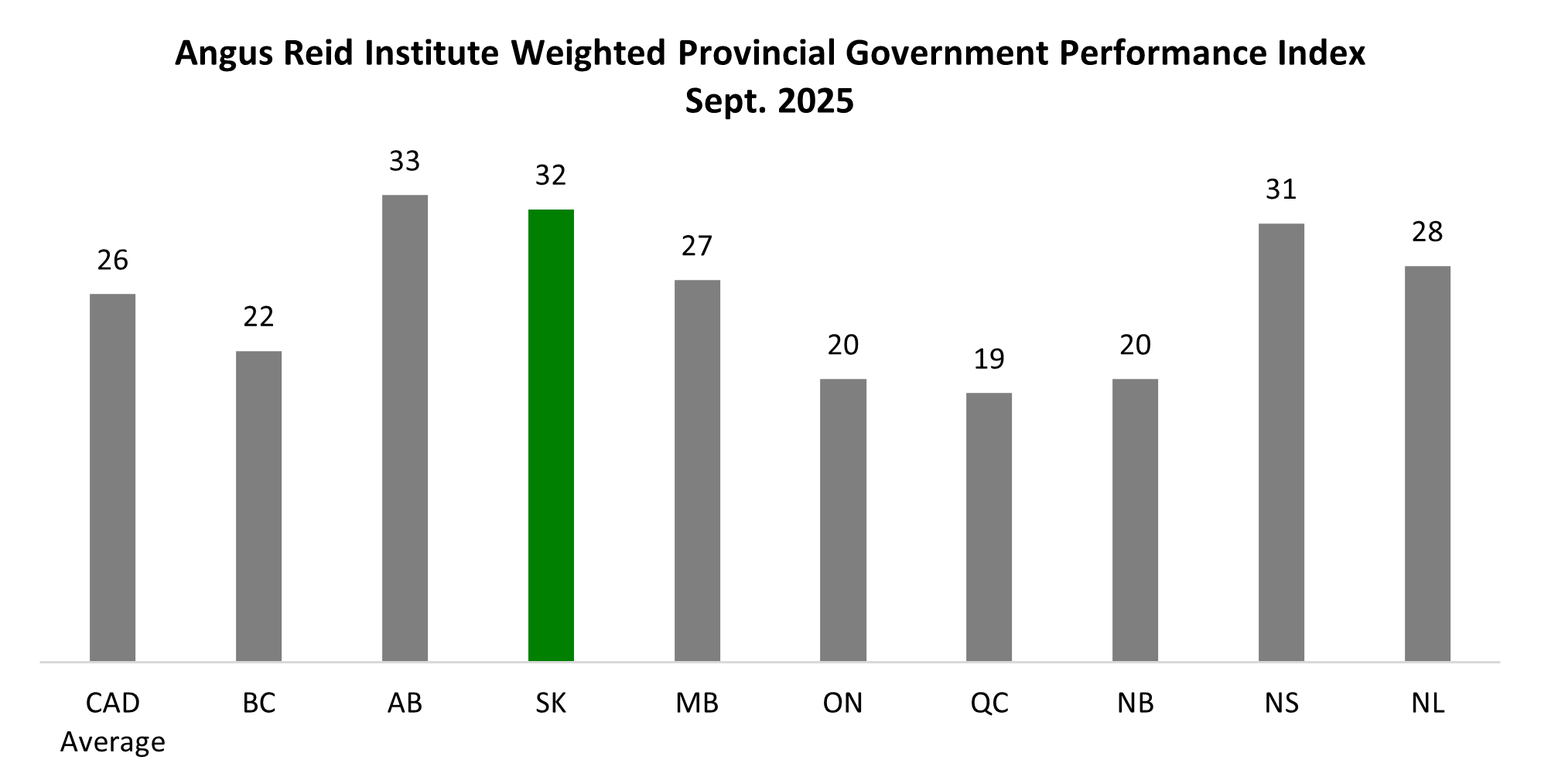
What this culminates in is a situation where the Saskatchewan Party holds the distinction of being the second highest ranked provincial government on the Angus Reid Institute’s Government Performance Index. Unfortunately, as many challenges persist, the score of a 32 is the lowest for the province since ARI began tracking in 2021.
INDEX
-
Views of premier and opposition leader
-
Government Performance Index
-
Government performance trend
-
Right track or wrong track?
-
Top issues
-
Performance on top issues
-
Vote intention update
Views of premier and opposition leader
Premier Scott Moe has been in China this week in a bid to end devastating canola tariffs that have hit Saskatchewan farmers. That sector, worth billions in trade, has been the target of retaliatory action after the federal government placed tariffs on Chinese electric vehicles. Moe continues to be well approved of at home, as half of residents hold this positive view. That said, 46 per cent disapprove of him, suggesting some consternation about many of the challenges facing the province.
Moe’s opposition in the legislature, NDP leader Carla Beck, is viewed favourably by one-in-three (35%) and unfavourably by a similar number to Moe (50%):
 Government Performance Index
The Angus Reid Institute’s Government Performance Index is a weighted average of the positive responses across all of the issues discussed in the survey. That is, more important issues are weighted more heavily than less important ones. For the full list of issues, see detailed tables. Using this weighted average, none of the provinces are performing particularly well. Consider that in March 2025 the Canadian average was eight points higher. The Saskatchewan Party scores a 32 on this measure, good for second highest in the country:
Government performance trend
The Saskatchewan Party’s performance can be viewed one of two ways. One could say it is a success, as all governments are facing significant criticism across the country and Saskatchewan fares well in comparison. Or, it could be viewed as a failure, as this mark of a 32 on the GPI is the lowest the government has recorded in nearly five years of tracking: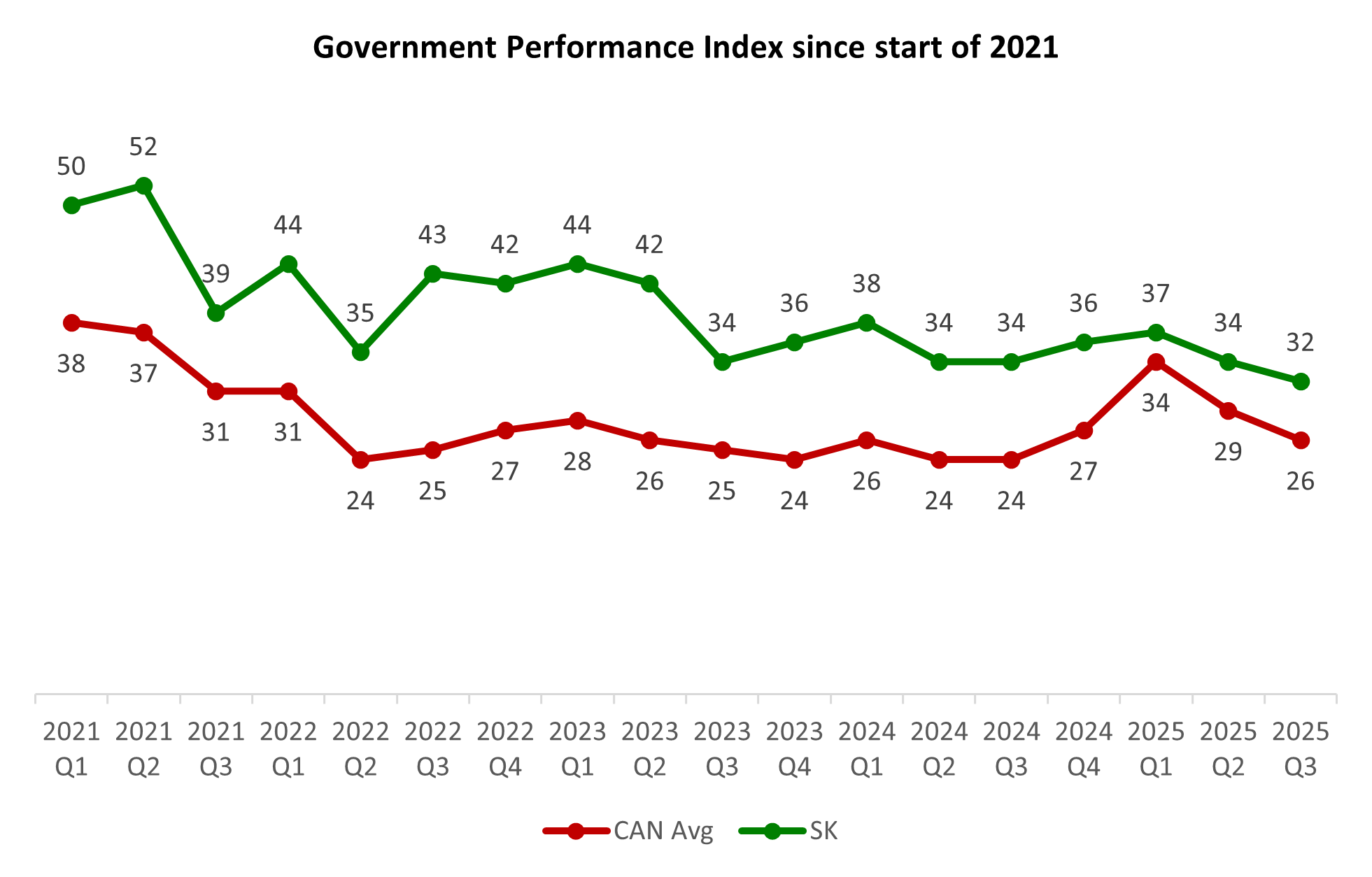 Right track or wrong track?
Saskatchewan is one of the few provinces in the country where residents are equally likely to say that the province is on the right track (42%) as those who say it’s on the wrong one (42%). This compares favourably to all other provinces canvassed aside from Manitoba and Nova Scotia:
 Top issues
While the top two issues are the same across Canada, these views are even more concentrated on two core priorities in Saskatchewan. Three-in-five say that the cost of living and health care are their most important concerns. Recent data has shown that Saskatchewan is making progress in health care hiring but concerns over staffing and rural care persist.
The province has also been hit hard by economic uncertainty and trade conflicts with China and the United States. The most recent budget forecast was revised from a $12-million expected surplus to a $349-million deficit.
 These top two issues in the province are subject to relative agreement, with half or more choosing each in all age groups. Other issues take on a generational tilt. Those younger than 55 show a pronounced concern about the economy and jobs, while 18- to 34-year-olds are the most worried about housing affordability. Those older than 54 are twice as likely as others to say that the deficit is a core concern:
 Performance on top issues
The Saskatchewan Party has one glaring bright spot in terms of provincial management – the economy. Half of residents say a good job is being done on economic management, a mark 11-points higher than any other province in the country (Alberta 39%).
On the top two issues of cost of living and health care, however, performance looks much more like other provinces. Seven-in-10 say the Saskatchewan government is doing a poor job on the cost of living and health care:

Vote intention update
Voters sent the Saskatchewan Party to a majority government less than one year ago. If an election were held again today, the result would be a similar success:
 Survey Methodology:
The Angus Reid Institute conducted an online survey from Aug. 28 to Sept. 5, 2025, among a randomized sample of 4,330 Canadian adults who are members of Angus Reid Forum. The sample was weighted to be representative of adults nationwide according to region, gender, age, household income, and education, based on the Canadian census. Discrepancies in or between totals are due to rounding. The survey was self-commissioned and paid for by ARI.

For more information on our polling methods, click here.
For detailed results by age, gender, region, education, and other demographics, click here.
For PDF of full release, click here.
For questionnaire, click here.
MEDIA CONTACTS:
Shachi Kurl, President: 604.908.1693 shachi.kurl@angusreid.org @shachikurl
Dave Korzinski, Research Director: 250.899.0821 dave.korzinski@angusreid.org
Jon Roe, Research Associate: 825.437.1147 jon.roe@angusreid.org