

One-quarter say province is on the right track, while nearly half 46%) say the opposite
Pour la version française, cliquez ici.
April 8, 2026 – With Premier François Legault stepping aside and the Coalition Avenir Québec facing declining support, the province’s next leader will inherit both a fragile mandate and an electorate increasingly skeptical about the government’s performance on the issues that matter most.
New data from the non-profit Angus Reid Institute finds Quebecers more negative than positive about both their personal circumstances, as well as the direction of their province. Nearly twice as many say they are worse off financially than better off compared to last year, while just one-in-four (25%) believe Quebec is on the right track, compared to 46 per cent who say it is headed in the wrong direction. These views come as cost of living and health care dominate public concern, yet government performance on these top issues remains among the lowest in the country.
While Quebecers report somewhat lower levels of financial pressure than the national average, broader sentiment toward government and direction suggests a restless electorate ahead of an election scheduled for the fall. With satisfaction lagging across nearly every major policy area and political leadership in flux, the months ahead are poised to reshape the province’s political landscape, as parties compete to convince voters they can better address the economic and social challenges defining this election.

About ARI
The Angus Reid Institute (ARI) was founded in October 2014 by pollster and sociologist, Dr. Angus Reid. ARI is a national, not-for-profit, non-partisan public opinion research foundation established to advance education by commissioning, conducting and disseminating to the public accessible and impartial statistical data, research and policy analysis on economics, political science, philanthropy, public administration, domestic and international affairs and other socio-economic issues of importance to Canada and its world.
INDEX
-
Views of the premier and opposition leader
-
Government Performance Index
-
Government performance trend
-
Top issues
-
Performance on top issues
-
Economic Outlook
-
Right track or wrong track?
Government Performance Index
Quebec Premier François Legault said recently that he is not worried about the future of his party. For the near-term, perhaps he should be. Legault announced his resignation in January, and will be replaced in the coming weeks, but whomever takes over the position of CAQ leader and premier will have some heavy lifting ahead.
The CAQ government is tied for second worst in the country on the Angus Reid Institute’s Weighted Provincial Government Performance Index, which scores performance across 16 different provincial issues. A score of 20 is well below the national average, and with his party a distant third or fourth in most polls, the new leader will need to work quickly to rebuild trust, with an election scheduled for this fall:

Government performance trend
CAQ government performance has been below the national average for more than a year. After a brief boost in government performance appraisal in early 2025 – largely due to the response to threats and tariffs from Donald Trump – the Canadian average has dipped significantly, alongside Quebec:

Top issues
The forthcoming provincial election will undoubtedly have myriad debates and issues, but the winner will likely be the party that best communicates its plans on a few key issues. The cost of living and health care are runaway choices as the top concern for Quebec residents right now, with housing affordability, the deficit, education, and the economy all making up a second tier:

Performance on top issues
All five top issues, as chosen by Quebec residents, are sources of low levels of government satisfaction. One-quarter say the government has handled education well. Recently more than 50,000 CEGEP and university students went on strike to protest austerity in education, and in late 2023, tens of thousands of teachers went on strike for better pay and working conditions. On the other four top issues, satisfaction levels are in the teens:

Economic Outlook
The economic story is not an overly positive one in any part of the country, as seen in the rest of this Cross-Canada Outlook series, and Quebec largely follows the palpable economic negativity. Nearly twice as many Quebec residents say they’re worse off now than they were at this time last year (30%), rather than better (17%):

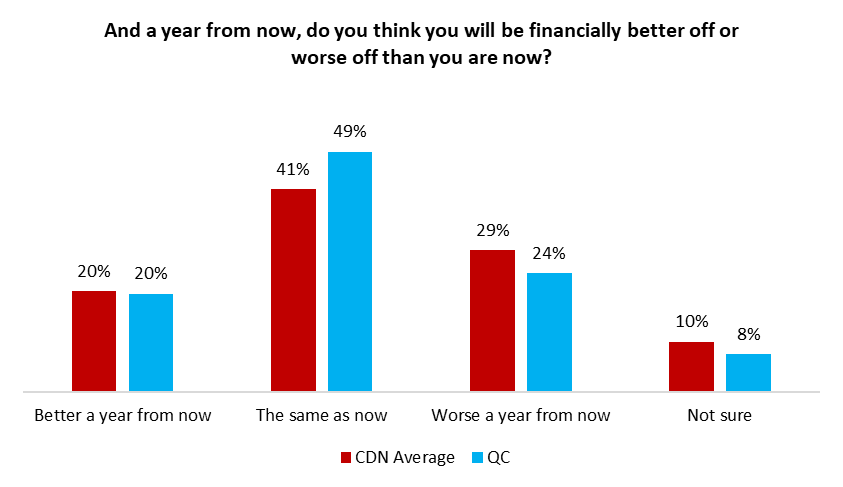
Optimism about the coming year matches the national average, and fewer say they’ll be worse off next spring:
To understand and compare the realities of Canadians across the country, ARI created a Financial Pressure Index, which scores respondents on eight questions and sorts them into one of four groups based on the intensity of the financial pressure they face. On this measure, Quebecers fare better than the average Canadian. Seven-in-10 (71%) are in the Low or Very Low financial pressure groups, 12-points over the national average.

Right track or wrong track?
Quebec residents are largely negative about the direction of the province. This perceived direction will play a key role in determining which party forms government in the fall, but for now, residents are almost twice as likely to say the province is on the wrong track (46%) rather than the right one (25%)

METHODOLOGY:
The Angus Reid Institute conducted an online survey from March 11-17, 2026, among a randomized sample of 665 Canadian adults who are residents of Quebec. Respondents are drawn from the Angus Reid Forum, a large-scale online panel developed to include Canadian residents in each of the 343 federal ridings in Canada and representative of the Canadian population by age, gender, family income, ethnic status and education. The sample was weighted to be representative of adults nationwide according to region, gender, age, household income, and education, based on the Canadian census. For comparison purposes only, a probability sample of this size would carry a margin of error of +/- 4 percentage points, 19 times out of 20. Discrepancies in or between totals are due to rounding. The survey was self-commissioned and paid for by ARI.
For detailed results by age, gender, region, education, and other demographics, click here.
For PDF of full release, click here.
MEDIA CONTACT:
Shachi Kurl, President: 604.908.1693 shachi.kurl@angusreid.org @shachikurl
Dave Korzinski, Research Director: 250.899.0821 dave.korzinski@angusreid.org
Jon Roe, Senior Research Associate: 825.437.1147 jon.roe@angusreid.org