


Majority say that crime in their community has risen over the past five years
January 12, 2026 – As the federal Liberal government proposes changes to the country’s criminal justice system aimed at concerns over violent repeat offenders, Canadians are expressing a growing concern about rising crime in their own individual communities. Some of the most common crimes facing Canadians, however, don’t involve ever seeing another person’s face.
New data from the non-profit Angus Reid Institute, the first in a series examining crime in Canada, finds three-in-five (62%) believe that over the last five years, crime has been rising in the communities where they live. It’s a proportion that far outnumbers those who say there’s been no change (24%) or a decrease (5%).
In 2014, more than a decade ago, Canadians were more likely to perceive stable crime rates (40%) than increasing ones (30%). The latter figure has doubled in the intervening years.
The perception is matched by empirical data from Statistics Canada, which shows a rise in both its Crime Severity Index and Violent Crime Severity Index since 2020.
That said, among the most widespread crimes – at least attempted – are fraud and identity theft, which appear to be increasing in frequency and targeting nearly everyone. More than four-in-five Canadians say they have been the target of an online or phone scam over the past two years. For 30 per cent of the population this has resulted in the loss of information or money. Notably, Canadians lost more than $638 million in reported fraud cases in 2024, although only five to 10 per cent of such cases are thought to be reported to authorities.
What this means is that while 13 per cent of Canadians have been involved in a police-reported crime during this two-year period, more than one-in-three (36%) have been victims of a crime if expanded to include this rampant fraud.

More in this release:
- The number of Canadians choosing “crime and public safety” as a top issue has increased four-fold compared to 2015 – now at one-in-five.
- For those working in retail, shoplifting, verbal abuse, and physical threats have become the norm.
- The proportion of Canadians feeling comfortable walking alone in their neighbourhood after dark has fallen compared to data collected in 2015 and 2022.
- Those 60 years of age and older are nearly twice as likely as 18- to 29-year-olds to report being victims of a scam or fraud over the past two years.
- Half of Canadians say shoplifting has increased in prevalence in their community, a sentiment supported by empirical data in recent years.
- Canadians are more likely than Americans to say that crime is rising in their communities (62% vs. 39%) with Republican and CPC voters more likely to say this than others.
- Canadians and Americans are equally likely to have been victim of a police-reported crime over the past two years. In each country 13 per cent say this.
INDEX
Part One: Experiences
-
13 per cent have been a victim of a crime over the past two years
-
A focus on fraud
-
How many have been victimized?
-
-
Focus on shoplifting and retail workers
-
Shoplifting, verbal abuse, and physical threats common
-
Perception among current and former retail workers is that crime is increasing
-
Part Two: Perceptions
-
Three-in-five say crime up over past five years
-
Crime as a top issue continues to rise
-
Number feeling unsafe walking alone after dark on the rise
Part Three: U.S.-Canada comparison
-
Political views drive perceptions
-
Similarities between the countries
Part One: Experiences
13 per cent have been a victim of a crime over the past two years
Crime has been a significant driver of the political conversation in recent years. Conservative leader Pierre Poilievre has led the charge, blaming former Prime Minister Justin Trudeau for failing to fix a “catch-and-release” bail system, but there have been debates at all levels of government about how to handle crime and just how serious the problem is.
There are many ways to conceptualize crime in this country. One way is to look at the number of Canadians that have been a victim of a crime for which they contacted the police within the past two years. The trend here has been remarkably consistent in recent years. Currently, 13 per cent say that this has happened to them, the same number as said this in 2022 and 2018. This suggests that while perceptions about community crime have been increasing among some, these views have not led to an increase in the personal point of contact.

A focus on fraud
Police-reported crimes are one aspect of this debate, but a more common occurrence and a crime apparently less often reported to authorities are crimes of identify theft and fraud.
Canadians lost more than $638 million to fraud in 2024. This, while reportedly only five to 10 per cent of cases are reported to the Canadian Anti-Fraud Centre. With the proliferation of AI campaigns, these numbers may continue to increase.
The prevalence of phishing and fraud attempts is astounding, with more than four-in-five Canadians saying they have been the subject of an attempt over the past two years. This is, evidently, a common experience in Canada:

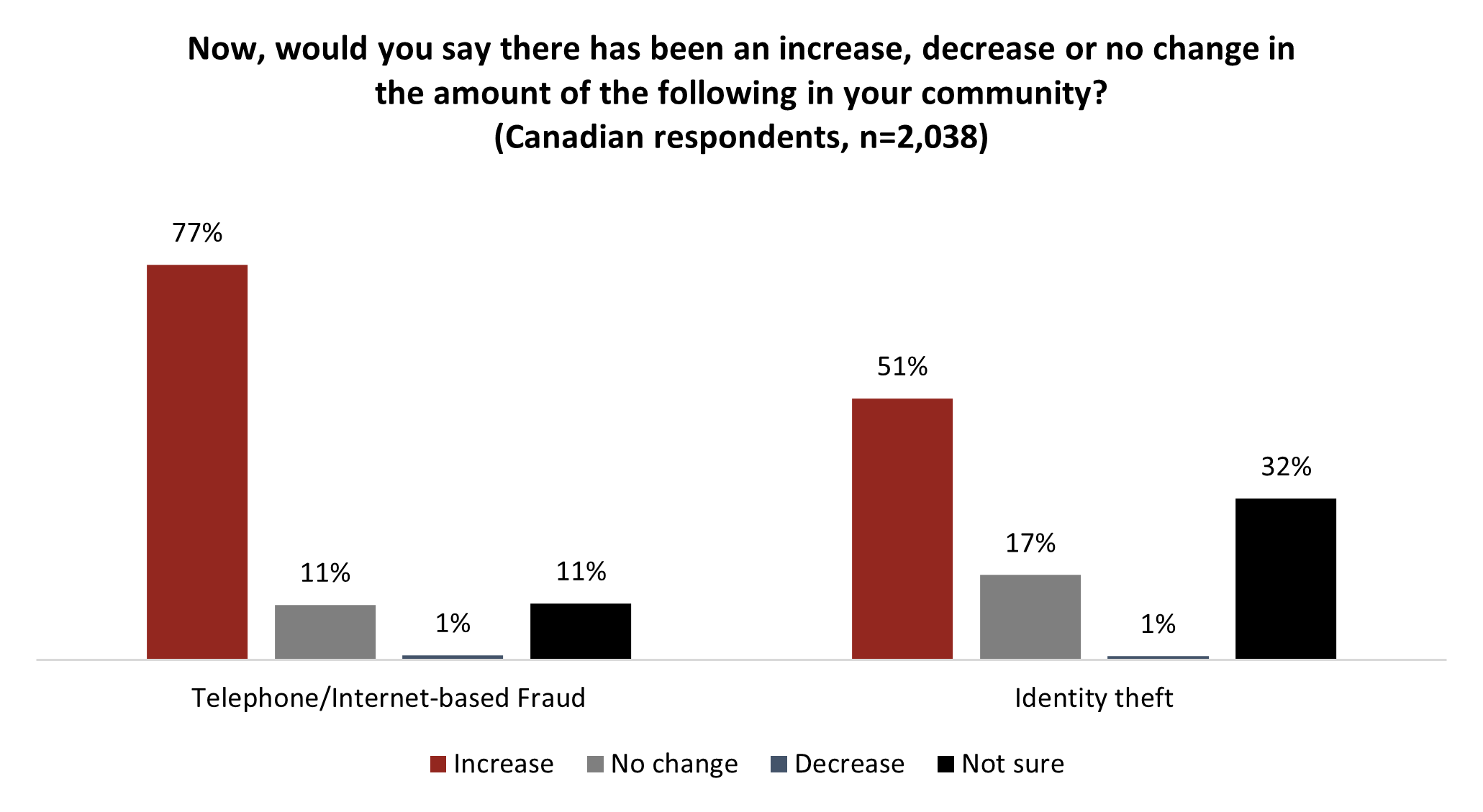
The sense is also that these issues are becoming a bigger part of life. Asked if they believe telephone or internet-based fraud and identity theft attempts have been increasing or decreasing in their communities, a majority in each case say they’re becoming more frequent:
How many have been victimized?
While more than 80 per cent have been contacted, 30 per cent say they had money or personal information taken from them by a scam. These proportions tend to be higher with age, as those 60 years of age and older are almost twice as likely as 18- to 29-year-olds to have been a victim. Some of this may be attributable to unfamiliarity with emerging AI strategies for fraud, which have become sophisticated at modeling authentic communications from recognizable sources:

Across income level there is little variance. Evidently Canadians of all financial backgrounds are targets. Between 27 and 35 per cent within all income ranges say they have been victimized by fraud of this sort:

So, while just 13 per cent of Canadians have been involved in a police-reported crime in the initial question, 30 per cent have been victims of a crime in the form of fraud or identity theft. Adding these proportions together – and ensuring an unduplicated count – finds that 36 per cent of Canadians have been victims.

Focus on shoplifting and retail workers
Many of the common crimes that Canadians may encounter have been on a downward trajectory in recent years, though one key offense has bucked this trend: shoplifting.
A complex web of interconnected phenomena appear to have helped to generate this sustained increase, which seas shoplifting incidents of $5,000 or less at their highest mark in decades. After a drop in incidents during the 2020 COVID-19 outbreak, each subsequent year has featured more crimes of this nature. Increased financial pressures, mental health and addiction issues, lower police staffing levels, and other aspects are credited for this, as well as a focus on theft among organized crime.

These datapoints collected by Statistics Canada are one thing, but how does this trend map onto the experiences of those working in retail workplaces? Angus Reid Institute asked nearly 200 Canadians who work in this type of space about their experiences. These individuals tend to be younger and comprise about eight per cent of the Canadian, a number that aligns with workforce estimates of about 10 to 11 per cent of the Canadian workforce. Retail is estimated to be the largest source of employment in the country and many of these individuals are facing challenges.

Shoplifting, verbal abuse, and physical threats common
Report after report during the past few years have noted the increase in shoplifting and abuse faced by the business community. The workers themselves appear to confirm much of this. Asked about their own current job and the past six months, two-in-five (40%) have dealt with shoplifting incidents “many times”, while one-quarter (24%) say it has happened once or twice. In terms of verbal abuse, four-in-five have faced this, while 43 per cent have endured physical threats:

Perception among current and former retail workers is that crime is increasing
The pool of responses was then expanded for Canadians who have ever worked in retail to weigh in on what they see. Across this group the majority says that shoplifting, verbal abuse, and physical threats have all increased in recent years.

Part Two: Perceptions of crime
Three-in-five say crime up over past five years
The proportion of Canadians choosing crime and public safety as a top issue in Angus Reid Institute’s quarterly tracking has crept upward over the past eight years. After residing in single digits from 2014 to 2019, the COVID and post-COVID environment has been one of elevated concern, with the proportion choosing this issue among their most important rising near the one-in-five mark:

According to Statistics Canada, police-reported crimes have risen since 2014, after decades of falling. That said, these rates are well-below the high point recorded in 1990. Property crimes and violent crimes have been relatively consistent over the past five years, though shoplifting and youth crimes have been a source of concern.

The sense among Canadians is that crime has been rising in their communities over the past five years. Three-in-five say this, the highest number in ARI’s tracking dating back to 2012. The data suggest that depending on which type of crime a person is considering, this may be correct or incorrect, but what is important here is perception. A majority of Canadians, just as in 2022, feel that crime in their community has been increasing:

Looking at the Crime Severity Index as defined by Statistics Canada, violent crime has risen from five years ago. Despite the slight downward trend over the past 12 months, this overall rise may be reflected in Canadians’ perceptions:

The perception that crime is rising near to home tends to be strongest within the Conservative political sphere. Those who voted CPC in 2025 believe there has been an increase in crime in their community at a rate 30-points higher than those who voted for Mark Carney’s Liberals (51%). A majority (58%) of past Bloc voters agree crime is increasing. Few Canadians (5%) say that crime has been decreasing where they live:

Number feeling unsafe walking alone after dark on the rise
One metric used to track sentiments around crime is a person’s comfort walking alone after dark in a familiar place. In 2015, ARI asked Canadians if they felt safe doing this in their neighbourhood, finding one-in-three (32%) strongly agreeing that they felt safe and half (48%) agreeing. This question was posited again in 2022 and 2025 – though importantly, with the addition of a “not sure” option. In both cases, though five per cent said they weren’t sure either way, the proportion who felt firmly safe had dropped, from 32 per cent in 2015, to 23 per cent in 2022 and 17 per cent in 2025. The number who do not feel safe has risen to three-in-10 (28%):

Part Three: U.S.-Canada comparison
Utilizing Angus Reid Forum USA, ARI surveyed 1,500 Americans with similar questions to understand the comparative realities of crime perception in each country. The story south of the border is multifold. The rate of police-reported violent crime rate was 334 incidents per 100,000 in 2023, which remains significantly higher than the rate in Canada – 252. That said, the gap between the U.S. and Canada has shrunk over the past 25 years.

Crime trends in both countries have fluctuated in recent years, but Canadians are much more likely to perceive crime as rising. Americans are still far more likely to say that crime is increasing (39%) than decreasing (10%) in their community, though many (37%) say there has been no change:

Political views drive perceptions
Just as in Canada, those on the right of the political spectrum are more likely to perceive a rise in crime within their communities. Half of Trump voters (49%) say this, 17-points higher than those who voted for Kamala Harris:

Similarities between the countries
On the measure of whether or not Canadians and Americans feel safe to walk alone in their neighbourhoods at night, little difference is noted. Approximately two-thirds in each country feel safe, while one-quarter feel unsafe:

In additional data synergy, the proportion of Americans who say they have been the victim of a police-reported crime over the past two years is identical to the Canadian number.
METHODOLOGY:
The Angus Reid Institute conducted an online survey from Nov. 5-7, 2025, among a randomized sample of 2,038 Canadian adults who are members of Angus Reid Forum. The sample was weighted to be representative of adults nationwide according to region, gender, age, household income, and education, based on the Canadian census. For comparison purposes only, a probability sample of this size would carry a margin of error of +/- 2 percentage points, 19 times out of 20. Discrepancies in or between totals are due to rounding. The survey was self-commissioned and paid for by ARI. Detailed tables are found at the end of this release.
ARI conducted a second online survey from Nov. 26 to Dec. 1, 2025, among a representative randomized sample of 1,500 American adults who are members of Angus Reid Forum USA. For comparison purposes only, a probability sample of this size would carry a margin of error of +/- 3 percentage points, 19 times out of 20.
Discrepancies in or between totals are due to rounding. The survey was self-commissioned and paid for by ARI.
For detailed results by age, gender, region, education, and other demographics, click here.
For PDF of full release, click here.
For questionnaire, click here.
MEDIA CONTACT:
Shachi Kurl, President: 604.908.1693 shachi.kurl@angusreid.org @shachikurl
Dave Korzinski, Research Director: 250.899.0821 dave.korzinski@angusreid.org