


Most point to lenient justice system, addiction, and mental health issues as main causes of crime
January 16, 2025 – Canadians increasingly believe crime is rising in their communities and are searching for answers. As the Liberal government proposes measures to toughen sentencing and reform bail conditions, most Canadians are supportive, albeit skeptical, that tangible improvements will come.
New data from the Angus Reid Institute finds broad agreement that Canada is not being tough enough on offenders, with three-in-five saying the country needs stricter approaches to crime (59%) rather than greater emphasis on social supports (32%). Asked about a number of proposed changes the appetite for “toughening up” the sentencing and bail standards is robust.
Some of proposed changes put forth by the Liberals in Bill C-14 include expanding the application of “reverse onus” bail, the accused must argue for the right to release while on trial; requiring consecutive sentences for multiple convictions; banning conditional sentences for those accused of certain sexual offences; and increasing the penalties for organized retail theft. For each, at least three-quarters of Canadians say it is a good idea. These same respondents are divided about whether this suite of changes will reduce crime significantly, but the vast majority say they will help at least a little.
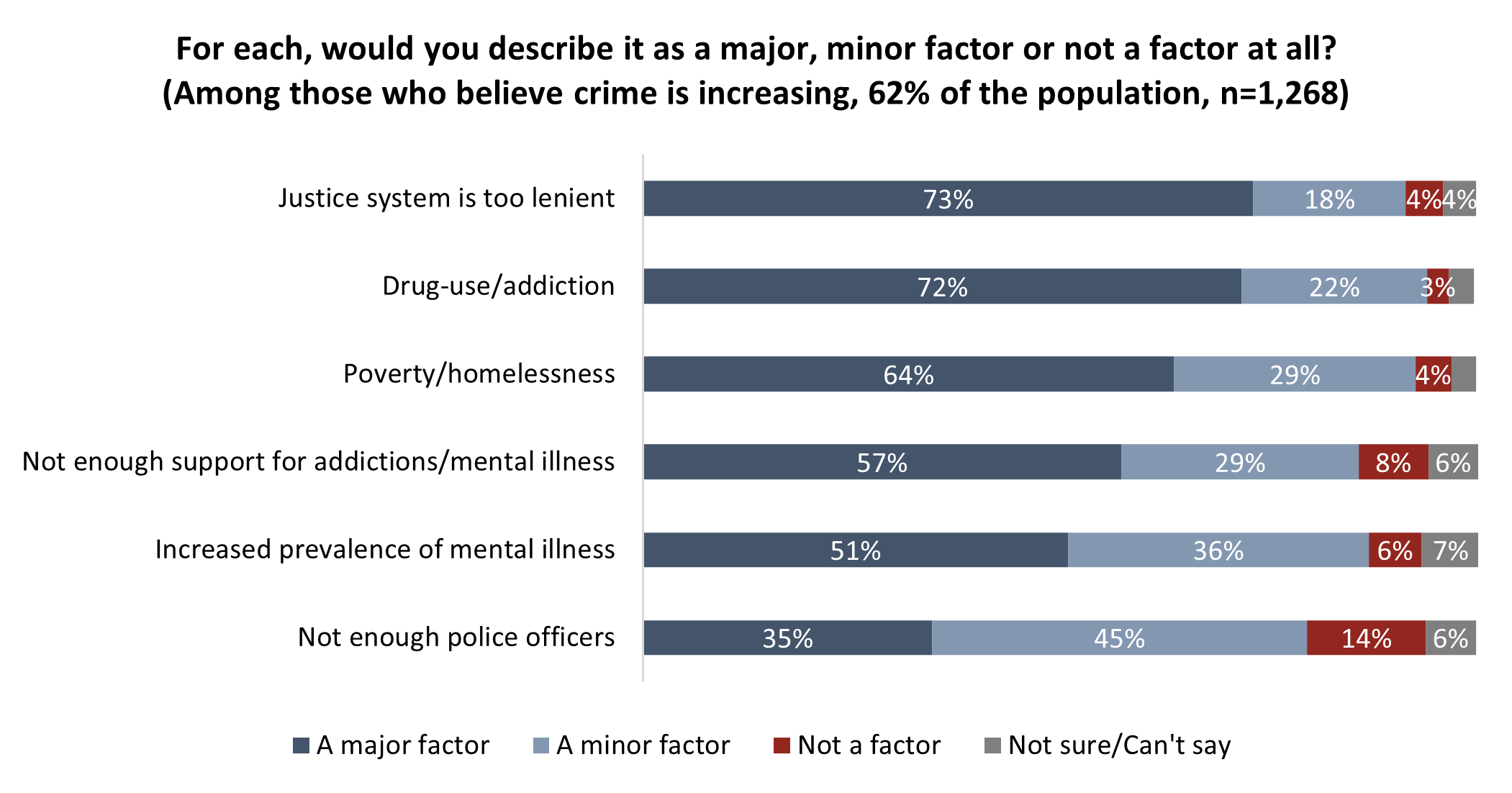
While the current preference appears to be for harsher sentencing, Canadians are alive to the social causes of crime. Asked what they believe are the biggest drivers of this (among the 62% who believe crime is rising) addiction, poverty, and mental illness all feature heavily. That said, the top choice as a major factor is justice system leniency. Three-quarters (73%) say this is a major factor.
For a certain portion of the population, about two-in-five, these personal economic and social factors should not be a consideration in sentencing. A similar number also oppose considering the Gladue principles required in sentencing Indigenous Peoples living in Canada. For the majority, however, these principles and other personal factors should at least play some role in sentencing. This suggests a tension between the perceived necessity of “cracking down” and the broader idea that those who commit crimes may need rehabilitation rather than punishment.

More Key Findings:
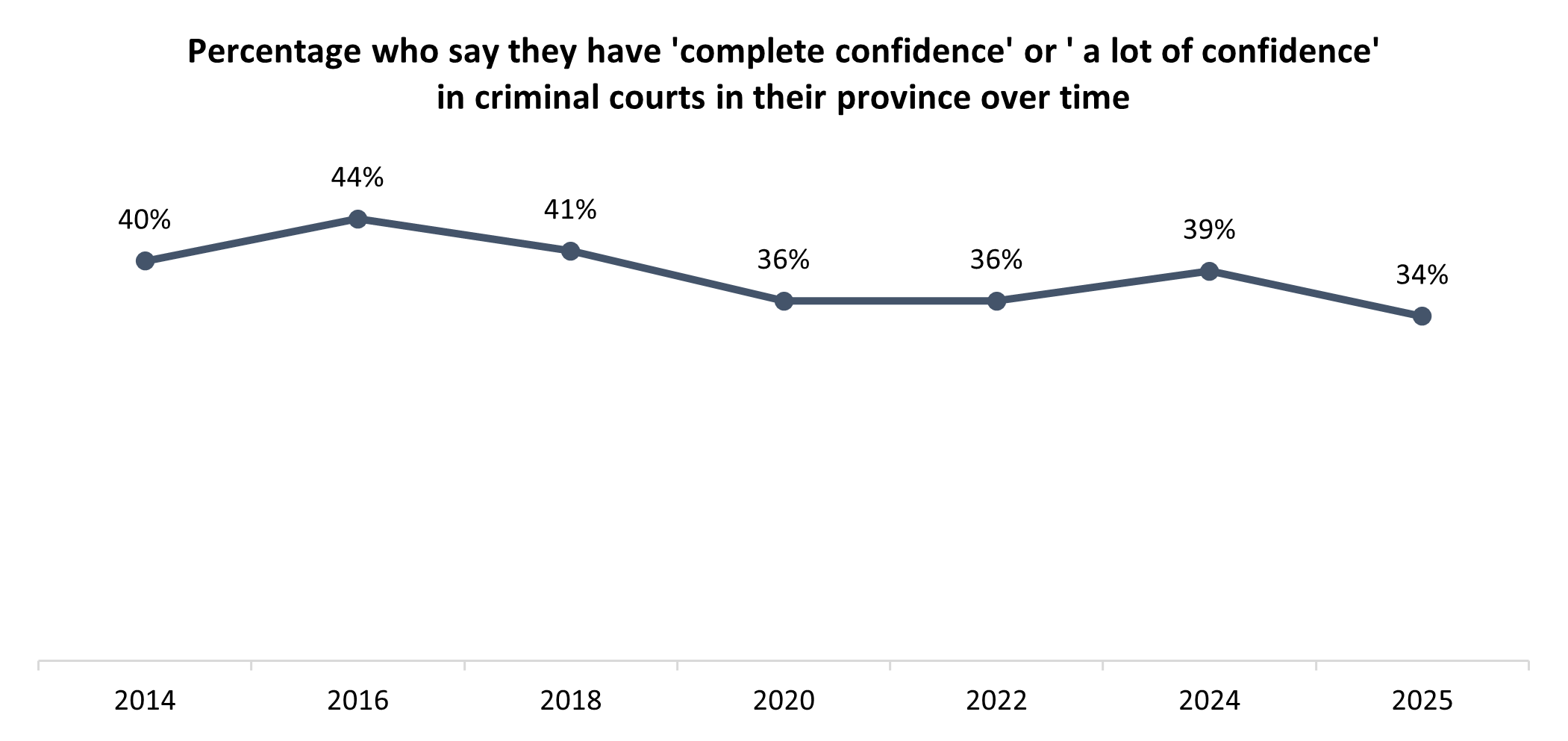
- Confidence in provincial criminal courts has fallen to some of the lowest levels seen in a decade. One-in-three (34%) have confidence in their provincial courts, compared to 44 per cent in 2016.
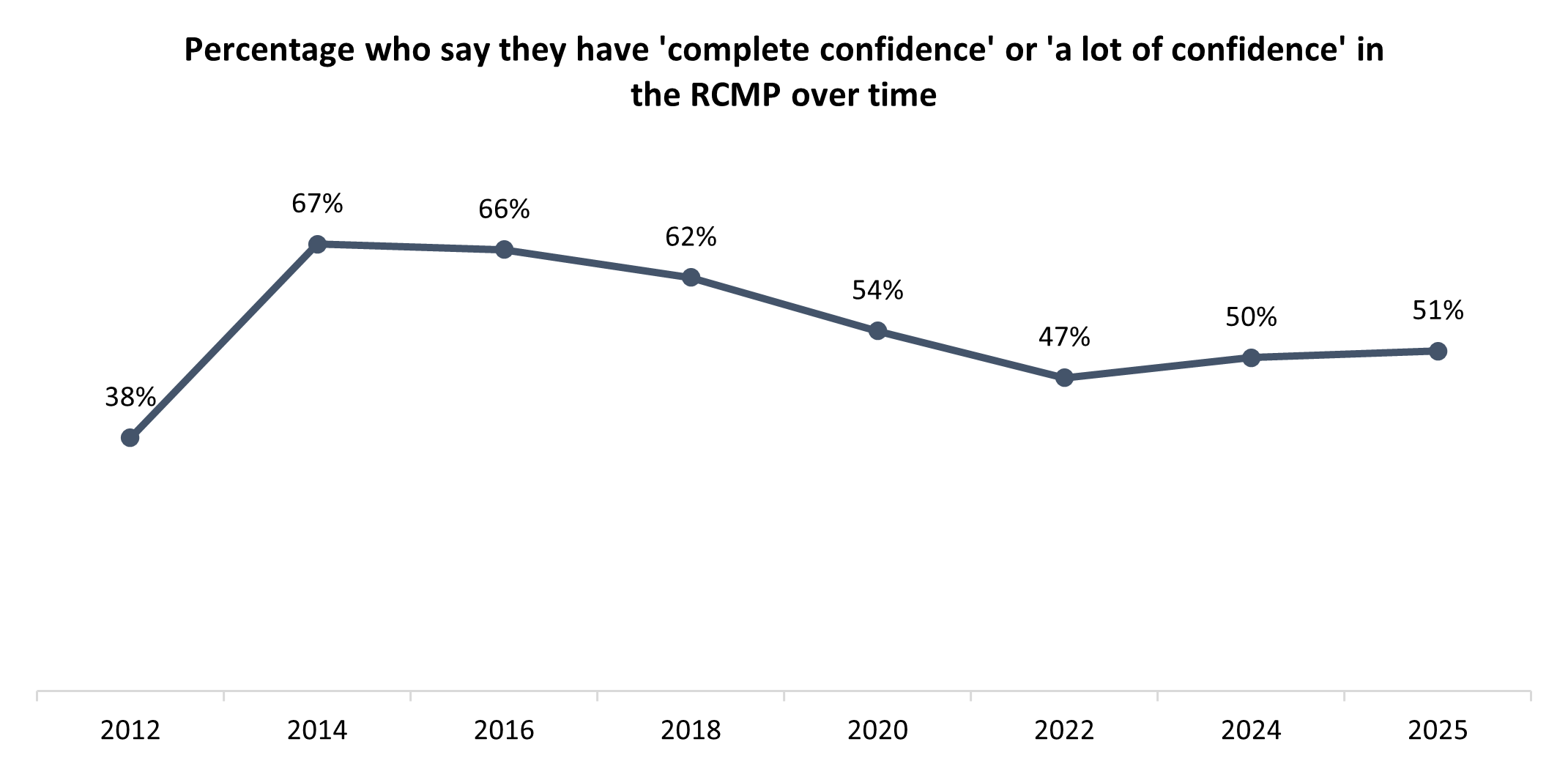
- Confidence in the RCMP registers at 51 per cent, similar to last year (50%).
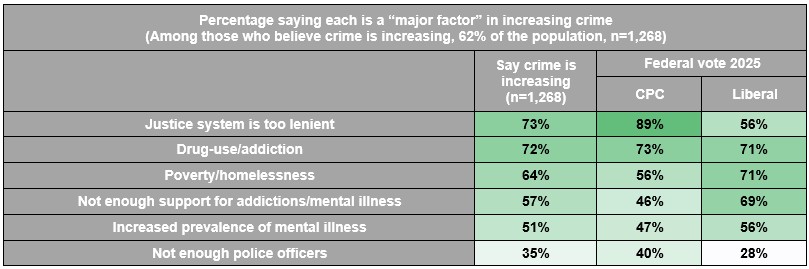
- CPC and Liberal voters are at odds over the causes of increased crime, with CPC voters far more likely to say the justice system is too lenient (89% vs 56%) and Liberal voters far more likely to say that mental health supports are lacking (69% vs 46%).
INDEX
Part One: Confidence in elements of justice system
Part Two: Perceived causes of crime
- Major factors – Addiction, poverty, mental illness, lenient justice system
Part Three: Sentencing and social considerations
- Should a person’s economic and social background play major role in sentencing?
- Gladue Principles
Part Four: Support for policy proposals
- Three-in-five say getting tougher on crime is the way to go
- Significant support for toughening sentencing, bail but doubt over efficacy
Part One: Confidence in elements of justice system
For more than a decade, Angus Reid Institute has been tracking Canadians’ views of several aspects of the justice system. Over this time, perceptions of the RCMP, municipal police, and courts, have changed as Canadians respond to experiences and reporting about each.
The reputation of the RCMP has been improved slightly over the past four years after a decade of sliding. Confidence in the force fell sharply through the late 2010s and after, dragged down by controversies such as the RCMP’s handling of the 2020 Nova Scotia mass shooting and years of reports about systemic workplace harassment. After 2022, perceptions inched upward, then flattened. Recently, the Ontario Provincial Police finished a review of the RCMP’s handling of the 2007 tasering death of Robert Dziekański. The report found that senior RCMP leadership did not commit obstruction of justice but did display serious mismanagement, communication failures, and mishandling of evidence and narratives around the case, which again raised concerns about organizational accountability even if criminal obstruction wasn’t established.
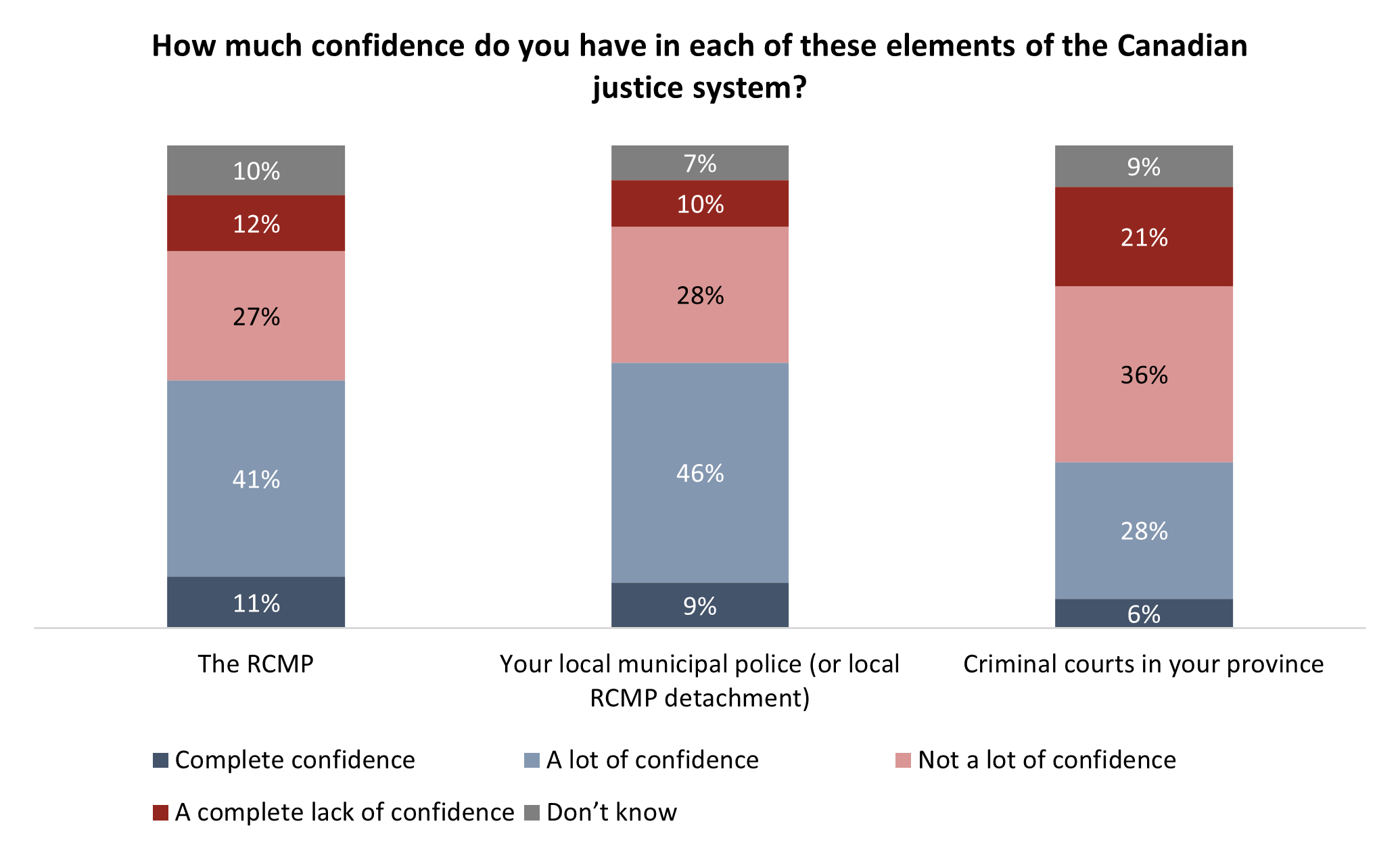
Canadians’ confidence in their local municipal police force rates slightly above the RCMP, though both ratings hover around the majority mark. Provincial criminal courts, however, are subject to higher levels of criticism. Much of this hinges on issues that will be discussed later in this series, namely the ideas that sentencing is too lenient in Canada and that bail reforms are needed.
Confidence in provincial criminal courts has reached a low dating back to 2014 in ARI tracking data with only one-third (34%) of Canadians saying they have confidence in that institution. This comes as the federal government looks to change elements of the system, with a focus on bail, to address concerns about violent repeat offenders.
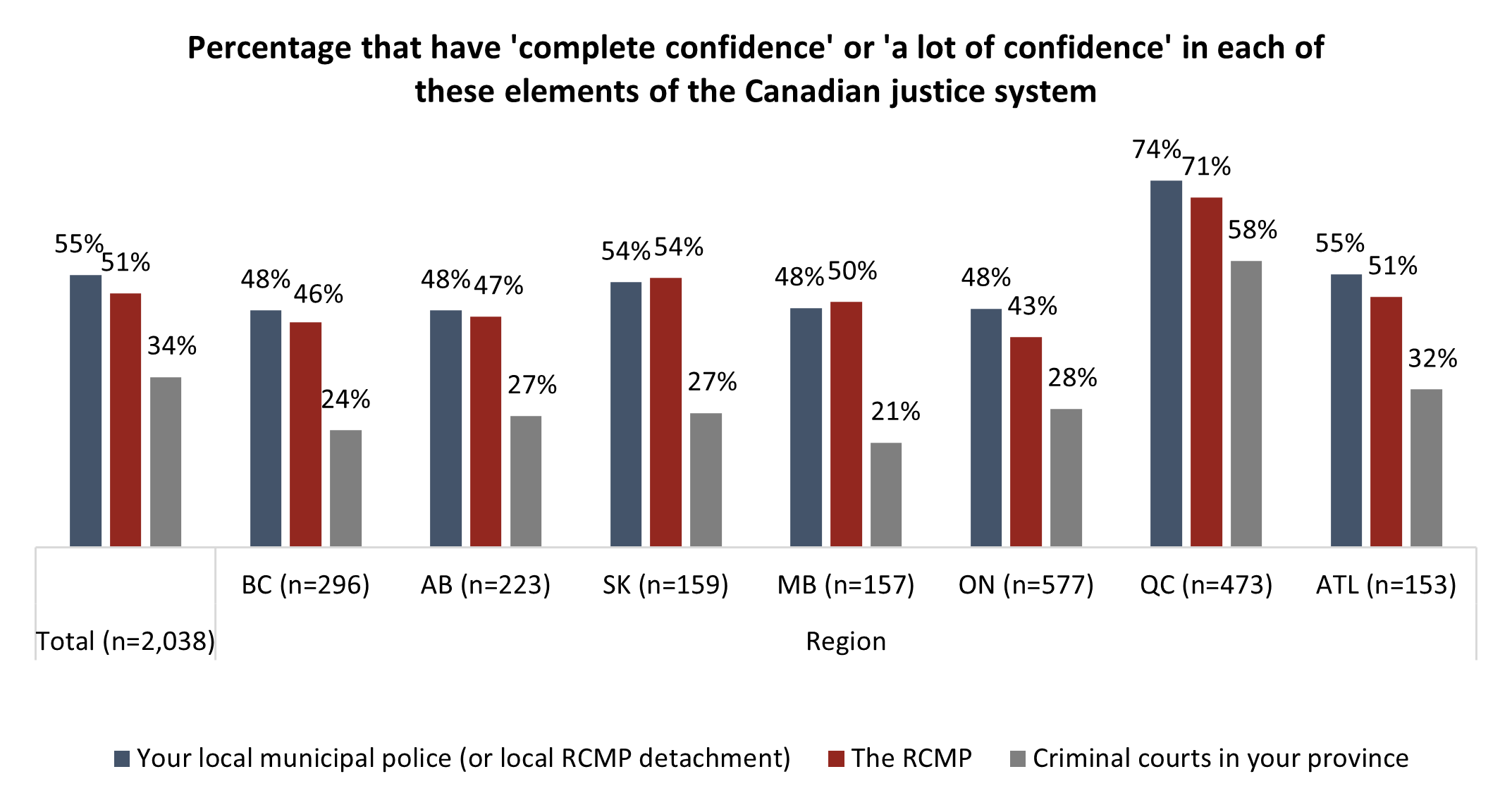
Regionally, Quebec shows much higher levels of confidence in elements of the justice system and is the only province wherein a majority have confidence in the criminal courts, just as ARI found in 2022.
Part Two: Perceived causes of crime
The first release in this series found that 62 per cent of Canadians felt that crime in their communities had been increasing over the past five years. That number represents a 32-point jump compared to 2024. The natural follow-up question for those concerned about this perceived increase is “why”?
Major factors – Addiction, poverty, mental illness, lenient justice system
Asked for their views on these issues, this large group of Canadians point to several key factors. The two aspects of this discussion most likely to be identified as increasing crime are a justice system that they say is too lenient (73%) and drug use or addiction (72%). The latter issue intertwines with another – homelessness and poverty – to establish a triumvirate of primary perceived causes. In terms of property crimes and shoplifting, there has been a suggestion from police in recent years that drug use and financial desperation have led to an increase in each.
Pressure from politicians – including Conservative Party leader Pierre Poilievre – and many police officials, has increased the focus on Canada’s bail system and what some called justice system leniency. Others disagree and point to myriad other issues of chronic underfunding and poor management for the current state of things, and say focusing on so-called “catch-and-release” issues is inaccurate.
What is less likely to be perceived as a major issue is understaffing of police, which is reportedly a major issue across the country.
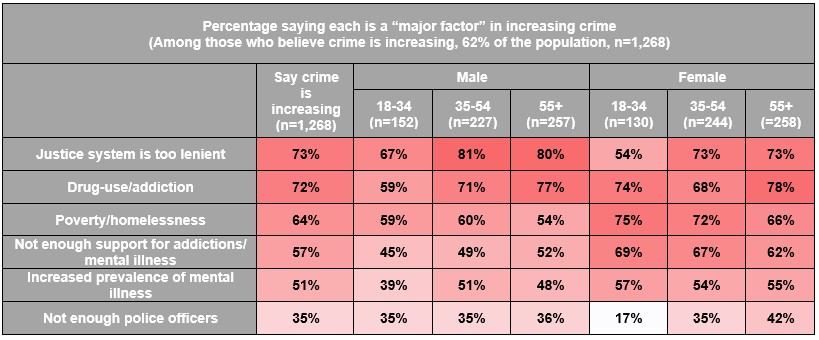
Generationally and across gender, there are differing perspectives on causes on increased crime. Women of all ages are much more likely than men to say that a lack of support for mental illness is a major factor, while men are more likely to see justice system leniency in this way.
Politically, there is a 33-point gap between Conservatives (89%) and Liberals (56%) when it comes to justice system leniency causing more crime. Liberal voters are much more likely (71% to 56%) to see poverty as causing this:
Part Three: Sentencing and social considerations
The Liberal government announced a series of changes in 2025 through the Bail and Sentencing Reform Act (Bill C-14). This law seeks to strengthen bail and sentencing for serious and organized crime, target repeat violent offenders, organized retail theft, and offenses against essential infrastructure. For Canadians, much of this is evidently desired, though many still consider a person’s background and conditions important in considering their sentencing.
Should a person’s economic and social background play major role in sentencing?
According to the Criminal Code of Canada, judges must impose sentences that are “proportionate” to both:
- the seriousness of the offence, and
- the degree of responsibility of the offender
In assessing responsibility, courts may consider personal circumstances, including:
- upbringing and family environment
- trauma or abuse
- poverty or housing instability
- addiction or mental-health challenges
- education and employment history
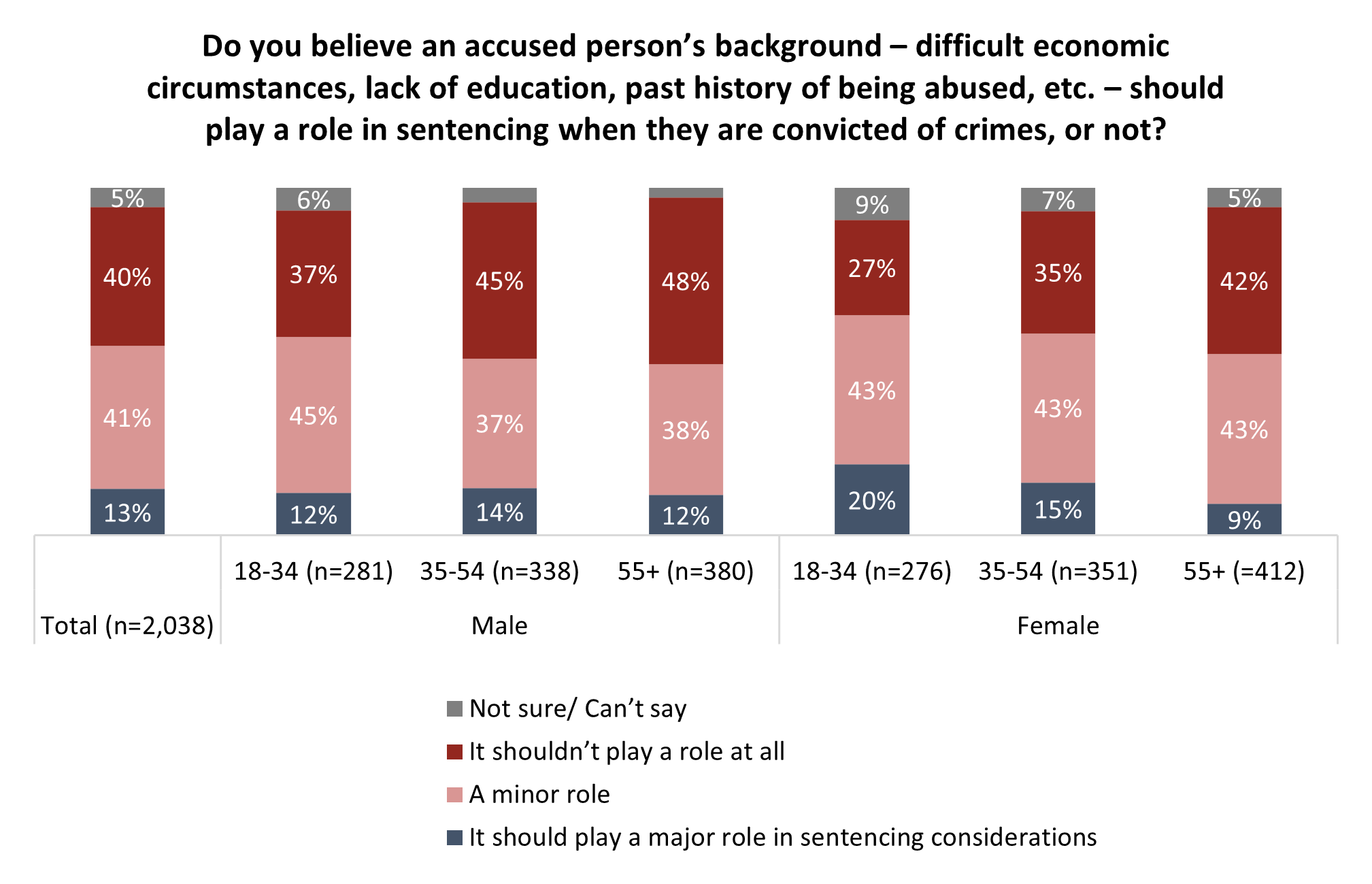
These factors do not excuse criminal behaviour, but they can influence how blameworthy the conduct is and what sentence best serves justice. For many Canadians, this is evidently too lenient. Angus Reid Institute asked whether some of these aspects of an accused person’s background should be considered, and just 13 per cent say they should play a major role in consideration. Equal numbers (two-in-five in each case) say they should be either a minor contributor, or no factor at all. Men of all ages are more likely than their similar-aged women to say there should be no role for these individual factors:
Political differences are prominent on this question. For a majority (62%) of those who supported the Conservatives in the 2025 federal election, the story is mostly black and white. Someone committed a crime and should face punishment. For all other party supporters, some level of consideration of the accused’s background is fair and relevant: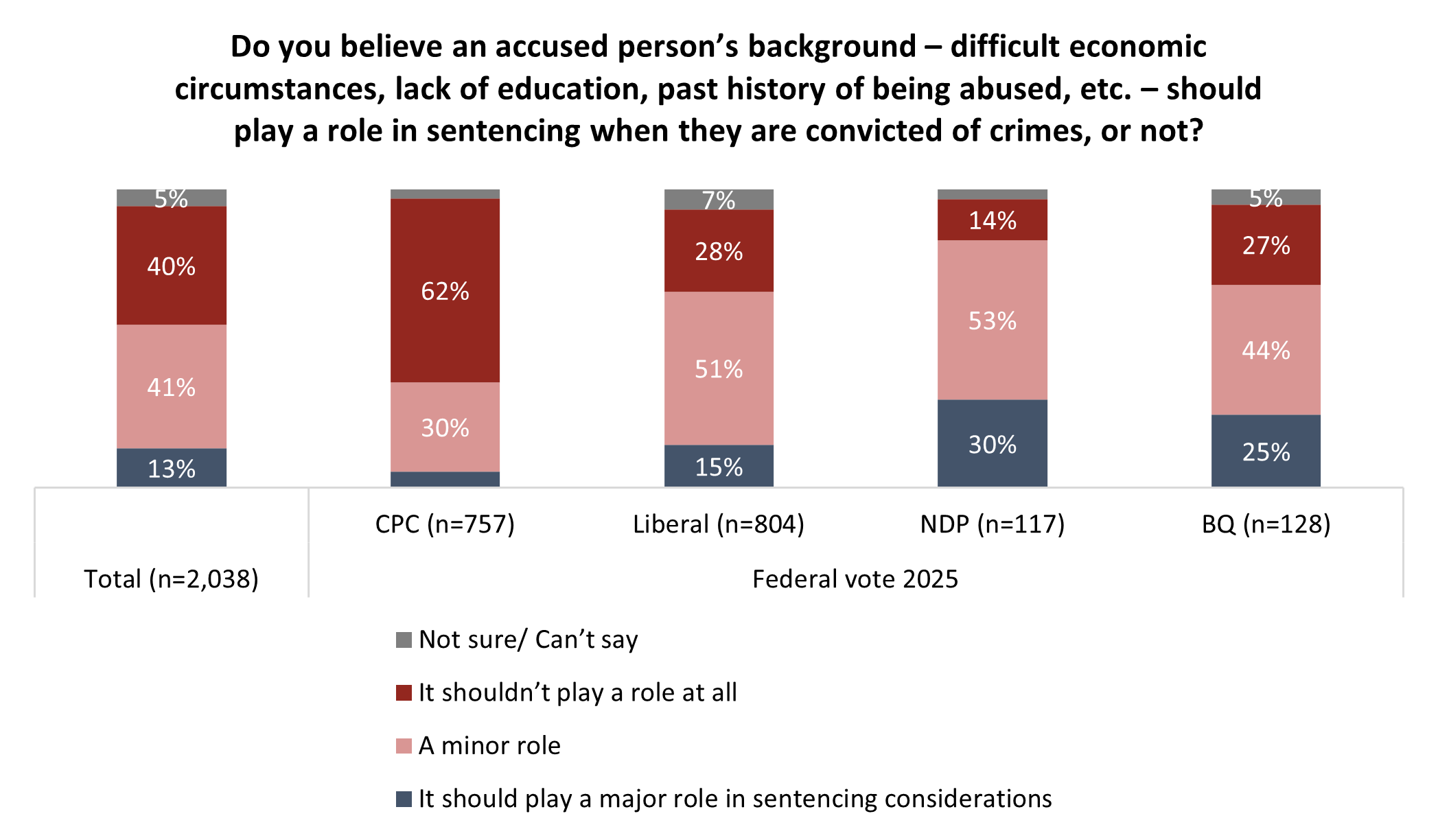
Gladue Principles
For Indigenous offenders, there exists another set of guidelines for the justice system. The Gladue Principles were established through a Supreme Court case in 1999 to consider the systemic and historical factors that have contributed to Indigenous People’s involvement with the criminal justice system and to explore reasonable, culturally appropriate alternatives to incarceration.
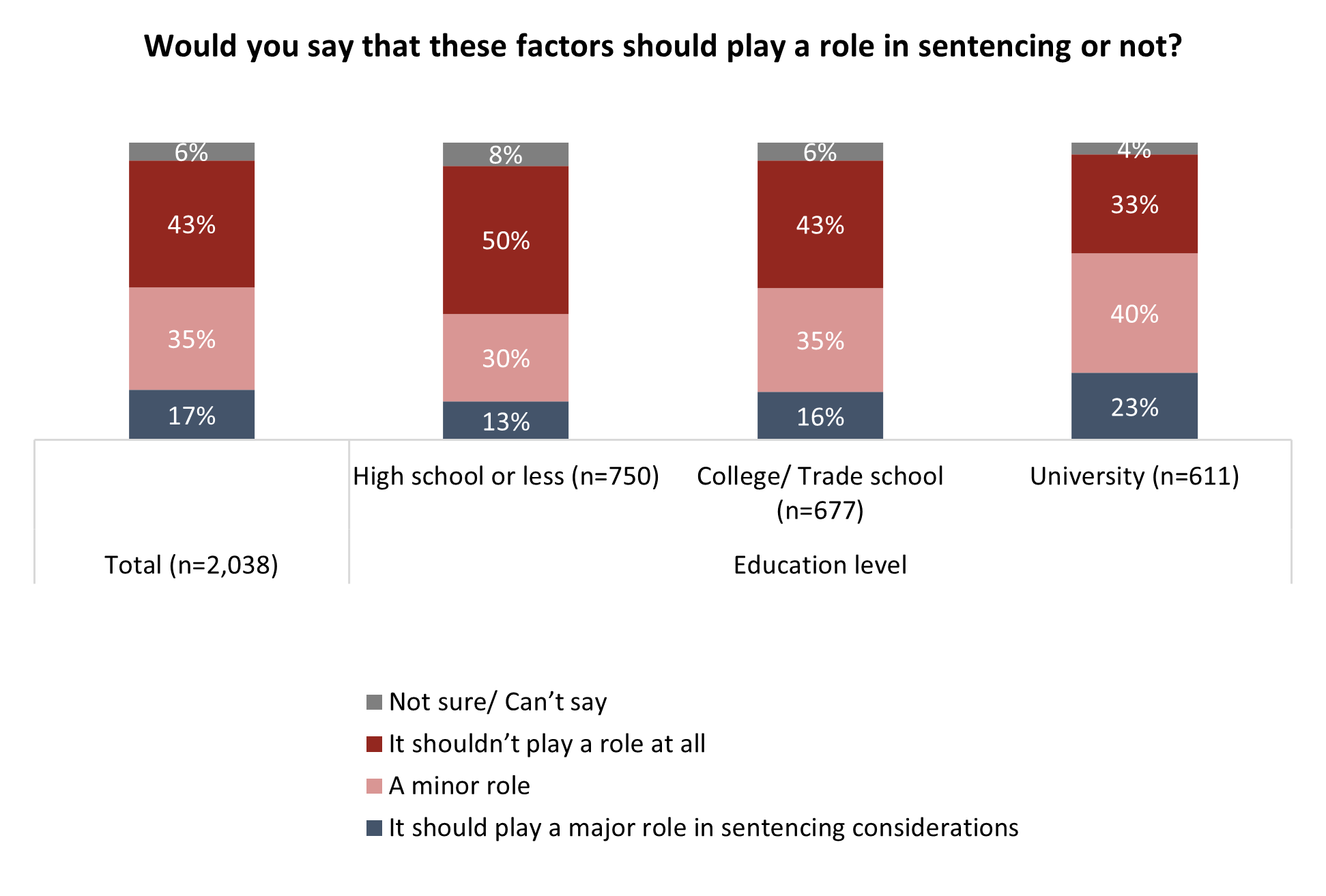
Asked whether some of these factors – if a person has been impacted by various factors related to the legacy of colonialism, racism, foster care, abuse, poverty, Residential School, etc. – should be applied to Indigenous sentencing, a similar number disagree totally (43%) as the previous question while a majority (52%) say it should play a role. Notably, education skews these data significantly, as seen in the following graph:
Part Four: Support for policy proposals
Three-in-five say getting tougher on crime is the way to go
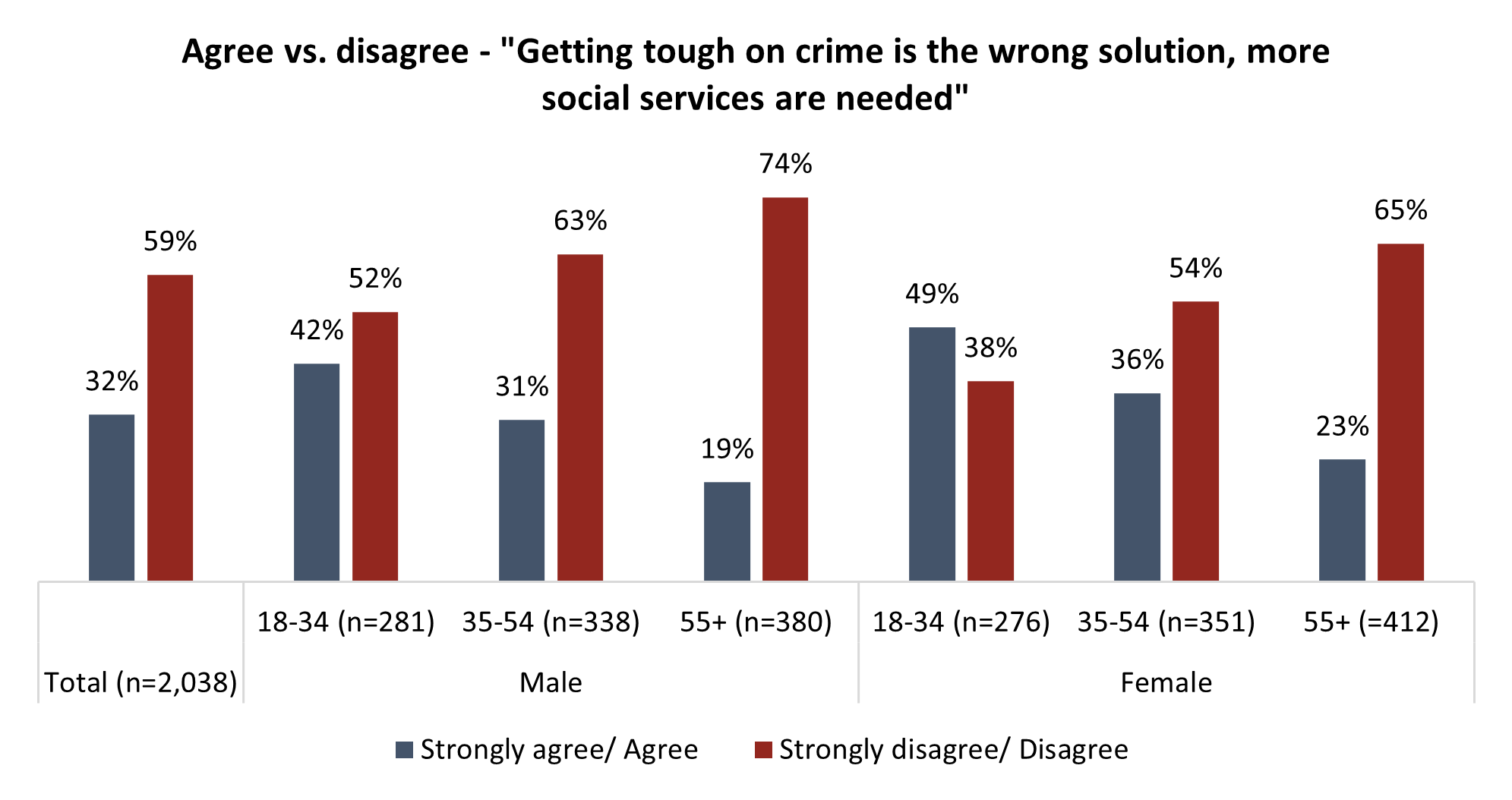
As mentioned, the federal Liberal government is looking to tightening bail and address concerns over repeat offenders with Bill C-14, otherwise known as the Bail and Sentencing Reform Act. The Bill makes changes to the criminal code by making it harder to get bail for “violent and repeat offending” and organized criminals and tougher sentencing for certain crimes. For most (59%), getting tougher on crime is the right path, in a simple faceoff between this and instead focusing more on social service. One-in-three disagree and would focus policy in the other direction (32%), though there are considerable divides based on age and gender in Canada:
Significant support for toughening sentencing, bail, but doubt over efficacy
Some of proposed changes include expanding the application of “reverse onus” bail, the accused must argue for the right to release while on trial; requiring consecutive sentences for multiple convictions; banning conditional sentences for those accused of certain sexual offences; and increasing the penalties for organized retail theft. The latter is a response to the rise of retail theft across the country; previously released data from this series found that a majority of Canadians with experience working in retail believed there has been an increase in shoplifting in recent years.
Related: Perception among current and former retail workers is that crime is increasing
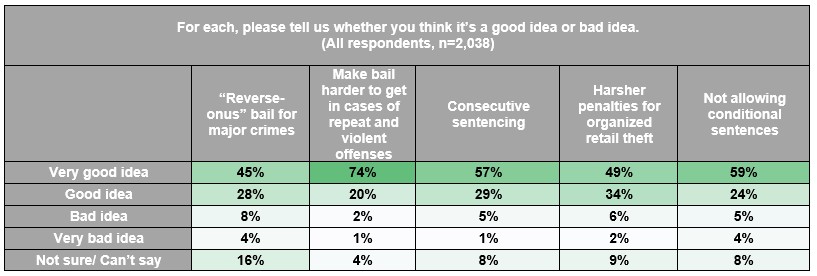
Canadians are largely on board with the suite of changes proposed by Bill C-14, with at least seven-in-10 believing that making bail harder to get for repeat and violent offenders (94%), consecutive sentencing (86%), harsher penalties for organized retail theft (83%), not allowing conditional sentences for certain sex offenders (82%) and expanding reverse-onus bail (72%) are “good ideas”. As one can see in the following table, there are evidently no bad ideas on this front:
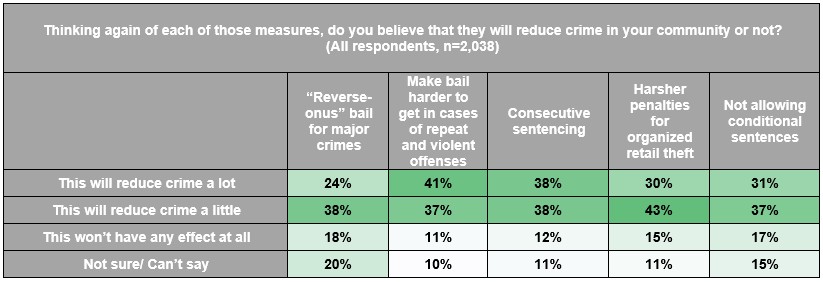
However, there is much doubt that these new policies will have a significant impact on crime. At most, two-in-five believe more restrictive bail for violent offenses (41%) and consecutive sentencing (38%) will reduce crime “a lot”. Three-in-10 say the same for increasing the penalties for organized retail theft (30%) and restricting conditional sentences for those accused of certain sexual offences (31%). One-quarter (24%) believe “reverse-onus” bail for major crimes will reduce crime a lot:
METHODOLOGY:
The Angus Reid Institute conducted an online survey from Nov. 5-7, 2025, among a randomized sample of 2,038 Canadian adults who are members of Angus Reid Forum. The sample was weighted to be representative of adults nationwide according to region, gender, age, household income, and education, based on the Canadian census. For comparison purposes only, a probability sample of this size would carry a margin of error of +/- 2 percentage points, 19 times out of 20. Discrepancies in or between totals are due to rounding. The survey was self-commissioned and paid for by ARI. Detailed tables are found at the end of this release.
For detailed results by age, gender, region, education, and other demographics, click here.
For PDF of full release, click here.
For questionnaire, click here.
MEDIA CONTACT:
Shachi Kurl, President: 604.908.1693 shachi.kurl@angusreid.org @shachikurl
Dave Korzinski, Research Director: 250.899.0821 dave.korzinski@angusreid.org
Jon Roe, Research Associate: 825.437.1147 jon.roe@angusreid.org