

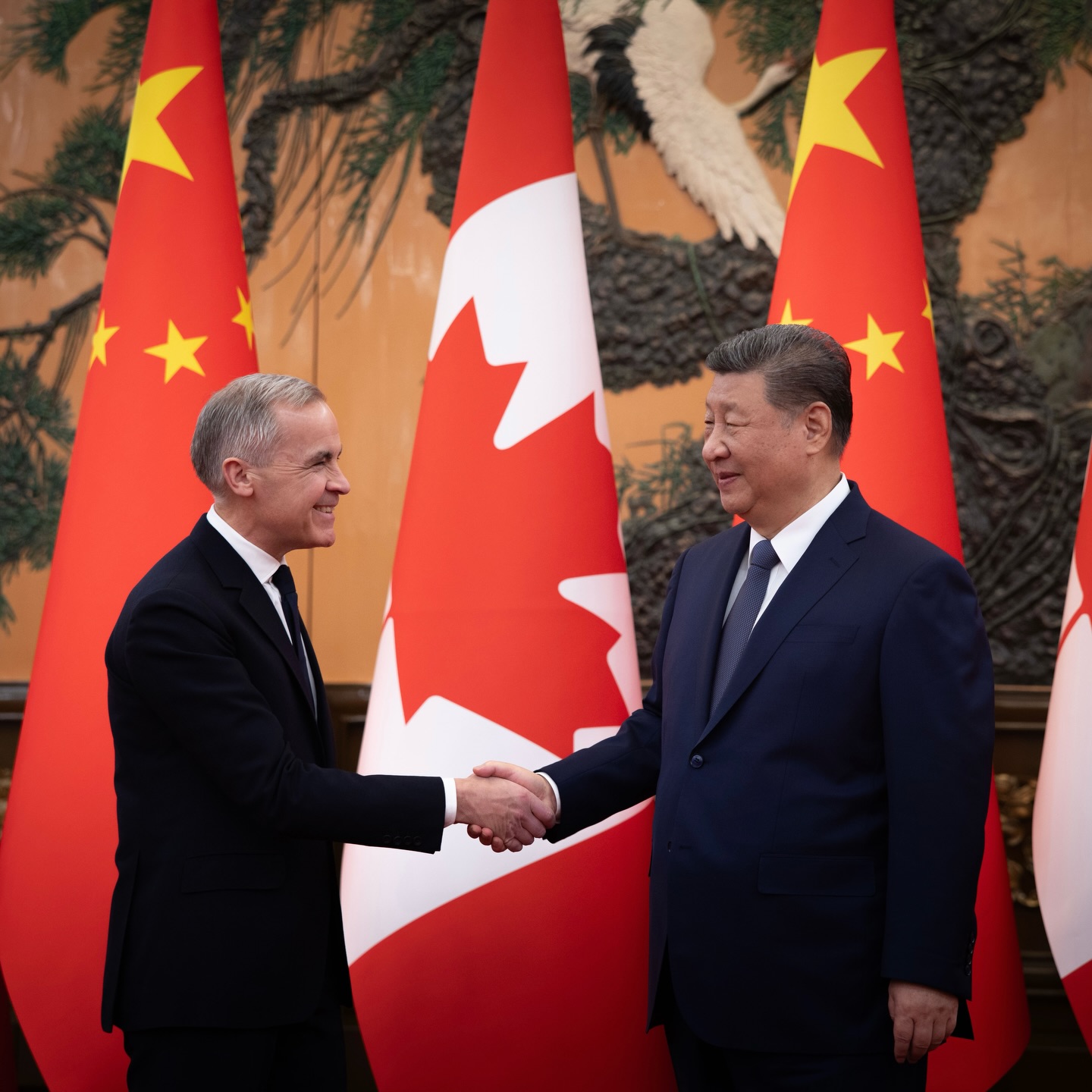
Most view Canada’s recent deal with China as a good one (65%) rather than a bad one (22%)
January 29, 2026 – Political economy isn’t a zero-sum game, but relationships ebb and flow. The best evidence of this in 2026 is Canada’s re-engagement with China as the traditional foundation of economic cooperation with the United States becomes more tenuous.
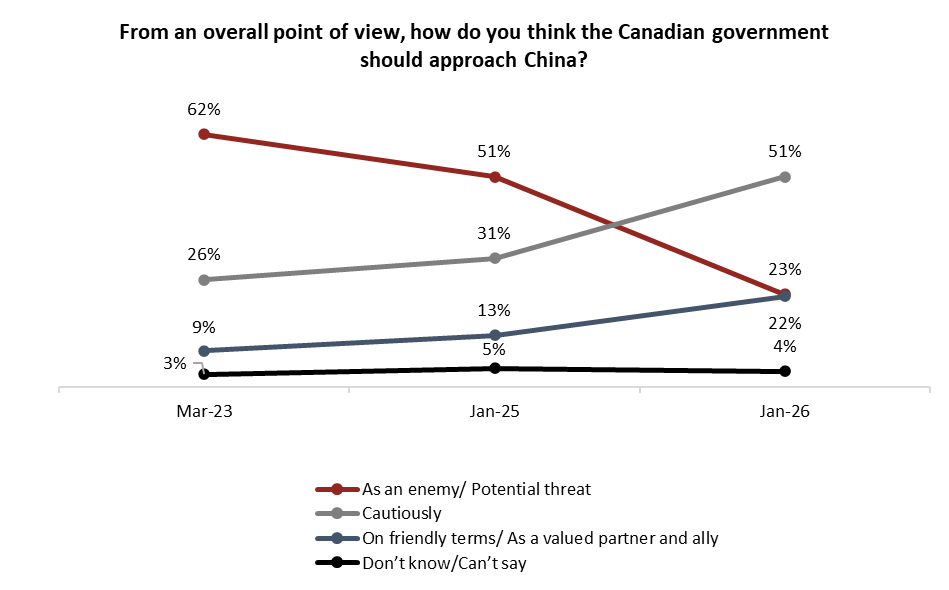
New data from the non-profit Angus Reid Institute finds Canadians, much like their government, more open to economic opportunities with China than they have been in recent years. Consider that the proportion who say China should be treated as an “enemy” or “threat” by Canada has fallen from 62 per cent in 2023 to 23 per cent. This, while the number who say they would approach the relationship with cautious engagement has doubled from 26 to 51 per cent. One-in-five (22%) would engage with China as a friend or ally.
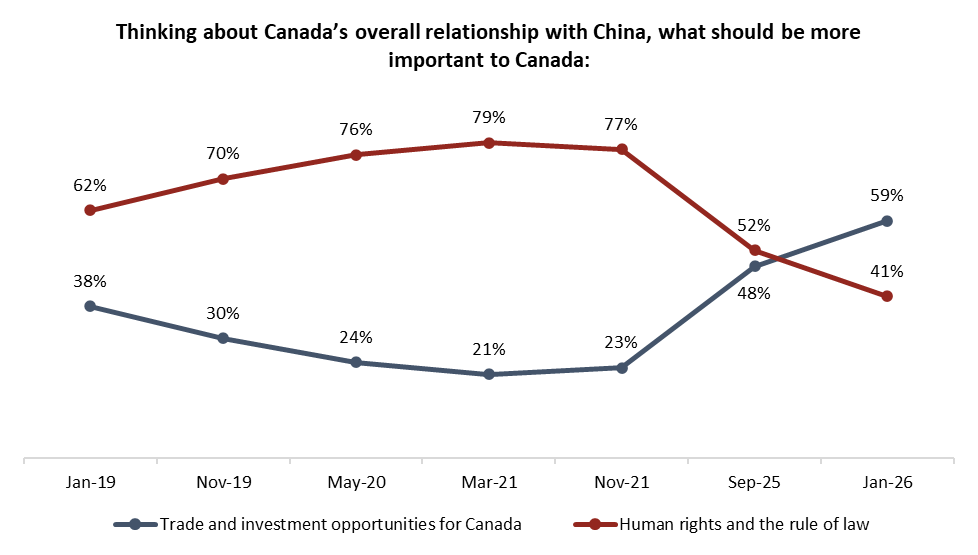
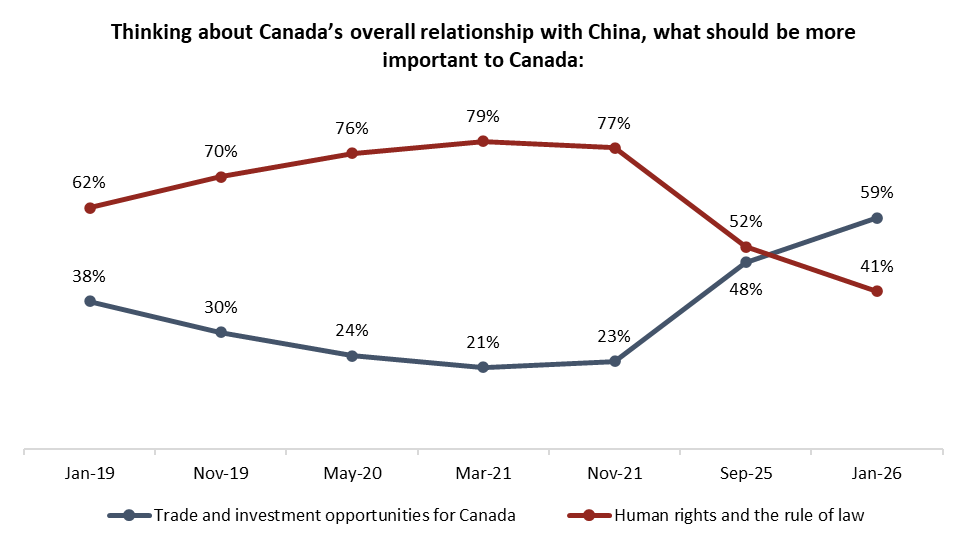
Concerns over China’s history of human rights violations has long coloured Canada’s approach to the country. It took on a renewed focus in during and after the 1,019-day long detention of two Canadians, Michael Kovrig and Michael Spavor. From 2019 to 2022, the vast majority of Canadians said if they had to make a choice between two priorities, they would rather Canada focus on China’s record on human rights and the rule of law rather than pursuing trade and investment opportunities. In 2025, that proportion was divided near evenly, as threats of tariffs from Donald Trump rattled Canadians. Now, after Carney’s trip to China, the first from a PM since 2017, three-in-five (59%) prioritize the economic aspect of this equation.
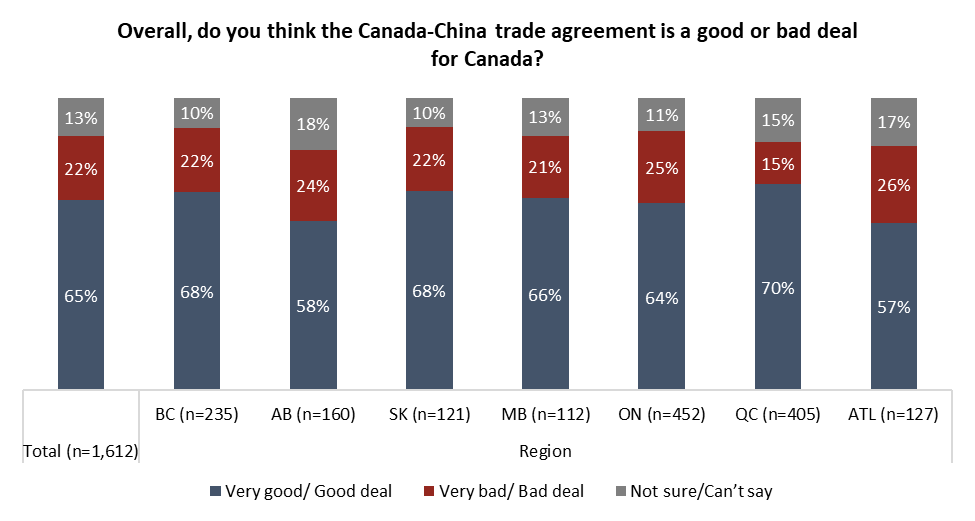
As for the deal signed by Carney, which saw Canada reduce tariffs on Chinese electric vehicles and increase the allowable import of these vehicles to 49,000 in exchange for reduced Chinese tariffs on many Canadian agricultural products, three-times as many Canadians call it a good one (65%) than a bad one (22%), with the potentially most affected provinces Saskatchewan and Ontario largely agreeing.
More Key Findings:
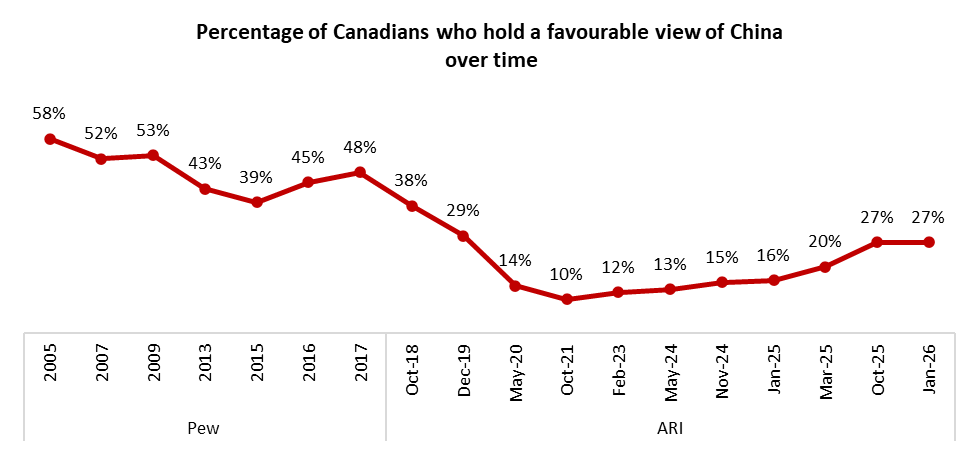
- Canadians’ favourability of China has risen 11 points compared to last January, from 16 to 27 per cent. There has been no change in favourability since October, however, suggesting this recent trip to China did not impact Canadians’ views.
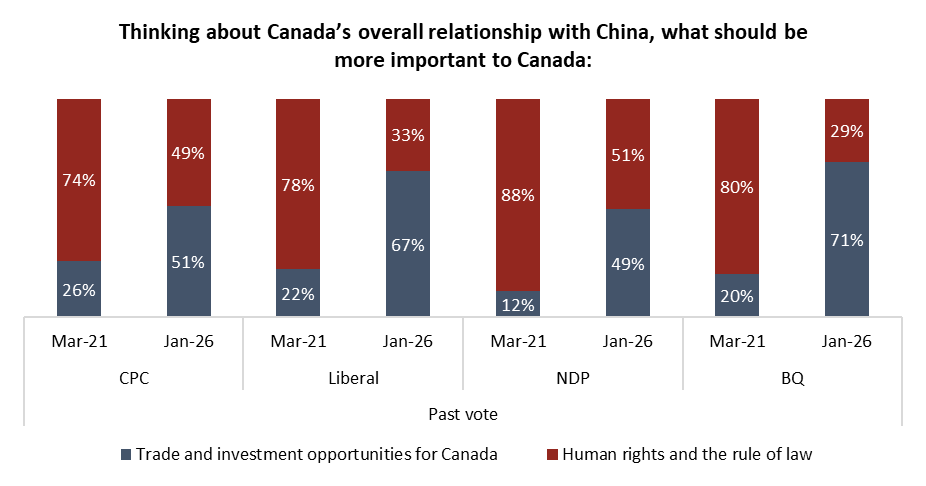
- In March 2021, no more than 26 per cent of CPC, Liberals, NDP, or Bloc Québécois voters said that they prioritised trade and investment over human rights and the rule of law. Now, no fewer than 49 per cent among all groups hold this view.
INDEX
Part One: Views of China
-
Favourability holds at 27 per cent
-
Canadians more open to ‘cautious’ partnership
Part Two: Human rights vs. trade and investment
Part Three: EV deal gets a thumbs up
Part One: Views of China
Favourability holds at 27 per cent
Prime Minister Mark Carney’s trip to Beijing to meet with Chinese President Xi Jinping was a further step towards the warmth of what had been a chilly relationship between the two leaders’ countries for many years. Carney became the first Canadian prime minister to visit China since his predecessor Justin Trudeau in 2017. The Huawei-Meng Wanzhou-Kovrig-Spavor interconnected events brought relations to a standstill, while tariffs became more common than economic cooperation and allegations flew in Canada of interference by Beijing in Canadian elections.
Related: The Angus Reid Institute archive on China
In October 2021, Canadian views of China hit rock bottom. Just one-in-ten (10%) said they had a favourable view of the country, the valley of a steady decline from the 58 per cent who said the same in 2005.
The last two years has seen both an official warming from the Canadian government, and a softening view of China from Canadians themselves, perhaps not unsurprisingly coinciding with the economic uncertainty brought on by the return of U.S. President Donald Trump to the White House.
Currently, one-quarter (27%) view China favourably, tying a high seen in ARI tracking dating back to May 2020:
Canadians more open to ‘cautious’ partnership
The favourability marker perhaps undersells that softening view from Canadians. As recently as a year ago, half (51%) of Canadians believed their government should approach China as an enemy or potential threat to Canada, outnumbering those who wanted a cautious (31%) or friendly approach (13%) instead. The events of the past year have shifted Canadians perceptions clearly. Now the proportion of those who prefer a hostile stance from their government (23%) is on par with those who would prefer a friendly one (22%) while general caution towards China is the prevailing sentiment (51%):
Part Two: Human rights vs. trade and investment
Concerns over human rights and the rule of law in China have often overshadowed any potential economic partnership. For most of the past seven years, Canadians have been much more likely to prioritize those concerns than trade opportunities for their own country. At one point, by a four-to-one margin, Canadians were more likely to say human rights concerns (79%) should be more important to Canada’s relationship with China than economic ones (21%).
For the first time in ARI tracking, more Canadians believe trade and investment opportunities should take the priority (59%) than issues over human rights (41%):
The calculus has shifted evidently across the political spectrum, no matter which group one analyses. Consider that in March 2021, no more than 26 per cent of party supporters among the CPC, Liberals, NDP, or Bloc Québécois said that they prioritised trade and investment over human rights and the rule of law. Now, no fewer than 49 per cent hold this view. New Democrats are most divided, with that 49 per cent proportion balanced against 51 per cent who would favour championing human rights:
Part Three: EV deal gets a thumbs up
Carney’s latest social-media based lashing at the hands of Trump centred on Canada’s relationship with China. Trump stated that if Canada struck a deal (meaning, after some digging, a free trade agreement) with China, this country would face a 100 per cent tariff from the U.S. on Canadian goods. Canada is not seeking a free trade deal with China.
What Carney did bring home was a shifting of tariffs on electric vehicles and agricultural products.
Carney announced an agreement for Canada to allow 49,000 electric vehicles made in China into the country each year at a tariff rate of about six per cent, far lower than the previous 100 per cent tariff. In return China will lower tariffs on Canadian agricultural exports of canola seed to 15 per cent from 84 per cent and remove tariffs on canola meal and peas, previously set at 100 per cent; and on crabs and lobsters, previously set at 25 per cent.
Canadians were asked how they feel about this deal, with three-times as many saying it’s a good one rather than a bad one:
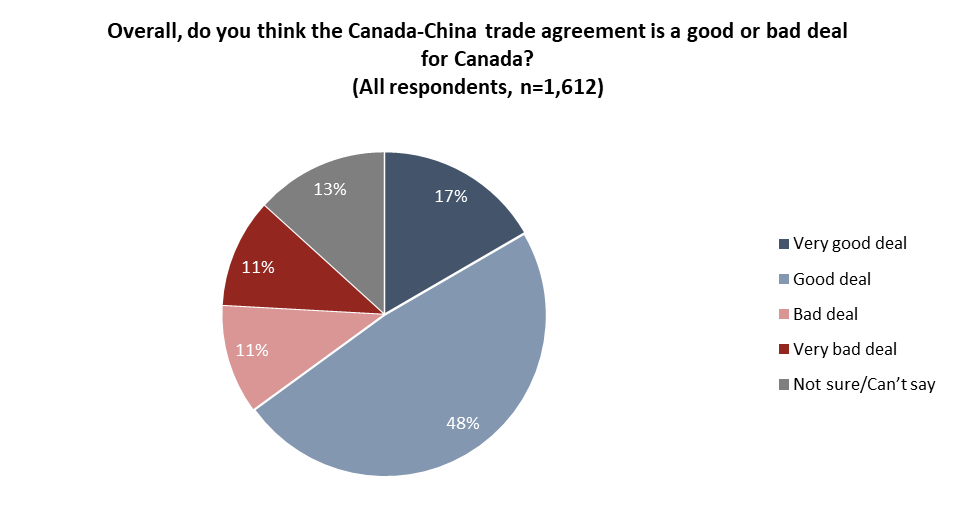
Perspectives are not widely divergent by region, though provincial leaders have responded to the deal differently. Ontario Premier Doug Ford was initially upset with the announcement, which will affect the automotive industry in his province, though has since met with Carney to mend any perceived rift. Meantime, Saskatchewan Premier Scott Moe praised the deal, which will help to boost agriculture in his province:
Survey Methodology:
The Angus Reid Institute conducted an online survey from Jan. 23 – 27, 2026, among a randomized sample of 1,612 Canadian adults who are members of Angus Reid Forum. The sample was weighted to be representative of adults nationwide according to region, gender, age, household income, and education, based on the Canadian census. For comparison purposes only, a probability sample of this size would carry a margin of error of +/- 2 percentage points, 19 times out of 20. Discrepancies in or between totals are due to rounding. The survey was self-commissioned and paid for by ARI.
For detailed results by age, gender, region, education, and other demographics, click here.
For PDF of full release, click here.
For the questionnaire, click here.
MEDIA CONTACT:
Shachi Kurl, President: 604.908.1693 shachi.kurl@angusreid.org @shachikurl
Dave Korzinski, Research Director: 250.899.0821 dave.korzinski@angusreid.org
Jon Roe, Senior Research Associate: 825.437.1147 jon.roe@angusreid.org