


Past CPC voters drive growing sentiment that Canada is doing “too much” to assist Ukraine
February 6, 2024 – February 24 will mark two years of bloody and devastating war initiated by Russia’s invasion of Ukraine in 2022.
As both sides continue to hunker down in the reportedly static conflict, new data from the non-profit Angus Reid Institute find that Canadians have shifted their gaze away from the region, and the number saying Canada has offered “too much support” has doubled since the early weeks of the war.
One-quarter (25%) of Canadians believe their country is doing too much to assist Ukraine in its fight against the Russian invasion, up from 13 per cent who said the same in May 2022. During the same interval, the number who say Canada is not doing enough has halved (38% to 19%).
One group is driving the bulk of this sentiment – Conservative voters. The number of 2021 CPC voters who say Canada has done too much for Ukraine has more than doubled from 19 to 43 per cent between May 2022 and now. And while there has been an increase in both past Liberal and New Democrat voters holding this view as well, their proportion respectively has risen closer to one-in-ten.
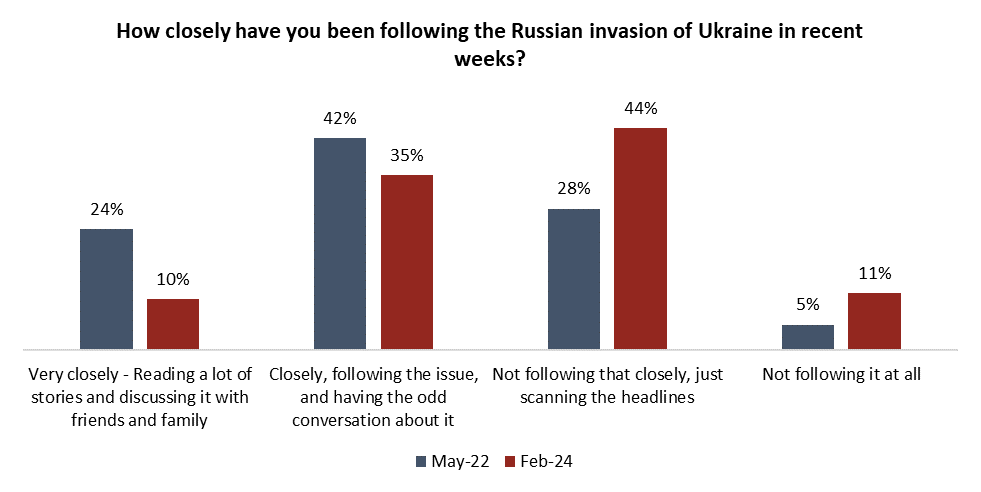
The number of Canadians following news of the conflict closely has dropped from 66 to 45 per cent in that same period – a trend that holds for Canadians of all ages and political stripes.
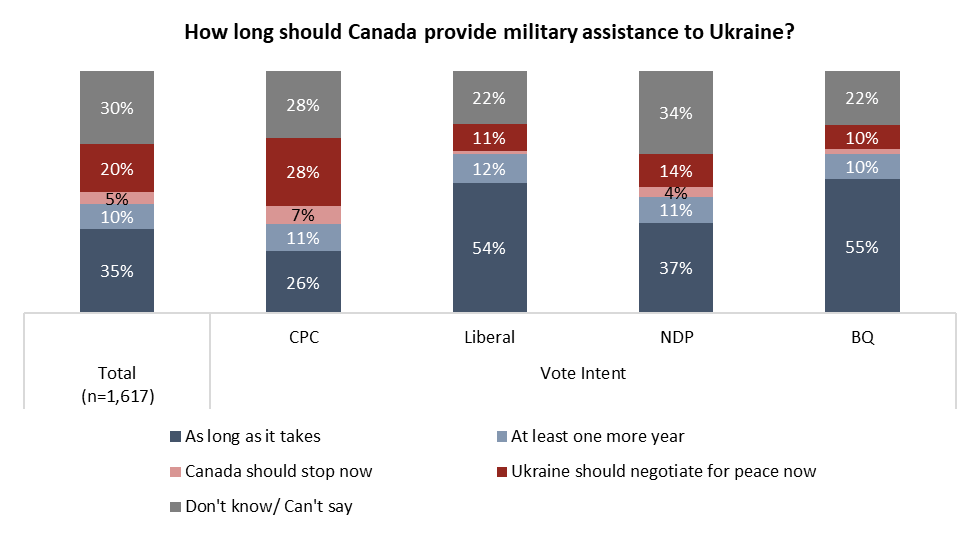
Much of this leads to questions about the future and what role Canada should play. One-third (35%) say Canada should support Ukraine “as long as it takes” and one-in-ten (10%) believe it should only continue for one more year. The rest of Canadians are uncertain (30%), believe the war should end now with a negotiation for peace initiated by Ukraine (20%) or want Canada to end its support (5%).
As the war drags on, few see Ukraine’s situation as futile despite Russia’s superior military force and economic might. Just one-in-five (19%) say supporting Ukraine is a “waste of money” because the country’s situation is “hopeless”. In fact, a majority (62%) believe the war will end with Ukrainian victory, though few Canadians (12%) believe it will have reclaimed all its territory at the end of it.
This is perhaps sustaining belief that the right move for Ukraine is to keep fighting the war. At the one-year anniversary of the war, a majority of Canadians (55%) believed it was not time for peace and Ukraine should keep fighting. A similar majority say the same today.

More Key Findings:
- On average, Canadians see the CPC voting against the Canada-Ukraine free trade deal in November as a net negative for Canada’s worldwide reputation and for trust in a potential CPC government to stand up for Canada’s allies. Likely Conservative voters are more likely to see blocking the deal as a positive on both fronts.
- Those who intend to vote Conservative if an election were held soon are half as likely (26%) to want Canada to provide military support to Ukraine for “as long as it takes” as Liberal (54%) or Bloc Québécois (55%) supporters.
- A majority of Canadians (57%) believe Canada has completely or mostly fulfilled its promises to Ukraine. Those who are following the war closest are the most likely to disagree at one-in-five (22%).
About ARI
The Angus Reid Institute (ARI) was founded in October 2014 by pollster and sociologist, Dr. Angus Reid. ARI is a national, not-for-profit, non-partisan public opinion research foundation established to advance education by commissioning, conducting and disseminating to the public accessible and impartial statistical data, research and policy analysis on economics, political science, philanthropy, public administration, domestic and international affairs and other socio-economic issues of importance to Canada and its world.
INDEX
Part One: Ongoing war, waning attention
Part Two: Canada first? Examining hardening Conservative opposition
-
‘Axe the tax’? Domestic politics vs. international reputation
Part Three: What should Canada do going forward?
-
Obligations fulfilled?
-
Support for all types of assistance falling
-
Majority want Ukraine to keep up fight, but how long do they want Canada to aid?
Part One: Ongoing war, waning attention
The second anniversary of Russia’s invasion of Ukraine approaches. The conflict has cost thousands of soldiers’ lives on both sides and the lives of more than 10,000 Ukrainian civilians. The frontline of the war has barely moved in recent months, though both Ukrainian President Volodymyr Zelenskyy and Kremlin officials have denied that the conflict is stalemated. Russia’s initial invasion had reached as far as Ukraine’s capital Kyiv, but since then Ukraine has pushed back Russian forces to the south and east of the country, where the frontline has largely remained despite months of war.
As the war has dragged on, Canadian focus has declined significantly from the ramp up to and immediate aftermath of the attack. In May 2022, two-thirds said they were following the war closely. Fewer than half (45%) say the same now:
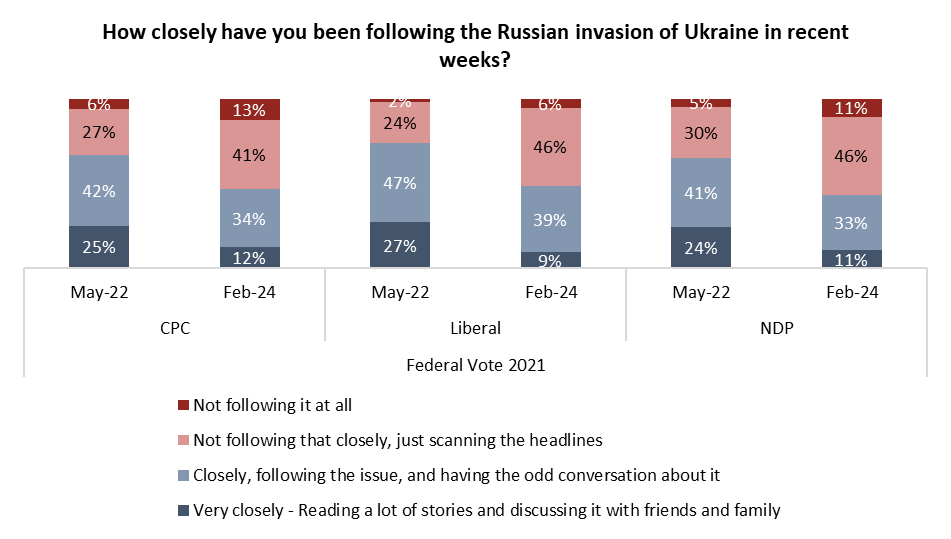
This decline in attention is shown across the political spectrum. Majorities of past voters of the three largest political parties said they were paying close attention to the Russian invasion of Ukraine in May 2022. Half of past CPC (47%) and Liberal (49%) voters, and two-in-five (43%) past NDP voters say the same now. It is worth noting that one-in-eight of both 2021 Conservative (13%) and NDP (11%) voters now say they are not following the war “at all”:
Part Two: Canada first? Examining hardening Conservative opposition
Canada has supplied $2.4 billion in military donations of equipment, vehicles, ammunition and weapons, as well as a $4.85 billion loan to the Ukrainian government. It has also provided more than $500 million in humanitarian, development and security assistance. As the pledged assistance has accumulated over the course of the war, there has been a growing sense among Canadians that Canada has done its fair share. In the nearly two years since the Angus Reid Institute first asked this question, the proportion of Canadians who believe Canada was providing too much has doubled while the Canadians asking for more for Ukraine has halved:

However, this objection to Canadian support of Ukraine is not evenly distributed on the political spectrum. The Conservative Party of Canada and leader Pierre Poilievre were criticized for not supporting Ukraine after the party voted against a free trade agreement between Canada and the Ukraine because of a clause related to promoting carbon pricing. More on that later in the release. Poilievre has said he and the party support Ukraine, and he recently called for the donation of a stockpile of thousands of aging rockets that the Canadian Armed Forces had slated for disposal.
Despite these words of support, the party’s followers have grown much more vocal in their belief that Canada has done too much for Ukraine. Though those who say Canada is offering “too much support” to Ukraine has doubled among 2021 NDP, Liberal and CPC voters, the increase is from 19 per cent to 43 per cent for those who voted CPC in 2021, and from five per cent to 10 per cent for past Liberal voters and 12 per cent for past NDP voters:

The sentiment that Canada is doing too much is also more common among Liberal leavers – those who voted Liberal in 2021 but don’t intend to vote for the party currently. One-quarter (25%) in that group say Canada’s done more than enough to assist Ukraine, eight times the number of those who have stuck with the party (3%, see detailed tables).
‘Axe the tax’? Domestic politics vs. international reputation
The Conservative base’s growing resistance to supporting Ukraine has coincided with the questions and speculation surrounding the party, and leader’s, official position on the war. In November, the CPC voted against an update to Canada’s free trade agreement with Ukraine, ostensibly due to language about cooperation between the two countries on carbon pricing. Ukraine has had a carbon tax since 2011 and the language in the free trade agreement was not binding. In the wake of the vote, Poilievre has insisted the Conservatives support Ukraine in its efforts to fight the Russian invasion, but he and the party have been heavily criticized for voting against the agreement. The League of Ukrainian Canadians accused the party of supporting Russian president Vladimir Putin. Prime Minister Justin Trudeau said Poilievre was voting “to appease Putin apologists”.
By a three-to-one ratio, Canadians believe the CPC vote against the Canada-Ukraine free trade agreement will have a more negative than positive effect on Canada’s reputation on the world stage. Half of likely CPC voters believe there will be no effect at all.
Meanwhile, likely CPC voters are more likely to see voting against the free trade agreement as boosting trust in a potential Conservative government to stand up for Canada’s allies. Majorities of likely Liberal and NDP voters see blocking the trade bill as a net negative on this front for a potential future CPC government:

Part Three: What should Canada do going forward?
Obligations fulfilled?
It has been two years of promises from Canada to Ukraine and largely, Canadians feel Ottawa has followed through. Only one-in-ten believe Canada has missed the mark, a figure that grows the more closely a respondent is paying attention. There is at least one glaring box that has not been checked off from Canada’s laundry list of military donations: a $406-million air defence system that Canada promised to buy from the U.S. for Ukraine more than a year ago. Canada paid for it in March 2023, but the timeline for delivery is still unknown. This unfulfilled promise has become more pressing as the war has stalemated and increasingly fought through missile barrages and air strikes.

Support for all types of assistance falling
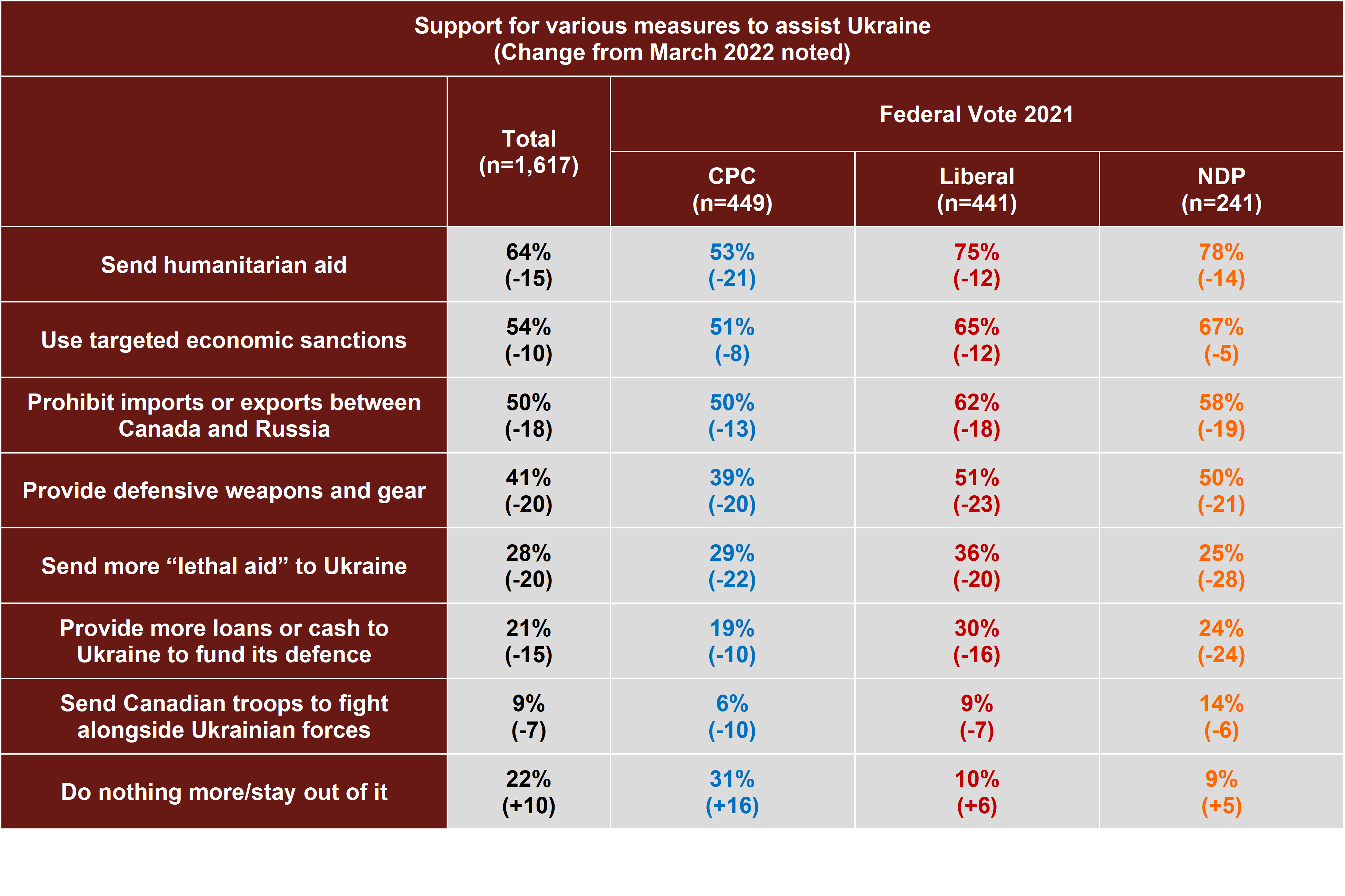
Canadians’ appetite for all forms of specific support of Ukraine has fallen. The war began with many shows of unity – Canadian landmarks were lit up in blue and yellow of the Ukrainian flag. In May 2022, half of Canadians said they had shown support in some way either by posting on social media, donating money, attending a rally or helping a refugee family.
This coincided with majority-level support for Canada to provide defensive weapons and gear, targeted and broad-based economic sanctions, and humanitarian aid. Now, only the latter two are supported by a majority. Support for providing “lethal aid” has fallen by 20 points to three-in-ten (28%). Two years ago, only one-in-eight (12%) said Canada should stay out of the war. That figure has risen to one-in-five (22%).
Support has fallen across the political spectrum, but past CPC voters are the most likely to believe Canada should stay out of the war now at three-in-ten (31%), a 16-point increase from March 2022. It is worth noting that 2021 Conservative voters were less supportive of all measures even at the beginning of the war, however:
Majority want Ukraine to keep up fight, but how long do they want Canada to aid?
Canadians’ beliefs as to how long Ukraine should continue fighting have remained consistent over the past year. One-in-five (20%) believe it should negotiate for peace now even if it means giving up their territory. Similar sized groups believe it should fight until it reclaims territory Russia invaded in 2022 (26%) and Ukraine should continue fighting until it drives Russia from Crimea (29%), which was taken over in 2014. Taken together, a majority (55%) of Canadians believe now is not the time to negotiate peace, equal to the number who said the same last year.
This question provides another example of the political delineation on the Ukraine issue. Likely CPC voters are the most likely to believe Ukraine should end the war and accept peace with Russia at the cost of lost territory at three-in-ten (28%). They are also the only group of party supporters to believe Ukraine should keep up the fight at less than a majority level:

Canadians don’t see Ukraine’s situation as futile – two-thirds (65%) disagree that supporting the country “is a waste of money because the country’s situation is hopeless”. In fact, a majority (63%) believe Ukraine will ultimately win the war, though most believe they will not reclaim all its previous territory (see detailed tables).
But again, it is Conservatives who express the most doubt. Three-in-ten likely Conservative voters (31%) believe Canada’s support is useless: 
Canadians’ resolve for their government to continue supporting Ukraine is declining over time, however. In February 2023, two-in-five (39%) Canadians believed the government should provide military assistance for “as long as it takes” – the language used by Trudeau when Zelenskyy spoke in parliament in Sept. 2023. Now, 35 per cent say the same. This has coincided with growing uncertainty (26% don’t know to 30%) and an increase in those who feel Ukraine should keep fighting, but Canada’s support should stop (2% to 5%):
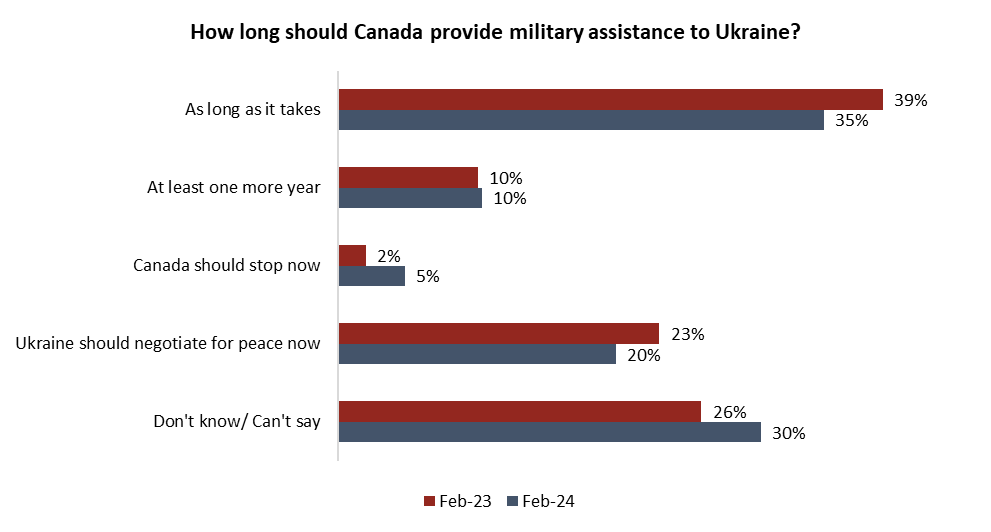
Conservative supporters are the least enthusiastic about indefinite Canadian military assistance to Ukraine, but likely NDP voters aren’t eager either. Majorities of Liberal and Bloc voters believe Canada should provide military support to Ukraine for “as long as it takes”.
Survey Methodology:
The Angus Reid Institute conducted an online survey from Jan. 29 – Jan. 31, 2024 among a representative randomized sample of 1,617 Canadian adults who are members of Angus Reid Forum. For comparison purposes only, a probability sample of this size would carry a margin of error of +/- 2 percentage points, 19 times out of 20. Discrepancies in or between totals are due to rounding. The survey was self-commissioned and paid for by ARI.
For detailed results by age, gender, region, education, and other demographics, click here.
For detailed results by attention paid to the Ukraine-Russia war, click here.
For a PDF of the full report, including detailed tables and methodology, click here.
To read the questionnaire, click here.
Image – Kedar Gadge/Unsplash
MEDIA CONTACT:
Shachi Kurl, President: shachi.kurl@angusreid.org @shachikurl
Dave Korzinski, Research Director: 250.899.0821 dave.korzinski@angusreid.org @davekorzinski
Jon Roe, Research Associate: 825.437.1147 jon.roe@angusreid.org @thejonroe