


Young adults support giving a year of their life to national service; but it depends on the kind of work
August 11, 2025 – Prime Minister Mark Carney spoke last week in Trenton, Ontario to announce what he called a “generational” increase in pay for members of the Canadian Armed Forces. And while this may bolster an already growing interest in joining the ranks of Canada’s military, which has reached a 10-year high this year, new data from the non-profit Angus Reid Institute find many Canadians evidently willing to serve their country in a number of different forms – even if it’s mandatory.
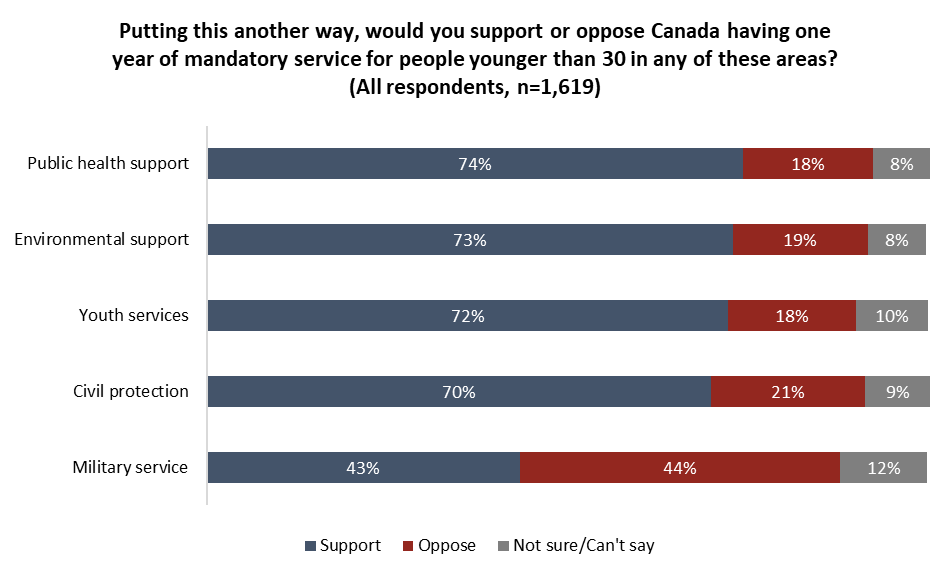
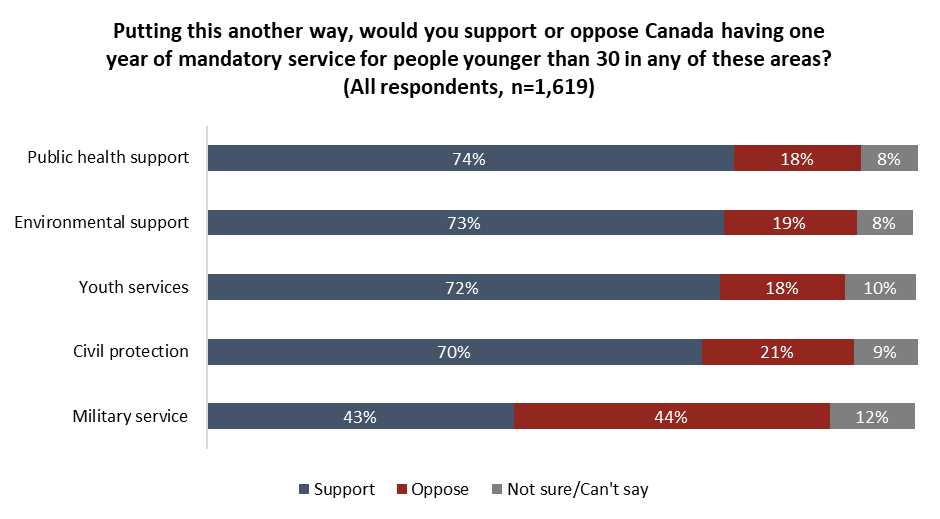
These data find Canadians overwhelmingly supportive of the idea of mandatory civilian service – that is, one year of time donated for those younger than 30 years of age – across a number of fields. This type of model has been utilized in Germany, France, Norway, and other countries in recent years to engage citizens. Whether it’s civil protection, public health support, environmental support or youth services (for definitions, click here), at least seven-in-10 say they would support one year of compulsory time donated.
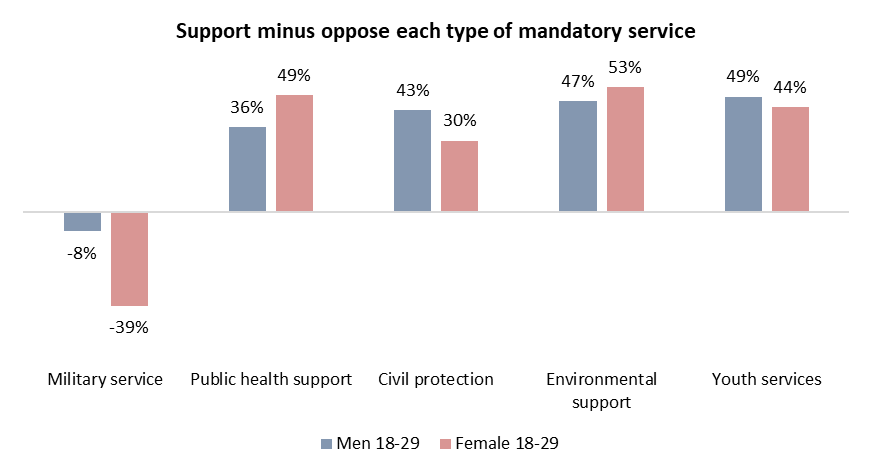
Perhaps most key here are the views of young people between the age of 18 and 29. Comparing support minus opposition across these four broad areas yields a +36 or higher among 18- to 29-year-old men in all four and a +30 or higher among 18- to 29-year-old women across each option. Young women are close to equally likely as young men to support each prospective field of service, aside from civil protection, which would include items like disaster response, emergency management, and firefighting, where their net score dips 13-points lower than men.
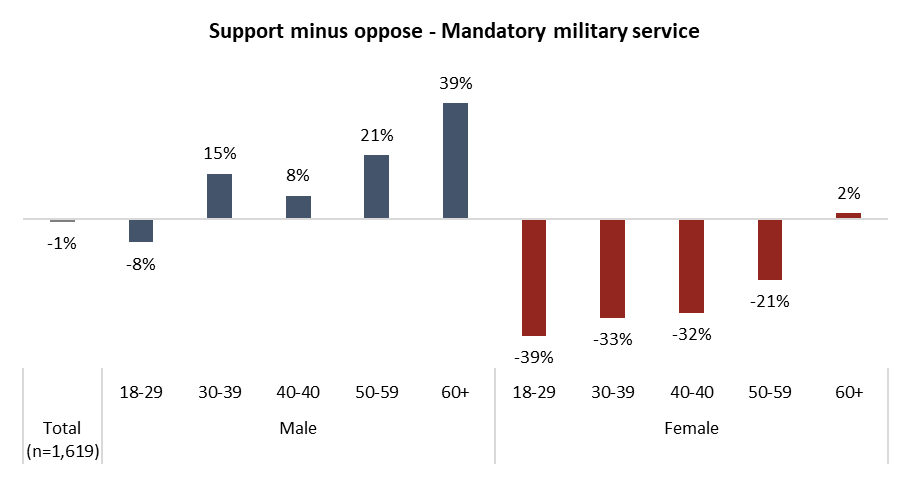
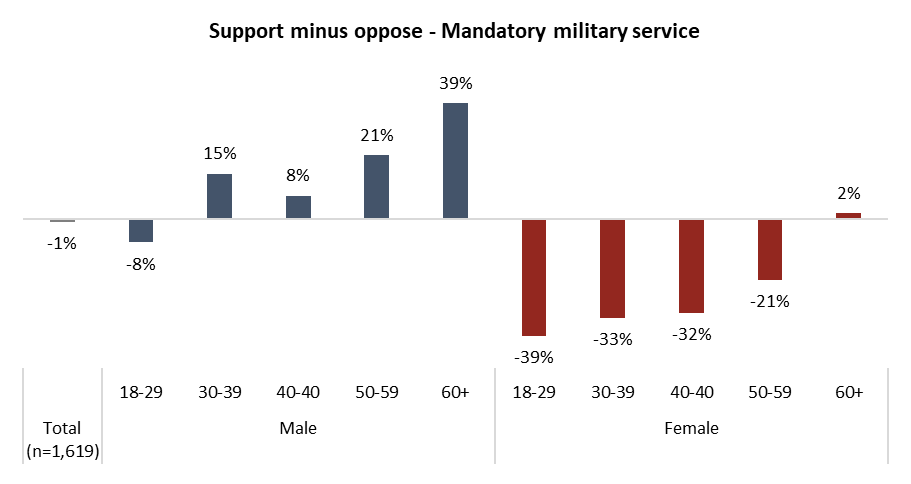
Mandatory military service, however, is much more divisive. Overall, the same number support (43%), as oppose it (44%). Using that same net score approach (support minus opposition) on one year of mandatory military service, men 30 and older all offer net support, while young men are more opposed (-8). All female age groups are widely in opposition to this idea, aside from those 60 years of age and older, who are divided evenly (+2) on each side.
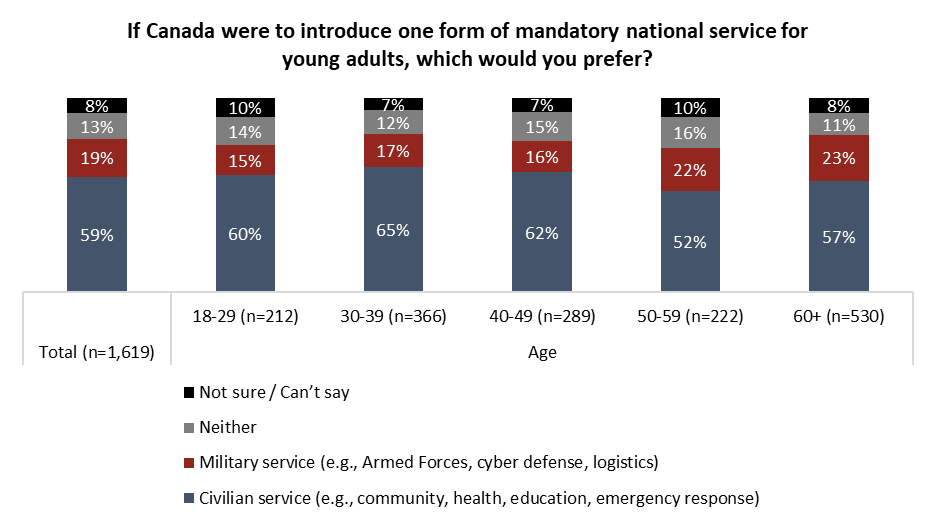
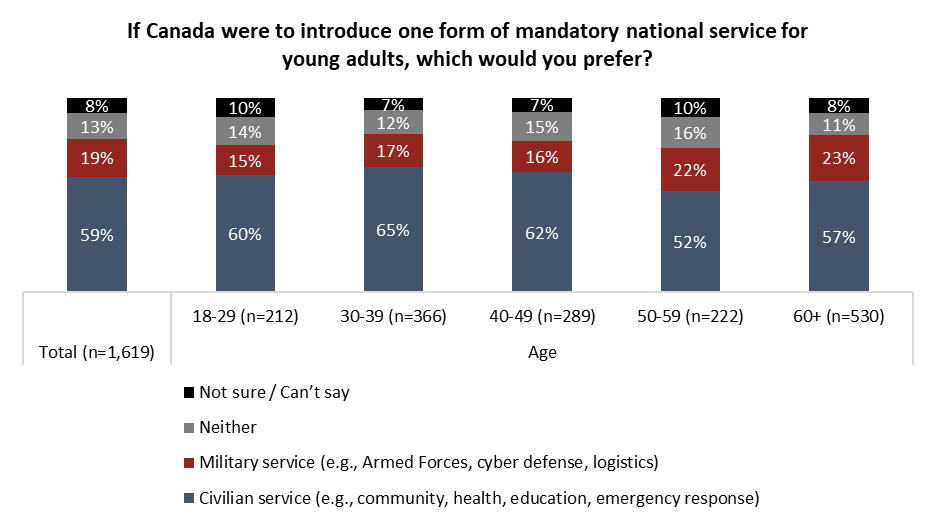
Ask which form they would support more if they had to choose one, three-in-five (59%) say they prefer civilian service, while one-in-five (19%) say military service. One-in-eight (13%) say neither.
INDEX
Part One: Would Canadians support mandatory youth service?
-
Military service divisive overall, particularly across generations
-
Civilian service vastly preferred to military
-
Young people supportive of serving their country in a non-military form
Part Two: Perceived benefits
-
Civilian service seen as better for core aspects of Canadian society
-
Conservatives more bullish about what military service would confer
Part One: Would Canadians support mandatory youth service?
Military service divisive overall, particularly across generations
One suggestion that has cropped up in recent years as a way to boost the Canadian shortfall in Armed Forces personnel recruitment is compulsory service. Some argue that mandating a portion of military service similar to that in countries like the Nordic nations or Greece would provide young adults with better physical health, and a sense of purpose that some lack, while also establishing a domestic emergency response capacity and a more secure nation. Opponents argue that this infringes on Canadians’ freedoms, pointing to previous crises during conscription periods in Canada.
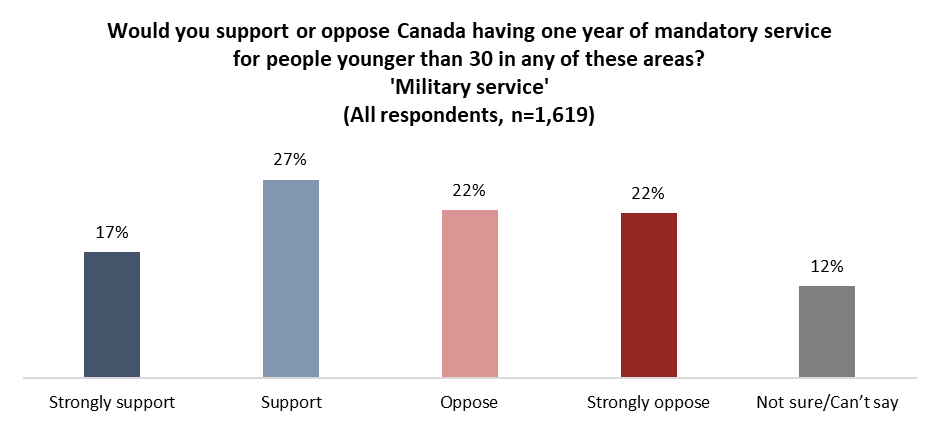
Canadians were asked if they would support or oppose Canada having one year of mandatory Armed Forces training for citizens before the age of 30. The issue is divisive, with 43 per cent in support and 44 per cent in opposition:
For men, this is much more of a positive prospect than for women. Responses also follow relatively linearly along generational lines, rising as age rises. Subtracting opposition from support yields a net support score, which is positive for men other than those 18- to 29-years-old and negative among women, other than those over the age of 59:
Civilian service vastly preferred to military
There are, however, other models of compulsory civilian service that have less of a focus on the military. For these alternatives, Canadians are much more supportive. For each of four additional options, including mandatory training in public health support, environmental support, youth services, or civil protection (see definitions here), Canadians are more than three-times as likely to support than oppose each:
Young people supportive of serving their country in a non-military form
What is perhaps most notable here are the views of those who, in this hypothetical, would be doing the work. In all cases other than military service, 18- to 29-year-old Canadians are widely supportive of a compulsory obligation for people in their age range:
Looking again at those who would be affected most, there are higher support levels for public health work among 18- to 29-year-old women compared to men of their age cohort. Men show higher levels of support for civil protection and military service.

Given the option to choose between the two broad areas, it is clear that Canadians would rather some form of civilian service that does not revolve around the Armed Forces. Indeed, they’re three times as likely to choose one of the aforementioned forms of civilian work than a military focused service:
Part Two: Perceived benefits
Civilian service seen as better than military for core aspects of Canadian society
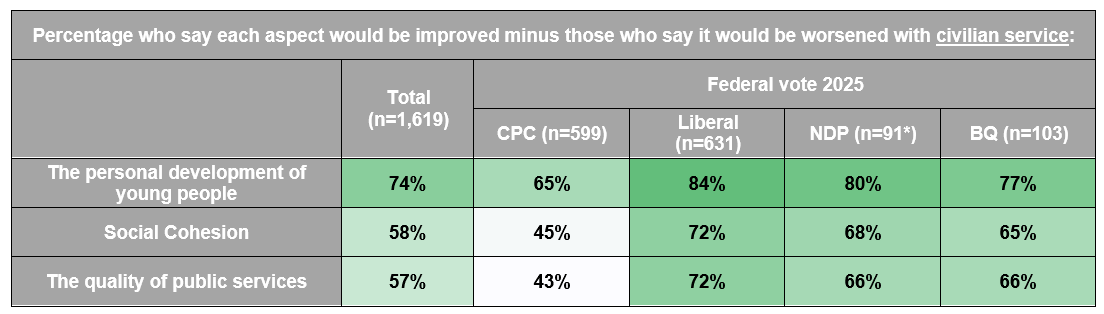
Asked to imagine any perceived benefits from non-military compulsory service, Canadians foresee significant improvements to some core aspects of their society. The biggest perceived boon would be to the personal development of young people. Here four-in-five (82%) say this aspect of young Canadians’ lives would be improved. Fewer, but still a firm majority, are bullish about the impact that this service would have on the quality of public services, with more people qualified to assist in health care, emergency response, and other areas, as well as the social cohesion of Canada more broadly:

These positive impacts are viewed as likely across most of the population, with significant net positive scores (improve minus worsen) among all ages (see detailed tables for age and gender combos):

Past Conservative Party supporters are less enthusiastic about what these aspects of service would engender for the population but are nonetheless much more positive than negative.
Conservatives more bullish about what military service would confer
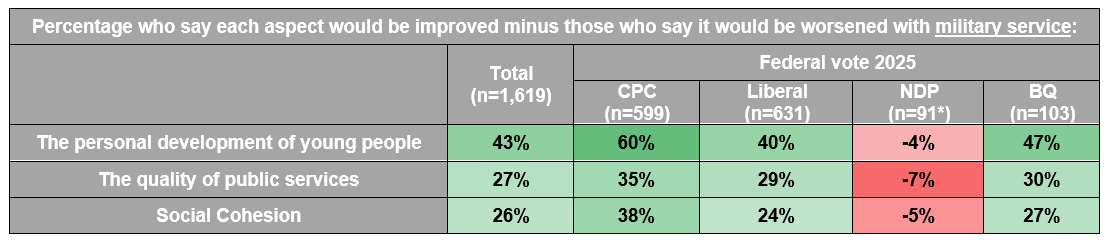
The benefits conferred by military service are less obvious to many Canadians. While a majority still say that each of the three aspects of society would be improved, all levels are considerably lower than those recorded for civilian service in the prior section of this report (personal development -18, public services -20, social cohesion -17):

Older Canadians are far more likely to perceive widespread benefits to military training for young people. Those younger than 40 are more dubious, with 18- to 29-year-olds most skeptical:

While 2025 CPC voters were less likely than others to say that civilian service would engender positive outcomes, they’re more likely to feel that military service would. For New Democrats, the overall impact of compulsory service in the Armed Forces would be negative:
Survey Methodology
The Angus Reid Institute conducted an online survey from June 20-23, 2025, among a randomized sample of 1,619 Canadian adults who are members of Angus Reid Forum. The sample was weighted to be representative of adults nationwide according to region, gender, age, household income, and education, based on the Canadian census. For comparison purposes only, a probability sample of this size would carry a margin of error of +/- 2.0 percentage points, 19 times out of 20. Discrepancies in or between totals are due to rounding. The survey was self-commissioned and paid for by ARI. Detailed tables are found at the end of this release.
For more information on our polling methods, click here.
For detailed results by age, gender, region, education, and other demographics, click here.
For PDF of full release, click here.
For questionnaire, click here.
Image – ID 72200045 © Syda Productions | Dreamstime.com
CONTACT:
Shachi Kurl, President: 604.908.1693 shachi.kurl@angusreid.org @shachikurl
Dave Korzinski, Research Director: 250.899.0821 dave.korzinski@angusreid.org
Jon Roe, Research Associate: 825.437.1147 jon.roe@angusreid.org