


Half of Canadians believe no federal political party ‘really represents’ their views
September 12, 2024 – ‘Extremism’ and ‘polarization’ have become common terms framing the discussion of Canada’s political scene. As federal political parties take turns labelling the other as extremists, there is widespread belief that political options are abandoning the middle.
New data from the non-profit Angus Reid Institute find many believe Canada’s two biggest political parties have moved towards the fringes and away from the middle when it comes to their political beliefs.
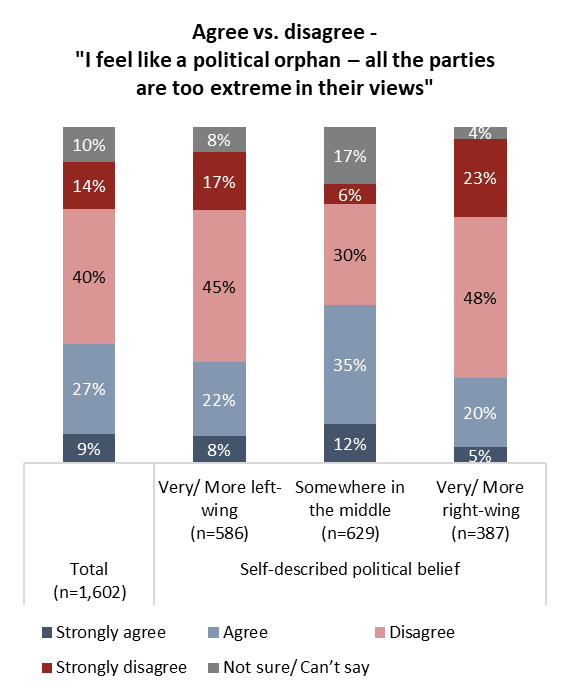
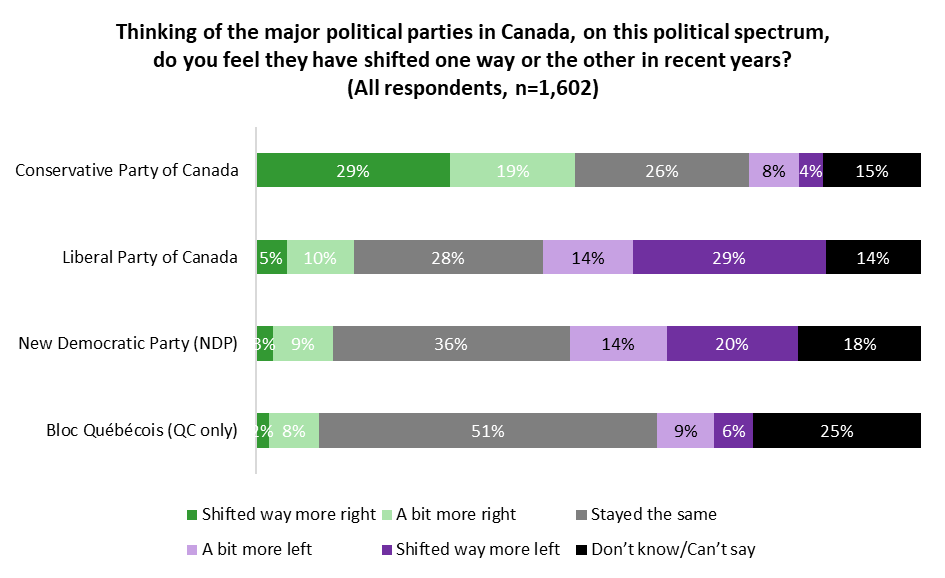
Half (48%) say the Conservative Party of Canada has shifted a bit (19%) or much more to the right (29%), while a plurality (43%) believe the Liberal Party of Canada has moved a bit (14%) or a lot more to the left (29%). Meanwhile, one-third (36%) of Canadians describe themselves as “political orphans” who find that all the parties are “too extreme”. This includes half (47%) of people who place themselves in the middle of the political spectrum.
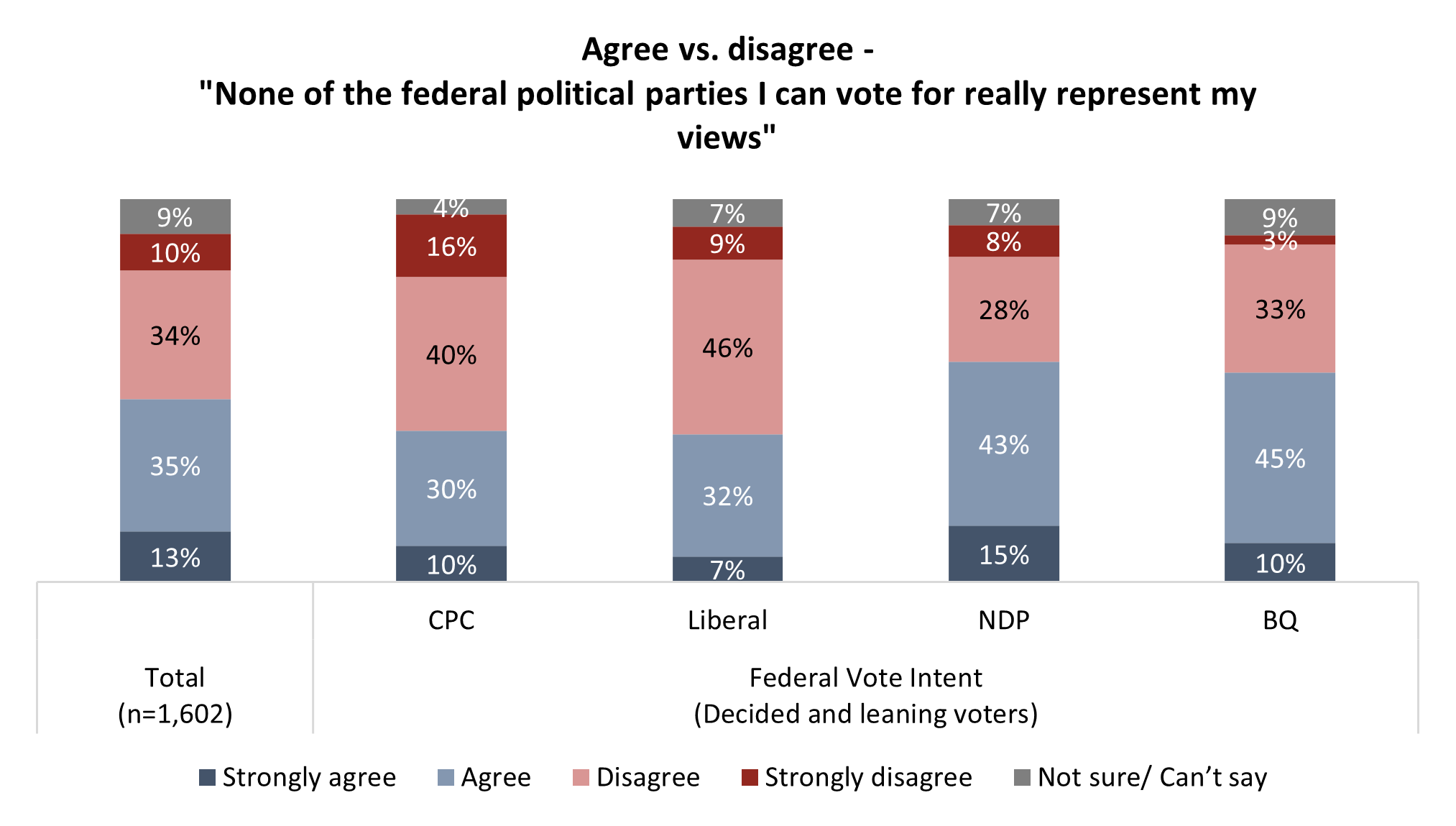
This sense of political polarization is accompanied by a wider spread disaffection with the federal political scene. Half (48%) say they don’t have an option to vote for that “really represents” their views. This is a common sentiment even among likely voters, with two-in-five current Conservative (40%) and Liberal (39%) supporters – and more likely NDP (58%) and Bloc Québécois (55%) voters – believing they don’t have political options that really speak for them.
Click below to see Key Takeaways from the data
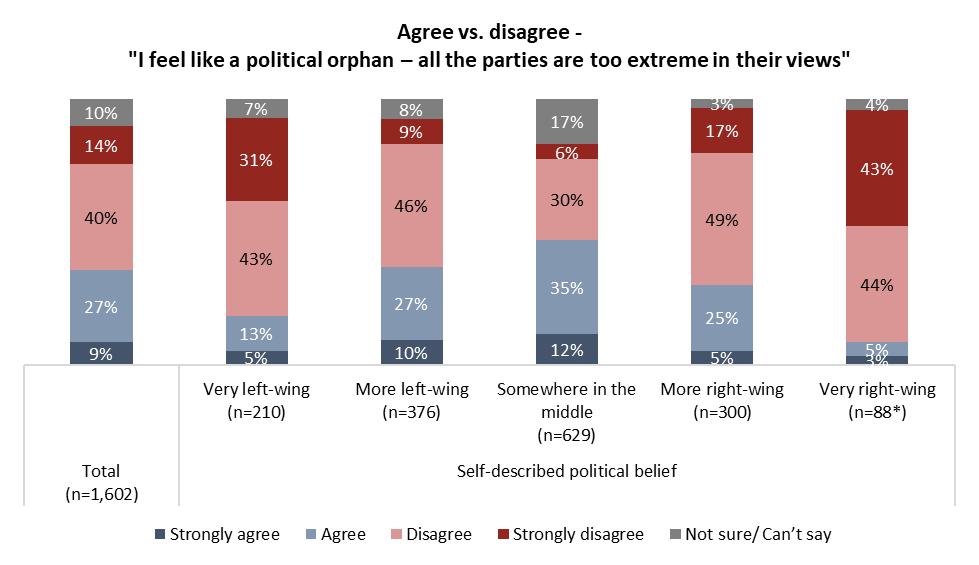
Overall, one-in-three (36%) Canadians believe “all the political parties are too extreme in their views”. Approaching half (47%) of those who place themselves in the middle of the political spectrum say they “feel like a political orphan”, making them the most likely to hold this view.
The most common view is the CPC has moved right (48%) and the Liberals have moved left (43%).
Half in Quebec (51%) say the Bloc Québécois has not moved along the political spectrum in recent years. Canadians are as likely to believe the NDP has stayed put (36%) as moved farther to the left (34%).
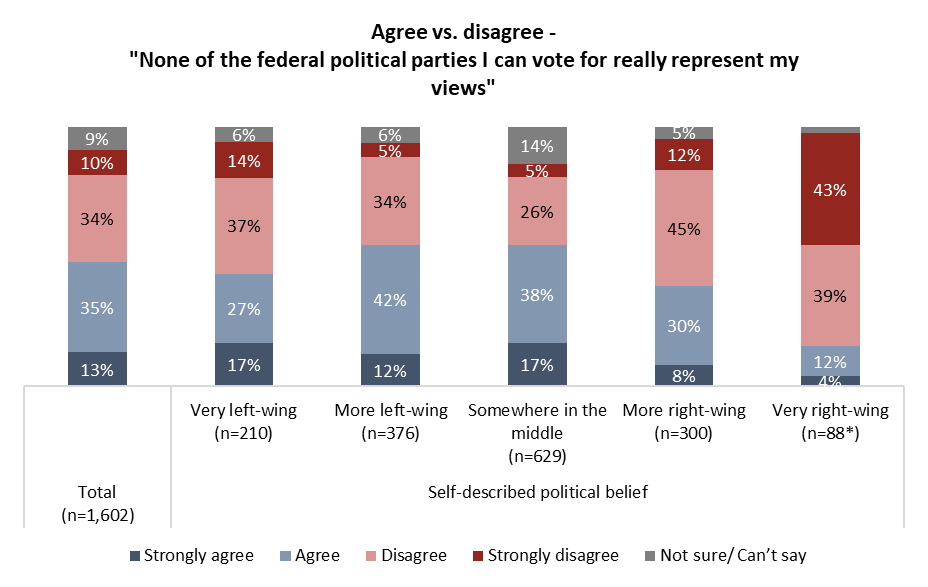
Canadians are more likely to agree (48%) than disagree (44%) that none of the federal political parties represent their views.
Large groups of likely supporters for each of the four biggest political parties in the country believe this as well, including majorities of NDP (58%) and Bloc Québécois supporters (55%).
The Full Story
INDEX
Part One: The political spectrum
Plurality say they’re ‘in the middle’; more people describe themselves as ‘left’ than ‘right’
More ‘progressives’ in B.C., Manitoba; more ‘conservatives’ in Alberta, Saskatchewan
Part Two: The missing middle?
Perception is CPC has moved more right, Liberals more left in recent years
More than one-third say federal parties ‘too extreme in their views’
Half believe no federal party truly represents their views
Part One: The political spectrum
The subject of political polarization has become a hot topic in Canada. Data from the Canadian Election Study shows Canadians have become more negative about opposing political parties over time. Earlier this year, approaching two-in-five (37%) Canadians told the Angus Reid Institute that “there is no room for political compromise in Canada today”.
Plurality say they’re ‘in the middle’; more people describe themselves as ‘left’ than ‘right’
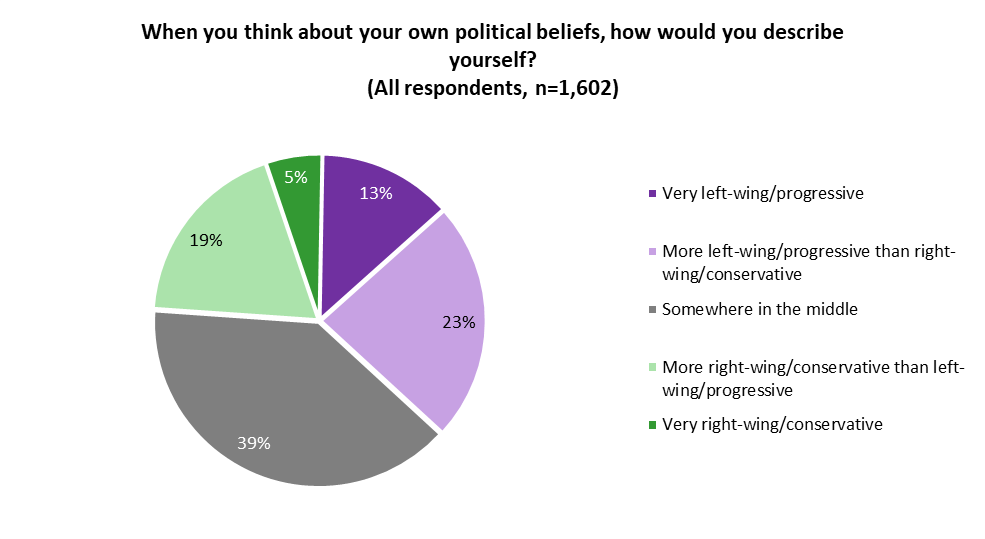
However, when it comes to self-describing their own political beliefs, the largest group of Canadians – two-in-five (39%) – say they are “somewhere in the middle” of the spectrum between progressive politics on the left and small-‘c’ conservative politics on the right. A slightly smaller group consider themselves more left-leaning (36%), while one-quarter (24%) of Canadians describe themselves as right-leaning.
Men older than 54 are the most likely to say they are “right-wing” at 38 per cent, while a majority (53%) of women under 35 say they are “left-wing”. The demographic most likely to believe themselves to be centrists are women older than 54, of whom half (47%) say they land “somewhere in the middle” on the political spectrum:

More ‘progressives’ in B.C., Manitoba; more ‘conservatives’ in Alberta, Saskatchewan
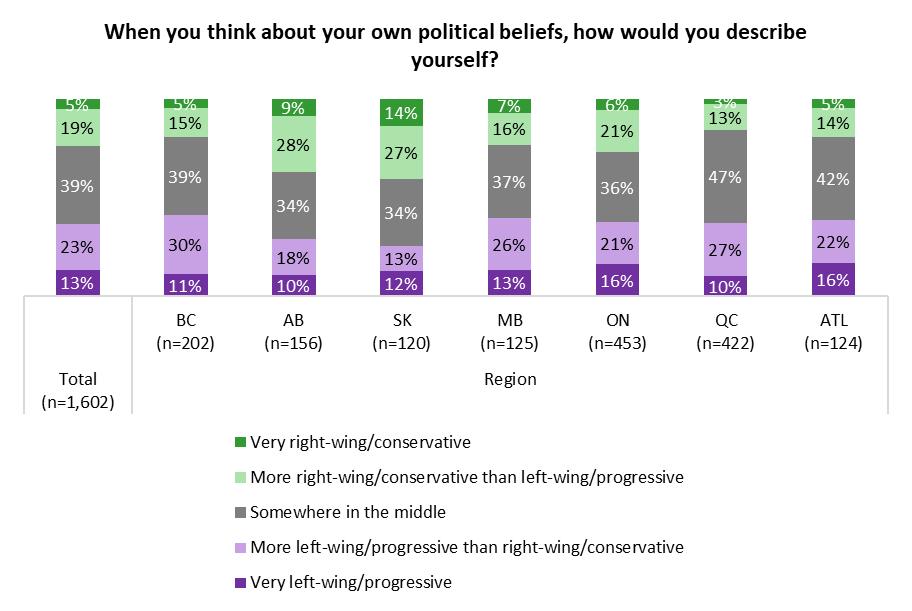
The distribution along the political spectrum in each province aligns with historical voting records. Alberta and Saskatchewan are the only two provinces in the country where a plurality view themselves to be “right-wing”. In no province is there a plurality of self-identified “left-wing” Canadians, though B.C. (41%) and Manitoba (39%) come the closest, where a statistically similar number of residents describe themselves as centrists (39% and 37% respectively).
Half (47%) in Quebec view themselves as being in the middle of the political spectrum, the most in the country:
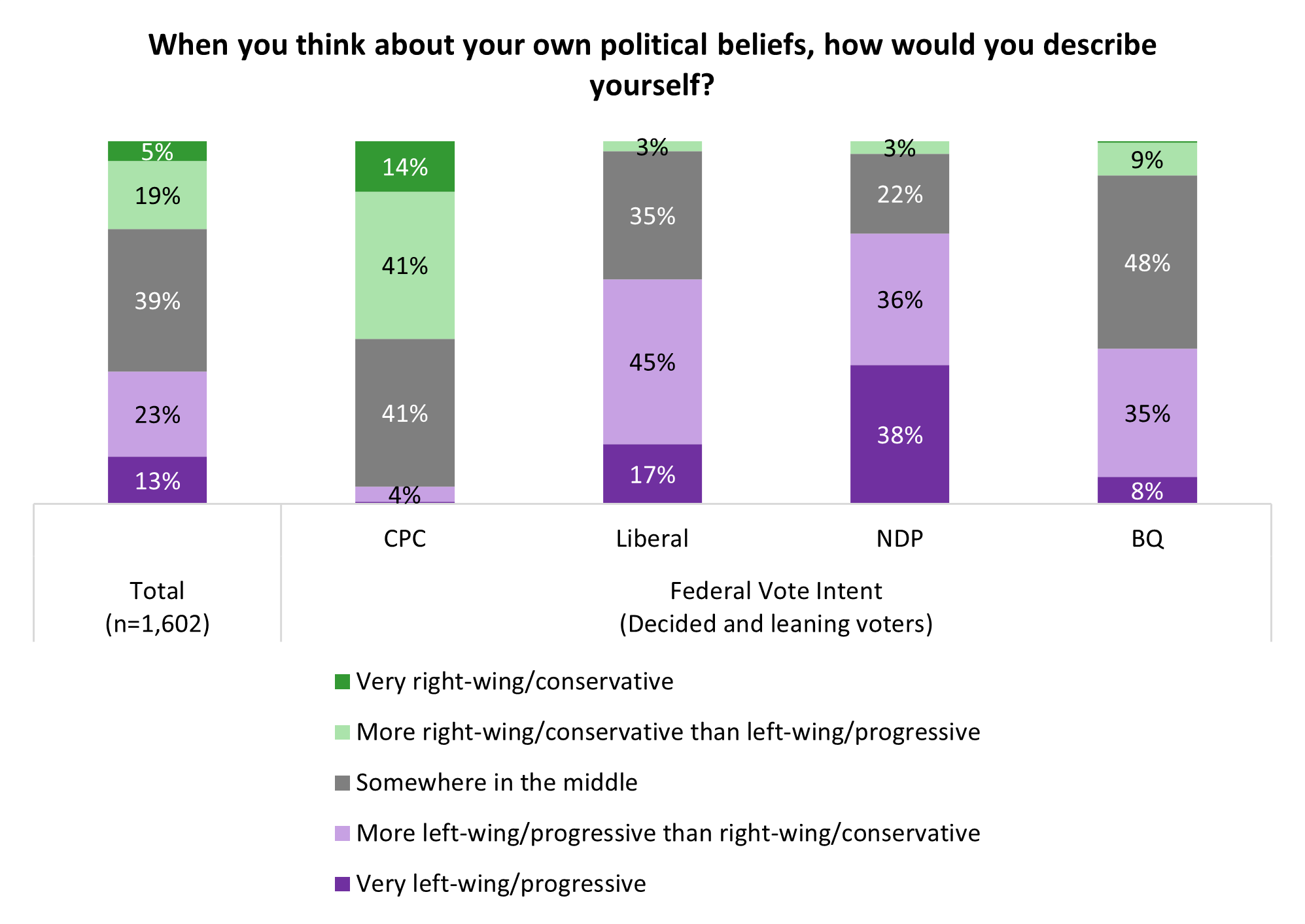
Strong majorities of likely Liberal (62%) and NDP (74%) voters describe themselves as “left-wing”, while just over half (55%) of CPC supporters view themselves as “right-wing”. Notably, there are self-described centrists supporting each of the three main political parties, though a smaller proportion of likely NDP voters (22%) describe themselves as “somewhere in the middle” on the political spectrum than other party supporters:
Part Two: The missing political middle
Perception is CPC has moved more right, Liberals more left in recent years
Labels of “extremism” have been generously applied by Canadians on their political opponents in recent years. Conservative leader Pierre Poilievre has been accused of “embracing far-right extremism” and welcoming “the support of conspiracy theorists and extremists,” the latter by Prime Minister and Liberal leader Justin Trudeau. Poilievre has been even more direct, calling Trudeau “an extremist”.
The perception from Canadians is that Canada’s two biggest political parties have moved further away from the middle on the political spectrum. Approaching half (48%) believe the Conservative party has moved a bit (19%) or “way more” (29%) right. A plurality (43%) believe the Liberals have moved more left either marginally (14%) or by a lot (29%).
There is more disagreement about the NDP, with 36 per cent believing it has stayed in the same place on the political spectrum in recent years and a similar sized group (34%) believing it has shifted left.
Half (51%) in Quebec say the Bloc Québecois has moved neither left nor right when it comes to the party’s politics, but among those who do believe it has shifted, more say it is to the left (15%) than right (10%):
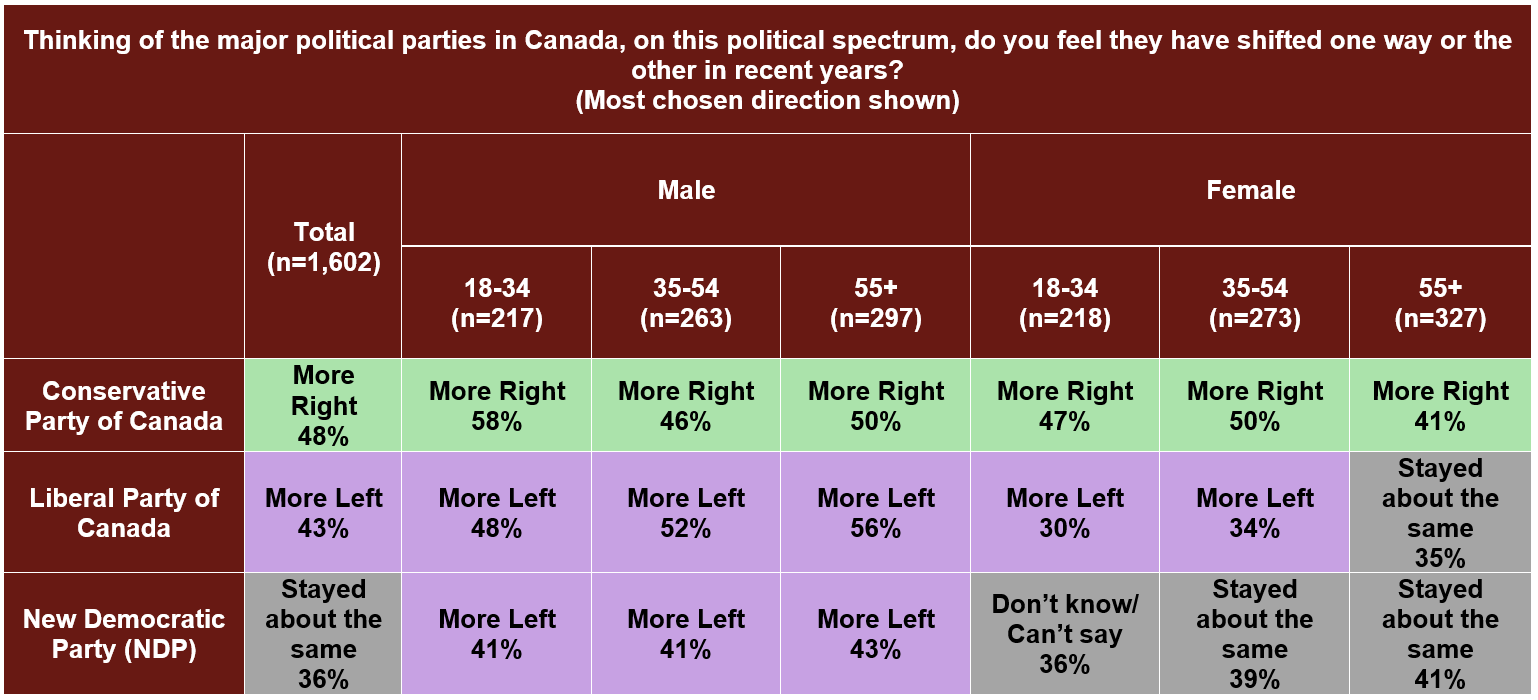
The perception of political movement varies among demographics. (See the full responses to these questions in the detailed tables.) There is agreement by a plurality of men and women of all ages that the Conservatives have moved “more right”.
At least half of men of all ages believe the Liberals have moved more to the left, but among women there is both more uncertainty and more belief that the party has not moved in either direction on the political spectrum.
Men also say the NDP have moved more left in recent years, while women aren’t as certain if the NDP have moved at all:
Perceptions also vary depending on where respondents align themselves on the political spectrum. The belief that the Conservatives have moved more right in recent years is strongest among self-described left-wingers. For those in the middle, one-in-three (33%) believe the party has moved more right, but three-in-ten (31%, see detailed tables) say the party hasn’t moved at all. A plurality of those who say they have conservative political beliefs agree with the latter.
On the Liberals, those who describe themselves as very left-wing believe the party has moved right-ward in recent years at a plurality level (41%). Though nearly as many (38%, see detailed tables) say the party has stayed in the same place politically. The belief the Liberals have moved more left becomes near unanimous the further right-ward the respondent is along the political spectrum.
It also those on the right who are most likely to believe the NDP has shifted to the left. Those on the left are more likely to believe the party has stayed in the same place. Notably, near equal numbers of those in the middle believe the NDP has shifted left (31%) as stayed the same (31%, see detailed tables).
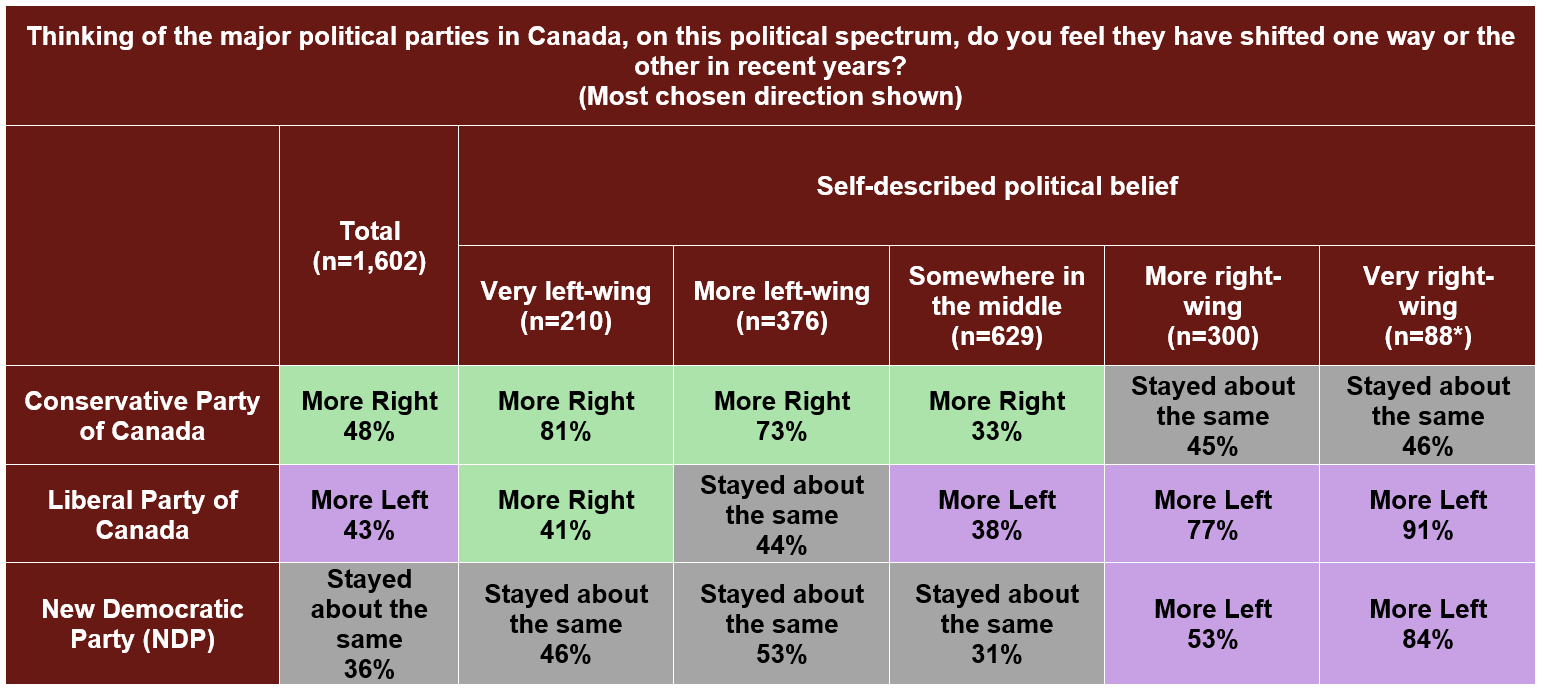
*Smaller sample size, interpret with caution
More than one-third say federal parties ‘too extreme in their views’
Allegations of extremism have become more common in modern political rhetoric, which is perhaps influencing the views of Canadians. One-third (36%) describe all political parties as “too extreme in their views”. That includes half (47%) of those who place themselves on the middle of the political spectrum. Those who put themselves on the left and right edges on the spectrum are least likely to believe the parties are too extreme:
*Smaller sample size, interpret with caution
Half believe no federal party truly represents their views
There is a wider sense of disaffection with the current political options overall. Half (48%) say there are no federal political options for them that really represent their views. This sentiment is highest among those self-described political centrists (55%) and who describe themselves as more left-wing than right (54%), and lowest among those who place themselves on the right-wing (38%) or very right-wing (16%):
*Smaller sample size, interpret with caution
It is notable that even among decided and leaning voters, there is a belief that none of the options available truly speaks for them. Two-in-five current Conservative (40%) and Liberal (49%) voters say this, while even more NDP (58%) and Bloc Québécois (55%) supporters express this sentiment:
There has been a burgeoning political movement to re-fill the centre of the political spectrum. In August, the Canadian Future Party announced it would be running candidates in the upcoming byelections in Winnipeg and Montreal. The party is trying to position itself as a centrist alternative to the Liberal and Conservative parties.
It has been difficult for new parties to break into the Canadian political scene. With the exception of splinter movements such as the Reform party, newly formed political parties such as the People’s Party of Canada or the Quebec-based Forces et Démocratie have not won seats in recent federal elections. It took 28 years for the Green Party of Canada to win its first seat.
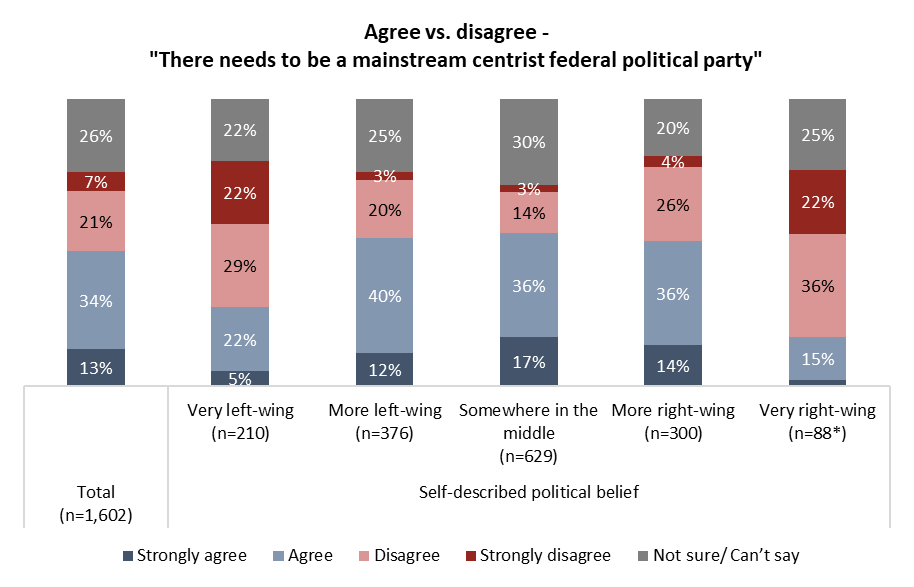
There is some appetite for this political movement among Canadians. Approaching half (47%) agree there should be a mainstream centrist federal political party, including a majority (53%) of those who place themselves in the middle of the political spectrum:
*Smaller sample size, interpret with caution
Survey Methodology
The Angus Reid Institute conducted an online survey from Aug. 29 to Sept. 4, 2024 among a representative randomized sample of 1,602 Canadian adults who are members of Angus Reid Forum. For comparison purposes only, a probability sample of this size would carry a margin of error of +/- 2 percentage points, 19 times out of 20. Discrepancies in or between totals are due to rounding. The survey was self-commissioned and paid for by ARI.
For detailed results by age, gender, region, education, and other demographics, click here.
For the full release including methodology, click here.
For the questionnaire, click here.
Shachi Kurl, President: 604.908.1693 shachi.kurl@angusreid.org @shachikurl
Dave Korzinski, Research Director: 250.899.0821 dave.korzinski@angusreid.org
Jon Roe, Research Associate: 825.437.1147 jon.roe@angusreid.org @thejonroe