


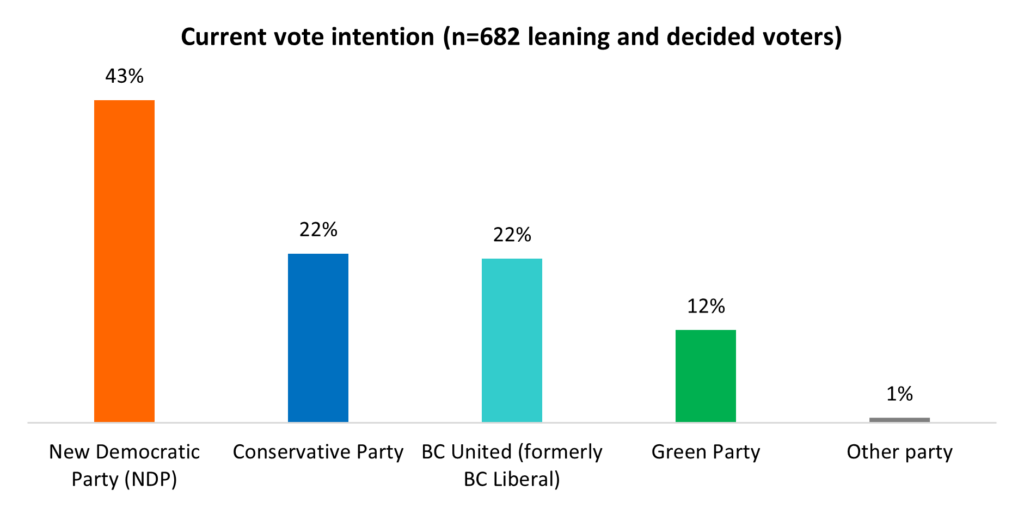
In an expected election year, 43% would vote NDP, 22% each back BC Conservatives, BC United
March 18, 2024 – There are no shortage of story lines ahead of an expected October provincial election in British Columbia. Premier David Eby will be looking to win his first elected term, after taking over the position from John Horgan in 2022. BC United will be hoping to overcome a precipitous fall in the polls, and the previously single digit polling provincial Conservative Party will hope to prove that they are indeed more than a spillover choice from the surging federal brand.
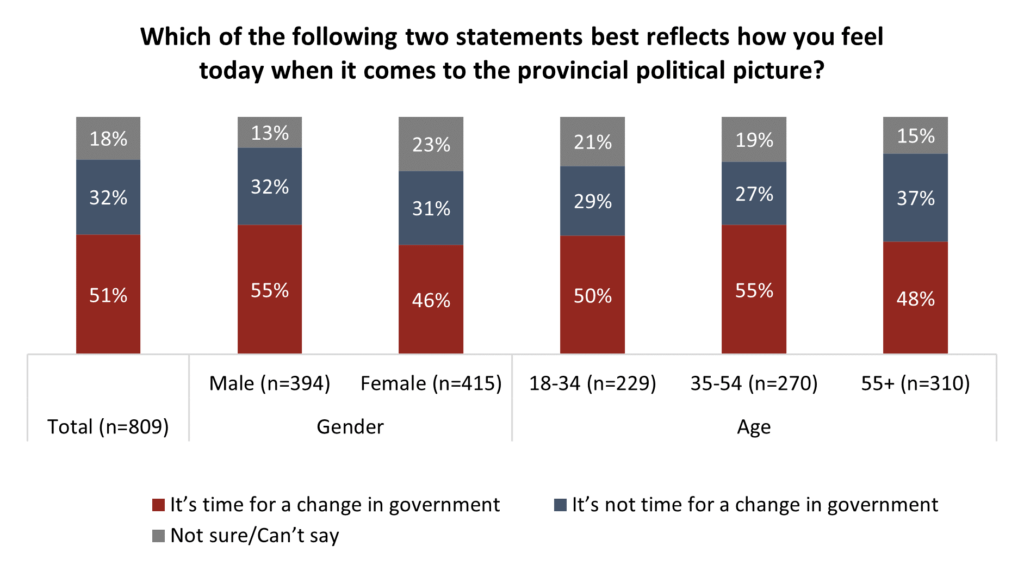
New data from the non-profit Angus Reid Institute finds conditions comfortable yet potentially concerning for the governing BC NDP. The good? The party doubles both of its closest rivals in vote intention (43% NDP, 22% BC United, 22% Conservative Party of B.C.) and is the preferred party to lead on a host of top issues facing the province, including the cost of living, and health care. The bad? For four of the five top issues facing the province, at least seven-in-ten residents say the government is doing a poor job on each. Amid this, fully half (51%) of residents say it’s time for a change in government.
Nonetheless, a fractured opposition and a muddled political picture has the BC NDP coasting, at least for now. This, as BC United leader Kevin Falcon and Conservative Party of B.C. leader John Rustad both fail to break 25 per cent in favourability. With election talk likely to continue to ramp up, both leaders will have an opportunity to meet and convince voters to make their party the real threat to the incumbent BC NDP.
More Key Findings:
- The Lower Mainland/Fraser Valley region is the most competitive in the province. Here, 35 per cent support the BC NDP, 29 per cent support the B.C. Conservatives, and 28 per cent support BC United.
- Metro Vancouver is a BC NDP strength. Half of residents say they would vote for the party in this region, with the B.C. Conservatives a distant second place (20%)
- Men are relatively divided in their vote intention, with two-in-five (38%) saying they would vote for the incumbents and one-quarter supporting each of the Conservatives (26%) and BC United (27%). Women are three times as likely to support the BC NDP than any other party.
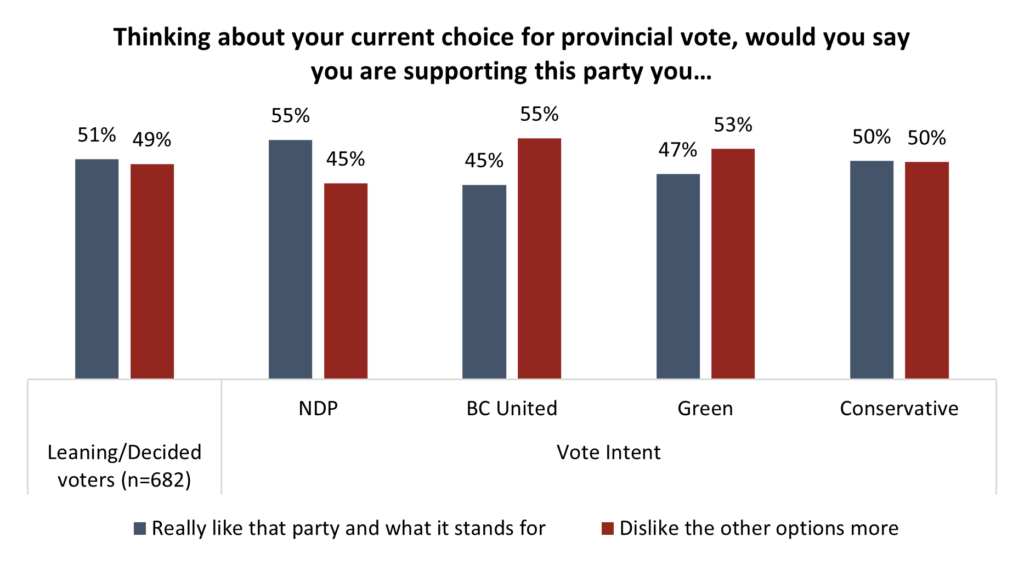
- Half of would-be voters say they are voting to block a party they dislike rather than to support one they do like. Even among those support the incumbents, just 55 per cent say they are voting for the party because they like what it stands for, while 45 per cent say they simply dislike the other options more.
About ARI
The Angus Reid Institute (ARI) was founded in October 2014 by pollster and sociologist, Dr. Angus Reid. ARI is a national, not-for-profit, non-partisan public opinion research foundation established to advance education by commissioning, conducting and disseminating to the public accessible and impartial statistical data, research and policy analysis on economics, political science, philanthropy, public administration, domestic and international affairs and other socio-economic issues of importance to Canada and its world.
INDEX
Part One: The leaders
- Eby’s positives dwarf views of still relatively unknown opposition
- Regional strengths and weaknesses
Part Two: The issues
- Cost of living, health care, housing affordability cause most pain
- Despite poor reviews, NDP still most trusted on top issues
Part Three: Vote intention
- Half say it’s “time for a change”
- Divided opposition gives BC NDP comfortable lead
- By region, age
- Half voting for a party, half against one
Part One: The leaders
Eby’s positives dwarf views of relatively unknown opposition
When David Eby took over the NDP leadership for his predecessor John Horgan, he had big shoes to fill. Horgan’s personal approval rating remained perennially in majority territory, a tough feat to replicate for most provincial leaders. Eby has yet to reach these levels. Recently, his government has faced pushback over a number of policy proposals. After announcing the implementation of changes to the BC Land Act, Eby announced that would no longer proceed. Some municipalities have also resisted changes to short-term rental rules.
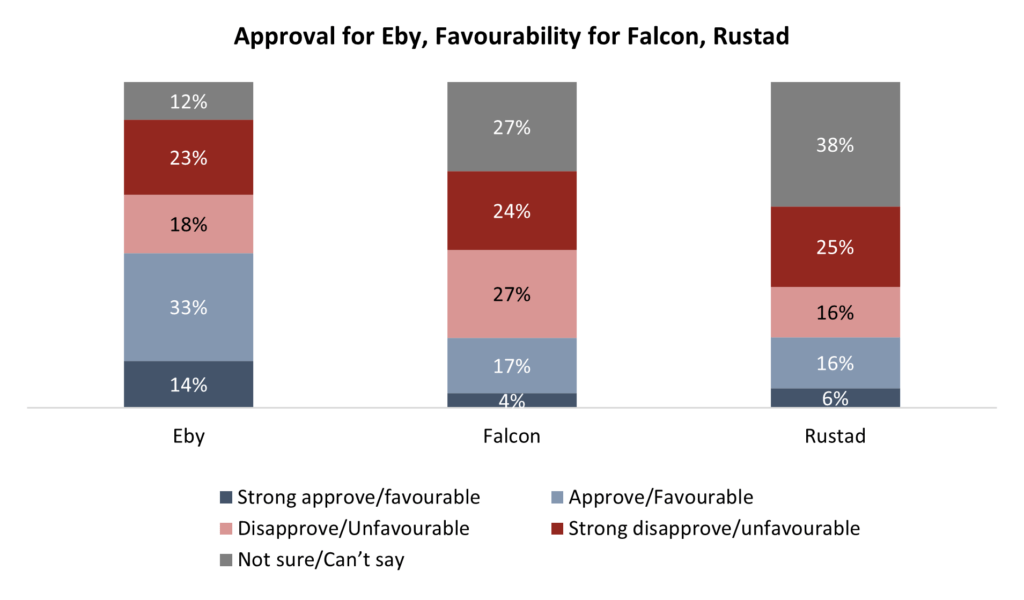
Eby’s personal approval levels have remained consistently between 46 and 48 per cent for more than a year. Opposition leader Kevin Falcon faces a tougher challenge. Between October 2022 and now, his favourability has moved from 17 per cent to 21 per cent. He and Conservative Party leader John Rustad both fail to reach the one-quarter mark on that measure. Rustad and Falcon are no strangers, having served as colleagues for more than a decade, as far back as under Gordon Campbell’s B.C. Liberals. Rustad was removed from caucus in 2022 and left the party after posting climate change denying information on social media. He went on to take over the B.C. Conservative Party shortly thereafter:
Regional strengths and weaknesses
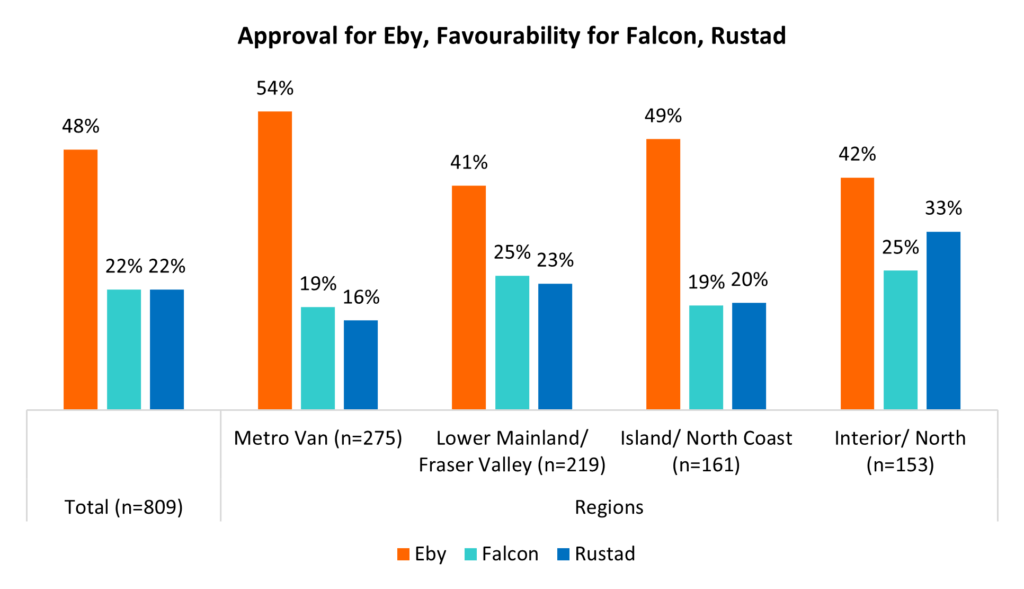
Eby’s strength resides in Metro Vancouver, but it is worth noting that he exceeds two-in-five in approval across the province. John Rustad resonates most in the Interior and North region, where his favourability jumps to 33 per cent:
Part Two: The issues
The provincial Conservative Party and opposition BC United have flirted with merger talks, but with just seven months until an expected election, time is running out for cooperation. This, as the BC NDP faces heavy criticism on many of the top issues facing the province.
Cost of living, health care, housing affordability cause most pain
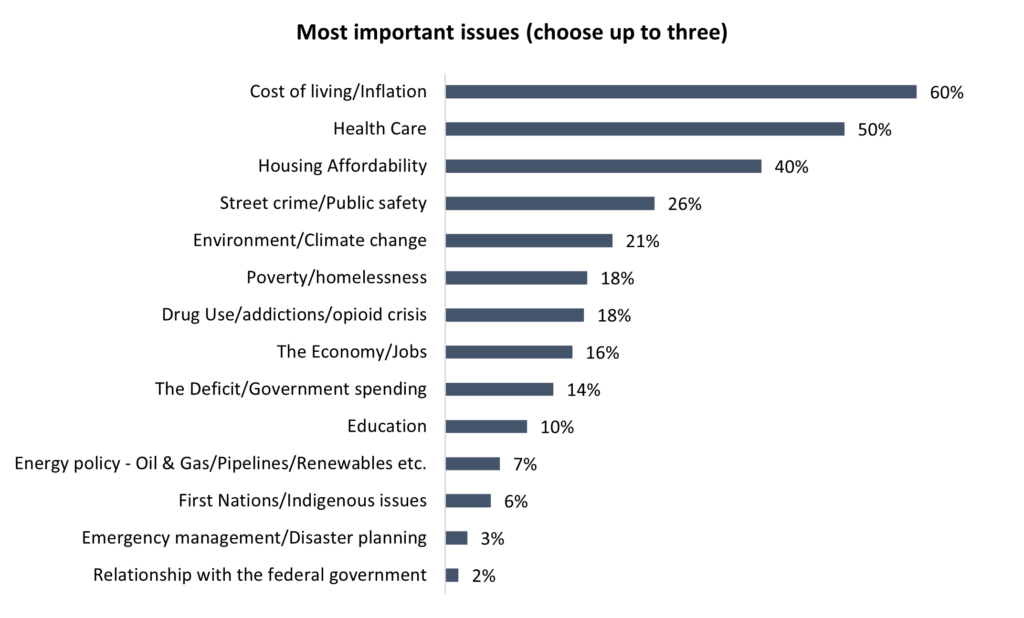
For a majority of residents in the province, the cost of living and health care are the most pressing issues. Two-in-five also choose housing affordability, while street crime and public safety also eclipses the quarter mark:
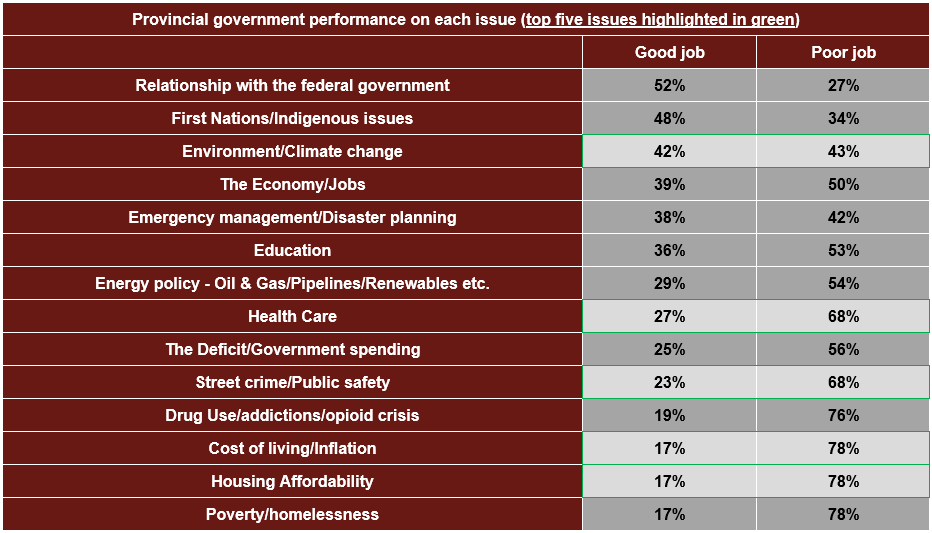
In terms of provincial performance, the government has few bright spots. Relationships with the federal government and Indigenous groups are the two most highly applauded areas of governance (neither area identified as a top priority by British Columbians, however), while residents are divided over provincial performance on fighting climate change.
More troubling for the incumbents, on the other four top issues in the province (outside of climate change) at least 68 per cent say the government is performing poorly:
Despite poor reviews, NDP still most trusted on key issues
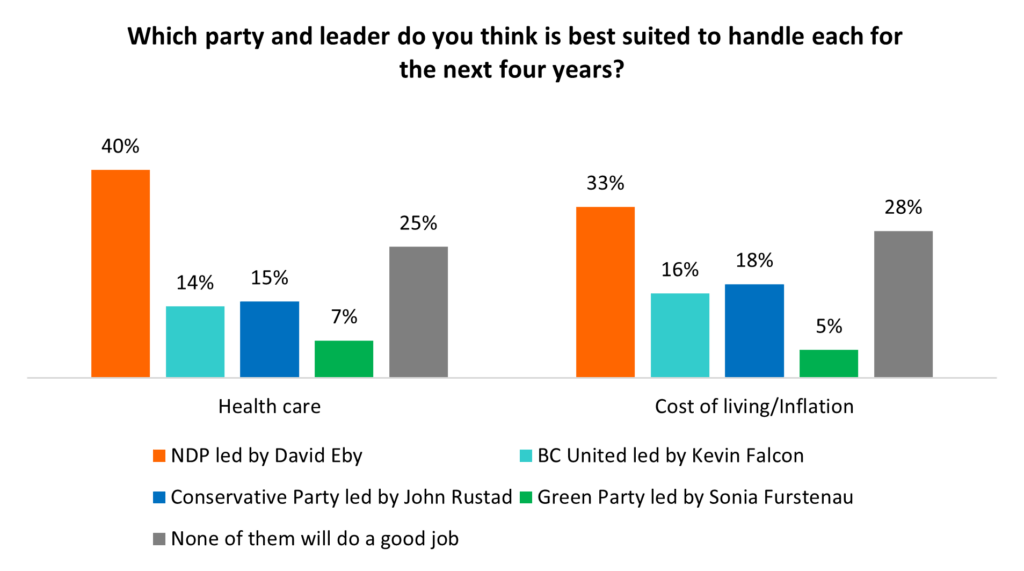
With the cost of living and health care dominating British Columbians’ priorities, it is notable that the BC NDP remains the top choice on both issues. Two-in-five say they trust the government most on health care, which has been a significant budgetary focus in recent years. Despite investments, wait times and access continue to challenge residents.
The growing cost of living has also been a top-of-mind concern in the post-pandemic environment. On this issue, one-in-three prefer to have the BC NDP continue to govern. Similar numbers of residents prefer both the BC Conservatives and BC United, while many are disenchanted with all options:
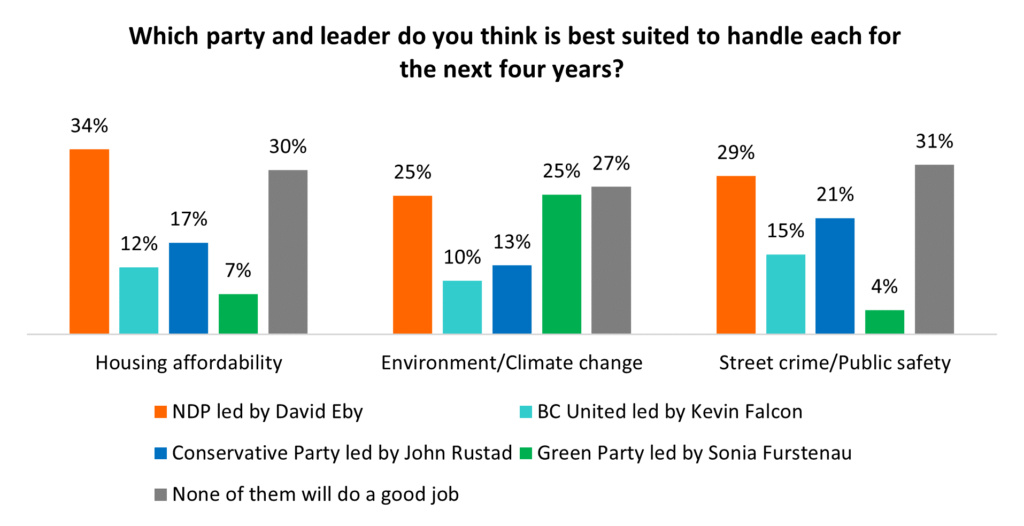
On other top issues, residents offer slight preference to the BC NDP, but are much more divided between the four major parties or outright dismissal of all options:
Part Three: Vote intention
If there is any sign in these data that portend a challenge in October for the BC NDP, it may be this: half of the province feels that it is “time for a change” in government. Governments have sustained their position in power with this sentiment, with Ontario perhaps the best recent example, but it does exemplify the threat a merger between BC United and the BC Conservatives would pose.
Divided opposition gives BC NDP comfortable lead
If this is, indeed, the slate of parties and leaders to run in an expected October election, the BC NDP appears in a comfortable position. Currently the incumbent party doubles both of its closest rivals:
Regional projections are particularly interesting in the Lower Mainland/Fraser Valley region where three parties receive 28 per cent or more of the vote share. The BC NDP stronghold appears to be Metro Vancouver, but it also holds a double-digit lead in both the Island/North Coast and Interior regions:

The BC NDP lead across all ages and among both men and women. Men, however, are much more divided than women, with more than one-quarter of each supporting the B.C. Conservative Party and BC United respectively.

Half voting for a party, half against one
One trend appears to unite British Columbians across all political affiliations. At least 45 per cent of all voters say they are voting against a party rather than for one. Those most enthusiastic about their own choice are New Democrats, but even that party’s supporters are relatively divided on this question:
| METHODOLOGY:
The Angus Reid Institute conducted an online survey from February 28 – March 6, 2024 among a representative randomized sample of 809 British Columbian adults who are members of Angus Reid Forum. For comparison purposes only, a probability sample of this size would carry a margin of error of +/- 3 percentage points, 19 times out of 20. Discrepancies in or between totals are due to rounding. The survey was self-commissioned and paid for by ARI. Detailed tables are found at the end of this release. |
For detailed results by age, gender, region, education, and other demographics, click here.
For full report including methodology, click here.
For questionnaire, click here.
MEDIA CONTACTS:
Shachi Kurl, President: 604.908.1693 shachi.kurl@angusreid.org @shachikurl
Dave Korzinski, Research Director: 250.899.0821 dave.korzinski@angusreid.org