


Most say more time needed to study the matter, would support a provincial referendum
February 13, 2024 – A significant change to the British Columbia Land Act has been put in motion by the provincial government, but most residents in the province have heard little or nothing about it.
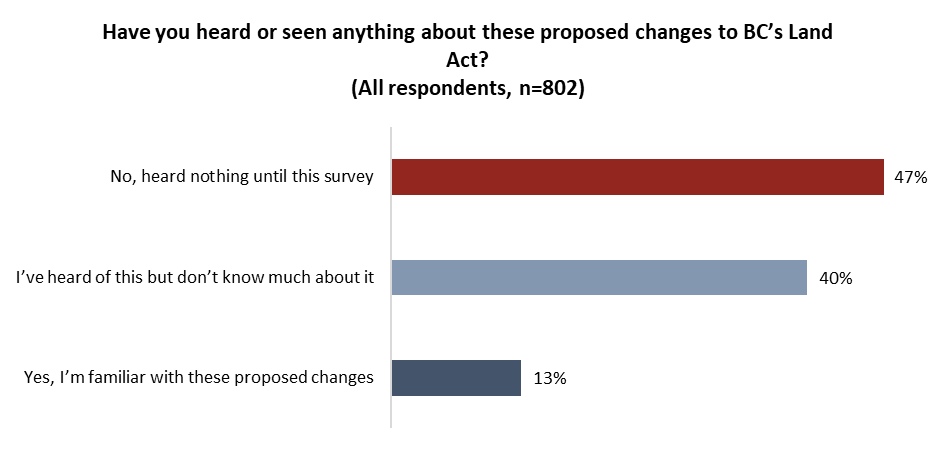
New data from the non-profit Angus Reid Institute finds the policy proposal from the BCNDP – to initiate co-management of public lands with B.C.’s 204 First Nations in accordance with the Declaration on the Rights of Indigenous Peoples Act – only well known to 13 per cent of residents. After being informed about the proposed amendment, 94 per cent say this is a major change and diverse views are evident.
Some observers have noted the relative silence surrounding consultations and the lack of a press release typically put forth to spearhead the public conversation. For their part, residents are clear that Indigenous consultation in some form is of importance to them.
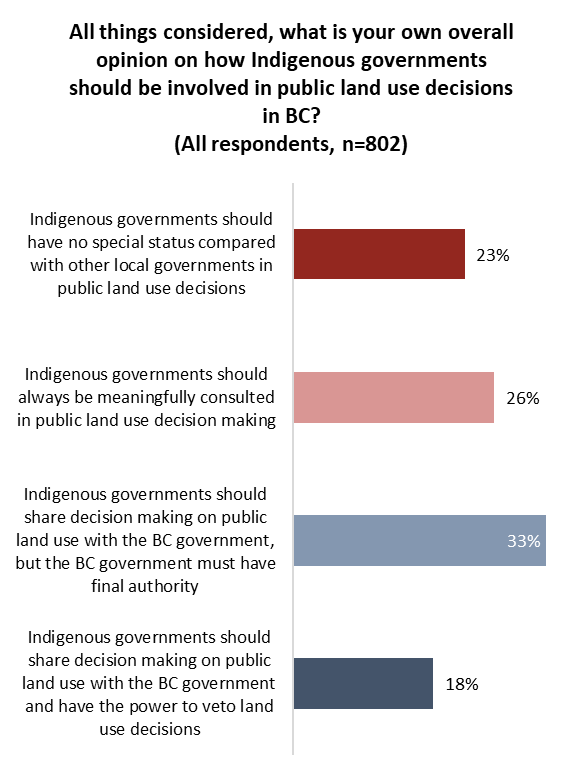
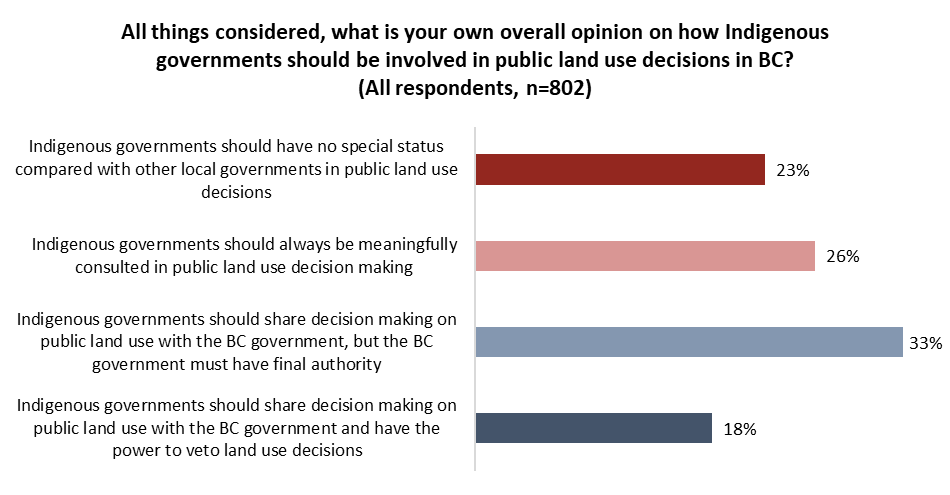
One-in-five would share decision-making equally, with a veto option available for First Nations.
Another one-quarter (26%) say only “meaningful consultation” is needed, and one-in-three (33%) say that the B.C. government should share decision-making but maintain final authority.
One-quarter (23%) say they would offer no special status in land decisions to Indigenous groups.
Given the opportunity to share their views on the situation, British Columbians give weight to a number of key priorities. More than half say that the respect for Reconciliation and the leadership shown by the government in including Indigenous partners in decisions are both important to them. That said, concerns about further complicating resource development (which already necessitates the consideration of Indigenous Peoples interests in relevant regions), and economic risks, are equally weighted by the population.
The BCNDP clearly then has a challenge on its hands in balancing these diverging concerns. Exacerbating this is a sense that the consultation timeline has been rushed. One-quarter (26%) say the current timeline offered by the government is acceptable. But more disagree, including half who (48%) want to see more consultation – extending deliberations into the fall or later this year – and one-quarter (27%) who want to kill the proposed changes entirely.
Politically, the risks are evident. Asked how they would vote if this were a key election issue, just over half (57%) of 2020 BCNDP supporters say that the party would be their choice again. Many fall into an undecided camp (20%) that will likely be looking for more information from the government in the coming weeks about the implications of these proposed changes.
More Key Findings:
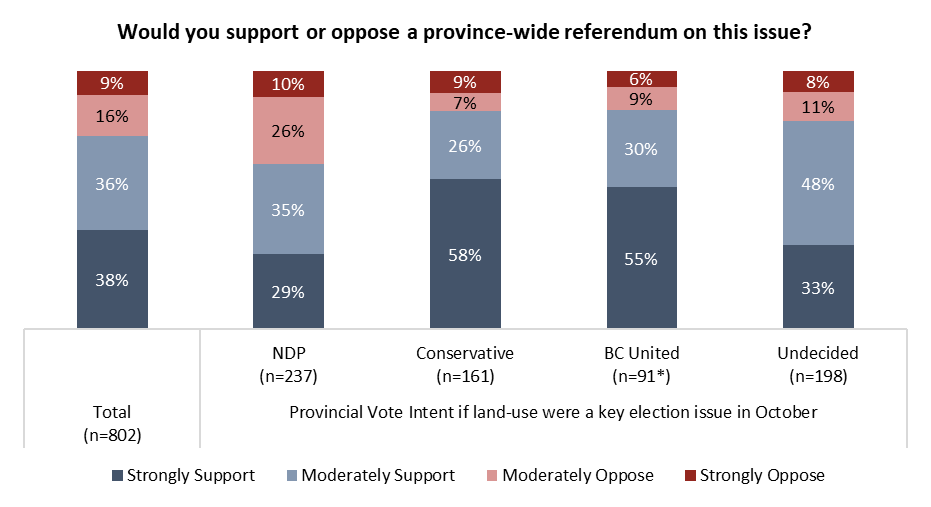
- A referendum on the issue? Most (75%) say they would support this, including two-thirds (64%) of those who say they would still support the BCNDP if this were a key election issue.
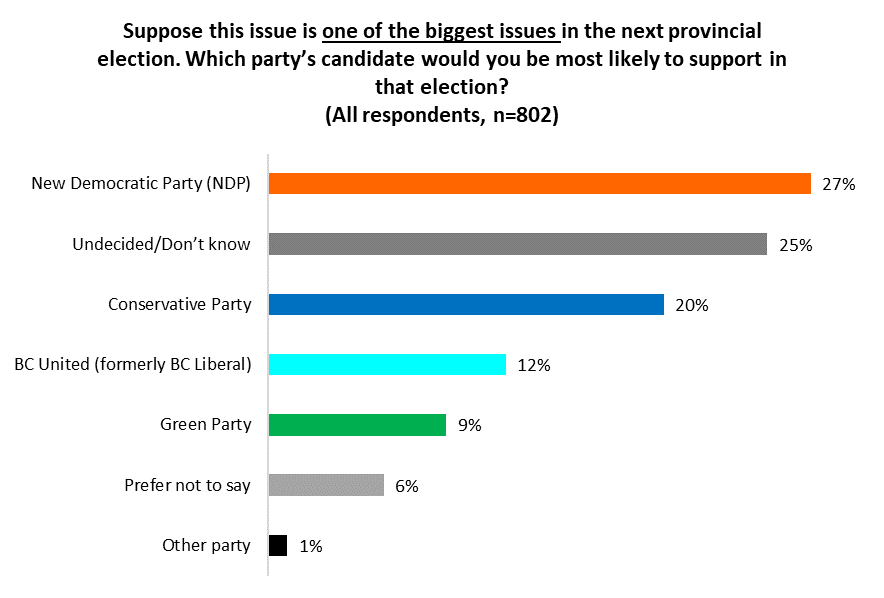
- One-quarter of all B.C. voters (25%) say they are undecided as to how they would vote if this were a key election issue, while a similar number would vote for the BCNDP (27%). The Conservative Party of BC is chosen by 20 per cent, followed by the BC United at 12 per cent.
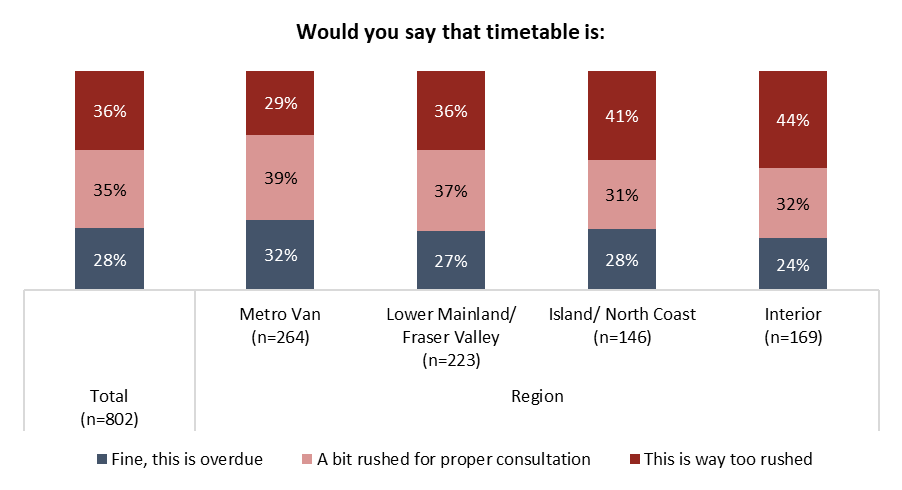
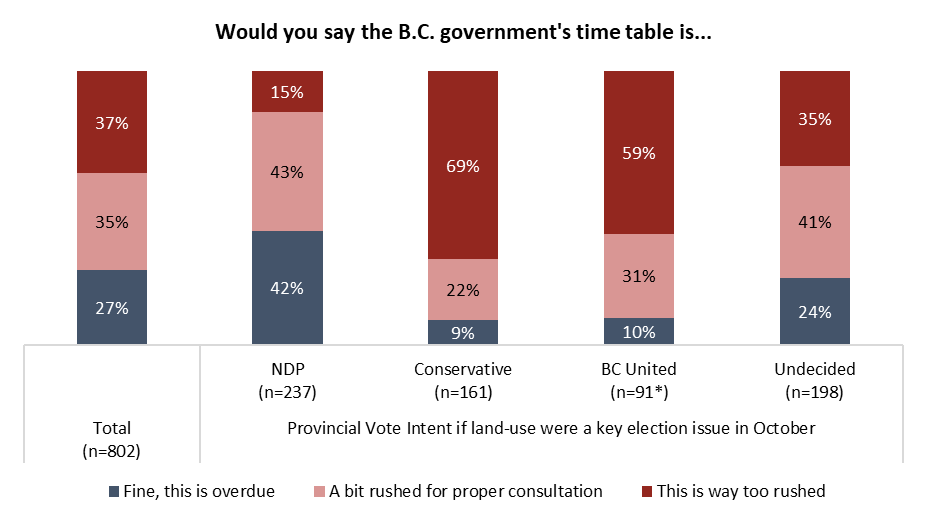
- Seven-in-ten overall say the consultation process is moving too quickly. Close to three-in-10 (27%) say it’s fine because the changes are overdue.
- Half of British Columbians had not heard of this issue before the survey (47%).
About ARI
The Angus Reid Institute (ARI) was founded in October 2014 by pollster and sociologist, Dr. Angus Reid. ARI is a national, not-for-profit, non-partisan public opinion research foundation established to advance education by commissioning, conducting and disseminating to the public accessible and impartial statistical data, research and policy analysis on economics, political science, philanthropy, public administration, domestic and international affairs and other socio-economic issues of importance to Canada and its world.
INDEX
Part One: Land use changes, a big issue flying under the radar
-
British Columbians see this as a major issue
Part Two: Government must balance a number of citizen priorities
-
Some divergence over level of shared decision making
Part Three: Timeline ruffles most who say process too rushed
-
Seven-in-ten feel consultation moving too quickly
-
One-quarter support timeline as-is, others would extend or dismiss plans altogether
-
Most say they’d support a referendum
Part Four: Potential political implications
-
If this were an important election consideration many aren’t sure how they’d vote
-
Who did the “Undecideds” support in 2020?
-
Where the votes move in this hypothetical scenario
-
Perspectives on relative weight of each consideration
Part One: Land use changes, a big issue flying under the radar
The B.C. government began consultations in January on proposed changes to the B.C. Land Act. The act governs the use of Crown land including the issuing of leases, licenses, permits and rights-of-way for community, industrial and business use. The government is exploring how to amend the act to share decision making with Indigenous groups as part of its implementation of the Declaration on the Rights of Indigenous Peoples Act (DRIPA) in 2019. DRIPA was passed as a step towards Reconciliation following the guidelines of the United Nations Declaration on the Rights of Indigenous Peoples.
However, the amendments to the Land Act – and how they were revealed to the public – have been controversial. The government has been accused of “quietly” launching the consultations on a government website without a news release and without notifying key industry groups. Some concerned argue the proposed amendments would give First Nations a “veto” in land use decision making, while the minister responsible for the file insisted that is not the case.
The issue has not grabbed the attention of many in B.C. Just one-in-eight (13%) say they were familiar with the proposed changes prior to this survey. A further two-in-five (40%) say they had heard of the changes but didn’t know much about them. Half (47%) had heard nothing of these proposed changes:
British Columbians see this as a major issue
When informed of the proposed changes, nearly all (94%) describe them as a major transformation of the rules governing public land use in B.C. That view is shared across all of B.C.’s regions, with those in the Interior leading the way in saying this is a significant change; more than half (54%) describe the proposed changes to the Land Act as “very major”:

Part Two: Government must balance a number of citizen priorities
While making steps towards the 2019 DRIPA is the driving force for the government’s changes to the B.C. Land Act, there are other considerations, including the potential effect of complicating resource development in the province. There are around 200 First Nations groups in B.C. and more than 90 per cent of the province’s land would be subject to the amended act.
British Columbians are most likely to see barriers to resource development as the most important consideration as the government looks to amend the act, but also assign weight to most arguments at an equal level, recognizing that these amendments are also a big step towards Reconciliation:

Some divergence over level of shared decision making
Government officials have been insistent that these proposed changes to the Land Act do not represent an Indigenous “veto” of potential projects on Crown lands. A senior government official told Business in Vancouver that if a First Nation rejected a project, the company proposing the project could apply for a judicial review. This has yet to appease critics of the amendments, who believe they do ultimately amount to a veto for First Nations on land use decisions.
British Columbians who believe Indigenous governments should have no special status in public land use decisions are in the minority. The rest of British Columbians are divided by how involved First Nations should be in the decision-making process. One-quarter say Indigenous governments should only be “meaningfully consulted” (26%). The largest group (33%) believe Indigenous governments and the B.C. government should share decision making, but the B.C. government should have final say. The smallest group – one-in-five (18%) – believe Indigenous groups should have a veto:
Part Three: Timeline ruffles most who say process too rushed
Seven-in-ten feel consultation moving too quickly
The consultation for these changes to the Land Act were launched in January and final submissions are due by March 31. The government aims to have a bill introduced during the spring legislative session in April and May.
The sense among British Columbians is the timeline for consultation is too short. Approaching three-quarters (72%) describe it as “rushed”. Those in the Interior are the most likely to believe the timeline is much too short for proper consultation:
One-quarter support timeline as-is, others would extend or dismiss plans altogether
As the government contemplates changes to the Land Act nearly all British Columbians describe as “major”, half (48%) want to extend the deadline for consultation. Notably, only one-quarter (27%) would scrap the changes, led by two-in-five men older than 34 (see detailed tables).
Those in the Interior (32%) are slightly more likely than those in Metro Vancouver (24%) to want to see these changes scrapped. Notably, at most three-in-ten (30%) in any region support the government’s current timeline for consultation:

Most say they’d support a referendum
If the issue were brought to a referendum, something that hasn’t happened provincially since the 2018 vote on electoral reform, many residents would be comfortable with the move. Three-quarters (74%) say they would support a province-wide referendum on the Land Act amendments, including between two-thirds and four-in-five in all regions of the province:

Part Four: Potential political implications
If this were an important election consideration many aren’t sure how they’d vote
British Columbians will return to the polls by October, and while there are many potential issues that will play a factor in determining who they will vote for in the coming election, respondents were asked to place their vote assuming the Land Act reforms will be a key election issue. Under this hypothetical scenario, the incumbent BCNDP hold a lead over rival parties in this scenario, but there are as many who say they will vote for the governing party (27%) as say they aren’t sure yet how they will vote (25%):
Who did the “Undecideds” support in 2020?
Among undecideds, three-in-ten (31%) voted for the NDP in the 2020 election. This suggests there is opportunity to attract previous voters – and risk to push them away – for Premier David Eby and his party as they embark on these changes.

Where the votes move in this hypothetical scenario
What is notable about this vote intention scenario is the evidently large group of past BCDNP voters who are hesitant to recommit to the party. More than half (57%) of 2020 BCNDP voters say they would vote for the party, while 20 per cent become “undecideds”.
The worst projection is noted for BC United, which ran under the BC Liberal banner in 2020. Just two-in-five past voters say they would vote for the party again, with a sizable chunk shifting to the upstart Conservative Party.

Perspectives on relative weight of each consideration
Values and priorities differ across the political spectrum. Would-be BCNDP voters place higher weight on the importance of these amendments to Reconciliation and affirming Indigenous rights in the province. Supporters of the more right of centre Conservative and BC United parties place more weight on economic concerns, though many in those groups still recognize that the amendments represent progress towards Reconciliation.
Those who are currently undecided where they might place their vote place more weight on the potential barriers to resource development that may occur should these amendments come into effect, but otherwise weigh other considerations similarly:

*Smaller sample size, interpret with caution
Likely NDP voters are the most satisfied (42%) with the proposed consultation timeline, but still believe there is not enough time for consultation at a majority level (58%). Majorities of Conservative (69%) and B.C. United (59%) voters view the timeline as “way too rushed”:
*Smaller sample size, interpret with caution
There is strong appetite across the political spectrum for British Columbians to have their voices heard on the issue of amending the Land Act. Two-thirds of likely NDP supporters (64%) join more than four-in-five potential Conservative and B.C. United voters in wanting a referendum on the matter:
*Smaller sample size, interpret with caution
Survey Methodology:
The Angus Reid Institute conducted an online survey from Feb. 6-9, 2024 among a representative randomized sample of 802 British Columbian adults who are members of Angus Reid Forum. For comparison purposes only, a probability sample of this size would carry a margin of error of +/- 3 percentage points, 19 times out of 20. Discrepancies in or between totals are due to rounding. The survey was self-commissioned and paid for by ARI.
For detailed results by age, gender, region, education, and other demographics, click here.
For a PDF of the full report, including detailed tables and methodology, click here.
To read the questionnaire, click here.
Image – Province of British Columbia/Flickr
MEDIA CONTACT:
Dave Korzinski, Research Director: 250.899.0821 dave.korzinski@angusreid.org @davekorzinski
Jon Roe, Research Associate: 825.437.1147 jon.roe@angusreid.org @thejonroe