


In 2023, the province lost 8,000 more residents to other provinces than it gained, an inter-provincial net loss not seen in B.C. since 2012. Further, more than one-in-three (36%) say departing B.C. is something they’re giving serious consideration to because of housing affordability.
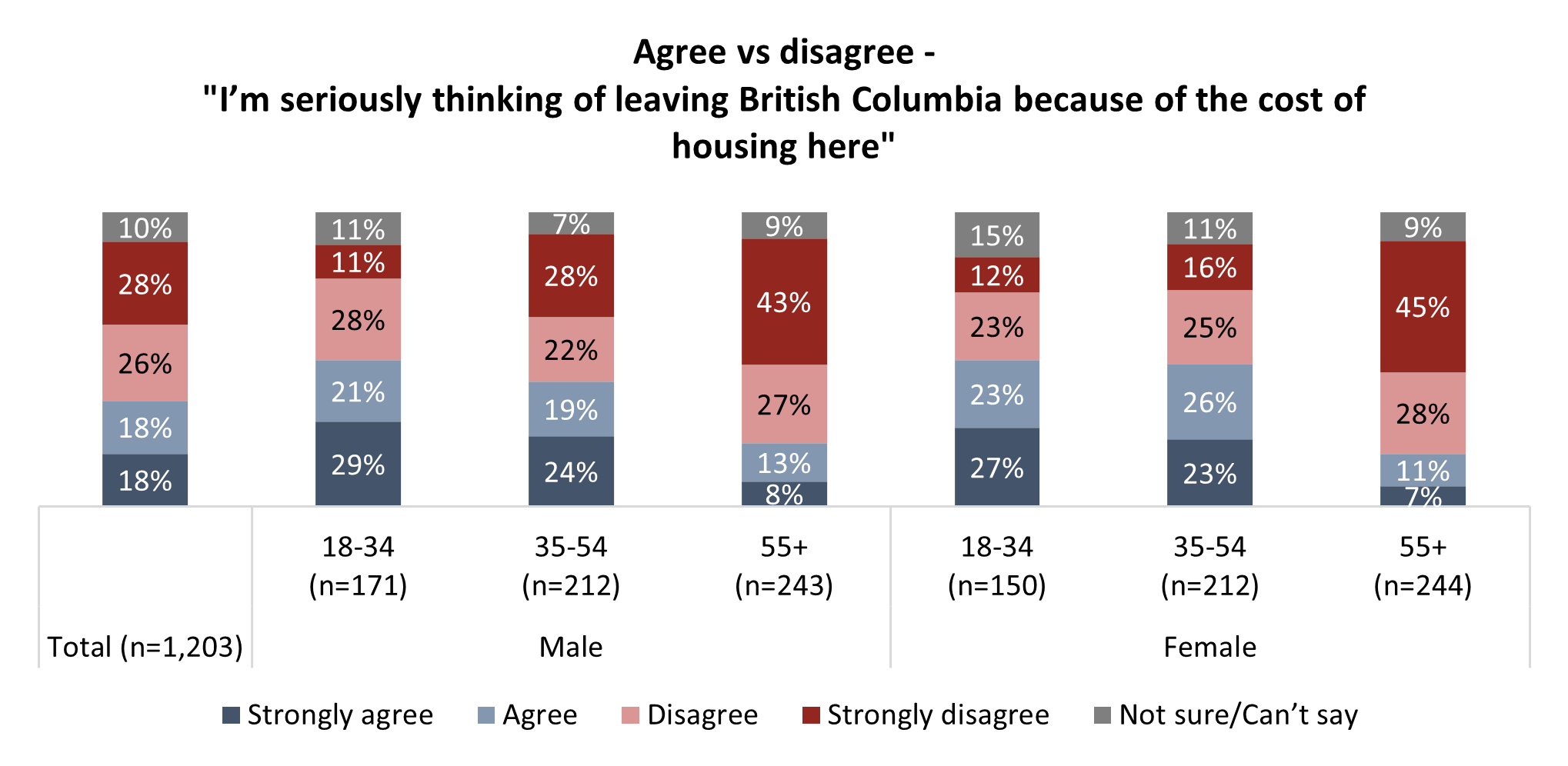
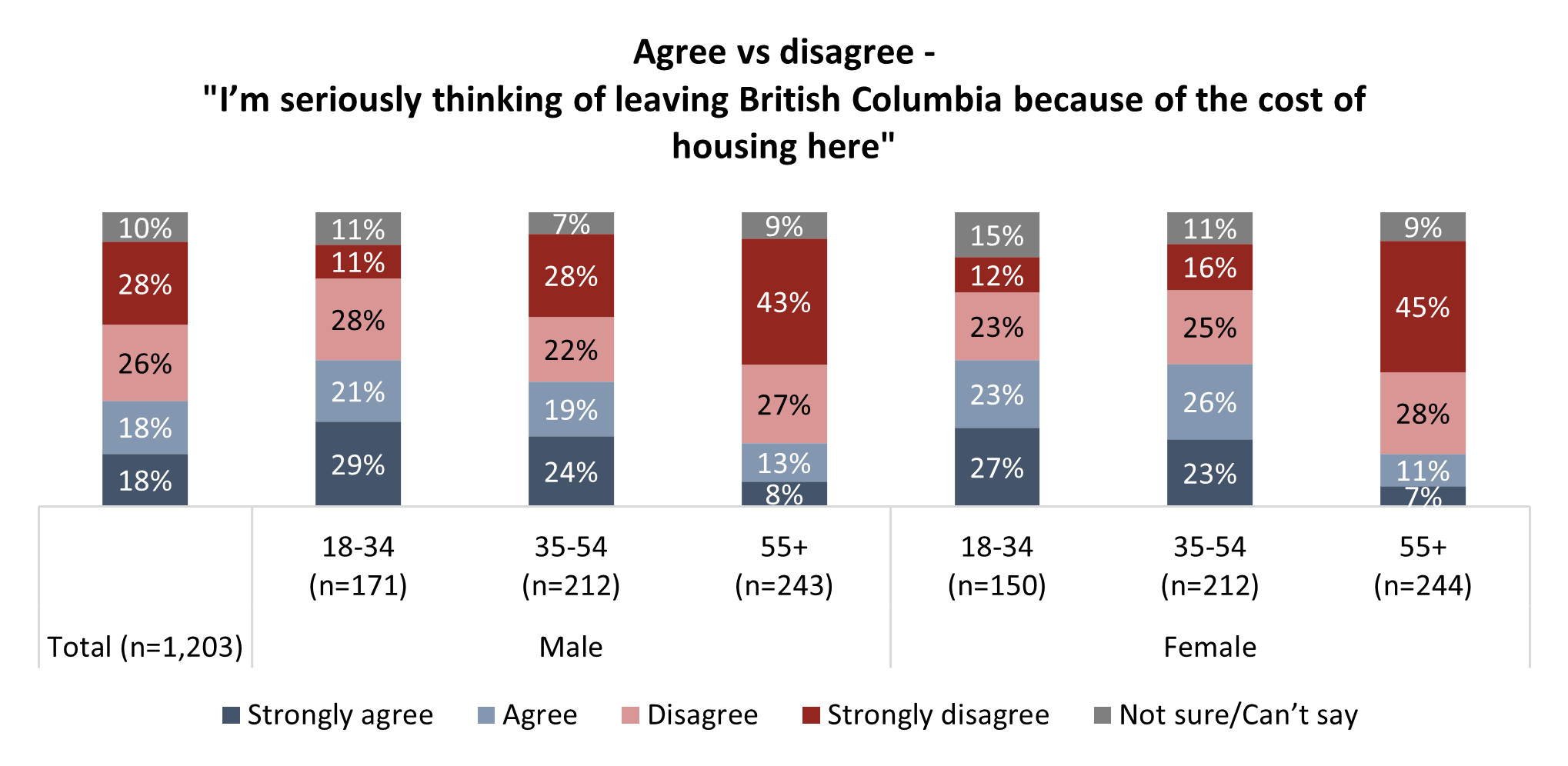
Among those 18-to-34 years of age, both men and women, the number who say they may leave because of the cost of housing rises to half.
On the housing file, those who would support the BC NDP in October are more bullish about the government’s efforts, though still two-in-five (43%) say more is needed. Majorities of all other would-be voters agree that not enough focus has been given to housing needs:

A plurality of residents say the government is not focused enough on encouraging investment. Equal numbers are unsure (24%) or say the government has given sufficient attention to this file, while five per cent say it is too focused on investment:
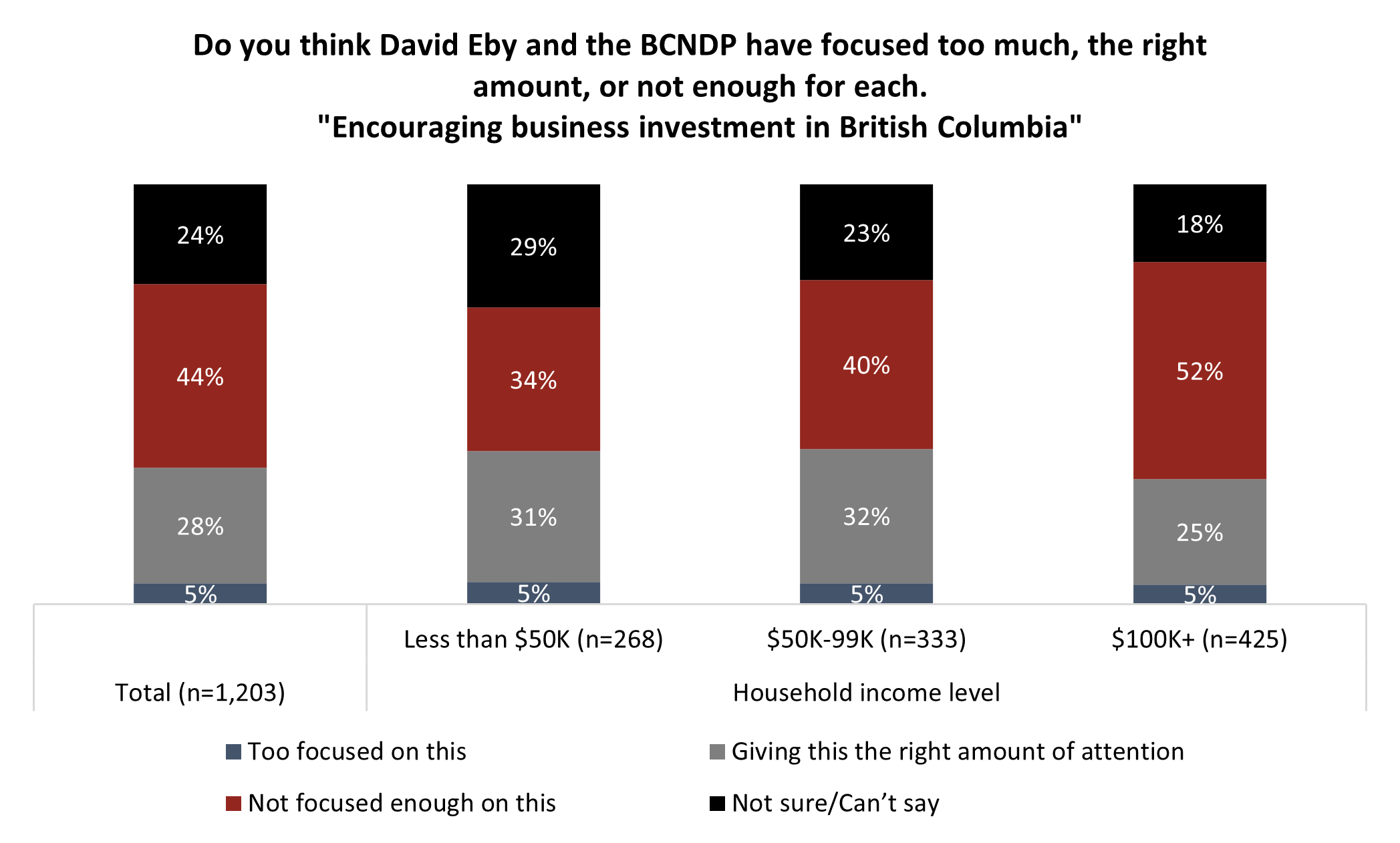
Those with higher income levels in the province are more likely to have a view of this issue and more likely to be critical of the provincial government. Half among this higher income group say more focus on investment is needed, while lower-income residents (sub-$50K) are divided between satisfaction, criticism, and uncertainty:
The Full Story
INDEX
Part One: Two-in-five say more focus needed on business investment
- Half with incomes over $100K hold this view
- NDP voters less concerned, centre-right opposition unified
Part Two: Housing affordability woes
- Majority say more effort needed on housing file
- NDP supporters divided whether government has done enough
- Half in every region say more needed
- One-in-three residents “seriously considering” moving out of province due to cost
Part One: Two-in-five say more focus needed on business investment
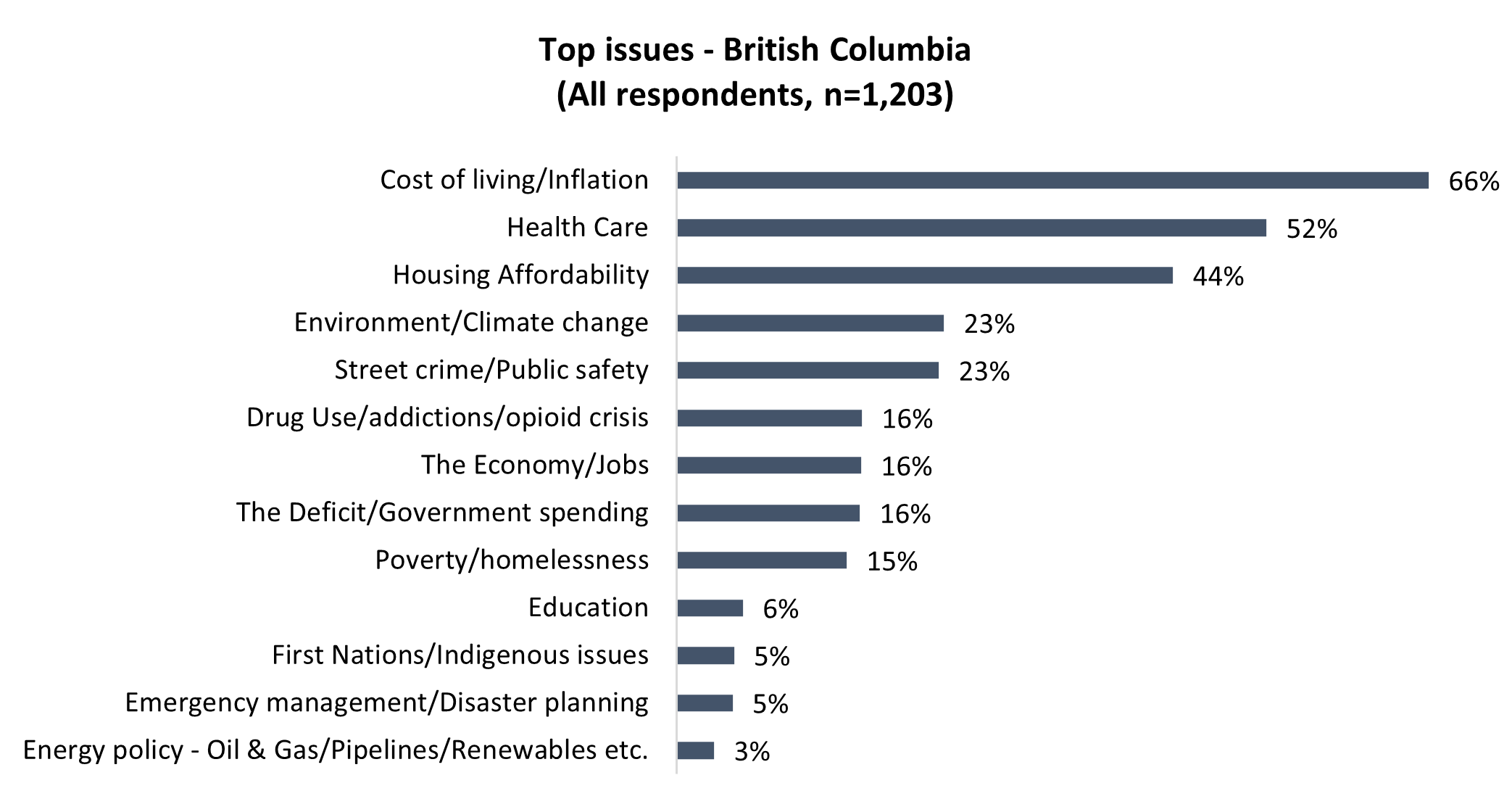
Ahead of the expected October provincial election, residents will take a hard look at candidates and leaders to see who they trust to handle the reins of B.C. for the next four years. Top among the issues they’ll be assessing are evidently a number of core issues, with the cost of living, health care, and housing affordability standing out among others:
With economic issues like inflation, jobs, and government spending all important to a significant number of British Columbians, the Angus Reid Institute asked residents how they feel the BC NDP has handled a key aspect of overcoming these challenges: business investment. The COVID-19 pandemic hit the province hard, and subsequent inflation and higher interest rates have evidently slowed investment after a two-year spike in 2021 and 2022. Slow economic growth is expected this year, though some predict investment will pick up again in 2025. Amid a weaker economic forecast, S&P Global downgraded the province’s credit rating from AA to AA- this spring.
For their part, when they consider the priorities of the BC NDP, a plurality of residents say the government is not focused enough on encouraging investment. Equal numbers are unsure (24%) or say the government has given sufficient attention to this file, while five per cent say it is too focused on investment:

Half with incomes over $100K hold this view
After an interest rate cut from the Bank of Canada last week, optimism is growing that investment levels will increase longer-term, though business leaders in British Columbia evidently hold mixed views of the B.C. environment. The Greater Vancouver Board of Trade offered the latest provincial budget a ‘C’ letter grade, but the Canadian Home Builder’s Association of BC was reportedly “pleased”.
Those with higher income levels in the province are more likely to have a view of this issue and more likely to be critical of the provincial government. Half among this higher income group say more focus on investment is needed, while lower-income residents (sub-$50K) are divided between satisfaction, criticism, and uncertainty:

NDP voters less concerned, centre-right voters unified
For the BC NDP, much of this years’ budget is tied to the selling voters ahead of the expected fall election. The province’s policies reportedly aimed at helping working and middle-class families is projected to result in the largest deficit in B.C. government history. On the investment question, one-in-five of those who say they would support the incumbents (22%) say the government needs to do more, but this pales in comparison to views among BC United or Conservative Party of B.C. voters, who tend to be much more critical:

Part Two: Housing affordability woes
Housing affordability challenges are nothing new to many British Columbians. Vancouver, Burnaby, Victoria, and Kelowna all rank among the 12 most expensive cities to rent in across the country, while purchase prices follow a similar trend. Home prices have been rising precipitously since the turn of the century.
Majority say more effort needed on housing file
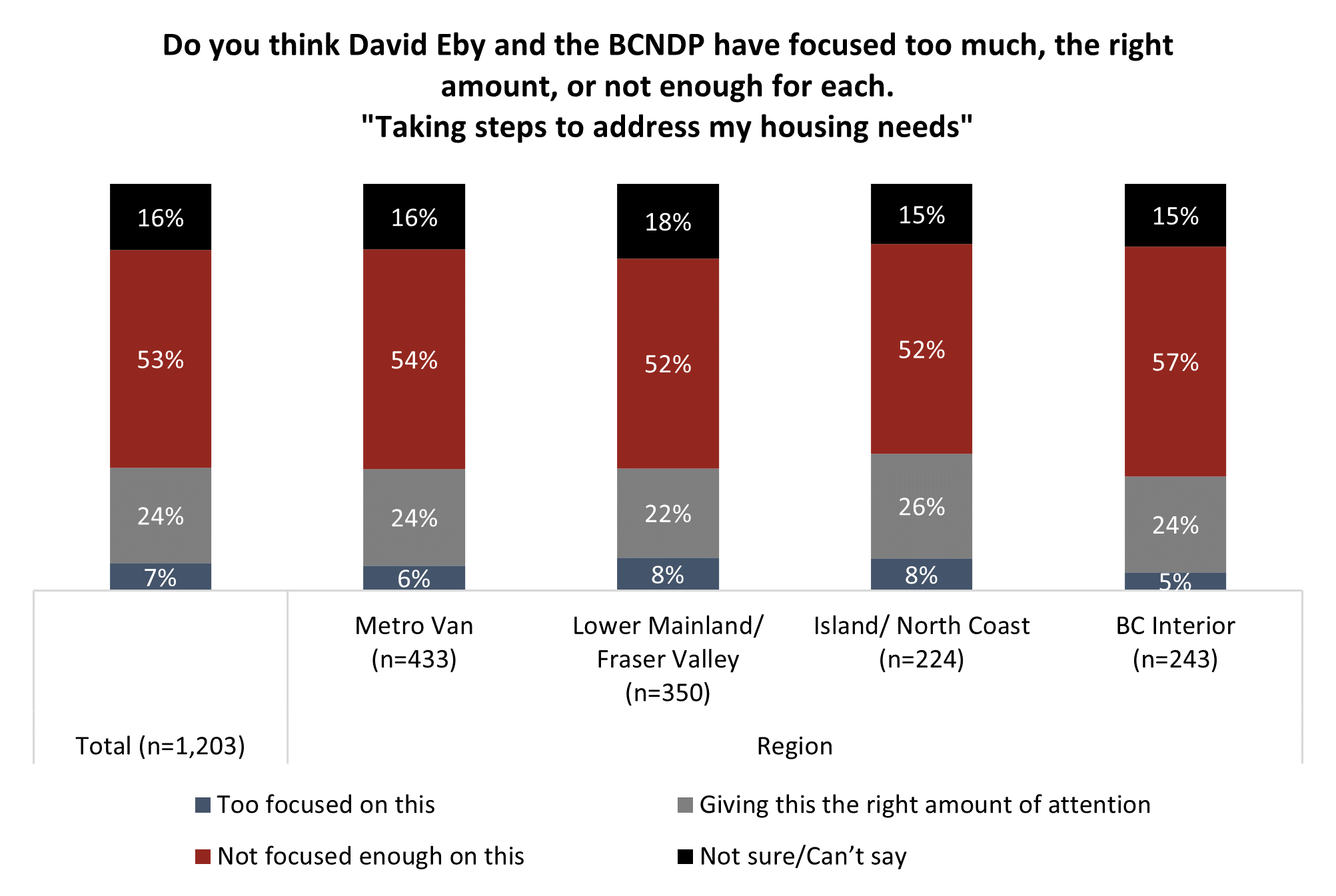
While the BC NDP has announced a series of actions on home affordability, and Metro Vancouver now leads the nations in new housing starts, residents continue to grapple with the reality of costs. Half (53%) say the government needs to focus more on taking steps to address their housing needs. One-quarter (24%) are satisfied, and seven per cent say the focus has been too heavy.
This latter group may be reacting to short-term rental restrictions and increasing provincial say in municipal home building, which have ruffled many feathers in recent months:

NDP supporters divided whether government has done enough
On this file, those who would support the BC NDP in October are more bullish about the government’s efforts, though still two-in-five (43%) say more is needed. Majorities of all other would-be voters agree with the latter sentiment:

Notably, 35- to 54-year-olds, those most likely to be in the throes of mortgage payments or be providing for children in addition to themselves, are most likely to say that more focus on housing affordability must be part of the government’s plans. More than three-in-five men and women in this age group say so:

These acute challenges are evident in every region of the province. Indeed, at least 52 per cent in all areas say their housing needs should be more of a focus:
One-in-three residents “seriously considering” moving out of province due to cost
In 2023, for the first time in more than 10 years, B.C.’s had a negative net interprovincial migration – that is the number of people who moved to B.C. from other provinces minus those who left for elsewhere in the country. Despite this outflow, the province’s population still grew, but the exodus of British Columbians to other provinces is perhaps emblematic of the affordability challenges the province faces. A study released in Nov. 2023 showed that B.C. had the highest cost of living of any province in the country.
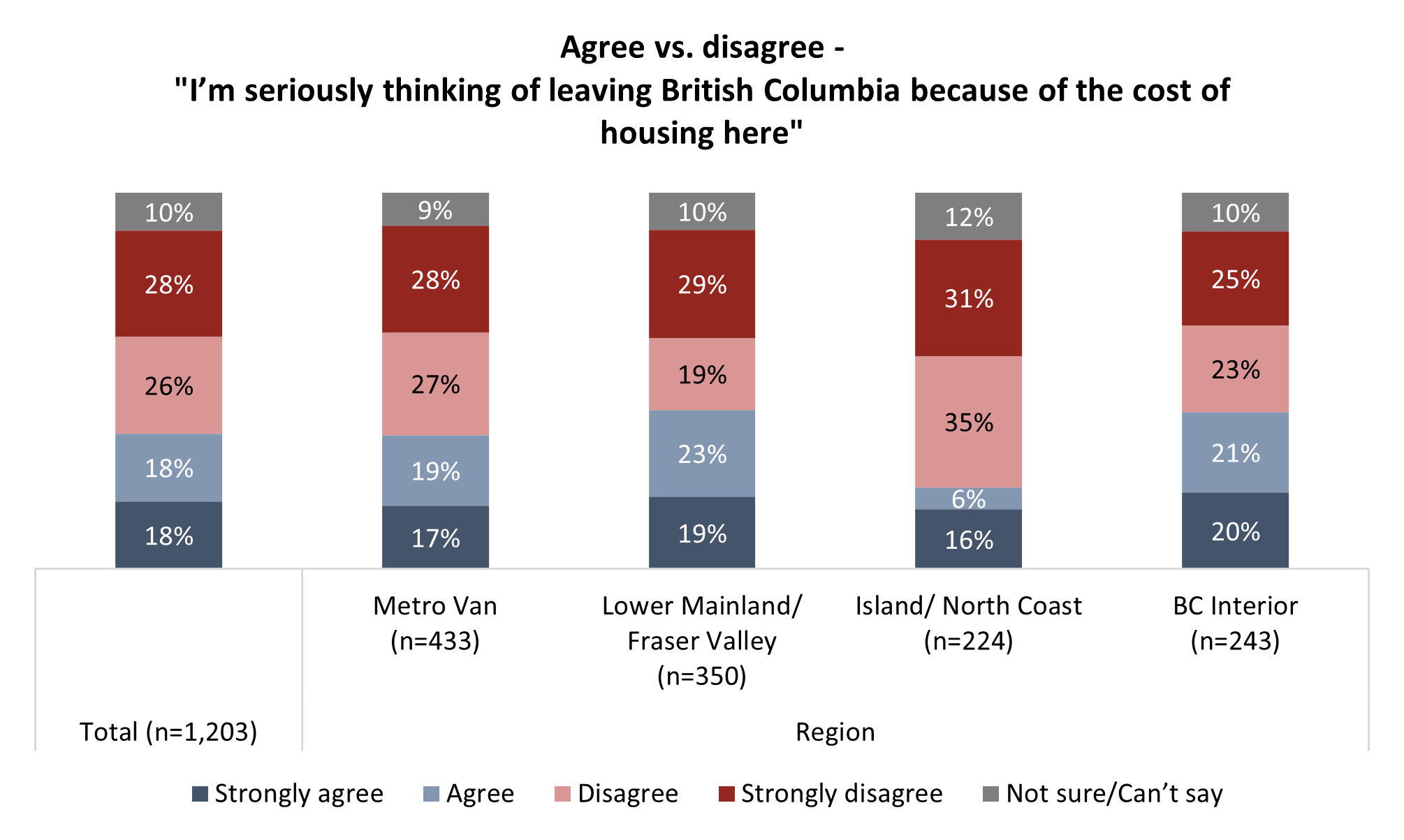
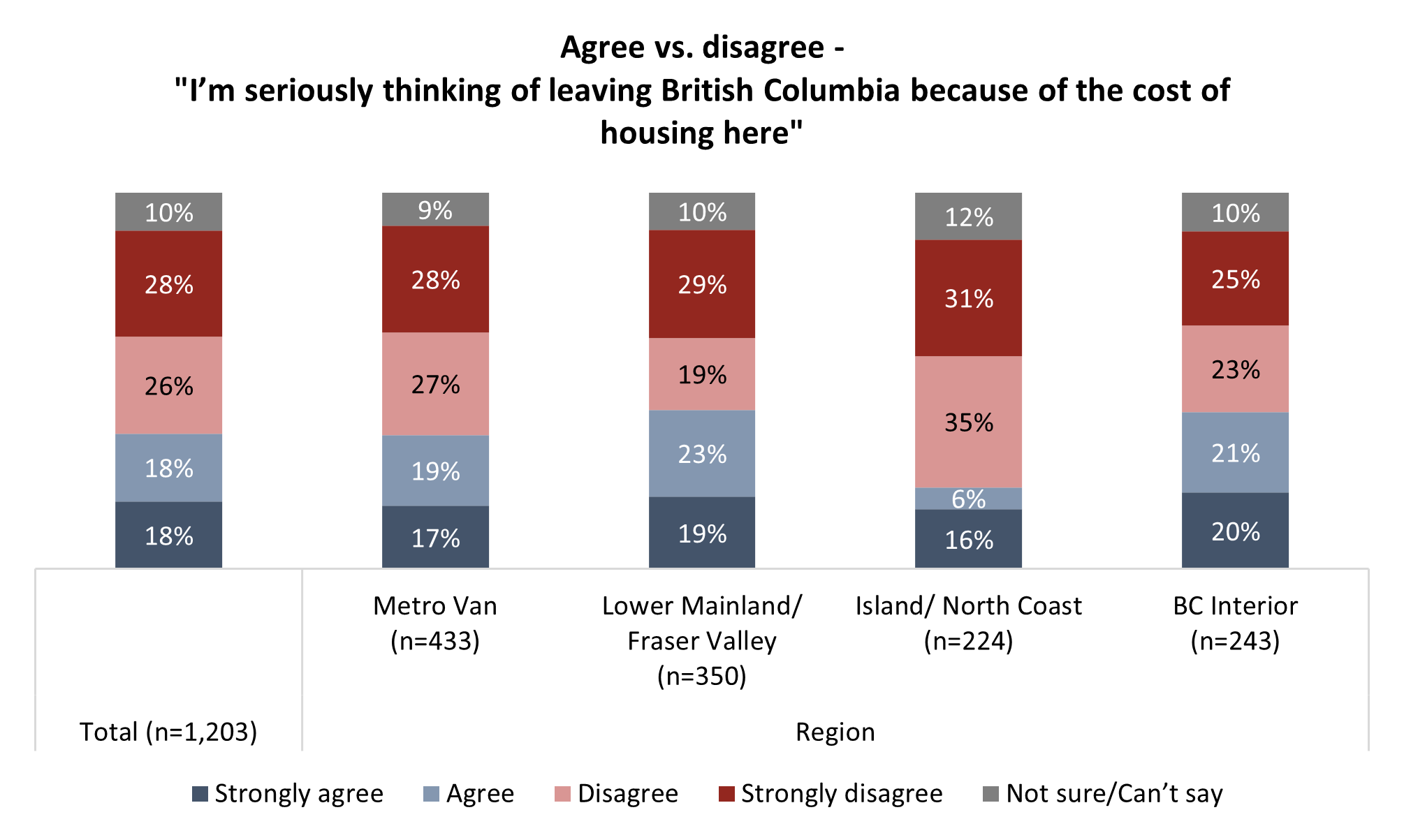
More than one-third (36%) British Columbians say they are contemplating leaving the province because of the high cost of housing, while a majority (54%) say that is not a consideration. Those in the Lower Mainland (42%) and Interior (41%) are more likely to say they are seriously thinking of leaving the province than those in Metro Vancouver (36%) and on the Island or North Coast (22%):
This sentiment is consistent across income levels (see detailed tables) but is not shared equally by British Columbians of all ages. Half of 18- to 34-year-olds and more than two-in-five 35- to 54-year-olds say they are seriously thinking of leaving the province because of the cost of housing. For older British Columbians, who are more likely to be more established perhaps with a home that they’ve paid off, leaving is less of a consideration:
METHODOLOGY
The Angus Reid Institute conducted an online survey from May 24-30, 2024 among a representative randomized sample of 1,250 British Columbian adults who are members of Angus Reid Forum. For comparison purposes only, a probability sample of this size would carry a margin of error of +/- 2 percentage points, 19 times out of 20. Discrepancies in or between totals are due to rounding.
ARI also surveyed an additional sample of 99 Indigenous adults living in British Columbia from May 24-30, 2024.
The survey was self-commissioned and paid for by ARI. Detailed tables are found at the end of this release.
For detailed results by age, gender, region, education, and other demographics, click here.
For full release including methodology, click here.
For full questionnaire, click here.
MEDIA CONTACT:
Shachi Kurl, President: 604.908.1693 shachi.kurl@angusreid.org @shachikurl
Dave Korzinski, Research Director: 250.899.0821 dave.korzinski@angusreid.org