


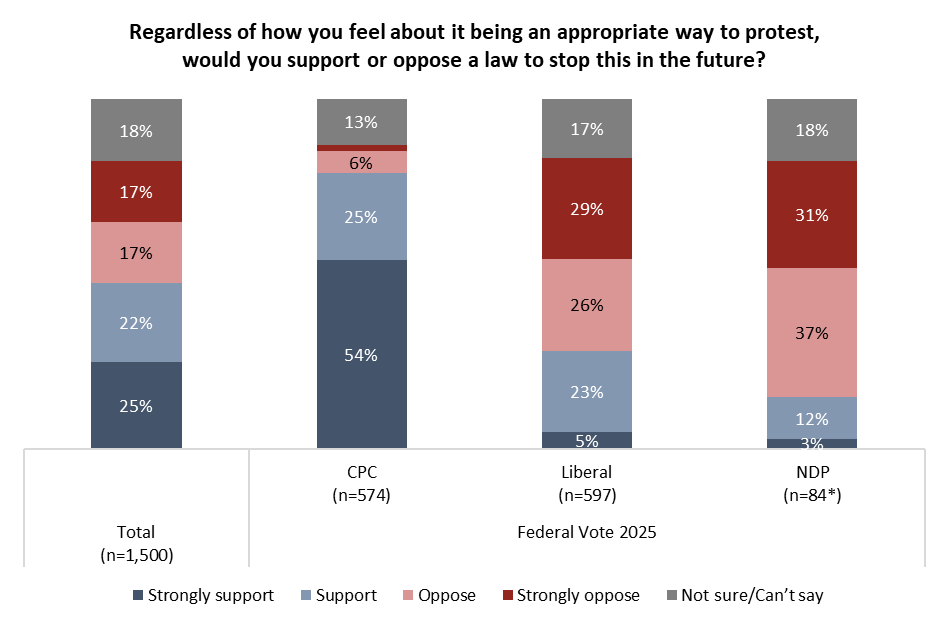
More Canadians support (47%) than oppose (34%) a law to prevent metre-long ballots in future elections
July 28, 2025 – After battling 90 other candidates in April and set to duke it out with 200 more in his upcoming August byelection, Conservative leader Pierre Poilievre wants to legislate a stop to what he calls the “longest ballot scam”.
New data from the non-profit Angus Reid Institute finds half (47%) of Canadians on board with passing a law to stop the efforts of the Longest Ballot Committee, which has stacked Poilievre’s last two election contests to protest Canada’s first-past-the-post electoral system.
*Smaller sample size, interpret with caution
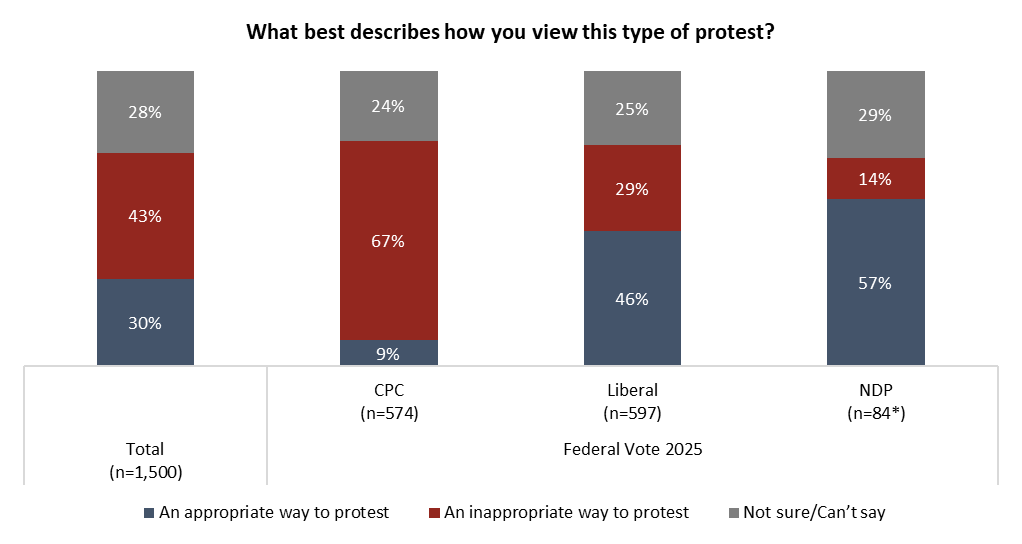
Two-in-five (43%) Canadians call it inappropriate to flood candidates in elections as a protest, which made the Carleton ballot a metre long in April. This, after Elections Canada announced voters would have to write-in their preferred candidate rather than printing an extended ballot to accommodate the hundreds of names put forward in the upcoming Battle River-Crowfoot byelection. That contest will pit Poilievre against more than 200 other candidates.
*Smaller sample size, interpret with caution
Although Poilievre has been the most recent target, past key Liberal byelections have also had long ballots. Despite this, it is Conservatives who are both more likely than others to call long ballot protests out-of-line (67%) and most likely to support a law making it more difficult to pull off in the future (79%).
About ARI
The Angus Reid Institute (ARI) was founded in October 2014 by pollster and sociologist, Dr. Angus Reid. ARI is a national, not-for-profit, non-partisan public opinion research foundation established to advance education by commissioning, conducting and disseminating to the public accessible and impartial statistical data, research and policy analysis on economics, political science, philanthropy, public administration, domestic and international affairs and other socio-economic issues of importance to Canada and its world.
INDEX
-
Seven-in-10 aware of Longest Ballot Committee protest
-
Two-in-five describe long ballot protest as ‘inappropriate’
-
Those who want measures to prevent future long ballot protest are mostly Conservatives
Seven-in-10 aware of Longest Ballot Committee protest
The recent 2025 federal election proved to be a headache for Conservative leader Pierre Poilievre for several reasons. Not only did his party fail to form government, but Poilievre lost his Carleton seat to the Liberal candidate, Bruce Fanjoy. Both had to contend with a metre-long ballot with 91 total candidates on election day due to efforts from the Longest Ballot Committee, who have been organizing mass candidate sign-ups as a protest to the first-past-the-post electoral system. The Longest Ballot Committee believe that politicians shouldn’t be deciding election rules because they have a conflict of interest. Instead, the committee believes a non-partisan body should decide Canada’s election system.
Electoral reform has been an issue that has been simmering in the past decade. During the 2015 campaign which first elected him as prime minister, Justin Trudeau famously proclaimed it would be “the last federal election conducted under the first-past-the-post voting system.” He eventually broke his promise to bring electoral change, but did say upon his resignation that he regretted not bringing forward a ranked ballot system to replace first past the post.
Related:
- Battle of the ballots: Two alternate voting systems seen as competitive to First Past the Post
- Electoral reform revival? Support for changing voting systems skyrockets post election
- Federal Politics: Three-in-five Canadians would have preferred outcome of election held using proportional distribution
Poilievre may have left his Carleton riding behind, but the long ballot is following him to Alberta. More than 200 candidates, the bulk of them organized by the Longest Ballot Committee, have signed up to contest the Battle River-Crowfoot riding Poilievre is targeting for his return to parliament in an upcoming byelection. Instead of a long ballot, Elections Canada announced that voters would have to write-in the name of their preferred candidate on election day.
Seven-in-10 Canadians say they have at least heard of the long ballot protest, while recent Conservative voters are much more likely to say they have been talking about it with friends and family:

*Smaller sample size, interpret with caution
Two-in-five describe long ballot protest as ‘inappropriate’
The long ballots, besides making it difficult for voters to find their preferred candidate on election day, have also resulted in delayed vote counts. Poilievre has spoken out against the protest, calling it a “scam”, while other candidates running Battle River-Crowfoot have said it has made it difficult for them to legitimately campaign.
While Poilievre has been the recent target of the Longest Ballot Committee, it has also flooded by-elections in historic Liberal strongholds in years past.
Canadians are more likely to describe long ballot initiatives as “inappropriate” (43%) than fair play (30%), but there is a strong correlation on those opinions depending on one’s politics. Two-thirds (67%) of Conservatives believe the Longest Ballot Committee protest is out of line:

*Smaller sample size, interpret with caution
Those who want measures to prevent future long ballot protests are mostly Conservatives
Poilievre has said he wants changes to election rules to prevent future long ballots. He’s proposed increasing the required number of signatures a candidate needs to be put on the ballot from 100 to 0.5 per cent of a riding’s population. Poilievre also wants rules limiting electors to signing only a single candidate nomination form; the Longest Ballot Committee often uses many of the same people to sign nominations for multiple candidates.
Half of Canadians (47%) support a law to stop future long ballot protests. However, support for such a law is highly concentrated among past Conservative voters. Other partisans are more likely to oppose finding a way to outlaw the Longest Ballot Committee’s efforts:

*Smaller sample size, interpret with caution
Survey Methodology:
The Angus Reid Institute conducted an online survey from July 23-28, 2025, among a randomized sample of 1,500 Canadian adults who are members of Angus Reid Forum. The sample was weighted to be representative of adults nationwide according to region, gender, age, household income, and education, based on the Canadian census. For comparison purposes only, a probability sample of this size would carry a margin of error of +/- 2.0 percentage points, 19 times out of 20. Discrepancies in or between totals are due to rounding. The survey was self-commissioned and paid for by ARI.
For more information on our polling methods, click here.
For detailed results by age, gender, region, education, and other demographics, click here.
For PDF of full release, click here.
For questionnaire, click here.
Top photo by John Lehmann/ Pierre Poilievre Facebook
MEDIA CONTACTS:
Shachi Kurl, President: 604.908.1693 shachi.kurl@angusreid.org @shachikurl
Dave Korzinski, Research Director: 250.899.0821 dave.korzinski@angusreid.org
Jon Roe, Research Associate: 825.437.1147 jon.roe@angusreid.org