

Albertans divided along political lines on abolishing senate and allowing province to appoint judges
April 10, 2026 – The focus of Alberta’s fall referendum may be a question on separation, but the provincial government has already created a laundry list of queries for Albertans to ponder on Oct. 19, including many on how the province should handle immigration.
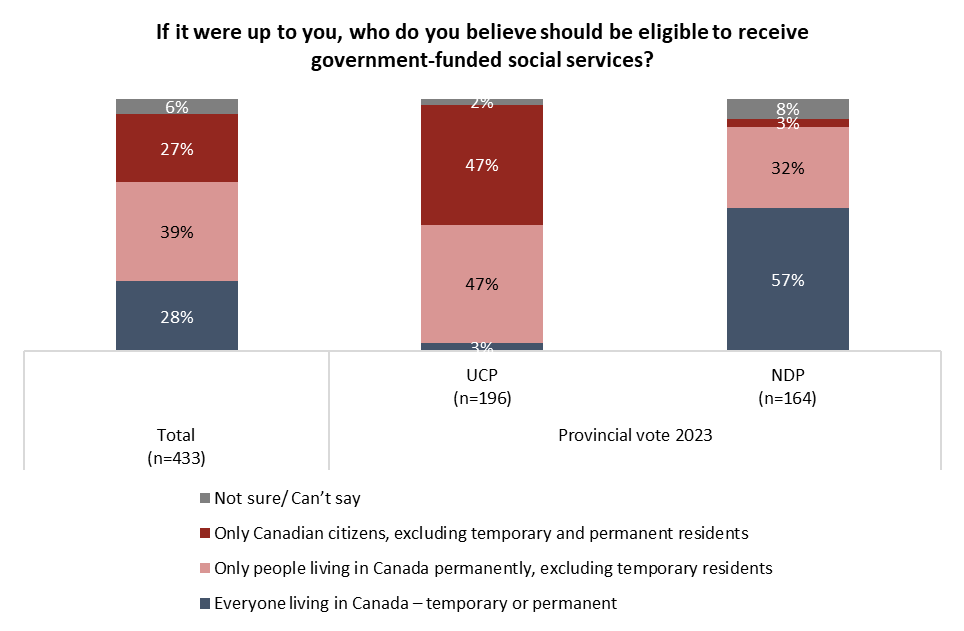
New data from the non-profit Angus Reid Institute finds support for at least one question on the ballot. Two-thirds (66%) of Albertans say they would support restricting temporary residents from accessing government-funded social services. That includes two-in-five (39%) who believe only those living in Canada permanently should have provincially funded access to things like health care and education, and one-quarter (27%) who would believe this should be reserved for Canadian citizens only. Three-in-10 (28%) say everyone living in Canada, temporary or permanent, should have access to government-funded social services.
Among those who voted for the UCP in 2023, half (47%) would exclude temporary residents from accessing government-funded social services and half (47%) say only citizens should be able to access government-funded health and education.
Three-in-five (57%) Alberta NDP voters believe everyone living in Canada should be eligible for social services with government funding. One-third (32%) would restrict that to only those living in Canada permanently.
ARI also asked Albertans about two other measures included on the fall ballot. There is a political divide on both changing the Constitution to allow provinces more control over the appointment of provincial judges (UCP voters, 81% support; NDP voters, 77% oppose) and abolishing the federal Senate (UCP voters 73% support; NDP voters, 60% oppose).
About ARI
The Angus Reid Institute (ARI) was founded in October 2014 by pollster and sociologist, Dr. Angus Reid. ARI is a national, not-for-profit, non-partisan public opinion research foundation established to advance education by commissioning, conducting and disseminating to the public accessible and impartial statistical data, research and policy analysis on economics, political science, philanthropy, public administration, domestic and international affairs and other socio-economic issues of importance to Canada and its world.
INDEX
-
Majority support for restricting access to government-funded social services
-
Political divide on allowing provincial government to appoint judges
-
Split on abolishing the senate
Majority support for restricting access to government-funded social services
Albertans will have much to consider this fall with at least nine referendum questions on the ballot on Oct. 19. And that’s without counting a potential question on the future of Alberta in Canada’s confederation. Alberta separatists say they have enough signatures to get their question on the ballot, but that has yet to be verified and the group needs to resolve an ongoing legal challenge from the province’s First Nations.
The current long ballot of referendum questions developed by Premier Danielle Smith and the UCP government include a series of questions on immigration, including whether or not the province should restrict the access of government-funded social service programs, such as health and education, to “Canadian citizens, permanent residents, and individuals with an Alberta-approved immigration status”.
Prior to the release of the province’s budget, Smith partly blamed an influx of newcomers for the province’s deficit. “Throwing the doors open to anyone and everyone across the globe has flooded our classrooms, emergency rooms and social support systems with far too many people, far too quickly,” she said, proposing Albertans vote on one of her solutions to the problem, restricting Alberta’s social services from temporary residents.
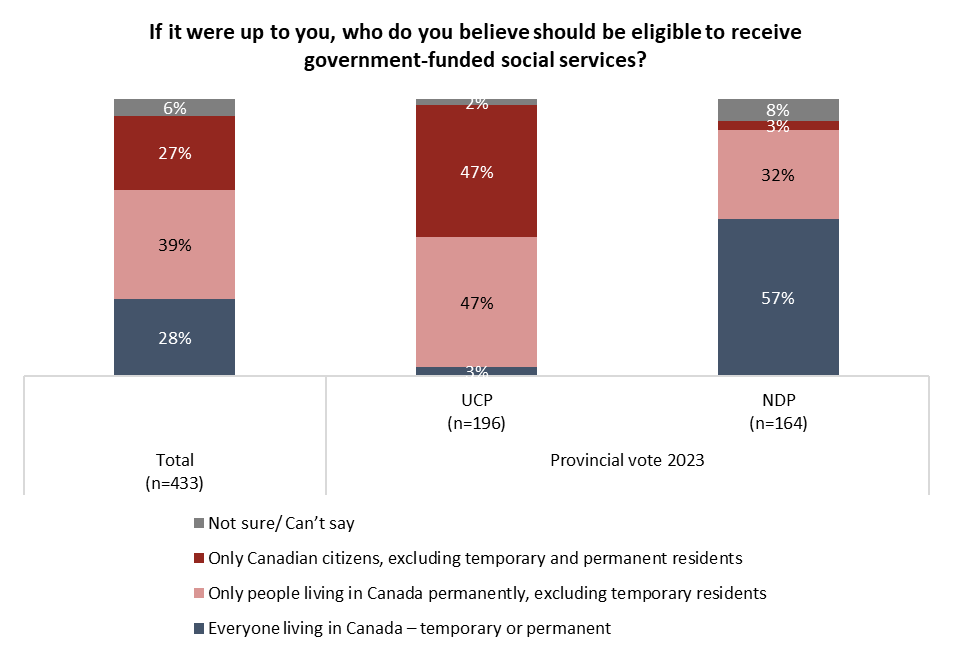
The idea that only those living in permanently in Canada should have access to government-funded social services is popular among a majority (66%) of Albertans. Two-in-five (39%) say they would exclude temporary residents from receiving provincially funded social services such as health and education. Another one-quarter (27%) would go further and only allow Canadian citizens to have access to government-funded social services.
There is near universal support from past UCP voters to restrict government-funded social services from temporary residents. UCP voters are overall split, however, as to how far they would go, with half (47%) wanting to also exclude permanent residents who aren’t Canadian citizens.
Three-in-five (57%) who voted NDP in the 2023 provincial election say everyone living in Canada should be eligible for government-funded social services. One-third (32%) say they would restrict those services from temporary residents:
Albertans older than 54 are much less likely than other age groups to believe everyone living in Canada, temporarily or permanently, should have access to government-funded social services. They are also more likely to say that only those who are full Canadian citizens should have access to provincially funded education and health care:

Political divide on allowing provincial government to appoint judges
Smith, alongside Premiers Doug Ford in Ontario, Scott Moe in Saskatchewan and François Legault in Quebec, want more provincial control of the judicial system. The four wrote a letter in March asking Ottawa to change the Constitution to require the federal government only appoint provincial superior and appeal court judges that have been approved and recommended by the provinces.
Although the province passed a motion in legislature proposing the above, it is also asking what Albertans think in the fall referendum on the same subject. Albertans are split as to whether they support or oppose provincial governments appointing judges instead of the federal government. Half (48%) say they support it, while two-in-five (40%) are opposed. The divide is largely political: UCP voters support the idea (81%); most NDP voters are opposed (77%):

Split on abolishing the senate
There will also be a referendum question on whether or not Albertans want their government to work with other provinces on abolishing the federal Senate.
In 2015, when ARI last polled on senate reform, 27 per cent in Alberta wanted it abolished, but 59 per cent preferred to have it reformed. One-in-six (15%) wanted to leave it as is.
Although the question is different in this most recent survey, there does appear to be more support in Alberta for abolishing the senate than there was 10 years ago. More than two-in-five (43%) in the province now say they support abolishing the senate. Past UCP voters (73%) are much more supportive of the idea than those who voted NDP in 2023 (17%):

METHODOLOGY:
The Angus Reid Institute conducted an online survey from March 11-17, 2026, among a randomized sample of 433 Canadian adults who are residents of Alberta. Respondents are drawn from the Angus Reid Forum, a large-scale online panel developed to include Canadian residents in each of the 343 federal ridings in Canada and representative of the Canadian population by age, gender, family income, ethnic status and education. The sample was weighted to be representative of adults provincewide according to region, gender, age, household income, and education, based on the Canadian census. For comparison purposes only, a probability sample of this size would carry a margin of error of +/- 5 percentage points, 19 times out of 20. Discrepancies in or between totals are due to rounding. The survey was self-commissioned and paid for by ARI.
For detailed results by age, gender, region, education, and other demographics, click here.
For PDF of full release, click here.
For questionnaire, click here.
MEDIA CONTACT:
Shachi Kurl, President: 604.908.1693 shachi.kurl@angusreid.org @shachikurl
Dave Korzinski, Research Director: 250.899.0821 dave.korzinski@angusreid.org
Jon Roe, Senior Research Associate: 825.437.1147 jon.roe@angusreid.org