


Albertans more likely to feel they would lose out rather than gain if province leaves CPP
December 11, 2023 – Alberta Premier Danielle Smith had the rest of the country’s attention in early November, after announcing that she believed her province to be entitled to more than half of the value of the Canada Pension Plan if it follows through on threats to leave the plan and form its own provincial alternative.
Those compensation numbers have been disputed, but Ottawa has yet to provide its estimate of how much Alberta would receive were it to leave the CPP. As Alberta pauses public consultations on its pension proposal while it awaits Ottawa’s figures, new data from the non-profit Angus Reid Institute finds little appetite among Albertans or other Canadians to find out just what a CPP without Alberta would mean.
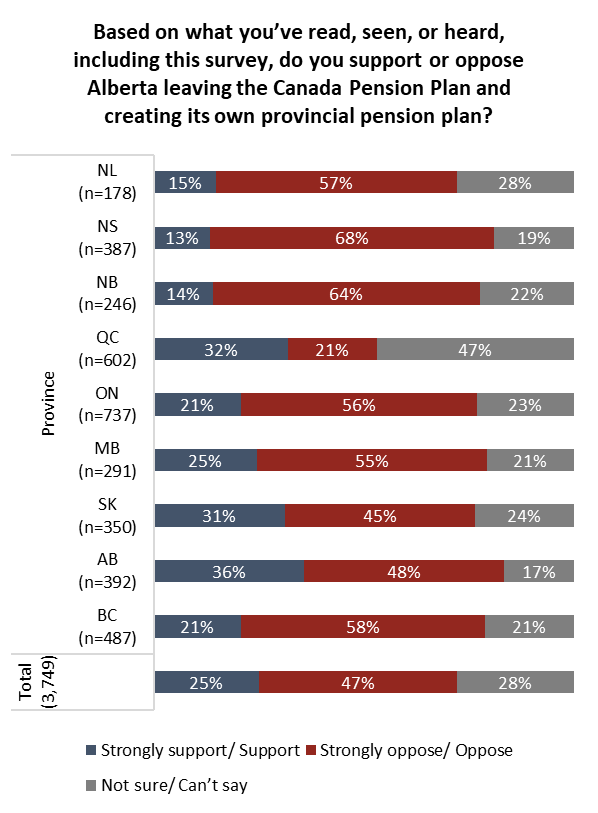
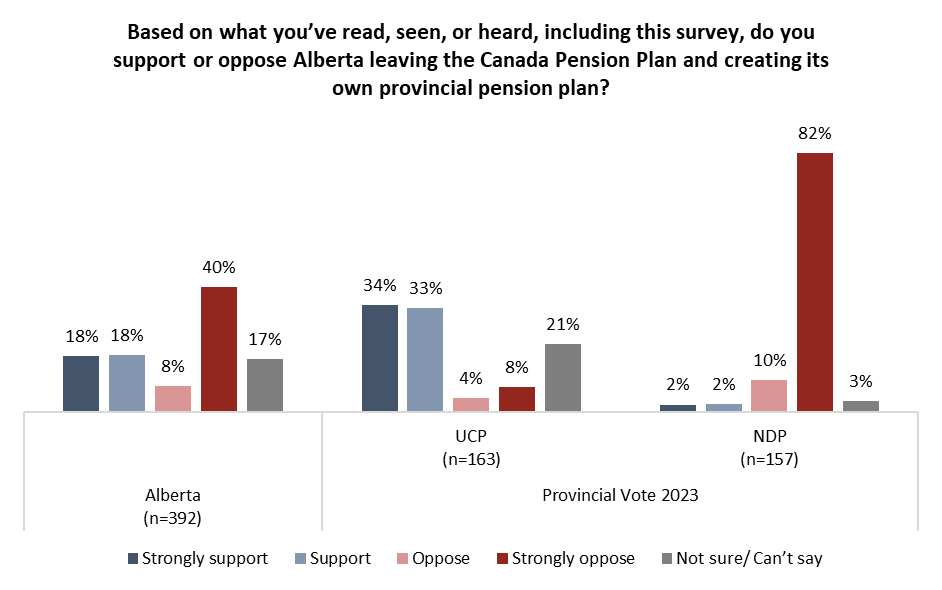
Indeed, half of Albertans (48%) say they oppose the idea of forming a provincial pension plan and leaving the federal program. This group is countered by 36 per cent in the province who support the proposal.
More than half in British Columbia, Manitoba, Ontario, and Atlantic Canada oppose this idea, while higher levels of support come from Saskatchewan (31%), and from Quebec (32%), which has had its own pension plan since the beginning.
Any province is eligible to leave the CPP with three years notice, but few would like their own to follow this path. The concept is most popular in Saskatchewan (37%), though opposition still wins out (44%). At least 57 per cent in all other provinces canvassed say they would not like to see their province go that route.
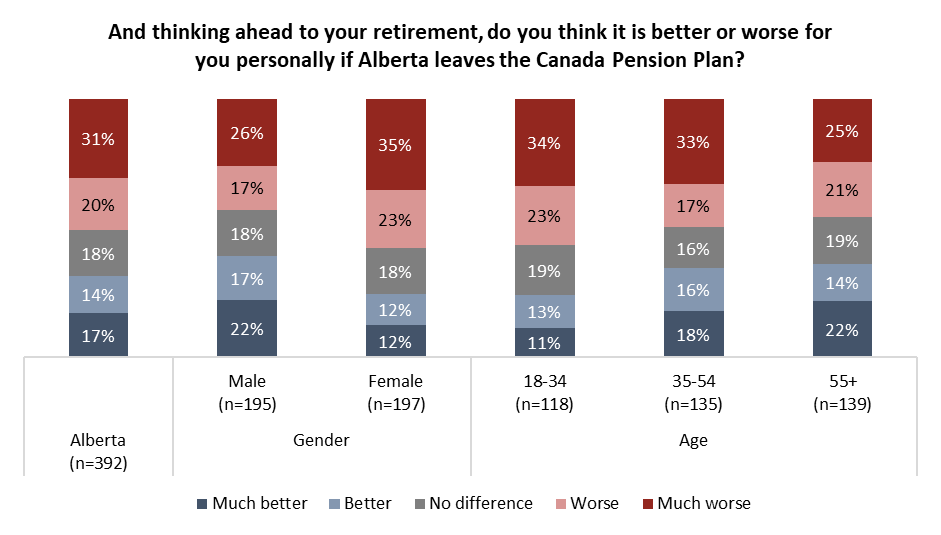
Much of the hesitation in Alberta appears to be regarding the disputed amount of benefit that Albertans would be eligible to receive. The prevailing sentiment is that there would be no change (18%) or a net loss (51%) to their own retirement savings. That said, three-in-10 Albertans (31%) feel they would end up receiving more in the future under an Alberta pension plan, compared to the CPP.
About ARI
The Angus Reid Institute (ARI) was founded in October 2014 by pollster and sociologist, Dr. Angus Reid. ARI is a national, not-for-profit, non-partisan public opinion research foundation established to advance education by commissioning, conducting and disseminating to the public accessible and impartial statistical data, research and policy analysis on economics, political science, philanthropy, public administration, domestic and international affairs and other socio-economic issues of importance to Canada and its world.
Note: Because its small population precludes drawing discrete samples over multiple waves, data on Prince Edward Island is not released.
INDEX
-
Canadians oppose Alberta leaving CPP at two-to-one ratio
-
Most would not want their own province to create separate pension plan
-
Albertans more likely to believe leaving CPP will cost them money
-
Half believe it will be worse for their retirement under an Alberta Pension Plan
Canadians oppose Alberta leaving CPP at two-to-one ratio
Provincial and territorial finance ministers met virtually in early November to discuss a proposal from Alberta Premier Danielle Smith to leave the Canada Pension Plan. All provinces except Quebec have been part of the Canada Pension Plan since pensions were mandated in 1966. Provinces have the right to depart from the system with three years notice and form their own alternative.
Alberta’s Smith has been critical of the amount that Alberta pays into the CPP, with her own government proposing that Alberta is entitled to more than half of the assets in the fund were it to leave. The argument that Alberta should receive so much is based on Alberta’s larger working-age population, and relatively high earning levels. Critics have disputed this estimate from Alberta, and federal Finance Minister Chrystia Freeland has asked the government’s chief actuary to “provide an estimate of the asset transfer”. The Alberta government had been holding public consultations on its proposal for a provincial pension plan, but has paused those as it awaits Ottawa’s estimates on the assets the province would be entitled to were it to leave the CPP.
Alberta’s departure from the CPP would be complicated by the need for international agreements to accommodate residents who spend most of their working life outside of the country (Quebec has agreements with 39 different countries) and concerns over the portability of such a program for those moving in or out of the province. Nonetheless, if this process is pursued, it will evidently rankle many Albertans. Overall, 36 per cent support the proposal, while half (48%) oppose it:

Few of the United Conservative Party’s recent voters oppose the idea, though one-in-five (21%) are uncertain. The opposition Alberta NDP find its previous voters near unanimously against leaving the CPP:
Even more so than those in province, the rest of Canada would also be largely opposed to an Alberta pension plan. Opposition is highest in Atlantic Canada, while support is notably elevated in Quebec, which has had its own pension plan since the 1960s:

Federal Conservative voters are much more divided than provincial ones (43% support vs 33% opposition), while 2021 Liberal and NDP voters show majority opposition:

Most would not want their own province to create separate pension plan
With Alberta mulling its own pension plan, it prompts a question to other residents in Canada: would you like your province to do the same?
The answer is largely a resounding “no”, as nearly three-times as many Canadians (outside of Alberta and Quebec) would not like to leave the CPP as would. Opposition is highest in Atlantic Canada:

Albertans more likely to believe leaving CPP will cost them money than save it
The lack of enthusiasm coming from Albertans when asked about leaving the CPP is largely based on concerns that their own household costs may increase. While more than one-in-three (37%) believe they would save money if Alberta leaves, a larger group (48%) say it would cost them more.

Half believe it will be worse for their retirement under an Alberta Pension Plan
Further, when asked to consider their own retirement, most Albertans are more comfortable with the CPP than they would be with a new APP. Half (51%) worry that they would be worse off, including one-in-five UCP voters. Another one-in-five overall (18%) say they anticipate breaking even, while three-in-10 (31%) say they would be better off with a provincial plan:

Notably, men are divided near-equally across all of these potential views of the situation, while women and younger people are most concerned that the APP would be a bad deal for them, personally:
Survey Methodology:
The Angus Reid Institute conducted an online survey from Nov. 24 – Dec. 1, 2023, among a representative randomized sample of 3,749 Canadian adults who are members of Angus Reid Forum. For comparison purposes only, a probability sample of this size would carry a margin of error of +/- 1.5 percentage points, 19 times out of 20. Discrepancies in or between totals are due to rounding. The survey was self-commissioned and paid for by ARI.
For detailed results by age, gender, region, education, and other demographics, click here.
For detailed results from Albertan respondents, click here.
To read the full report, including detailed tables and methodology, click here.
To read the questionnaire, click here.
Image – Chris Schwarz/Government of Alberta
MEDIA CONTACT:
Shachi Kurl, President: 604.908.1693 shachi.kurl@angusreid.org @shachikurl
Dave Korzinski, Research Director: 250.899.0821 dave.korzinski@angusreid.org @davekorzinski