


One-in-eight say they’ve been looking for more than a year or have given up on finding a family doctor
Feb. 5, 2026 – Once a source of pride for Canadians, Canada’s health-care system has been on a 10-year slide with more Canadians than ever before having to overcome hurdles to see their family doctor, never mind specialists, diagnostics, surgeons or even emergency physicians.
New data from the non-profit Angus Reid Institute analyzes the changes in a decade worth of public opinion data that highlights these struggles. From 2015 to 2025, the percentage of Canadians who have difficult or no access to a family doctor has increased by 25 per cent (40% of Canadians in 2015, 50% in 2025).
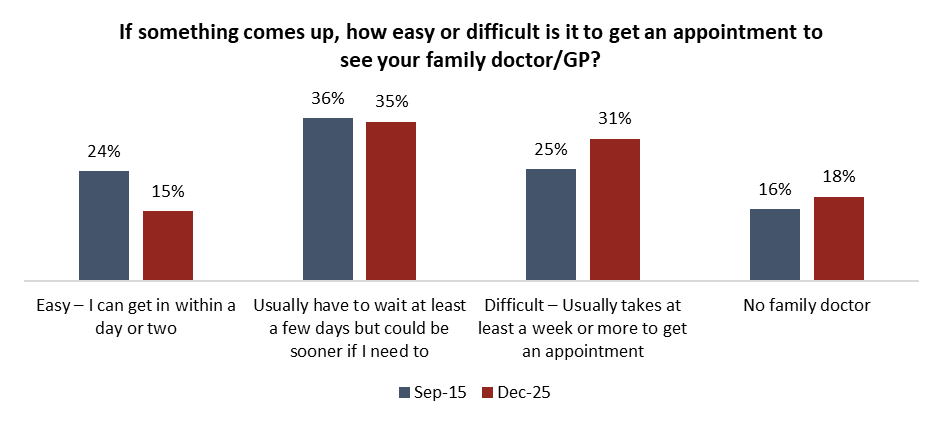
Meanwhile, those who say it’s easy for them to get an appointment within a day or two has declined by nine points from 24 per cent in 2015 to 15 per cent currently.
The family doctor issue remains a challenging one for Canada’s provincial health-care systems to address. According to data from The Canadian Institute for Health Information, the number of family doctors per capita has risen across the country since 2015 and in every province except Alberta and Ontario. But because of an aging population with increasingly complicated medical needs, and more specialized family practices, Canadians have less access to their family doctor in general. Indeed, in every province in the country, there are more Canadians who say they don’t have a family doctor or can’t get a timely appointment with the one they had, than said so in 2015.
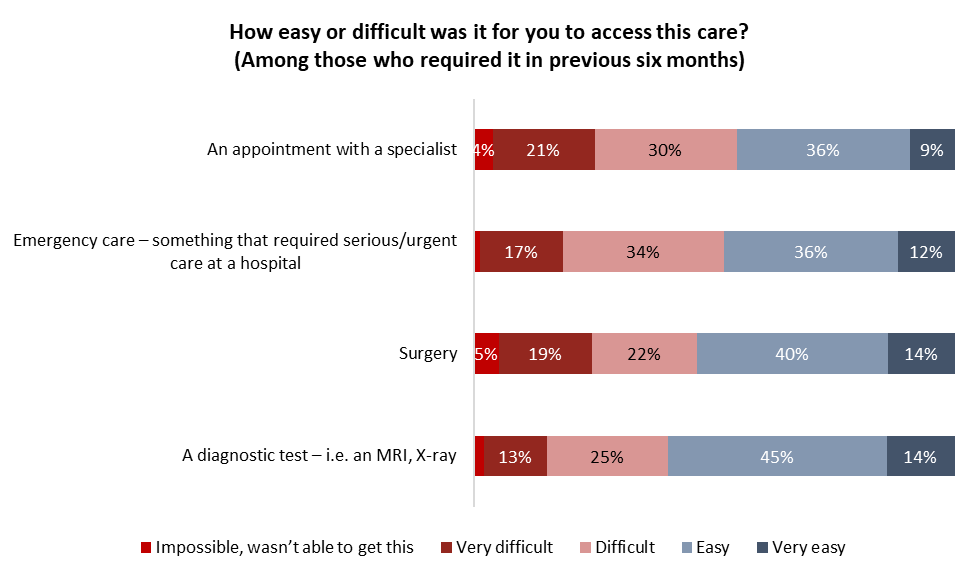
Other facets of the health-care system are also under strain. Among those who needed care from the system in the past six months, two-in-five (40%) say they faced difficulties booking a diagnostic test, more (46%) said it was hard to get surgery they needed, a majority (56%) faced barriers obtaining an appointment with a specialist and half (52%) found it difficult to access emergency care.
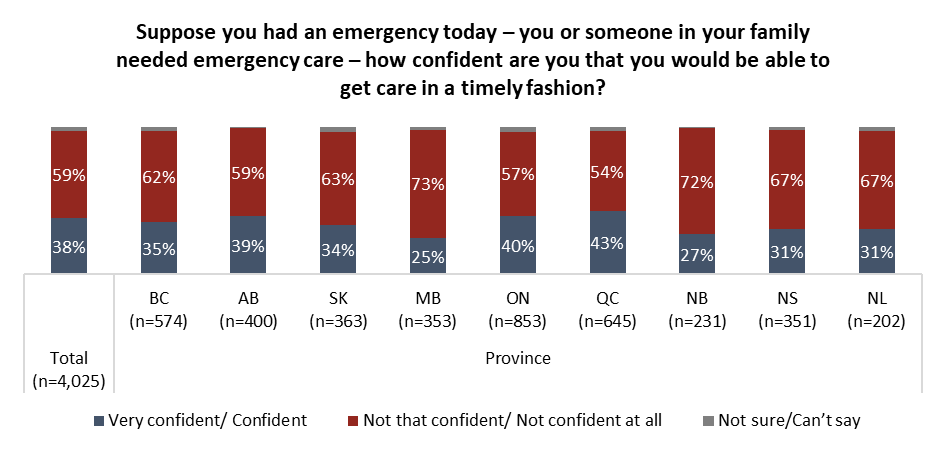
With all these evident issues with health care, seven-in-ten (70%) say the quality of the health-care system in their province has deteriorated in the past decade. Since 2015, spending on health care in Canada has nearly doubled, from $219 billion to $399 billion, including a $130-billion increase in public spending. And yet, the crisis in the health-care system has left many wondering if medical care will be there when they need it. Three-in-five (59%) say they are not confident that they will be able to get timely access to health care if they had an emergency.
More Key Findings:
- Seven-in-ten (71%) say they are dissatisfied with the performance of the provincial government on health care.
- The regions where Canadians report the most issues accessing family doctors are Saskatchewan (41% difficult access, 22% no family doctor), Quebec (29% difficult access, 31% no family doctor) and Atlantic Canada (39%, 21%).
- Quebec also leads the way in the proportion of the population who have been looking for more than a year for a family doctor (18%).
INDEX
Part One: The family doctor question
-
The regional story: struggles in Saskatchewan, Quebec, Atlantic Canada
Part Two: Persistent challenges elsewhere in the system
-
More difficulties accessing diagnostic tests in B.C.
-
Many had difficulties accessing specialist appointments across the country
-
Health Care Access Index
-
Health Care Access Index by province
-
Most aren’t confident they could get timely care if they needed it
Part Three: Perceptions and assessments
-
Most dissatisfied with their province’s handling of health care
-
Going the wrong direction?
Part One: The family doctor question
It’s been 10 years since the Angus Reid Institute first did an in-depth survey on the state of health care in Canada. Much has changed in the intervening years, and the country still appears to be in search of the best approach to patch the cracks in the system exposed by the bright light of the COVID-19 pandemic. Canadians’ focus on the health-care system has been rising. In 2015, 20 per cent selected it as the top issue facing the country; 41 per cent do so now.
The state of primary care and access to family physicians are key issues for the health of Canada’s medical system as a whole. And on one front, there is positive news. Despite rapid population growth of nearly one million additional people per year post-pandemic prior to immigration changes in 2024, the ratio of family doctors to the general population has grown, according to the Canadian Institute for Health Information (CIHI). Other than Alberta and Ontario, which have fewer family physicians per capita than they did in 2015, every province in the country has more doctors per patient than they did 10 years ago.
The above data from CIHI mirrors findings from ARI’s survey data over the years. In 2015, 84 per cent of Canadians reported having a family doctor, a figure that is statistically unchanged in 2025 (see detailed tables).
Despite the supply of family physicians staying relatively stable in the past decade, there has been much made of a family doctor shortage in Canada in recent years. The Canadian Medical Association points to fewer general family doctors, and more specialists, and Canada’s aging population as two key reasons why there Canadians are struggling to find family doctors. Indeed, the percentage of Canada’s population that is 65 and older grew from one-in-six (16.1%) in 2015 to one-in-five (19.5%) in 2025, according to Statistics Canada. And the expectation is that Canada’s average age will continue to rise as the changes to immigration rules implemented by the federal government take hold.
The effect of a family doctor workforce strained by an aging population is perhaps evident in Canadians’ reported ease of access to their own family doctor. In 2015, 16 per cent didn’t have a family doctor and one-quarter (24%) reported it took more than a week to get an appointment with the GP they had. Combined, that represented 40 per cent of the population who had difficult or no access to a family doctor. Now, 18 per cent don’t have a family doctor and 32 per cent say it is difficult to see the one they have, representing 50 per cent of the adult population.
Saskatchewan is one of the regions which struggles the most with 63 per cent total either without a family doctor (22%) or reporting difficulties accessing the one they have (41%). Albertans (14% no family doctor, 31% difficult access to current doctor) and Manitobans (15%, 33%) are comparatively well-positioned by this metric but have worse access to family doctors than they did 10 years ago:

Access to primary care in Atlantic Canada (21% no family doctor, 31% difficult access to one) and Quebec (31%, 29%) is some of the worst in the country, according to Canadians. Ontario does well relative to other provinces, with 12 per cent reporting no family doctor and 28 per cent reporting difficult access, but that is also a deterioration of the situation from 2015.
Quebec is a special case that has consistently struggled with primary care access since 2015 despite having the second highest rate of family doctors per-capita in the country behind only British Columbia. In Quebec, new GPs must take on specific medical activities (AMP) in the first 15 years of their career, which take them out of their offices for 30 per cent of the week. This has been noted in other research as a long-standing issue for the performance of Quebec’s medical system.

Those without a family doctor are more likely to report difficulties finding one today than they were in 2015. A decade ago, three-in-ten (31%) who were looking for a GP said they had been searching for more than a year; 45 per cent say the same now (see detailed tables). There also has been an increase in the proportion of Canadians without a family doctor who say they have given up on finding one from 21 per cent in 2015 to 25 per cent currently.
When taken as a percentage of a population as a whole, this represents a three-per-cent bump in the percentage of Canadians who either have been searching for a family doctor for more than a year or have given up on finding one (from 10% in 2015 to 13% in 2025).
The situation on the search for family doctors in the western provinces is relatively stable compared to 2015, with fluctuations within the margin of error.

But Quebec stands out again on this metric. One-quarter in Canada’s second most populous province say they’ve either been looking for a family doctor for more than a year or have given up on finding one, the highest rate in the country. That also represents a seven-point increase in that figure from a decade ago.
Meanwhile, there is also a growing proportion of those in Atlantic Canada who are unable to find a family doctor within one year:

Part Two: Persistent challenges elsewhere in the system
Family doctors are key point of contact for Canadians to the health-care system, according to previous ARI research. But they are not the only source of issue in the system. Many Canadians who required health care services including specialists, diagnostics, and emergency care in the past six months report issues accessing the care they need. More than half (55%) say it was ‘difficult’, ‘very difficult’ or ‘impossible’ to access an appointment with a specialist; half (51%) say it was difficult to access urgent care at a hospital; two-in-five (41%) found difficulties receiving the surgery they say they needed and five per cent say it was impossible; and two-in-five (38%) had difficulties accessing a diagnostic test recently:

More difficulties accessing diagnostic tests in B.C.
Diagnostic testing is a key source of frustration for many Canadians, with the most acute challenges evidently in British Columbia. While few say it is “impossible” to access these types of tests, like imaging, lab work and others, 13 per cent say it was very difficult and one-quarter say it was difficult. In B.C., where staffing pressures have exacerbated long-wait times, one-in-five say it was very difficult to access their test within the past six months, well ahead of any other province.

Many had difficulties accessing specialist appointments across the country
Specialist wait times have been a consistent issue for Canadians. In 2023, the Canadian Medical Association reported Canada had some of the longest wait times for specialists compared to other wealthy countries. It is perhaps unsurprising then, that more than half of Canadians say it was difficult or worse trying to see their specialist. In B.C. that number reaches 60 per cent:

Most aren’t confident they could get timely care if they needed it
One of the foundational measures of health care coverage is simple – if one needs emergency care, can they get it? This has been a persistent challenge in the post-COVID environment. Currently, two-in-five (38%) are confident they could access care in a timely fashion if an emergency were to befall them. In 2024, one in five hospitals with an ER or urgent care had an unplanned shutdown.

Confidence in the availability of emergency care varies between men and women. More than two-in-five (45%) men say they are very confident or confident that emergency care will be there for them or a family member in a timely fashion if they needed it. Fewer than one-third (32%) of women say the same (see detailed tables).
It also varies across the country from two-in-five who express confidence that timely emergency care will be available to them in Quebec (43%), Ontario (40%) and Alberta (39%) to the fewer than three-in-ten who are confident in New Brunswick (27%) and Manitoba (25%):

Part Three: Perceptions and assessments
Most dissatisfied with their province’s handling of health care
Asked how they feel about the overall state of health care in their province, Canadians are critical. A majority in each region say they are dissatisfied, seven-in-10 or more saying this in British Columbia, Saskatchewan, Ontario, and Quebec. The passage of Bill 2 has perhaps exacerbated criticism in Quebec, after many doctors have been public outspoken about the divisive legislation. The Canadian Medical Association described the bill as follows:
“Bill 2 imposes a new contract on Quebec physicians, who have not had a collective agreement since March 2023. Under this new law, 10% of physicians’ salaries will be tied to performance targets set by the province — with payments clawed back if they don’t meet them.
Some of the targets include ensuring 75% of emergency department patients are seen within 90 minutes and 97% of surgeries are completed within a year of assessment. The contract also imposes capitation on family physicians, paying them a fixed sum per patient.”

Going the wrong direction?
These current struggles are viewed as part of a broader trend. While COVID-19 exposed significant deficits in the system, Canadians say that the past 10 to 15 years of health care have been increasingly poor. Overall, seven-in-10 say health care has deteriorated, with at least two-thirds in all regions feeling this way:

Survey Methodology
The Angus Reid Institute conducted an online survey from Nov. 26 to Dec. 1, 2025, among a randomized sample of 4,025 Canadian adults who are members of Angus Reid Forum. The sample was weighted to be representative of adults nationwide according to region, gender, age, household income, and education, based on the Canadian census. For comparison purposes only, a probability sample of this size would carry a margin of error of +/- 1.5 percentage points, 19 times out of 20. Discrepancies in or between totals are due to rounding. The survey was self-commissioned and paid for by ARI.
For detailed results by age, gender, region, education, and other demographics, click here.
For PDF of full release, click here.
For the questionnaire, click here.
MEDIA CONTACT:
Shachi Kurl, President: 604.908.1693 shachi.kurl@angusreid.org @shachikurl
Dave Korzinski, Research Director: 250.899.0821 dave.korzinski@angusreid.org
Jon Roe, Senior Research Associate: 825.437.1147 jon.roe@angusreid.org