


As was the case in late August, Kamala Harris holds a four point vote intention advantage over Donald Trump:

Harris’ key advantage appears to be among women, where she is favoured over Trump across all age groups. Young men, too, say they would vote Harris (59%) over Trump (37%), while men over the age of 54 offer a significant advantage to the former president (61% to 36%)

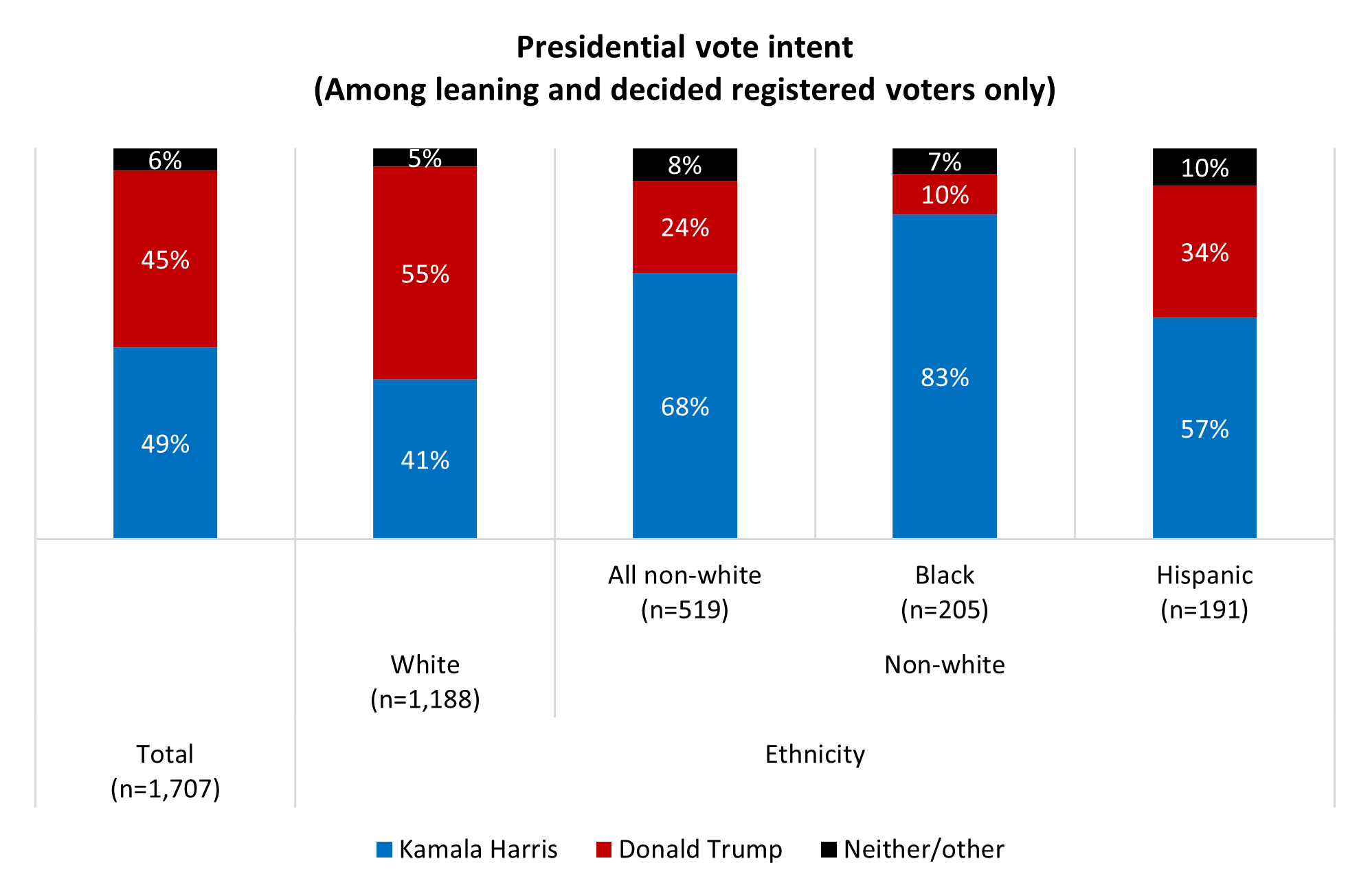
Vote intention among White voters favours Trump (55%) over Harris (45%). He trails by nearly a three-to-one ratio among non-White voters (68% Harris, 24% Trump)
While a majority of Trump and Harris supporters say their candidate won the debate, those who currently intend to vote Trump are much less convinced of their candidate’s performance in the debate last week:

The Full Story
INDEX
Part One: Vote intent
Part Two: Leadership
- Favourability of Trump and Harris
- How Americans describe each candidate
- Views of the debate
- Harris supporters much more convinced their candidate won debate
Part Three: Life satisfaction and vote
- Trump voters more likely to be stressed, dissatisfied with personal finances
Survey Methodology
Vice President Kamala Harris’ performance in the first (and potentially only) presidential debate between the two candidates was lauded by many and appears to have helped to solidify her chances of winning the White House on Nov. 5. Just as was the case late in August, polling from Angus Reid Institute finds leaning and decided registered voters preferring her to former President Donald Trump by four points. Harris holds a significant advantage among women, and delivers a near-split among men:
For Trump, the path to victory in November appears to run a number of ways potentially. The first would be further solidifying his advantage among White voters, where he leads by 10 points. The second would be to make up ground among non-White voters, where he fares poorly. In 2020, Trump lost the Black and Hispanic votes by approximately 80 and 20 points respectively:
Favorability of Trump and Harris
Views of each candidate closely mirror vote intention, with Harris holding a five-point advantage over Trump, and sharing the same age and gender splits:

How Americans describe each candidate
Each candidate has their own strengths and weaknesses according to voters. For example, three of the top five terms respondents use to describe Harris are negative, while two are positive. Women are much more likely to view her as “inspiring”, “strong”, and “compassionate”, while men are more likely to use terms like “dishonest”, “weak”, and “corrupt”:

Trump is viewed more uniformly by Americans on some fronts. Across all age and gender groups he is viewed as “arrogant” by at least 54 per cent and as a “bully” by at least 47 per cent. His most commonly described positive characteristic is strength:

The debate
The Presidential debate held on Sept. 9 was well watched political theatre, drawing reportedly more than 67 million viewers. Overall, among registered voters two-thirds say they watched all or some of it.

Among those who watched the debate, Harris was largely viewed as the winner. Half say she won “clearly” (48%) while another eight per cent say she won by a smaller margin. Notably, even among men 55 years of age and older, she was seen as winning by more people than Trump. This, from a group that offers the former president his highest levels of favourability and vote intention support:

Harris supporters much more convinced their candidate won debate
Perspectives on the debate are different depending on which candidate the respondent currently supports. Although, as one might expect, a majority of Trump and Harris supporters say their candidate won the debate, those who currently intend to vote Trump are much less convinced of their candidate’s performance in the debate last week:
Part Three: Life satisfaction and vote
The top issues have remained relatively stable during the campaign, with cost of living continuing to outpace other concerns. Three-in-five (57%) select the high cost of living as a top concern, while issues around border security (32%), the economy more broadly (31%), reproductive rights (22%) and health care (22%) trail behind (see detailed tables).
Despite these lingering issues, voters are more happy than not overall. Two-thirds (67%) say they are “very” or “pretty” happy, while three-in-ten (31%) are either “not too happy” or “not happy at all”.
A majority of both current Trump (61%) and Harris (72%) supporters say they are pretty or very happy. However, likely Trump voters are more likely to say they are unhappy:

Trump voters more likely to be stressed, dissatisfied with personal finances
Across most facets of life – their own health, access to health care, friends, family, community, free time – Harris and Trump supporters express similar levels of satisfaction (see detailed tables for full responses to the question). However, there are three areas where there is a gap between the two groups of partisans: overall quality of life, stress levels and personal financial situation. On all three, likely Trump voters are more likely to say they are dissatisfied:

Survey Methodology
The Angus Reid Institute conducted an online survey from Sept. 13-16, 2024 among a representative randomized sample of 1,707 American adult registered voters who are members of Angus Reid Forum USA. For comparison purposes only, a probability sample of this size would carry a margin of error of +/- 2 percentage points, 19 times out of 20. Discrepancies in or between totals are due to rounding. The survey was self-commissioned and paid for by Angus Reid USA. Detailed tables are found at the end of this release.
For detailed results by age, gender, region, education, and other demographics, click here.
For detailed results by past vote and vote intention, click here.
For the full release including methodology, click here.
For the questionnaire, click here.
Images – Trump – Gage Skidmore/ Flickr; Harris – Wade Technical Community College/ Flickr
Shachi Kurl, President: 604.908.1693 shachi.kurl@angusreid.org @shachikurl
Dave Korzinski, Research Director: 250.899.0821 dave.korzinski@angusreid.org
Jon Roe, Research Associate: 825.437.1147 jon.roe@angusreid.org @thejonroe