


Three-in-five say gov’t should take a hard line in negotiations (63%), other prefer soft approach (37%)
July 15, 2025 – Another day, another tariff threat from the Trump administration. This time, U.S. President Donald Trump suggested in a letter that Canada will be subject to a 35-per-cent tariff on all goods by Aug. 1. For Prime Minister Mark Carney and the Canadian negotiating team, the approach appears to centre on keeping their head down rather than their elbows up. Canadians appear to want more push back.
New data from the non-profit Angus Reid Institute finds nearly half of Canadians saying they support the decision to kill the digital services tax on American tech companies, after negotiations were stalled by Trump and his team, calling that tax a non-starter for a deal. That said, Canadians are drawing a line in the sand with many key items on Trump’s list of trade irritants, and three-in-five say Canada should take a “hard approach” (63%) rather than a “soft one” (37%). Note that these data were taken both before and after Trump’s announcement of the new 35-per-cent tariff rate.

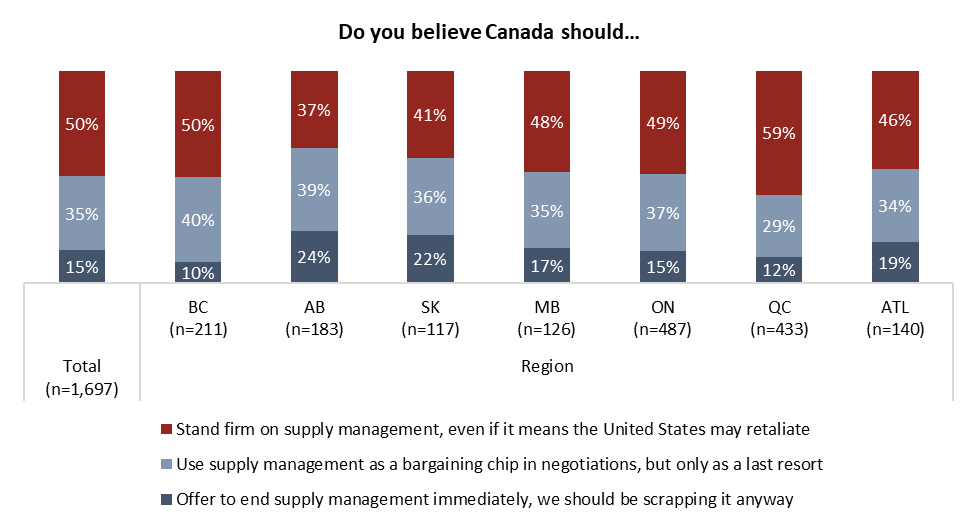
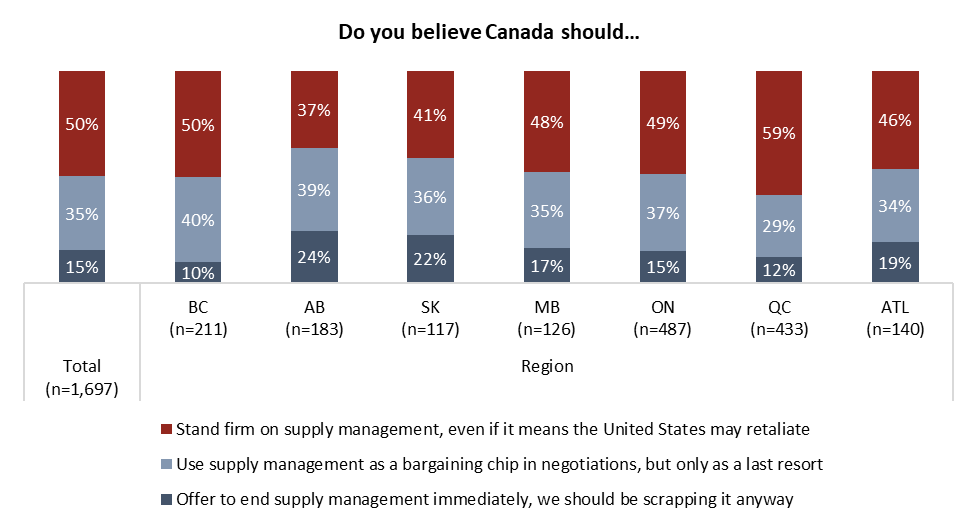
When it comes to supply management, half of Canadians say Canada’s team should stand firm, even if it means retaliation. Trump has repeatedly made false claims about the policy and appears to be pushing for concessions. One-in-three (35%) would put it on the table as a last resort, while 15 per cent would offer to end the program of quotas and price controls outright.
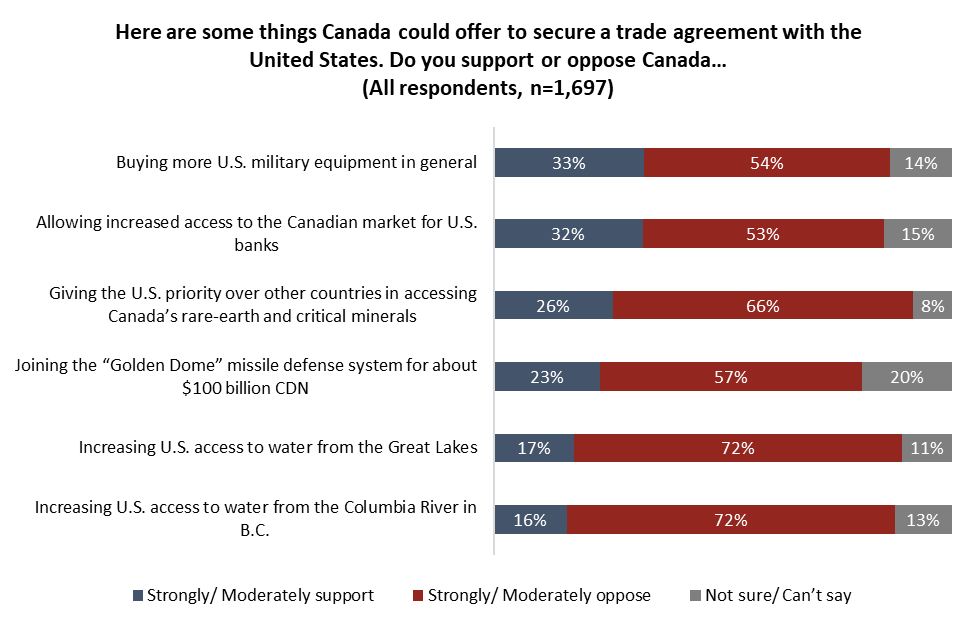
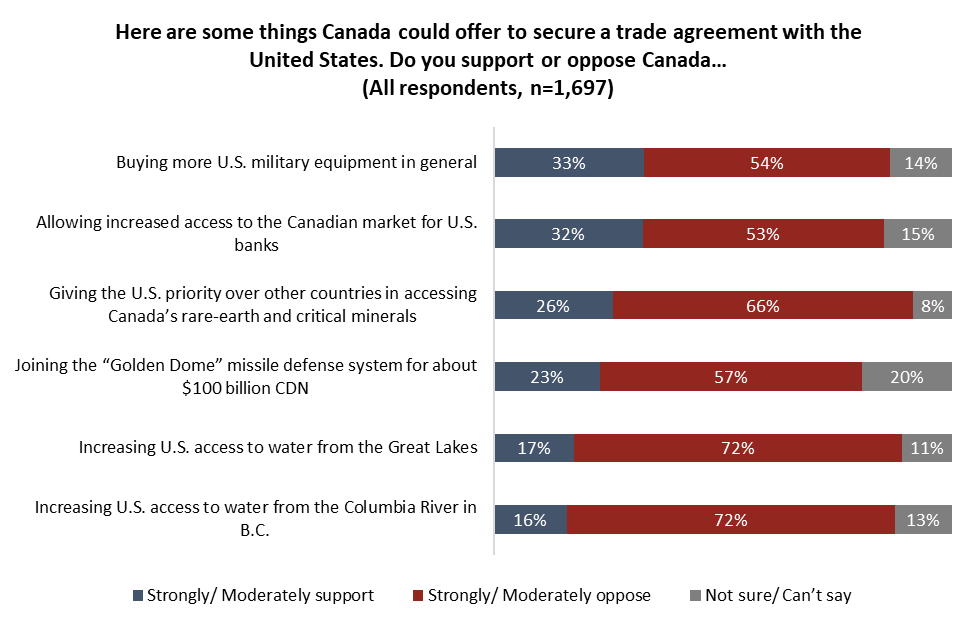
Other areas are stickier. Seven-in-10 oppose increasing any U.S. access to water in this country, whether it’s the Columbia River (72%) or the Great Lakes (72%), as the Trump administration has threatened to walk away from deals governing the latter, and paused negotiations on management of the former.
Two-thirds (66%) say no to offering the U.S. first priority on critical minerals, and more than half say the same to the idea of increasing access to the Canadian market for U.S. banks (53%) or committing to buying more U.S. military equipment (54%). This, after Carney announced a commitment to work with Europe in reaching new NATO spending targets.
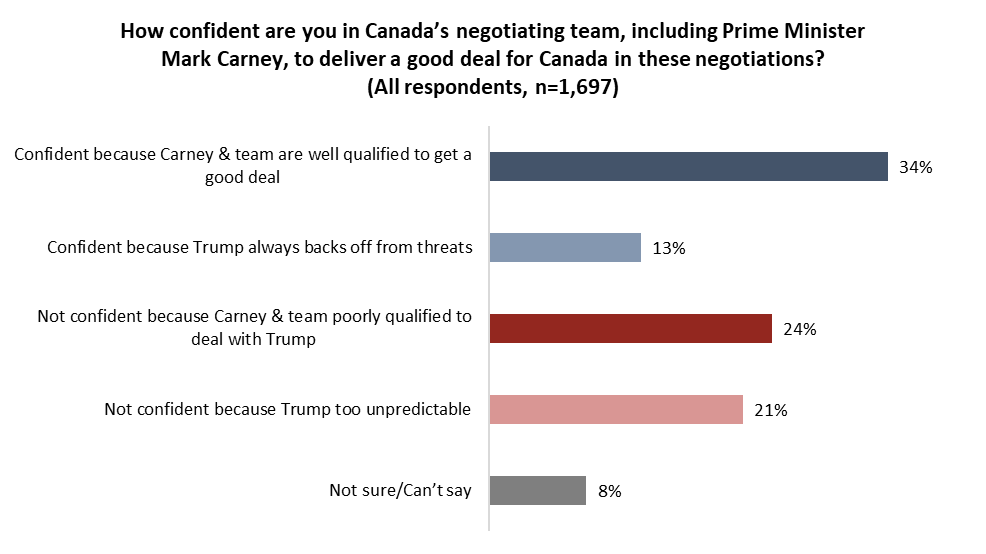
With the tit-for-tat unfolding daily in headlines, managing domestic confidence will be a challenge for Carney and his team. Currently an equal number of Canadians are confident (46%) and not confident (45%) that he will be able to deliver a good deal for Canada. Those who have confidence say it’s largely because they trust the PM (72%), while those who lack it are divided between the sentiment that Trump is too difficult to deal with (47%) or that Carney isn’t the right person to find an agreement (53%).
More Key Findings:
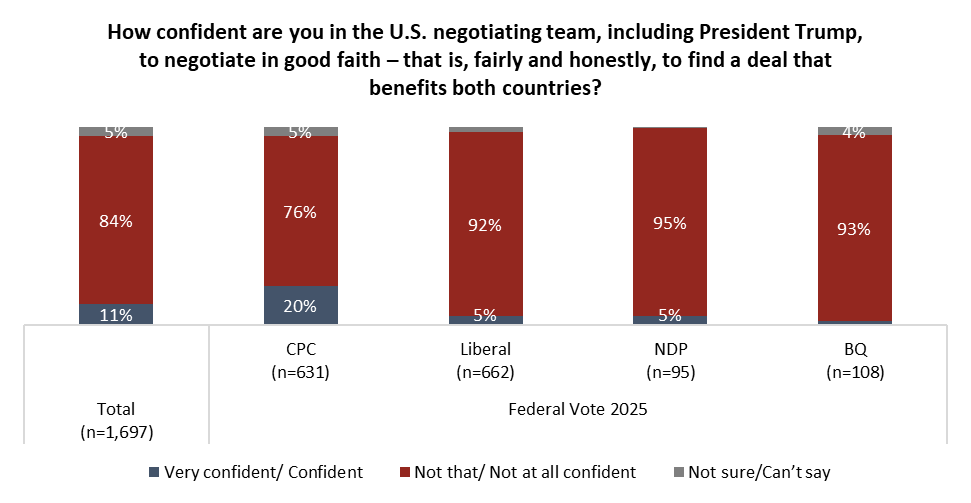
- More than four-in-five Canadians (84%) say they are not confident that Trump will negotiate in good faith. One-in-10 (11%) say he will, primarily comprised of past Conservative voters (20% say this).
- Asked about killing the digital service tax of three per cent that Canada planned to charge American tech companies, Canadians are more likely to say it was a good idea to end it (46%) than a bad idea (33%), to keep negotiations moving.
- One-in-three (32%) say Canada should only accept a deal that reduces all tariffs on the automotive industry to zero. One-in-five (22%) would accept reduced tariffs, while three-in-10 (29%) say Canada should focus on getting the best trade deal even if it might include tariffs on the auto industry.
About ARI
The Angus Reid Institute (ARI) was founded in October 2014 by pollster and sociologist, Dr. Angus Reid. ARI is a national, not-for-profit, non-partisan public opinion research foundation established to advance education by commissioning, conducting and disseminating to the public accessible and impartial statistical data, research and policy analysis on economics, political science, philanthropy, public administration, domestic and international affairs and other socio-economic issues of importance to Canada and its world.
INDEX
Part One: The Negotiators
-
Confidence in Canada? Canadians split over whether Carney can deliver a deal
-
Unpredictable Trump or Carney not qualified?
-
For those who are confident, trust in PM the main reason
-
-
Only one-in-10 believe Trump will negotiate “in good faith”
-
Canadians say take a “hard line” amid threats
Part Two: What’s on the table?
-
More support than opposition to scrapping digital services tax
-
Supply management
-
Automotive industry
-
Majority would kill zero emission vehicle mandate
-
-
Banking, critical minerals, and other sticking points
Part One: The Negotiators
Confidence in Canada? Canadians split over whether Carney can deliver a deal
The deadline for a trade deal between Canada and the United States has been extended until Aug. 1 after a late-night announcement that the Trump administration would levy a 35-per-cent tariff on all Canadian goods. This, the latest in a series of threats that has thus far amounted to tariffs on all aluminium and steel imports, automotive parts, and Canadian goods not covered by the Canada-U.S.-Mexico Agreement on trade (CUSMA).
The stop and start nature of these discussions and the persistent threats from U.S. President Donald Trump have Canadians evidently uncertain whether Canada can ultimately secure a good deal. While 46 per cent of Canadians say they have confidence in Prime Minister Mark Carney and the Canadian negotiating team, an equal number do not (45%). Women are more likely to put their faith in Carney, while men lean toward lacking confidence:

Unpredictable Trump or Carney not qualified?
Those who say they do not have confidence in Canada’s team were asked for the primary driver of this view. Notably, they’re close to equally likely to cite specific doubts about Carney (53%) as they are to say Trump, himself, is a challenge that no Canadian government would be well-qualified to handle (47%):

Only one-in-10 believe Trump will negotiate “in good faith”
Another aspect of this negotiation that is perceived as a challenge is the trustworthiness of Trump. Only 11 per cent of Canadians say that he will act in good faith and seek a negotiation wherein both parties benefit. More than four-in-five (84%) say Trump is a bad faith actor:
For those who are confident, trust in PM the main reason
On the optimistic side of perspectives, approaching three-quarters (72%) of those who have confidence in negotiations say it is because Carney and the Canadian team are capable. One-quarter (28%) of those who have confidence, meantime, subscribe to the TACO Trump mindset, that Trump Always Chickens Out, and any serious threat will be eventually caved on:
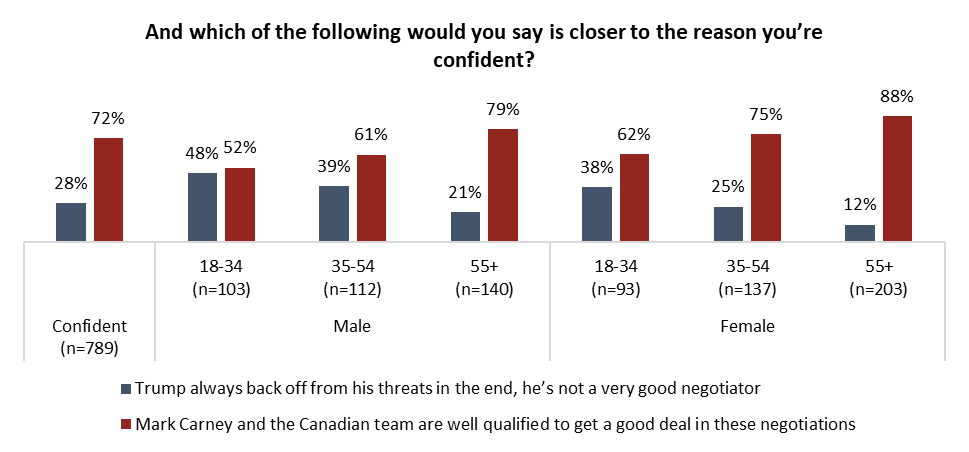
Breaking this down across the full sample finds one-third confident in Carney (34%) with another 13 per cent confident because they doubt Trump. Another one-quarter (244%) are not confident because of Carney and his government, and one-in-five not confident because of Trump’s unpredictability:

Canadians say take a “hard line” amid threats
Carney has thus far attempted to keep conversations cordial, striking a conciliatory tone in the face of more aggressive language from the U.S. President. Some have criticized Carney, who promised an “Elbows Up” approach during the 2025 election campaign, while others have praised him for level-headedness. For their part, most Canadians (63%) feel that going forward in negotiations, Canada must take a hard approach and refuse difficult concessions. Three-quarters of Liberal, NDP, and Bloc Québécois voters agree with this approach. A majority of CPC voters (54%), and 37 per cent of Canadians overall favour a softer tactic:

Part Two: What’s on the table?
More support than opposition to scrapping digital services tax
Perhaps the best example of the soft approach that some Canadians want is the recent walking back of a Trudeau-era tax on American tech giants. The digital services tax would have applied a three-per-cent tax on revenue from some of these firms. It drew the ire of Trump, who ended negotiations over the fee, that would also have been applied to large domestic companies. Canada rescinded the tax in favour of continuing broader negotiations.
To assess Canadians views on this decision, ARI asked the following question:
“Recently, Canada agreed to scrap a proposed Digital Services Tax (DST) of 3 per cent aimed at large U.S. tech companies operating in Canada. This was after the Trump administration walked away from trade negotiations, citing the tax as a deal breaker. Negotiations have now resumed.
Do you think this was the right decision for Canada to make?”
Canadians are more likely to say it was the right call (46%) by the government than not (33%):

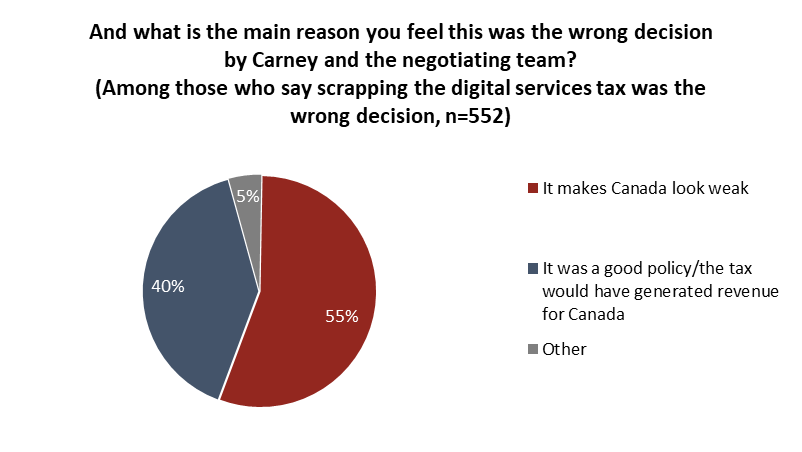
Among those who say the decision was the wrong one, more than half (55%) say it makes Canada look weak, while two-in-five (40%) feel it is a wasted opportunity to apply good policy:
Supply management
Canada’s system of supply management – which sets prices and quotas for dairy, eggs and poultry while also limiting imports through tariffs – has long been a source of irritation for Trump. The system was a nearly spanner in the works during the negotiations for CUSMA, which replaced the North American Free Trade Agreement (NAFTA). Canada partially softened the protections on supply management to help grease the gears and get CUSMA done in 2018.
Trump has set his sights on Canada’s protectionist agricultural regime again this time around. In social media posts throughout the recent trade spat, Trump has claimed that Canada has put somewhere between a 250 and 400 per cent tariff on U.S. dairy products. But in reality, those tariffs are only put in place when the U.S. fills its quota, which has never happened, according to a dairy policy expert.
The “sacred cow” of supply management has become more sacrosanct in the wake of a Bloc Québécois bill that passed in the recent parliamentary session which prevents the government from increasing the quota or reducing the tariff rate on dairy, poultry or eggs in trade negotiations.
Regardless, half (50%) of Canadians believe Canada should stand firm on supply management in trade negotiations with the United States, including a majority (59%) in Quebec where it is often a hot-button issue.
In 2017, when Trump was previously complaining about the unfairness of Canada’s protectionist dairy policies, Canadians were more willing to use supply management as a bargaining chip. However, it’s important to note that the 2017 survey was a more in-depth examination of the system and the issues surrounding it (compare the 2017 and 2025 questionnaires here). The 2017 data also showed that few knew much at all about supply management and how it worked.
Automotive industry
Canada’s auto sector has been hit hard by tariffs during the 2025 trade war with the United States. The tariffs may even cause Ontario to enter a “modest” recession, according to the province’s financial accountability officer. While major automakers who operate in Canada say there have been no job losses so far, there have been “signs of weakness” in employment reported in the sector. Ontario Premier Doug Ford has called on the federal government “to work around the clock to secure a deal that is right for Canada and eliminates all American tariffs”.
One of Trump’s stated goals from the liberal application of tariffs is to bring manufacturing, including vehicle production, to the U.S. He may not be dissuaded from stifling Canada’s auto industry.
Canadians are divided when it comes to how their country should approach trade negotiations with regards to the auto industry. Near equal numbers say there should be no agreement if there are still tariffs on autos and auto parts (32%) as say Canada should seek the best trade deal possible even if that means tariffs on vehicles remain (29%). The latter, taken together with the one-in-five (22%) who would accept a deal with the U.S. that has reduced, but remaining, tariffs on cars, suggests that half of Canadians (51%) would support an agreement even if auto tariffs aren’t removed:

Majority would kill zero emission vehicle mandate
The country’s automakers have used the tariffs to highlight their concern with Canada’s zero emission vehicle (ZEV) mandate, which will require 100 per cent of cars sold in the country to be fully electric or plug-in hybrids by 2035. Canadian vehicle manufacturers the targets “cannot be met” because of the state of the electric vehicle market including declining sales after the conclusion of the federal government’s rebate program.
A majority of Canadians, including a majority in every province except Quebec – one of two provinces alongside B.C. has its own electric vehicle mandate – support Canada cancelling the ZEV mandate.

The idea of cancelling the ZEV mandate is twice as popular among Conservatives (80%) as any other group of past voters. Notably, past ARI data has found Conservative voters are more likely to dismiss the threat of climate change than others in the country.
The much lower support for cancelling the mandate among those elsewhere on the political spectrum is also important to note since part of Carney’s electoral success was due to the boost he received from past NDP voters across the country and, in Quebec, those who voted Bloc Québécois in 2021.

Banking, critical minerals, and other sticking points
During this trade war, the Trump administration has raised a whole host of issues with Canada, besides setting their sights on Canada’s agriculture and auto sectors. The Carney Liberal government will hope that an old issue – defence spending – is now dealt with given its commitment to spending five per cent of GDP on defence at the most recent NATO conference.
Related: Hitting the Mark? Two-thirds support 2% defence spending pledge; almost as many say 5% ‘too much’
Currently, Canada sources 75 per cent of military weapons and tools from the U.S. but has looked to diversify given the threats from the Trump administration. Some speculate that may come with political consequences in the wake of a USA Today editorial penned by U.S. Secretary of State Marco Rubio, that argues that the U.S. “must” be allowed to compete for European defence contracts. On top of that, Trump also wants Canada to join his “Golden Dome” missile defence system for a cost of US$71 billion.
The Trump administration has also shown interest in rewriting the agreements which govern fresh water sharing between the two countries, according to reports. Negotiations to replace the agreement that governs the Columbia River, which originates in B.C. and terminates on the Oregon-Washington border, were paused earlier this year. During the presidential election campaign, Trump referred to a “very large faucet” in B.C. that could be turned on to address the persistent droughts in California. While vague, it is believed that he was referencing the Columbia River, though the feasibility of redirecting water from the river to California has been questioned.
Meanwhile, in March, the New York Times reported that U.S. Secretary of Commerce Howard Lutnick told then Finance Minister Dominic LeBlanc that Trump wanted to abandon the agreements which govern how Canada and the U.S. manage the shared Great Lakes of Superior, Huron, Erie and Ontario. There is already concern about how cuts to the U.S.’s Environmental Protection Agency will affect the ecosystems of the Great Lakes.
Trump also apparently has his eye on Canada’s critical minerals as the U.S. looks to decouple itself from China and “friendshore” – perhaps a dated term given the recent American stance to Canada – rare earths, lithium, and cobalt, which are key to both to the electric vehicle supply chain and advanced defence technology like the U.S. F-35 fighter jet.
Finally, Trump has also complained about the unfairness of the border between the two countries’ banking industries, falsely claiming that Canada does not allow American banks to do business north of the border. While “more difficult” for foreign entities to enter Canada’s banking sector, U.S. banks are allowed to open branches or subsidiaries in the country.
The Angus Reid Institute measured Canadians’ views on all these issues, and whether they believe they should be included or not as potential bargaining chips as Canada looks to build “a new economic and security relationship” between itself and the U.S.
Across the board, there appears to be little appetite among Canadians to include any of the above as potential clauses in a future U.S. trade deal.
Allowing increased access to Canadian fresh water, whether via the Columbia River or the Great Lakes, was opposed by nearly three-quarters. A majority (57%) oppose joining the Golden Dome system as part of any trade agreement. Further, a majority (54%) oppose buying more U.S. military equipment in general. A majority (53%) do not want increased access to the Canadian market for U.S. banks. And two-thirds (66%) oppose giving the U.S. priority access to Canada’s critical minerals:
Survey Methodology:
The Angus Reid Institute conducted an online survey from July 9-13, 2025, among a randomized sample of 1,697 Canadian adults who are members of Angus Reid Forum. The sample was weighted to be representative of adults nationwide according to region, gender, age, household income, and education, based on the Canadian census. For comparison purposes only, a probability sample of this size would carry a margin of error of +/- 2.0 percentage points, 19 times out of 20. Discrepancies in or between totals are due to rounding. The survey was self-commissioned and paid for by ARI.
For more information on our polling methods, click here.
For detailed results by age, gender, region, education, and other demographics, click here.
For the full PDF of release, click here.
For the questionnaire, click here.
MEDIA CONTACT:
Shachi Kurl, President: 604.908.1693 shachi.kurl@angusreid.org @shachikurl
Dave Korzinski, Research Director: 250.899.0821 dave.korzinski@angusreid.org
Jon Roe, Research Associate: 825.437.1147 jon.roe@angusreid.org